
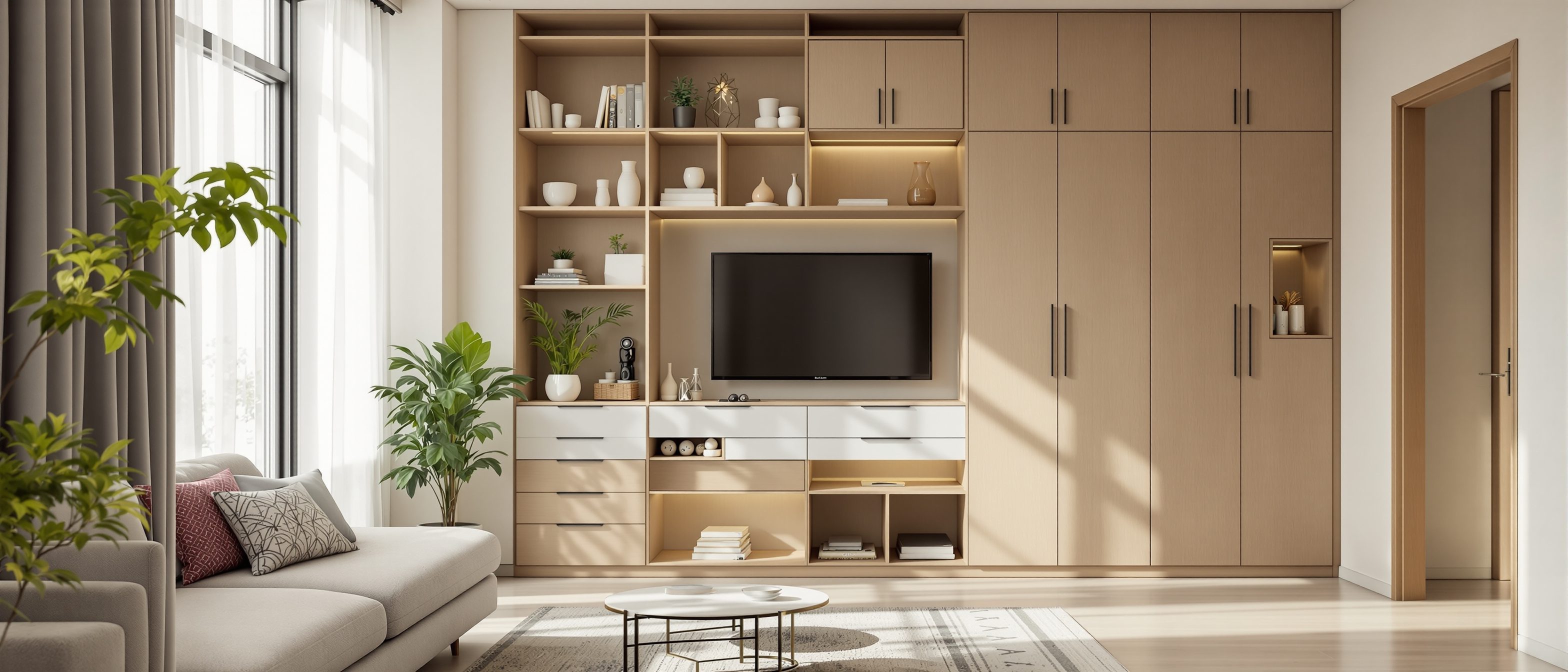
Storage Design for Small Apartments
How to build real storage into a 1RK, 1BHK or 2BHK builder flat from the layout stage — not by buying more boxes, but by designing for height, dead space and double-duty furniture.
A young couple moves into a 580 sq ft 1BHK in Pune. It is bright, the kitchen is tidy, the developer's brochure called it "smartly planned." Six months later there are two cartons of festival décor behind the sofa, a steel almirah blocking half a window, suitcases stacked on the wardrobe, and the pressure cooker living on the floor because the kitchen ran out of cabinet. Nothing is messy, exactly — there is simply nowhere for things to go. This is the most common failure in small Indian flats, and almost none of it is the resident's fault. The builder gave them floor area; nobody gave them storage.
The instinct, when a small flat overflows, is to buy: more baskets, a shoe rack, another almirah, a set of stackable bins from the nearest store. Each purchase eats floor, and the room shrinks a little more. The flat starts to feel smaller precisely because it is being treated as a shed. The fix is almost never "buy more storage." It is to design storage into the bones of the flat — into the walls, the height, the corners and the furniture — so it disappears.
In a small flat, you do not find storage by giving up floor space; you find it by going up the walls, into dead corners, and inside furniture that does two jobs.
1. Start with the rule, then the audit
A home needs roughly 10–15% of its carpet area dedicated to storage to live comfortably without clutter. That ratio does not get smaller just because the flat is small — a 580 sq ft 1BHK still needs around 60–85 sq ft of effective storage. The catch is that you cannot afford to spend floor on it the way a 3BHK can. So in a small flat the same target has to be met vertically and in concealed volumes rather than in standalone units sitting on the ground.
This is why the planning sequence matters and why this guide sits one level up from a product list. For the catalogue of what to buy and fit — sliding shutters, pull-outs, modular inserts — send yourself to storage solutions for compact apartments and the broader smart storage ideas. This guide is about the prior decision: where storage should live before any product is chosen.
Begin with a decluttering pass, because building cabinets around things you do not use is the most expensive mistake in a small flat. You are sizing storage for what you keep, not what you own today.
"Tidying is not just deciding what to discard but also cherishing the things you want to keep." — Marie Kondo, The Life-Changing Magic of Tidying Up
Once you know roughly what stays, do a quick audit of where it currently has to live and how often you reach for it. Daily items want hand-height, comfortable-reach storage; seasonal and bulk items can go to lofts and low boxes. Our pillar guide, storage planning before interior design, walks through this inventory step in detail — do it before you commission a single carpenter.
2. Go vertical — the single biggest move
Most builder flats have a 3000mm (10 ft) floor-to-ceiling height, and most people use only the bottom 2100mm of it. That top ~900mm, multiplied across every wall, is the largest untapped store in the flat. Going vertical means three specific things.
Floor-to-ceiling units. A wardrobe or kitchen tall unit that stops at 2100mm wastes the band above it and collects dust. Take it to the ceiling. The top band becomes a loft for suitcases and off-season goods; you give up zero extra floor for a third more capacity.
Above-door and bridging lofts. The 300–600mm of wall above every internal door is dead. A shallow shelf or bridging loft there holds light, rarely-touched things — spare bedding, archive files, the good crockery used twice a year.
Lofts proper. The traditional Indian loft (the attaa / overhead storage above the kitchen or passage) is the cheapest cubic storage you will ever build. Reserve it for low-frequency, lightweight bulk: empty luggage, cartons, Diwali and wedding-season items.
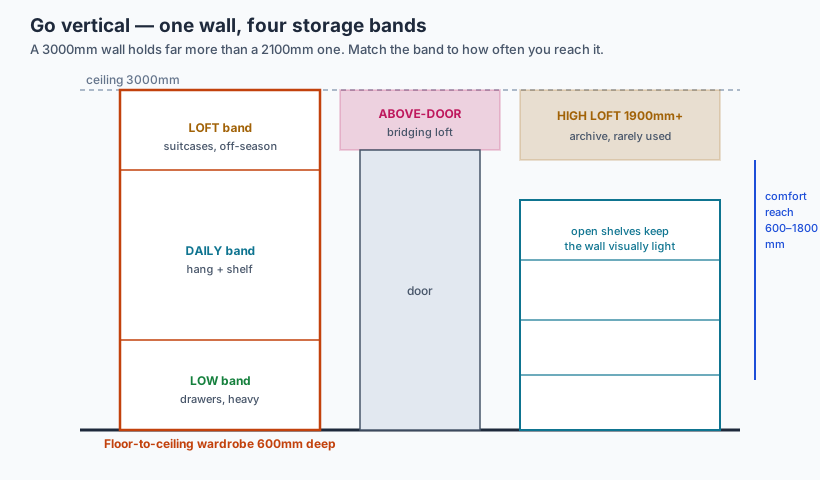
Figure 1: One wall, four bands. Match the band to how often you reach it — daily things at 600–1800mm, bulk and seasonal goods above 1900mm and below knee height.
To see how much a full-height wardrobe actually swallows before you commit, run your wall dimensions through the storage calculator and the wardrobe storage capacity calculator.
3. Borrow the dead space
Every flat is riddled with volume that the builder left over: corners, the cavity under a window, the wall over the WC, the gap above the fridge, the void under the stairs in a duplex. Individually each is small; together they can absorb most of a flat's awkward overflow. The trick is to identify them at the planning stage and assign each a job.
| Dead space | Typical size | Best stored there | Build note |
|---|---|---|---|
| Under-window cavity (living/bedroom) | 400–500mm deep × full width | Books, board games, box-seat bedding | Box seat doubles as extra seating |
| Corner (kitchen/living) | 600 × 600mm | Pull-out carousel, brooms, mops | Magic corner or simple lazy-Susan |
| Above the WC | 300mm deep × 600mm high | Toiletry stock, cleaning supplies | Mirror-front cabinet hides it |
| Over the fridge | 350–600mm to ceiling | Lightweight appliances, large utensils | Match cabinet face to kitchen |
| Above internal doors | 250–400mm × door width | Archive files, spare linen | Bridging loft, light items only |
| Under the bed | 200–350mm clear | Off-season clothing, bedding | Hydraulic lift or drawer base |
| Under sink / vanity | 600 × 500mm | Buckets, cleaning, plumbing access | Leave service access |
| Behind the entry door | 100–250mm deep | Shoes, umbrellas, keys | Slim shoe unit or pegs |
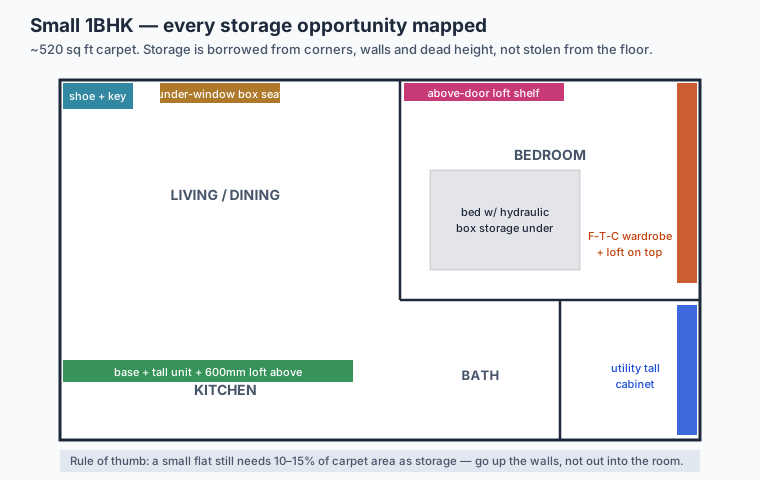
Figure 2: A ~520 sq ft 1BHK with every storage opportunity mapped. Each cabinet is borrowed from a wall, a corner or dead height — none of it eats the usable floor.
For the deeper concealment moves — kick-toe drawers, false-bottom seats, integrated headboard storage — see hidden storage solutions for Indian homes. Sketching where each of these lands is far easier on a measured plan; the layout planner and room measurement tool let you map them before the carpenter quotes.
4. Make furniture do two jobs
In a small flat, every piece that does only one thing is a luxury you cannot afford. Convertible and double-duty furniture earns its footprint twice — once as furniture, once as storage — and lets a single room change job through the day.
- Sofa-cum-bed with under-seat storage — daytime living, nighttime sleeping, and a deep box for bedding inside.
- Storage bed (hydraulic or drawer base) — the single largest concealed volume in most flats; reserve it for low-frequency bulk so you are not lifting the mattress daily.
- Fold-down (Murphy) wall desk — work-from-home surface that vanishes flat against the wall, freeing the floor for the rest of the day.
- Nesting / extending dining table — seats two daily, six at a festival, then folds back.
- Ottoman and bench seats with lift-up lids — seating that hides toys, shoes or linen.
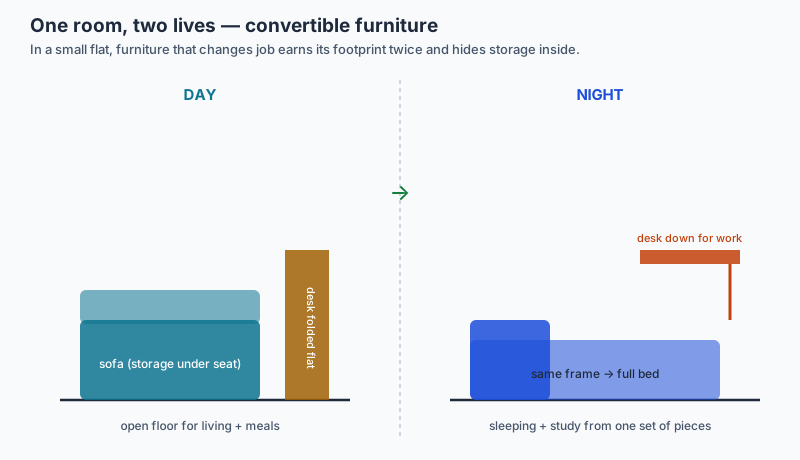
Figure 3: The same footprint, two lives. Convertible pieces let one small room be a living room by day and a bedroom-cum-study by night, with storage built into each piece.
Wardrobes deserve their own discipline even in a small flat — internal sub-division decides whether 600mm of depth holds a season's clothes or wastes half its volume. The wardrobe-specific planning lives in wardrobe and closet planning, why wardrobes become inefficient and our wardrobe planning tool for designers.
5. Budget the storage room by room
Storage in a small flat is not optional spend; it is the spend that decides whether the flat feels calm or cramped. Putting numbers against each zone early stops the storage budget from being the thing that gets cut at the end. The figures below are indicative built-in (carpentry) ranges for a metro 1BHK/2BHK in 2026 and will vary with material, city and finish.
| Zone | What it covers | Indicative built-in cost |
|---|---|---|
| Bedroom wardrobe (F-T-C) | 1800–2400mm wide, loft included | ₹55,000 – ₹1,40,000 |
| Kitchen storage | Base + tall unit + loft + pull-outs | ₹90,000 – ₹2,50,000 |
| Entry / foyer | Shoe + key + coat unit | ₹15,000 – ₹40,000 |
| Living-room units | TV unit + open shelves + under-window seat | ₹40,000 – ₹1,20,000 |
| Utility / balcony | Tall cabinet, cleaning + machine area | ₹20,000 – ₹55,000 |
| Under-bed / convertible | Storage bed, sofa-cum-bed | ₹25,000 – ₹70,000 each |
Kitchen storage is consistently the highest-value rupee per cubic foot in a small flat — get the planning right there first; the kitchen storage planning guide covers cabinet logic, and the utility-area optimization guide handles the wet, service end. For the foyer, where shoe and key storage either works or spills across the doormat, see entry and foyer design.
6. Mind the damp, the dust and the helper
Indian storage has constraints a Western design book will not mention. Plan for them or the cabinets fail within two monsoons.
- Monsoon damp. Lofts and bottom drawers on an external wall trap moisture. Keep a ventilation gap, line metal lofts, and store fabric and paper away from external-wall cavities. Silica or naphthalene in luggage lofts keeps the off-season saree from coming out musty.
- Dust. Open shelving looks light and airy (and it is the right move for visual lightness) but in a dusty Indian city it needs weekly wiping. Keep daily-touch items behind shutters; reserve open shelves for objects you actually use or display.
- Service and helper access. Cleaning supplies, the broom, the mop and buckets need a deliberate home near the utility or bathroom, reachable by domestic help without opening your wardrobe. A utility tall cabinet earns its place here.
- Festival and seasonal goods. Diwali lights, the good dinner set, wedding-season clothes and luggage are the predictable bulk that overwhelms small flats. They are exactly what lofts and under-bed boxes are for — see seasonal storage solutions for the rotation system.
"There is a place for everything, and everything in its place" only works when the place exists and is the size of the thing — Julie Morgenstern's Organizing from the Inside Out makes the case that organization fails when storage is assigned without matching it to the volume and frequency of what it holds.
7. Don't let storage make the flat feel smaller
Here is the trap that catches careful planners: in the rush to add capacity, they wrap every wall in floor-to-ceiling shutters, and the flat ends up feeling like the inside of a cupboard. Volume goes up; the sense of space collapses. A small flat needs storage and visual breathing room, and the two must be balanced deliberately.
The principles that keep a heavily-stored small flat feeling open:
| Do | Don't |
|---|---|
| Concentrate bulk storage on one or two walls | Line every wall with full-height cabinets |
| Match shutter colour to the wall so units recede | Use dark, heavy shutters that loom |
| Mix in open shelving and negative space | Make every surface a closed box |
| Run units to the ceiling so the eye reads one clean line | Stop cabinets mid-wall and stack things on top |
| Use handleless / push-to-open fronts for a calm face | Cover walls in protruding handles and clutter |
| Keep one clear sightline across the room | Block windows and through-views with units |
The deeper craft of making a small flat read as larger — sightlines, mirrors, light, scale — is its own subject. Pair this storage plan with how to make apartments feel bigger and, if you are working with a single-room or studio footprint, studio apartment design. And once the flat is built and stored, home organization through design is what keeps it from sliding back into cartons-behind-the-sofa.
Sources & further reading
- Bureau of Indian Standards / National Building Code of India 2016 — room and circulation standards relevant to small dwellings.
- Julie Morgenstern, Organizing from the Inside Out (Henry Holt & Co.) — matching storage to use and frequency.
- Marie Kondo, The Life-Changing Magic of Tidying Up (Ten Speed Press) — decluttering as a prerequisite to storage.
- Christopher Alexander et al., A Pattern Language (Oxford University Press) — patterns on "Things From Your Life" and built-in storage.
- Ernst Neufert, Architects' Data — anthropometric reach zones and standard cabinet/wardrobe depths (600mm wardrobe, 300mm shelf).
- Studio Matrx tools: storage calculator, layout planner.
If you are at the planning stage, read the pillar storage planning before interior design first, then borrow concealment tricks from hidden storage solutions for Indian homes, and once the flat is fitted out, keep it that way with home organization through design.
Export this guide
Related Guides — Deep-dive reading
Space-Efficient Homes — A 2026 Working Reference for Compact Indian Apartments
Five spatial multipliers · Floor plan tricks · Dual-purpose furniture
Room PlanningStorage Planning Before Interior Design
Why storage must be planned first — audited, budgeted and given its floor area — before a single layout, colour or sofa is chosen. The homeowner's plan-it-first master guide for Indian homes.
StorageWhy Scale Matters: Keeping Rooms Comfortable for Humans
How sizing furniture, art and lighting to the human body — not the showroom — keeps small Indian flats from feeling crushed and large halls from feeling empty.
Design PrinciplesRelated Tools — Try Free
Apartment Furniture Size Chart
Standard furniture dimensions for Indian apartments — sofas, beds, tables, dining, storage.
Reference ChartWardrobe Storage Capacity Calculator
India-specific garment math — sarees, lehengas, kurtas, shirts, shoes. Pick a layout (2-door → walk-in), see live fill and saturation gauges.
Capacity CalculatorCross-Ventilation Analyzer
Estimate airflow and air changes per hour (ACH) from room size, window areas, layout, and local wind — with NBC 2016 Part 8 compliance check.
Ventilation Calculator