
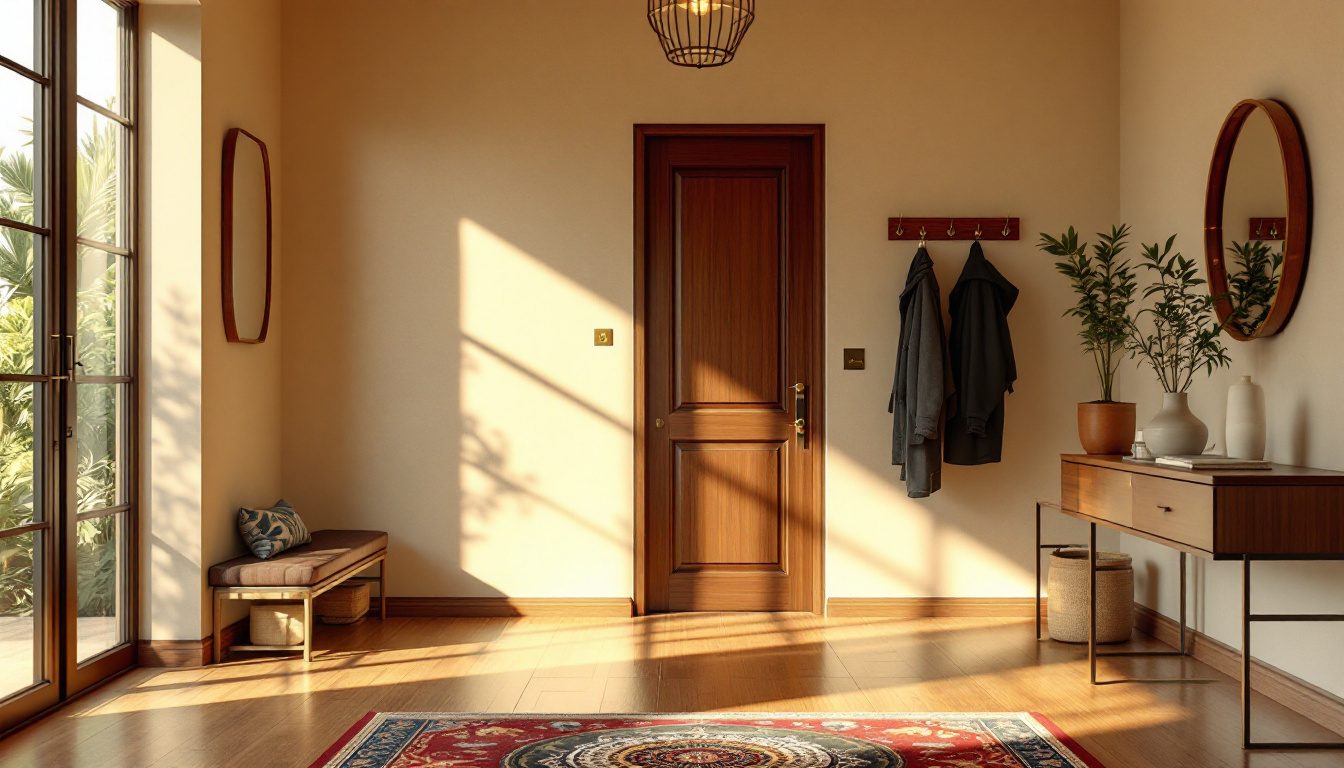
Entry & Foyer Design: Getting the Arrival Right
The SAAPE arrival sequence, designing the real back-door entry, a small foyer that works, and a drop-zone that tames the clutter — Indian context
Entering a home is never a single act. It is a small journey that begins the instant a visitor first spots your gate from the road and ends only when they have slipped off their chappals, set down a bag, and felt — without anyone saying a word — that they have truly arrived. When that journey runs in the right order, the whole house feels gracious from the first step. When the order is scrambled, the home feels subtly wrong in a way that guests can rarely put their finger on. They will say it felt cramped, or confusing, or that they were not sure where to go. What they actually felt was an arrival sequence that misfired.
This guide is about getting that sequence right on a real Indian plot — the 30 by 40, the 1,200 square foot apartment, the narrow site with a stilt below. How the grand idea of approach scales down to a short paved path and a framed gate; why so many of us actually enter through the "back" from the car or utility side, and how to design that honest, everyday entry well; and how even a tiny 4 by 6 foot foyer can carry a brass nameplate, a bench to remove shoes, and a sightline that pulls you deeper into the home rather than onto the sofa.
A home makes its first impression long before anyone steps inside. Get the order of arriving right, and even a modest entry will make every guest — and every returning family member — feel genuinely welcomed.
The sequence that makes arriving feel right: SAAPE
Designers describe the arrival journey with five beats, in this exact order: See, Approach, Arrive, Park, Enter — SAAPE for short. Each one is a distinct psychological and physical moment. Skip a beat, or reorder them, and the experience feels off. The single most common mistake — and you will recognise it the moment you read it — is being forced to park before you have arrived, stopping the car at a spot from which the front door is not even visible. You then have to hunt for the entrance, squeeze past the bonnet, and walk in sideways. The house never gets to say hello.
What each stage actually does
See is first contact: the little lift you feel when the right house comes into view. Approach is the foreground that builds anticipation — even a modest home gains it from a pair of planters, a gentle curve in the path, or two post lights. Arrive is the beat that says stop here: a widening of the paving, a change in floor material, a gate, a porch column. Only after you feel "there" should you Park. And Enter is not merely the door swinging open — it is the whole passage from public outside to private inside, ending where you hang your keys and let your shoulders drop.
| SAAPE stage | What it is | The cue that signals it | Typical Indian failure |
|---|---|---|---|
| See | First sighting of the house from the road | A visible gate, nameplate, a tree, a coloured facade | Identical row-house facades; no number visible from the street |
| Approach | The build-up as you move toward the door | Framing planters, a curved or paved path, post lights | Walking straight off the road onto the porch with no transition |
| Arrive | The felt sense of "I am here" | Change in paving, a wider apron, a gateway or porch | No marker at all — the door is just another point on a wall |
| Park | Physically stopping the vehicle | A defined pull-in, stilt bay, or compound parking | Car blocks the door; you reverse blindly into the gate |
| Enter | Crossing from outside to inside | Threshold, level change, foyer, drop-zone | Door opens straight onto the living-room sofa |
The order matters more than the grandeur. A 30-foot-wide bungalow with a thoughtful gate, a six-foot paved path, and a clearly-the-door front door delivers SAAPE far better than a sprawling villa where you must park first and then go looking for the entrance.
If you park before you arrive — when the front door is not even visible from where you stop — the whole thing feels clumsy, no matter how expensive the marble.
Scaling the grand approach down to an Indian plot
On a 30 by 40 or a 40 by 60 site you will rarely have room for a tree-lined drive, and a circular turning court needs roughly a 12 to 15 metre (40 to 50 foot) diameter to swing through without reversing — which almost no urban plot can spare. But the principle scales down beautifully, because SAAPE is about sequence and cues, not square footage.
The three gestures that do the heavy lifting
You need only three small moves to manufacture a real sense of arrival on a tight plot. First, a framed gate — even a simple 1.2 metre wide MS or wooden gate with a planter on each side reads as a threshold to the road. Second, a short paved approach path, just 1.0 to 1.2 metres wide and three to five strides long, in a flooring that differs from the driveway — Kota stone, charcoal granite, or a contrasting paver. That change underfoot is the "arrive" beat. Third, a visible, framed front door: a porch column, an overhead chajja, a pair of wall lights, or a deeper reveal in the wall so the door is unmistakably the door and not a service entry.
Where the car goes changes everything
The hardest knot on a small plot is parking. If your design pulls the car into a stilt below the house or a compound bay beside it, the danger is that the resident's true daily route becomes car-to-side-door, and the gracious front entry sits unused. You have two honest options: either keep the front door clearly seen and reached after a moment of arrival — never after squeezing past the bonnet — or accept that the side entry is the real one and design it as a proper threshold (covered in the next section). What you must not do is leave a no-man's-land where you park in a dark stilt and then wander past cycles and the washing area to reach the kitchen, with nowhere in that route feeling like entering a home.
A practical Indian heuristic: the front door should be visible from the spot where a guest stops, and the daily-driver door should have at least 0.6 metres of clear standing space beside the parked car so you are not contorting past a wing mirror with bags in both hands.
The modern reality: most of us enter through the back
Here is the honest truth of how Indian homes are actually lived in. The gracious front foyer — the one with the nameplate and the rangoli — often sits unused for days, opened only for guests and festivals. Meanwhile the family enters through the parking, the utility balcony, or a side door, dodging cycles, helmets, drying clothes, gas cylinders and shopping bags on the way to the kitchen. Nowhere in that route feels like entering your home in any meaningful way. You simply materialise in the kitchen, harried, with your hands full.
The fix is small and quietly transformative. If your plan and budget can spare even a few extra square feet beside the parking or the side door, build a proper drop-zone: a short stretch of wall with a bench, hooks, a shoe shelf, and a tray for keys. Even a 0.9 by 1.5 metre pocket changes how it feels to come home, because it denotes a place of entry where there was none.

Components of a working drop-zone
The drop-zone is the unsung hero of a calm Indian home. It catches the chaos at the boundary so the clean floors stay clean and the kitchen stays a kitchen. Build it from these parts, sized to the family.
| Component | Recommended size | Why it earns its place | Approx. cost (₹) |
|---|---|---|---|
| Bench to sit and remove shoes | 900 to 1200 mm long, 400 mm deep, 450 mm high | Nobody balances on one leg at the door; seating is dignity | 4,000 to 12,000 |
| Shoe storage (closed cabinet) | 600 to 900 mm wide, 300 to 350 mm deep | Hides 8 to 12 pairs; closed front keeps odour and dust in | 8,000 to 25,000 |
| Wall hooks / rail | 4 to 6 hooks at 1300 to 1600 mm height | Bags, helmets, dupattas, the dog leash, a wet umbrella | 600 to 3,000 |
| Key and tray ledge | 250 to 400 mm shelf | The single most-lost objects in any home | 1,500 to 6,000 |
| Umbrella stand / wet corner | 250 mm footprint, near a floor drain ideally | Monsoon survival; keeps drips off the living floor | 800 to 4,000 |
| Hand-wash / sanitiser point | Tap or dispenser at 1000 mm | Post-2020 habit; very practical at the boundary | 0 to 15,000 |
A drop-zone does not need to be expensive. A 900 mm bench with a shoe rack below, a row of hooks above, and a tray on a ledge can be assembled for 12,000 to 20,000 and will outperform a far costlier foyer that has no place to put anything down.
First impressions inside: what the foyer says
The foyer is your home's first interior statement, and it speaks mostly through materials and sightlines. A stone or patterned floor at the entry quietly announces "this is the threshold"; then a change to a softer or warmer floor as you step into the living spaces makes those rooms feel more intimate by contrast. This is an old trick that costs nothing extra if you plan it — you were going to floor the entry anyway, so choose a material that transitions rather than continues.
The sightline and the focal point
The best entries begin an axis — a sightline that runs from the front door, through the foyer, and lands on something composed at the end: a console with a lamp and a piece of art, a glimpse of a green courtyard, a textured feature wall. This gives the whole house a sense of order from the first step. The corollary is just as important: do not let the door dump straight onto the living-room seating. Walking in to find yourself standing inside the conversation, with everyone's knees facing you, is the foyer equivalent of arriving mid-sentence. A half-wall, a slatted partition, a shoe-cabinet-as-divider, or even a console that turns the body 90 degrees gives the entry its own small territory before the living room begins.
The entry is a room, even when it is only four feet wide. Give it a floor, a focal point, and a sightline, and it stops being a leftover corridor and starts being a welcome.
The Indian rituals of arrival
The Indian threshold carries meaning that a Western foyer simply does not, and a good design makes room for it rather than treating it as decoration bolted on later. Plan for a rangoli spot on the floor just outside or inside the door; a brass nameplate beside the frame; a toran hung across the lintel; a diya or small deepam ledge; and the all-important shoe cabinet, because footwear comes off at the door in most Indian homes and has to go somewhere. A console for keys, a place for the daily flowers, and a hand-wash point complete the ritual zone. If you follow Vastu, the main door's orientation and the placement of these elements matter to many families — our Vastu compass tool helps you check your door direction against the cardinal points before you finalise the plan.
There is one more very Indian requirement the foyer must quietly serve: it is a thoroughfare for the help and for deliveries. The maid, the cook, the dabba delivery, the Amazon parcel and the gas cylinder all pass through this zone daily. A foyer that forces every delivery deep into the home, or that has no surface to set a parcel down on, creates friction a dozen times a day. A small ledge near the door and a clear, uncluttered path solve it.
Taming the clutter at the door for families
If there are school-aged children in the house, the entry route is where bags, water bottles, shoes, and damp socks pile up by 4 p.m. every day. The only defence is to plan for it rather than fight it. Give each child a cubby or locker — a labelled open shelf at their height for the school bag and the water bottle, plus a hook for the uniform tie or the helmet. Keep a mud zone at the boundary where wet shoes and dripping umbrellas come off before the clean floors begin. This single move — moving the mess to the threshold instead of letting it migrate to the bedrooms — keeps the rest of the home calm.
Sizing the foyer: small versus generous
You do not need a grand foyer for any of this to work. You need the right moves at the right sizes. The table below shows what fits at each scale, from a tiny apartment entry to a bungalow foyer.
| Foyer scale | Footprint | What fits comfortably | Best for |
|---|---|---|---|
| 1.2 by 1.8 m (4 by 6 ft) | Slim shoe cabinet, 3 hooks, key tray, narrow bench-top | Apartments, narrow plots | |
| Compact | 1.5 by 2.1 m (5 by 7 ft) | Bench + shoe cabinet + console + a small rangoli/diya ledge | Most 2 and 3 BHK homes |
| Comfortable | 2.1 by 2.4 m (7 by 8 ft) | Full bench, closed shoe storage, console, partition for sightline | Independent houses |
| Generous | 2.4 by 3.0 m+ (8 by 10 ft+) | Seating, art axis, coat closet, drop-zone and ritual zone separated | Bungalows, villas |
Making a 4 by 6 foot foyer actually work
The pocket foyer is the most common Indian reality, and it can be excellent. The trick is to make every surface do double duty. Run a slim 300 mm deep shoe cabinet along one wall with a cushioned top at 450 mm — that is your bench and your storage in one. Mount three hooks and a small mirror above it; the mirror doubles the visual space and lets you check yourself before stepping out. Place a narrow ledge for keys and a diya beside the door. Then, critically, angle the layout so a guest's eye is drawn past the foyer toward a focal point deeper in the home, not into the sofa. Even in 24 square feet, that sightline is what separates a real foyer from a cramped landing.
To plan the adjacencies properly — where the foyer sits relative to the living room, kitchen and parking — work it out as bubbles before you draw walls. Our bubble-diagram planner lets you test those relationships, and the room-programming worksheet helps you decide how much of your floor area the entry deserves.
Lighting, thresholds and security
A foyer is judged in the first two seconds, and lighting does most of that work. The threshold and the door hardware do the rest — quietly, but every single day.
Lighting the entry
The entry needs three layers of light, and most Indian homes install only one (a single tube light or downlight) and wonder why the welcome feels flat. Layer them like this.
| Layer | Purpose | Fitting and placement | Notes |
|---|---|---|---|
| Exterior approach | Safety and the "approach" beat | Wall sconces or post lights flanking the gate/door, 1800 to 2000 mm high | Warm 2700K; motion-sensor option saves power |
| Foyer ambient | Even, welcoming fill | Recessed downlights or a small pendant, 3000K | One per 1.2 m of foyer length |
| Accent / ritual | Highlight art, nameplate, diya ledge | Picture light or a small spot | Makes the focal point read at a glance |
A common upgrade that costs almost nothing: put the exterior approach light on a dusk-to-dawn sensor or a timer, so the house is never a dark facade when you return at night. The "See" beat depends on it.
Thresholds, level changes and the grille door
The physical threshold deserves care. A level change of one step (150 mm) at the entry is traditional, drains monsoon water away from the interior, and gives a satisfying "you are stepping up into the home" feeling — but it is also a trip hazard and a barrier for elderly parents and wheelchairs. Where you can, keep the change gentle (a 12 to 18 mm weather lip rather than a full step) or pair any step with a ramp option, in keeping with barrier-free guidelines. Mark level changes with a contrasting nosing or a light so they are seen.
On security, the double-door system is near-universal in India for good reason: a solid main door behind an outer MS or SS grille (safety) door. The grille lets you keep the main door open for cross-ventilation and to receive deliveries while staying secure, and a video door phone at the gate or door lets you screen visitors before opening. Plan a small wired or Wi-Fi point for the door phone and any smart lock at the design stage — retrofitting wiring into a finished foyer is needlessly painful. A peephole, a sturdy night latch, and good lighting on the approach complete a foyer that is as safe as it is welcoming.
Pull these threads together — the SAAPE sequence, an honest drop-zone at the door you actually use, a foyer with a sightline and a place for the rangoli, layered light and a secure threshold — and the welcome of your home begins long before anyone crosses it.
See it before you build it. Browse 25 foyer & entryway designs — compact apartment entries, console-and-mirror vignettes, jali and fluted-glass partitions, shoe-cabinet drop-zones and grand statement foyers — and recolour each one instantly across five finishes to find the arrival that fits your home.
Bring it to life with Studio Matrx
Tell Studio Matrx about your plot, where you park, and how your family actually comes home, and get entry and foyer layouts that sequence the approach, place the door where it can be seen, and build in a true threshold — bench, shoe cabinet, hooks, ritual ledge and all. Whether you are working with a 4 by 6 foot apartment pocket or a bungalow foyer, start designing your entry with Studio Matrx and make arriving feel right from the very first step.
References
- Bureau of Indian Standards. National Building Code of India 2016 (SP 7). New Delhi: BIS, 2016. (Requirements for means of access, exits, corridor and lobby widths, and door dimensions.)
- Panero, Julius, and Martin Zelnik. Human Dimension and Interior Space: A Source Book of Design Reference Standards. New York: Whitney Library of Design, 1979. (Anthropometric data for clearances, seating depths, and circulation used for foyer and bench sizing.)
- Central Public Works Department (CPWD), Government of India. Handbook on Barrier Free and Accessibility. New Delhi: CPWD. (Standards for ramps, level changes, thresholds, and accessible entrances.)
- Ministry of Housing and Urban Affairs, Government of India. Harmonised Guidelines and Standards for Universal Accessibility in India, 2021. (Barrier-free entry, threshold lips, and door clearances for the elderly and persons with disabilities.)
- Bureau of Indian Standards. IS 4963: Recommendations for Buildings and Facilities for the Physically Handicapped. New Delhi: BIS. (Door widths, level differences, and ramp gradients at building entrances.)
- Ching, Francis D. K. Architecture: Form, Space, and Order. Hoboken: John Wiley & Sons. (Approach, entrance, and the spatial sequence from exterior to interior — the basis for thinking about arrival as a path.)
- Alexander, Christopher, et al. A Pattern Language: Towns, Buildings, Construction. New York: Oxford University Press, 1977. (Patterns on the entrance transition, the gateway, and the experience of arriving at a building.)
- Hirsch, William J. Jr. Designing Your Perfect House: Lessons from an Architect. Dalsimer Press. (A general inspiration for this series' approach to designing an entry where arriving feels right.)
Export this guide
Related Guides — Deep-dive reading
Mudrooms for Indian Homes
The threshold where the outside is left behind — designing a real shoes, dust and wet-weather drop-zone, from a slim niche in a flat to a proper mudroom in a house.
StorageDesigning Adaptable & Universal-Design Homes
Accessibility, Aging-in-Place, and the Multi-Stage Family — Code, Anthropometrics, and Plan-Stage Discipline for Indian Residential Architects
Room PlanningSpace-Efficient Homes — A 2026 Working Reference for Compact Indian Apartments
Five spatial multipliers · Floor plan tricks · Dual-purpose furniture
Room PlanningRelated Tools — Try Free
Apartment Video Door System Planner
Enter flats, entrances, floors and guard desk for a first-pass building intercom plan — door stations, indoor monitors, guard station, the right architecture and an indicative cost band.
Building PlannerApartment vs Villa Interior Planning Guide
Compare ceiling height, structural flexibility, lighting, storage, and services between apartments and villas.
Planning GuideCross-Ventilation Analyzer
Estimate airflow and air changes per hour (ACH) from room size, window areas, layout, and local wind — with NBC 2016 Part 8 compliance check.
Ventilation Calculator