
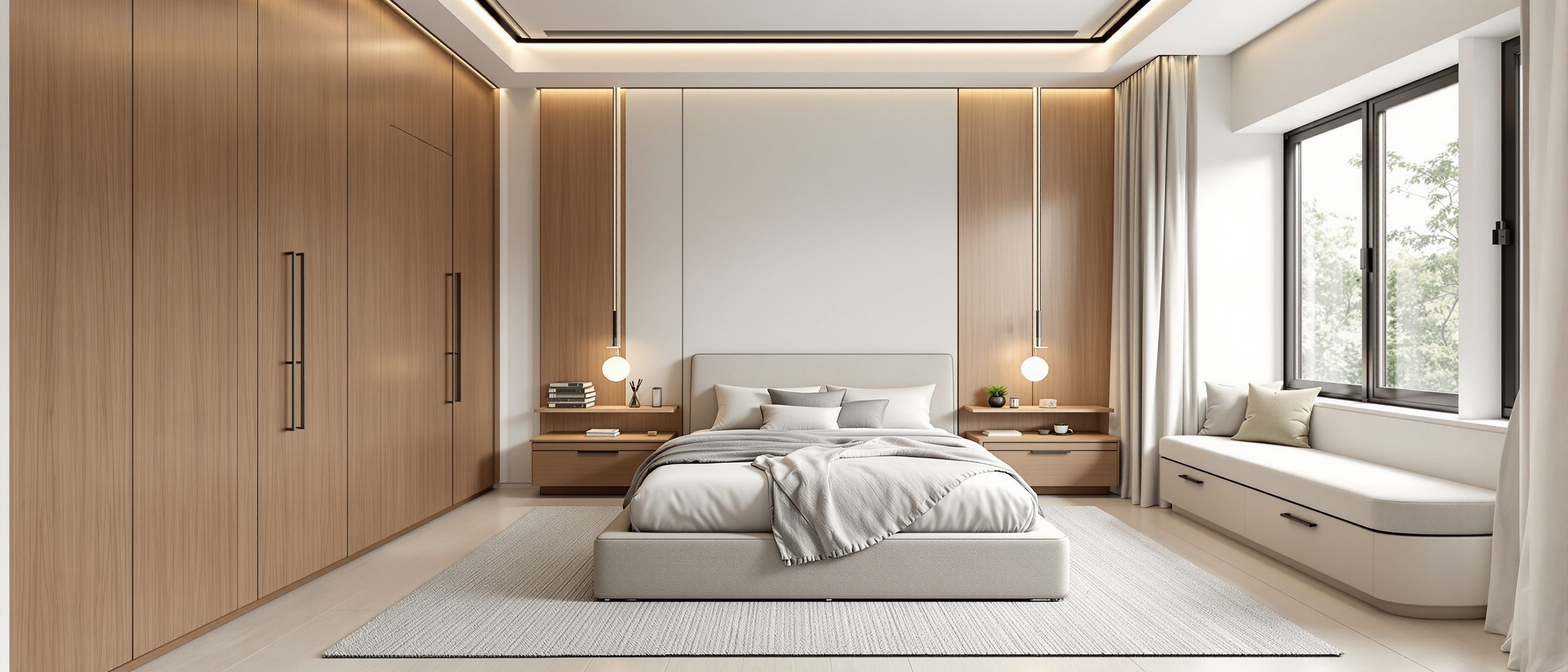
Hidden Storage Solutions
Concealed and integrated storage for Indian homes — under-bed boxes, under-stair drawers, diwan seating, lofts and panel-front cabinets that make storage disappear so rooms stay calm.
Walk into most Indian flats and the storage is shouting at you. A steel almirah in the corner, a shoe rack spilling at the door, a stack of suitcases on top of the wardrobe, cartons under the bed wrapped in old saris, festival décor in a polythene bundle behind the sofa. The stuff is housed — but the room never feels at rest, because every object you own is on display.
Now picture the same family, same possessions, in a flat where you cannot see a single cupboard. The bed lifts to swallow two winter quilts and a spare mattress. The staircase has drawers tucked under each tread. The bench by the window opens for the children's toys. The pooja niche slides shut behind a panel when guests arrive. Nothing has been thrown away — it has simply been made to disappear.
That is the whole craft of hidden storage. It is not about owning less; it is about putting volume where the eye does not travel — under, over, inside and behind — so the room reads as space, not as a warehouse.
Hidden storage is geometry, not gadgetry: you are harvesting the dead voids a builder flat gives you for free — under the bed, under the stair, inside the plinth, above the wardrobe, behind the seat — and accepting a small, deliberate loss of access in exchange for a calmer room.
1. The one rule: trade access for calm, on purpose
Every hidden-storage decision is the same bargain. You move an object out of sight, and in return it becomes slightly harder to reach — a loft needs a stool, an under-bed box needs you to heave the mattress, a false-ceiling hatch needs a ladder.
That trade is brilliant for things you touch twice a year and terrible for things you touch twice a day. The discipline is to match the frequency of use to the cost of access. Get this backwards and you will never open the box, or leave it permanently ajar — which defeats the point.
"Storerooms become junk heaps for a simple reason: things go in by category but come out by occasion. If you cannot retrieve a single item without disturbing ten others, you have built a tomb, not a store." — adapted from Julie Morgenstern, Organizing from the Inside Out
Before committing carpentry, it is worth doing a rough volume audit of what you actually own season by season — the storage capacity calculator and the wardrobe storage capacity calculator turn "a lot of stuff" into cubic-metre numbers you can plan against. The discipline behind that exercise — treating storage as a designed system rather than an afterthought — is set out in depth in storage planning as a design discipline.
This guide is deliberately narrow. For the broad menu of ideas, see smart storage interiors and smart storage ideas for Indian homes. Here we only talk about storage you cannot see.
2. The bedroom: under, over and behind the bed
The bedroom is the richest hunting ground because the bed and wardrobe already monopolise the floor — so the voids around them are pure bonus volume.
Under-bed storage. A queen bed (1500 × 1900mm) sits over roughly 2.85 m² of floor. Lift it on a hydraulic box mechanism and you get a clear internal depth of around 280–320mm — close to a full cubic metre of dead air turned useful. It is the single best home for bulky, low-frequency goods: out-of-season quilts, the guest mattress, large suitcases. Use hydraulic struts (gas lifts), not hinged flaps or roller drawers — a strut holds the mattress open hands-free. Roller drawers under a bed are a trap in Indian flats: they need clear side floor to pull out and collect dust and the odd cockroach in the runner channel.
Loft over the wardrobe. Wardrobes are 2100–2200mm tall; ceilings are 3000mm. That 800–900mm gap, full width, is a loft — front it with the same shutter line so it reads as one tall cupboard. It is the right home for once-or-twice-a-year things: large suitcases, festival décor, the carton of children's outgrown clothes saved for the next baby.
Headboard storage. A 250–300mm-deep headboard becomes a hidden niche or a slim cabinet for books, the night-time clutter of phone-charger-spectacles, and a reading lamp — keeping the floor and any side table clear.
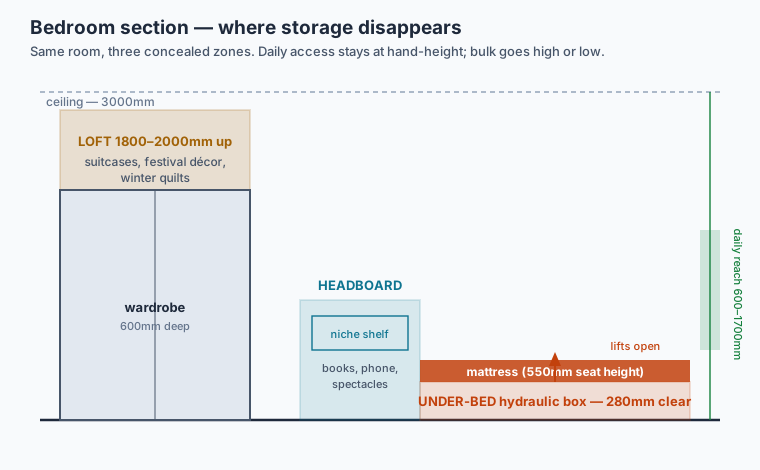
Figure 1: One bedroom, three concealed zones. Daily-reach items live in the 600–1700mm band; bulk goes high (loft) or low (under-bed). Match access cost to how often you actually touch the thing.
For how the wardrobe itself should be planned so it does not silt up, see wardrobe and closet planning and the diagnosis in why wardrobes become inefficient; for the spend, the wardrobe cost guide.
3. The staircase: the cupboard the builder gave you free
In duplexes, row houses and villas, the triangular void under the staircase is the most wasted volume in the whole home — usually given over to a token shoe rack or a dump for buckets. Planned properly it becomes 1.5–2.0 m³ of joinery, and because the void changes height along the run, each part suits a different job.
At the tall end (1700–1900mm clear) put a full-height pull-out for brooms, the mop, the ironing board and the vacuum. The mid-run section takes a stack of deep drawers — linens, tools, extension boards, the toolbox. At the toe, where the void is only 300–400mm high, a tilt-out shoe drawer holds twenty-plus pairs and keeps the entrance clear (the alternative — an open rack at the door — is the single ugliest thing in most Indian halls).
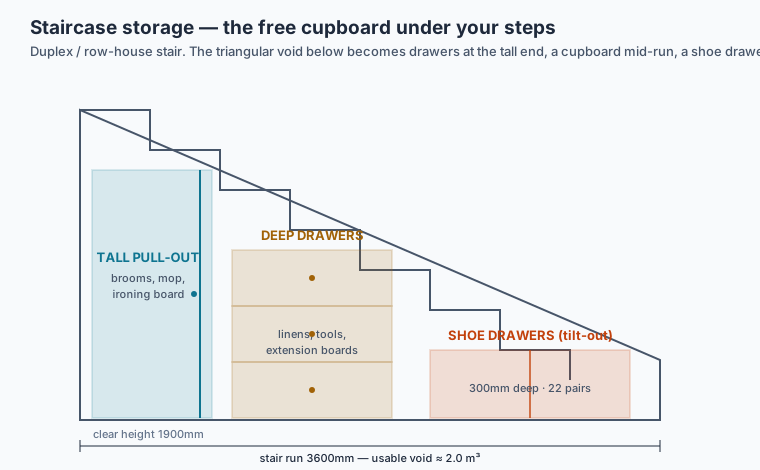
Figure 2: The under-stair void carved into three access types — a tall pull-out, deep drawers and a low shoe drawer — yielding around 2 m³ from space that was doing nothing. Drawers and pull-outs beat hinged doors here because the void is awkward to reach into.
Two site-specific cautions. Never fully seal the stair void if it shares a wall with a bathroom or an external wall — leave service access and ventilation, because damp and the occasional plumbing leak will rot whatever is trapped behind a permanent panel. And if you would rather keep the under-stair as a small pooja or reading nook, that is a legitimate choice too — storage is not the only honest use of the void.
4. Seating that stores: diwans, ottomans and window seats
Any horizontal surface you sit on at 400–550mm height is sitting on a box of air. Indian homes have a long tradition here — the diwan (the deep daybed in the hall) has always lifted to store bedding. Modernise it and you have a whole family of concealed stores.
- Lift-top diwan / divan bed: the classic. Spare bedding, mattresses, blankets for the relatives who arrive at festival time. A 1900 × 900mm diwan gives roughly 0.6 m³.
- Storage ottomans and pouffes: small, mobile, perfect for throws, the TV remotes-and-cables drawer, or children's books in the living room.
- Bay-window / balcony seats: the window ledge becomes a cushioned bench with drawers or a lift-top below — toys, magazines, board games.
- Dining-bench storage: a bench instead of two chairs on one side of the table, lifting to hold table linen, serving dishes and the rarely-used dinner set.
The access rule still bites. Lift-top seating is wonderful for low-frequency bulk because you only open it occasionally; it is annoying for anything daily, because you have to move the cushions and whatever is sitting on top. So store the spare quilt in the diwan, not the daily remote.
5. False ceilings, plinths and toe-kicks: the millimetre voids
The ceiling and the floor edge hide volume too — smaller, but free.
False-ceiling perimeter loft. Where a false ceiling drops 200–300mm around the room edge (common in halls and bedrooms), a section of it can be built as a top-access or side-access loft for flat, light, rarely-touched things — certificates, the children's old artwork, off-season curtains. Keep it shallow and light; this is not for suitcases.
Toe-kick / plinth drawers. The 100–150mm recess at the bottom of every wardrobe and kitchen run is normally dead. Convert it to a shallow toe-kick drawer for flat items — bedsheets, gift-wrapping rolls, in the kitchen for baking trays and chopping boards. Tiny per drawer, but it runs the whole length of a unit.
Mirror-front and panel-front cabinets. A full-height mirror in the bedroom or foyer can be the door of a shallow 120–150mm cabinet for jewellery and accessories. In the living room, push-to-open panel-front cabinets with no visible handles let a whole storage wall read as flat panelling — router, cable box, games and bar all vanish behind a continuous surface.
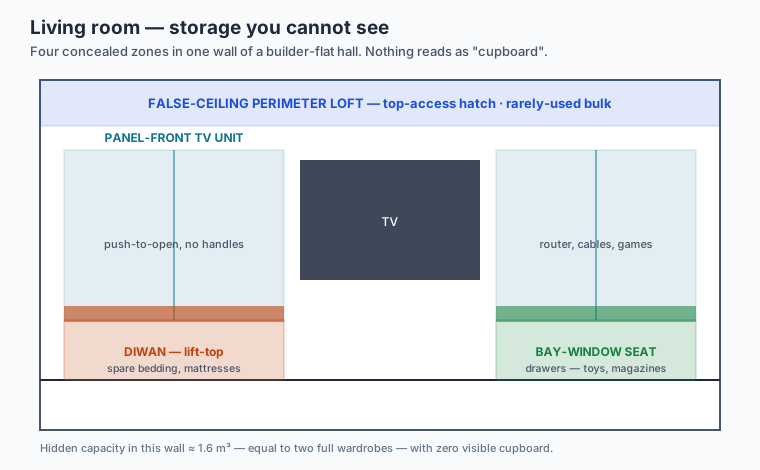
Figure 3: A single hall wall hiding around 1.6 m³ — two wardrobes' worth — across four concealed zones, with no visible cupboard. Panel-front, push-to-open shutters keep the surface reading as wall, not furniture.
6. The hidden specials: pooja, bar, shoe and appliance units
Some things in an Indian home are better concealed for cultural or aesthetic reasons, not just to save space.
- Hidden pooja unit: a niche or compact mandir behind bi-fold or sliding shutters — keeps the sanctity, removes the clutter, and shields it from grease near a cooking zone.
- Concealed bar: a fold-down or pocket-door unit inside a sideboard — discreet where an open bar is unwanted in front of elders or children.
- Hidden shoe storage: built into the foyer console or a slim 300mm tilt-out by the door, so arrival stays clean — see entry and foyer design.
- Appliance garage (kitchen): a roller-shutter cabinet on the counter that hides the mixer-grinder, toaster and kettle so the worktop reads clear. See kitchen storage planning.
"A house that has a place for everything... is a house that supports the rhythm of daily life. The genius is to keep the things you reach for daily within easy reach, and to put everything else respectfully out of the way." — paraphrasing Christopher Alexander, A Pattern Language
7. Where hidden storage is NOT worth it
Concealment has a cost — joinery, mechanisms and, above all, access friction. There are clear cases where open or visible storage wins.
- High-frequency daily items. Keys, the day's medicines, school bags, the spice box you use every meal. These belong on open shelves, hooks or a shallow tray at hand-height. Hiding them just means leaving the door open all day.
- Damp-prone goods in monsoon zones. A sealed under-stair or under-bed box on an external/bathroom wall in Mumbai, Kerala or the coast will trap humidity and grow mildew. Either ventilate it or store damp-sensitive things elsewhere.
- Heavy items overhead. Lofts and false-ceiling stores are for light, low-frequency goods only. Lifting a heavy suitcase to 2000mm is a fall risk, especially for elders.
- Rentals and short stays. Built-in concealed joinery is a capital investment you cannot take with you. In a rented builder-flat, lean on freestanding lift-top diwans, storage ottomans and modular dual-purpose furniture instead.
- When it kills daylight or air. A storage bench that blocks a window's opening, or a loft that seals a ventilator, costs you more in comfort than it returns in cubic metres.
The honest summary: hide the bulk and the occasional; keep the daily and the damp-sensitive accessible.
8. Hidden-storage type → where it works → the trade-off
| Hidden type | Where it works best | Capacity (typical) | Access trade-off |
|---|---|---|---|
| Under-bed hydraulic box | Bedrooms — bulk, seasonal | ~0.9–1.0 m³ | High: clear bed, lift mattress; suits 1–2×/year items |
| Wardrobe loft (800–900mm) | Above any wardrobe | 0.5–0.8 m³ | High: needs a stool; light items only |
| Under-stair joinery | Duplex / villa stairs | 1.5–2.0 m³ | Medium: drawers good, deep voids awkward |
| Lift-top diwan / bench | Hall, dining, window | 0.4–0.7 m³ | Medium: move cushions / clear top |
| Storage ottoman | Living room | 0.05–0.15 m³ | Low: lift lid; great for daily soft goods |
| False-ceiling perimeter loft | Halls, bedrooms | 0.2–0.5 m³ | Very high: ladder; flat, light, rare items |
| Toe-kick / plinth drawer | Base of wardrobes, kitchen | 0.02–0.05 m³ each | Low: flat items only (sheets, trays) |
| Mirror / panel-front cabinet | Bedroom, foyer, hall | 0.1–0.3 m³ | Low–medium: shallow, daily-friendly |
| Hidden pooja / bar | Hall, dining edge | varies | Low: opens daily, closes for guests |
| Appliance garage | Kitchen counter | 0.1–0.2 m³ | Low: roller-shutter, very accessible |
9. A room-by-room hidden-storage opportunity map
Every room hides volume in a different place. Walk your flat with this list — the room measurement tool and the layout planner help you size the voids before you commission carpentry.
| Room | Best hidden opportunity | What to store there | Note for Indian homes |
|---|---|---|---|
| Master bedroom | Under-bed box + wardrobe loft | Quilts, spare mattress, suitcases | Hydraulic, not roller drawers |
| Kids' room | Under-bed drawers + bay-window seat | Toys, books, outgrown clothes | Soft-close so fingers are safe |
| Living / hall | Panel-front TV wall + diwan + ottoman | Cables, bedding, games, bar | Push-to-open keeps wall flat |
| Dining | Bench-seat storage + sideboard | Table linen, rarely-used crockery | Bench seats two on one side |
| Foyer / entry | Console with hidden shoe drawer | Shoes, keys-tray (open), umbrellas | Tilt-out 300mm keeps door clear |
| Staircase | Under-step drawers + pull-out | Cleaning kit, linens, shoes | Ventilate if on a wet wall |
| Kitchen | Toe-kick drawers + appliance garage | Trays, boards, mixer, toaster | Hides counter clutter, easy reach |
| Pooja corner | Niche behind sliding shutter | Lamps, samagri, photos | Conceal yet keep dignified, ventilated |
| Balcony / utility | Bench seat + plinth drawer | Garden tools, cleaning stock | Weatherproof material; see utility guides |
For flats where every one of these voids matters because floor space is so tight, the companion guide storage design for small apartments goes deeper on prioritising which voids to harvest first; storage solutions for compact apartments is a broader solutions list.
A closing word on restraint
Hidden storage tempts you to store more because you have hidden the evidence. Resist it. The point was never to hoard more efficiently — it was to give the things you genuinely keep a calm, out-of-sight home so the room can breathe.
"Keep only those things that speak to your heart. Then take the plunge and discard all the rest." — Marie Kondo, The Life-Changing Magic of Tidying Up
Decide what stays first; then build the void to fit it. A hidden store sized to today's clutter will be full by next Diwali; a hidden store sized to what you have chosen to keep will stay calm for years.
Sources & further reading
- Christopher Alexander, Sara Ishikawa & Murray Silverstein, A Pattern Language: Towns, Buildings, Construction (Oxford University Press, 1977) — patterns on built-in storage and "a place for everything".
- Julie Morgenstern, Organizing from the Inside Out (Henry Holt, 1998) — retrieval-led storage planning.
- Marie Kondo, The Life-Changing Magic of Tidying Up (Ten Speed Press, 2014) — deciding what to keep before designing the store.
- Bureau of Indian Standards, National Building Code of India (NBC) 2016 — clearances, ventilation and storage-space provisions.
- Ernst Neufert, Architects' Data — anthropometric reach zones and standard furniture/storage dimensions.
- Studio Matrx, storage planning as a design discipline and smart storage interiors — companion references.
This guide pairs with the cluster pillar storage planning before interior design, with storage design for small apartments where every hidden void counts, and with seasonal storage solutions for the festival décor and winter quilts your hidden boxes are really built to hold.
Export this guide
Related Guides — Deep-dive reading
Storage Planning Before Interior Design
Why storage must be planned first — audited, budgeted and given its floor area — before a single layout, colour or sofa is chosen. The homeowner's plan-it-first master guide for Indian homes.
StorageMudrooms for Indian Homes
The threshold where the outside is left behind — designing a real shoes, dust and wet-weather drop-zone, from a slim niche in a flat to a proper mudroom in a house.
StorageWhy Scale Matters: Keeping Rooms Comfortable for Humans
How sizing furniture, art and lighting to the human body — not the showroom — keeps small Indian flats from feeling crushed and large halls from feeling empty.
Design PrinciplesRelated Tools — Try Free
Cross-Ventilation Analyzer
Estimate airflow and air changes per hour (ACH) from room size, window areas, layout, and local wind — with NBC 2016 Part 8 compliance check.
Ventilation CalculatorApartment Furniture Size Chart
Standard furniture dimensions for Indian apartments — sofas, beds, tables, dining, storage.
Reference ChartWardrobe Storage Capacity Calculator
India-specific garment math — sarees, lehengas, kurtas, shirts, shoes. Pick a layout (2-door → walk-in), see live fill and saturation gauges.
Capacity Calculator