
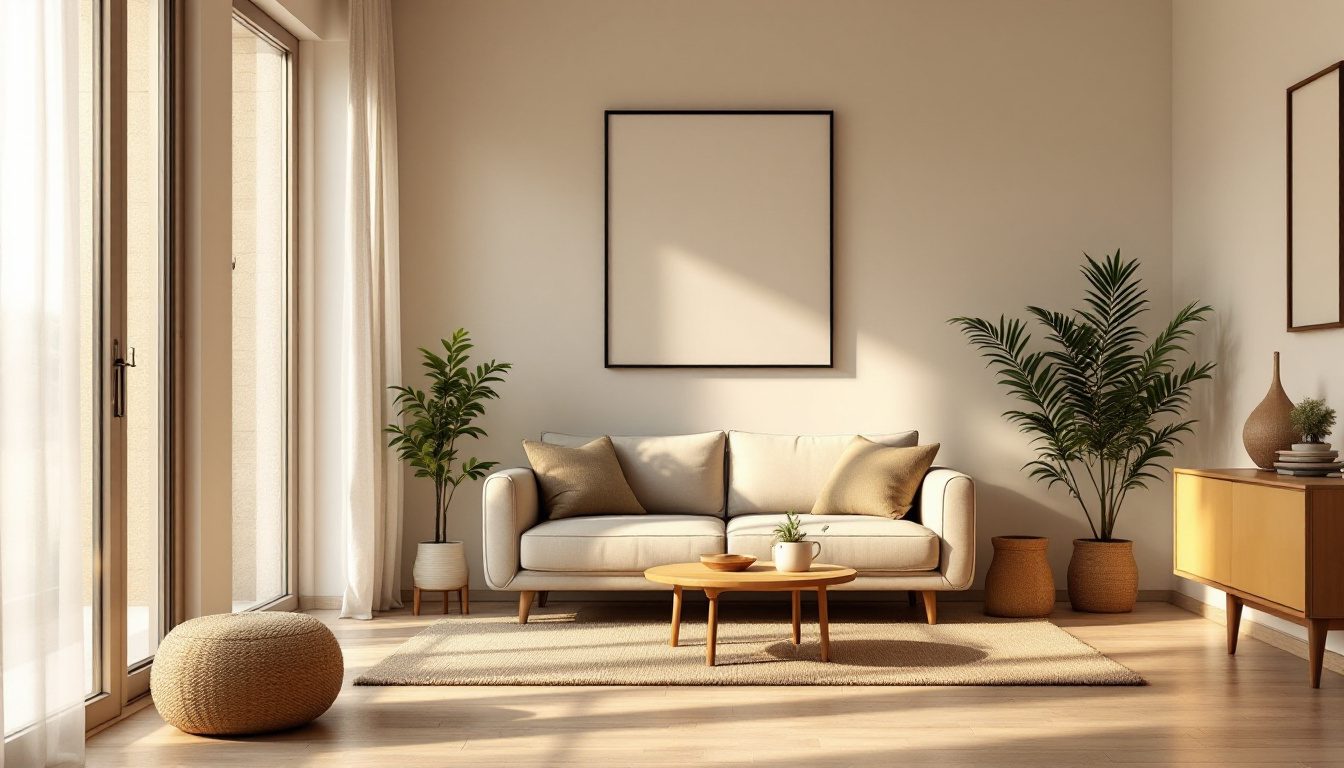
Why Scale Matters: Keeping Rooms Comfortable for Humans
How sizing furniture, art and lighting to the human body — not the showroom — keeps small Indian flats from feeling crushed and large halls from feeling empty.
Stand a 7-foot sofa against the wall of a 10-by-12-foot living room and watch what happens. The sofa is beautiful — you saw it in a showroom the size of a badminton court and it looked perfect there. In your flat it eats the floor. The walkway to the balcony shrinks to a shuffle, the coffee table has nowhere to go, and the room that the brochure called "spacious" suddenly feels like a furniture warehouse. Nothing is wrong with the sofa. It is simply the wrong size for the body that has to live around it.
This guide is about that quiet, decisive relationship: the size of a thing measured against the human body and against everything next to it. We call it scale. It is the reason an imported king bed strangles a 10-by-10 bedroom, the reason a grand chandelier looks ridiculous in a 9-foot room and lost in a banquet hall, the reason a builder's "standard" kitchen counter wrecks your back. Scale is felt instantly and specified almost never — which is exactly why getting it right is one of the highest-leverage moves in a home.
Scale is not about whether a thing is big or small in the abstract — it is about whether its size is right for the human body using it and for the objects around it. Get scale wrong and even expensive, beautiful pieces make a room feel cramped, lost, or subtly uncomfortable in a way you can feel but cannot name.
Scale and proportion are not the same thing
People use these two words interchangeably, and the confusion costs them. They are siblings, not twins.
Proportion is about the relationship of parts to each other and to the whole — the ratio of a window's height to its width, of a room's length to its breadth, of a cabinet's drawers to its doors. It is internal, abstract, geometric, and it is the subject of our companion guide on the golden mean and proportion in interiors. Proportion asks: do these dimensions sit in pleasing ratio?
Scale is about size relative to a reference — and the master reference is always the human body. A door is well-scaled when a person can walk through it without ducking or feeling dwarfed. A chair is well-scaled when an average adult's feet rest flat and their knees bend at a right angle. A painting is well-scaled when it neither shrinks against a vast wall nor crowds it. Scale asks: is this the right size for the person, and for what sits beside it?
The architect Francis D. K. Ching, in his standard text "Architecture: Form, Space, and Order," separates them cleanly: proportion is the mathematics of a design, scale is how we perceive a thing's size against a known constant. The known constant, for interiors, is us. This is why scale is the more visceral of the two. You may not consciously read a 1.4 ratio, but your body knows the instant a ceiling is too low for the room's width or a sofa is too deep for your legs.
Proportion is a relationship between dimensions; scale is a relationship to the human body. You can admire proportion on paper, but you only ever feel scale when you walk in and your body answers.
The human body is the only ruler that matters
Long before designers had software, they had the body. The field that codifies the body's dimensions is anthropometrics, and it is the foundation of every comfortable room. Ernst Neufert's "Architects' Data" and Julius Panero and Martin Zelnik's "Human Dimension and Interior Space" are the two reference bibles here, and Le Corbusier built an entire proportioning system, the Modulor, around the dimensions of a standing man with a raised arm.
The principle is simple: furniture and architecture must be sized to the range of bodies that will use them, not to a showroom's sense of drama. A few dimensions do most of the work, and they barely change across the world because human legs, hips and reach are roughly constant — though Indian designers reasonably trim a centimetre or two from Western norms for average stature.

| Element | Comfortable dimension | Why the body needs it |
|---|---|---|
| Seat height (sofa, dining chair) | 400–450 mm | Feet flat on floor, thighs level; too high dangles legs, too low jams knees up |
| Seat depth (sofa) | 550–600 mm | Back reaches the cushion with feet down; deeper and short people perch or slump |
| Kitchen counter | 850–900 mm | Chopping without stooping; tuned to the cook's elbow, roughly 100 mm below it |
| Desk / study table | 720–750 mm | Forearms level with the keyboard, shoulders relaxed |
| Dining table | 750 mm, 600 mm width per diner | Elbow room and a lap that clears the apron |
| Door clear width | 800–900 mm | One person plus a margin; 750 mm is the squeeze minimum |
| Bed height (mattress top) | 550–600 mm | Sit and your feet touch the floor; very low platform beds are a knee-strain for elders |
These numbers are not opinions. They are what the body returns to after every fashion passes. A counter at builder-standard 800 mm will, over years, ache the back of anyone over about 5 foot 7; a sofa with a 700 mm seat depth will leave most Indian adults choosing between lumbar support and feet on the floor. You can test every one of them yourself, and our scale and proportion calculator lets you check a piece against your own height before you buy.
Circulation: the space the body needs to move
Scale is not only about the objects — it is about the gaps between them. A room can have perfectly sized furniture and still feel wrong because the pathways are too tight for a body in motion. Circulation width is the most ignored dimension in Indian homes, and the first casualty when furniture is over-scaled.
The body needs roughly 600 mm to pass through a gap sideways, 750–900 mm to walk through comfortably facing forward, and around 1,200 mm for two people to pass or for a main route through a living-dining space. Pull a dining chair out and you need about 750–900 mm of clearance behind it; sit down to a desk and you need 900 mm to push back and stand. These clearances are the silent reason a beautiful room feels claustrophobic — the eye sees lovely furniture, but the body keeps colliding with it.
| Movement | Clear width needed | Common failure in Indian flats |
|---|---|---|
| One person edging past | 600 mm | Sofa-to-wall gap left at 300–400 mm |
| Main walkway through a room | 900–1,200 mm | Oversized sectional blocks the route to the balcony |
| Chair pull-back at dining / desk | 750–900 mm behind | Table for 8 jammed into a space for 6 |
| Walking around a bed | 600–700 mm each side | King bed leaves 300 mm slivers, wardrobe won't open |
| Kitchen aisle (galley) | 1,000–1,200 mm | Island added to a 900 mm aisle, two cooks can't pass |
This is where scale meets the floor plan, and why it belongs in the same conversation as our guide on space-planning principles for Indian homes. When you choose furniture, you are not choosing objects — you are choosing what is left over for the body to move through. The layout planner lets you draw furniture to scale and see the gaps before the delivery van arrives.
The showroom trap: why everything looks too big at home
There is a structural reason almost everyone buys furniture that is too large. Showrooms are enormous. A sofa floats in 3,000 square feet of polished floor under 18-foot ceilings, surrounded by equally large pieces. In that context it looks normal, even modest. Your eye calibrates scale against the surroundings — a phenomenon the Gestalt psychologists documented a century ago as the way we perceive size only in relation to a frame. Strip away the cavernous showroom and drop the same sofa into a 120-square-foot living room with a 9-foot ceiling, and it balloons.
The same trap operates online, where a product photo is shot in a styled set and the dimensions hide in a spec table nobody reads. A "compact" three-seater that measures 2.1 metres long is not compact in a room whose longest wall is 3.6 metres — it consumes more than half of it.
The defence is boringly effective: ignore how a piece looks and read the dimensions, then tape them onto your own floor. Cut newspaper to the sofa's footprint and lay it down. Mark the bed on the bedroom floor with painter's tape and walk the gaps. The body will tell you in ten seconds what the showroom hid for an hour. Indian flats are getting smaller — the average metro 2BHK is well under 1,000 square feet — while imported and aspirational furniture is sized for larger Western homes, so the mismatch is structural, not personal.
The Indian over-scaling epidemic: king beds, giant TVs and builder defaults
Walk through new apartments and the same over-scaled pieces recur, each a small tragedy of scale.
The imported king bed in a 10-by-10 bedroom. A king mattress is 1,830 mm wide; with a frame and headboard it is often over 2 metres wide and 2.1 metres long. Drop that into a 10-by-10 (3-by-3 metre) bedroom and after leaving the bed you have barely 500 mm on each side and at the foot — too little to walk comfortably, too little for a wardrobe door to swing, too little for a bedside table that isn't a tripping hazard. A queen (1,520 mm) or even a smaller double often gives the same sleeping comfort and returns half a metre of life to the room. The bed people actually need is almost always smaller than the bed they buy.
The giant TV unit and the giant TV. A 65-inch television and a 2.4-metre media console have become default aspirations, mounted in rooms where the viewing distance is barely 2.5 metres. The console swallows a wall, the screen dominates the room, and the recommended minimum viewing distance is violated, straining the eyes. Television size should scale to viewing distance — roughly the screen diagonal times 1.5 to 2.5 for comfortable viewing — not to the neighbour's purchase.
Builder-standard dimensions. Developers build to a spreadsheet, and their defaults quietly impose the wrong scale: kitchen counters at 800 mm regardless of who cooks, wardrobes 2.1 metres tall with a top shelf nobody can reach, door heights and window sills set by repetition rather than by the body. The National Building Code of India 2016 sets minimums for door widths and room sizes, but a minimum is a floor, not a fit. Builder-standard is the average of nobody.
| Piece | What people buy | What the room usually needs | What it costs the room |
|---|---|---|---|
| Bed (10x10 bedroom) | King, 1,830 mm wide | Queen, 1,520 mm | A king leaves <500 mm walkways, blocks wardrobe doors |
| Sofa (small living room) | 3-seater, 2.1–2.4 m + recliner | 2-seater + chair, or 1.8 m loveseat | Eats the walkway, kills circulation |
| TV console | 2.4 m unit, 65-inch screen | 1.5–1.8 m unit, screen to suit 2.5 m distance | Visually crushes a small wall, eye strain |
| Dining table | 6–8 seater | 4 seater, extendable | No chair pull-back room, blocks kitchen route |
| Chandelier / pendant | Grand multi-arm fixture | Slim pendant or flush fixture | Hangs into head height, dwarfs a 9-ft room |
This is the everything-too-big habit, and it is worth pausing on the opposite failure too.
The under-scaled room: when furniture floats and looks lost
Over-scaling crushes; under-scaling diminishes. A large hall — a builder's grand living-dining run, a farmhouse great room, a double-height space — furnished with small, timid pieces looks unfurnished and slightly forlorn. A 1.5-metre loveseat marooned in the middle of a 6-metre wall, a tiny coffee table adrift, a single small artwork lost on a tall expanse: the eye reads the emptiness, not the objects. The room feels like a waiting area, not a home.
The fix is not to add more small things — clutter is its own scale failure — but to choose fewer, larger pieces that answer the volume: a deep sectional, a generous rug that anchors the seating, a substantial coffee table, a large artwork or a grouped gallery that reads as one big gesture. Rugs are the classic under-scaling casualty: a rug should sit under the front legs of all the seating at least, not float like a postage stamp in the middle. The rule of thumb is that the seating should sit on the rug, framing it, not perch around a tiny island.
Scale, then, is a two-sided discipline. Match the furniture to the room and the body: small rooms want fewer, leaner, lower pieces that leave the body room to move; large rooms want fewer, bigger, bolder pieces that fill the volume with confidence. The failure in both directions is the same root error — sizing by habit or aspiration instead of by the actual dimensions of the space and the people in it. Our guide on programming your home around room functions is the upstream step: decide what each room is for, and how many bodies it serves, before you size a single object.
Scaling art, mirrors and lighting to the wall and the body
The objects on and above the surfaces follow the same law, and they are where scale most often goes quietly wrong.
Art to wall. A picture should occupy roughly two-thirds to three-quarters of the wall or furniture it hangs above — neither marooned in a sea of paint nor crowding the edges. Hung over a sofa or console, art should span about two-thirds of the furniture's width and sit so its centre is at roughly 1,450–1,600 mm from the floor, eye level for a standing adult. A small frame on a large wall is the commonest under-scaling mistake in Indian homes; the answer is a larger single piece or a deliberately grouped cluster that reads as one mass.
Mirrors. A mirror is sized both to the wall and to its job — a full-length mirror to the body, a console mirror to roughly the width of the console below it. An undersized mirror over a wide console looks like an afterthought.
Lighting. Pendants and chandeliers are the most over-scaled objects in Indian homes, partly because lighting showrooms, like furniture showrooms, are vast. A dining pendant should be roughly half to two-thirds the width of the table below it and hang about 750–900 mm above the table top — high enough to clear sightlines, low enough to pool light. A chandelier in an entry or living room is sized to the room: a common designer formula adds the room's length and width in feet and reads the sum in inches as the fixture's diameter. A 12-by-14-foot room suggests a fixture around 26 inches across — not the grand 40-inch piece the showroom pushed. And in a 9-foot room, the bottom of any hanging fixture must clear head height, around 2,100 mm in a walkway, or it becomes a hazard and visually presses the ceiling down.

| Object | Scale rule of thumb | Common error |
|---|---|---|
| Art over furniture | ~two-thirds of furniture width; centre ~1,500 mm high | Tiny frame lost on a big wall, or hung too high |
| Gallery wall | Reads as one mass spanning ~two-thirds of the wall | Scattered frames with no edge, looks like clutter |
| Dining pendant | Half to two-thirds of table width; 750–900 mm above top | Vast fixture dominating, or hung at head height |
| Living-room chandelier | Diameter (inches) ≈ room L + W (feet) | Showroom grandeur dwarfing a 9-ft room |
| Mirror over console | ~console width; below ceiling line | Undersized, looks like an afterthought |
| Rug under seating | Front legs of all seating on it, ideally all legs | Postage-stamp rug floating in the middle |
Pattern follows the same logic: a large bold print can overwhelm a small room and a tiny motif disappears on a tall wall, so the scale of a wallpaper or upholstery print should answer the size of the surface and the room. Scale is the thread that runs through every layer of a room, from the sofa to the cushion's print.
How to get scale right: a practical method
You do not need to be a designer to get scale right. You need a tape measure, a little discipline, and a refusal to trust the showroom.
1. Measure the room and the body first, the furniture last. Note the room's dimensions, the longest unbroken wall, the ceiling height, and the routes a body must travel through it. Then size furniture to fit those, not the other way around.
2. Tape it out. Mark the footprint of every major piece on the floor with painter's tape before you buy. Walk the gaps. If a walkway falls below 600 mm or a main route below 900 mm, the piece is too big.
3. Default to one size down. In a small Indian flat, the right bed, sofa and table are almost always one size smaller than the aspiration. A queen, a loveseat-plus-chair, a four-seater that extends.
4. Match height to the body, not the brand. Counters to the cook's elbow, desks to forearm level, seats to a flat-footed sit. Where you control the build, deviate from builder-standard toward your own family's stature.
5. Fill a large room with fewer, bigger gestures. Resist scattering small pieces. One generous sofa, one large rug, one bold artwork beats five timid things.
6. Scale the small stuff to the big stuff. Art to the furniture below it, pendant to the table, mirror to the console, rug to the seating. Nothing floats; everything answers a neighbour.
7. Mind the ceiling. Scale is three-dimensional — a hanging fixture, a tall wardrobe and a high headboard all relate to the height overhead, which is why scale and our guide on the science of ceiling heights are inseparable. A piece that works under 12 feet can dominate under 9.
Scale is the discipline that turns a collection of nice objects into a room that fits you. It is invisible when it is right and unbearable when it is wrong, and it costs nothing but attention to get it right.
How Studio Matrx helps
Scale is hard to judge from a brochure and easy to judge from your own floor — but easiest of all to judge from a render of your actual room. DesignAI lets you visualise your real room dimensions with furniture drawn to scale, so you can see whether that king bed leaves room to walk, whether the sofa swallows the walkway, and whether the pendant fits the table before you spend a rupee. Pair it with our scale and proportion calculator to check a piece against your own height, and you will never again be ambushed by a beautiful thing that turns out to be the wrong size.
References
1. Ching, F. D. K. (2014). Architecture: Form, Space, and Order. Wiley. — On the distinction between proportion and scale, and the human body as the perceptual reference for scale.
2. Neufert, E. Architects' Data. Wiley-Blackwell. — Standard anthropometric and furniture dimensions, clearances and circulation widths.
3. Panero, J. & Zelnik, M. (1979). Human Dimension and Interior Space. Whitney Library of Design. — The definitive anthropometric reference for interior dimensions.
4. Le Corbusier (1948). The Modulor. — A proportioning system scaled to the dimensions of the human body.
5. Bureau of Indian Standards. National Building Code of India 2016 (NBC 2016), Part 3. — Minimum door widths, room sizes and habitable-space dimensions.
6. Koffka, K. (1935). Principles of Gestalt Psychology. — On the perception of size relative to a surrounding frame, underlying the showroom-scale illusion.
7. Alexander, C., Ishikawa, S. & Silverstein, M. (1977). A Pattern Language. Oxford University Press. — On sizing rooms, alcoves and furniture to the human body and its activities.
Part of the Studio Matrx Design Principles series, anchored by why design principles beat magazine examples. Continue with the golden mean and proportion in interiors, the science of ceiling heights, and space-planning principles for Indian homes.
Export this guide
Related Guides — Deep-dive reading
Furniture Ergonomics: Sizes, Heights & Clearances for Indian Homes (2026)
The master reference for human-centred furniture dimensions — the seat, table, desk and counter heights, the clearances and walkways, and the reach zones that make a piece comfortable to use every day, tuned to Indian bodies, floor-seating habits and multi-generational homes.
FurnitureThe Golden Mean: The Secret Proportion Behind Beautiful Rooms
How the golden ratio, the rule of thirds and classic room proportions make a space feel resolved — and how India's vastu mandala and talamana traditions solved the same problem.
Design PrinciplesSofa Buying & Sizing Guide for Indian Homes (2026)
How to pick the right sofa type and seat count, size it to your living room with the two-thirds wall rule, get the seat depth and height comfortable, and — the part everyone forgets — make sure it actually fits through your door, lift and stairwell.
FurnitureRelated Tools — Try Free
Apartment Furniture Size Chart
Standard furniture dimensions for Indian apartments — sofas, beds, tables, dining, storage.
Reference ChartApartment Interior Planning Checklist
51-item checklist across structural, ceiling, lighting, furniture, storage, electrical, kitchen, bathroom.
ChecklistApartment Video Door System Planner
Enter flats, entrances, floors and guard desk for a first-pass building intercom plan — door stations, indoor monitors, guard station, the right architecture and an indicative cost band.
Building Planner