
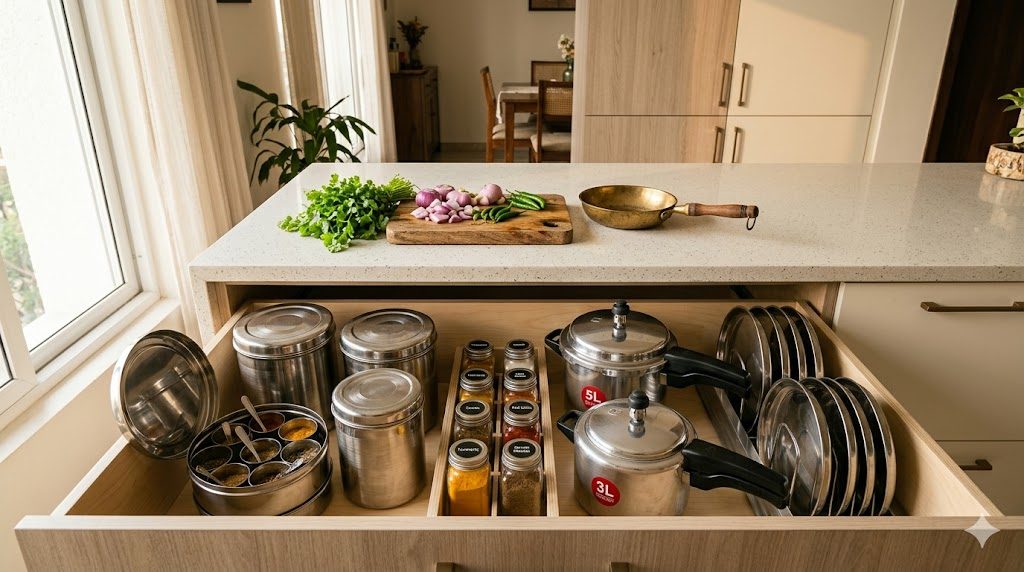
Kitchen Storage Planning Guide
Tall pull-outs, corner carousels, pantry zoning, and the drawers-beat-shelves rule for a real Indian kitchen
A kitchen is not a furniture exercise; it is a storage problem with a counter on top. The carcase you see is the smaller half of the design — the half that wins or loses the kitchen is the fittings inside it. Drawers versus shelves, tall pull-outs versus loose loft jars, a Le-Mans tray versus a dead corner: each decision is the difference between cooking with everything to hand and cooking with everything ten centimetres too far away.
This guide is about the storage strategy for a real Indian kitchen — masalas at the hob, atta in a deep drawer, thalis on the serve side, festival pots in the loft. It is a deep-dive companion to our best modular kitchen layout for Indian cooking, and it pairs with the modular kitchen guide, the storage solutions for compact apartments and our piece on why most wardrobes become inefficient — the same reach-zone logic, applied to the kitchen.
1. Start with the golden reach zone
Every body has a band it can reach without bending, stretching, or hauling out a step-stool. For most Indian cooks that band runs from roughly 600 mm above floor (just above the knee) to 1850 mm (just below eye-level). Inside it, you grab things in a single motion. Outside it, every reach costs a small tax — a sore back at 60, a dropped pressure cooker at any age.
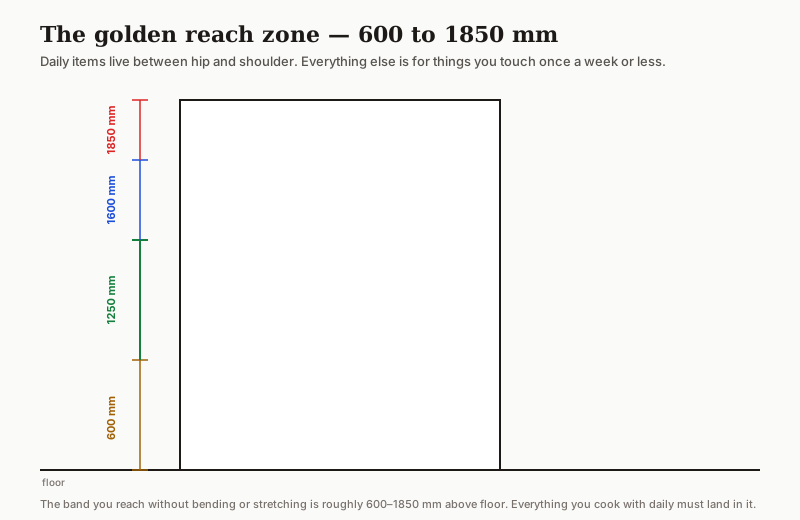
The rule is brutally simple: what you touch daily lives between 600 and 1850 mm. What you touch weekly can go up to ~2100 mm. Anything above 2100 mm is a loft for the festival biryani pot, the idli stand, and the second pressure cooker.
| Zone | Height band | What belongs there |
|---|---|---|
| Dead loft | 2100–2700 mm | Festival serveware, large pots, off-season appliances |
| Shoulder to eye | 1450–1850 mm | Cups, glasses, dry packets, masala dabba on rail |
| Golden zone | 950–1450 mm | Daily oils, cutlery drawer, mixie, daily plates |
| Knee to hip | 600–950 mm | Pressure cookers, kadhai, mixer base, heavy items |
| Below knee | 0–600 mm | Rice sacks, idli stand, rarely-used bulk |
2. Drawers beat shelves for everything you use daily
Open a typical Indian base cabinet with two fixed shelves and you will find that the back third is, in practice, dead space. You cannot see what is behind the front row of dabbas, so you stop putting things there. A 600 mm wide shelf base offers maybe 55 usable litres. The same 600 mm carcase fitted with three deep drawers gives you about 95 usable litres — and every litre is visible the moment you slide it open.
The reason is geometry plus behaviour. A shelf forces you to bend down and reach back; a drawer brings the entire cabinet contents out to you at eye-down. You see everything, you reach for one thing, you push it back. There is no rummaging because there is nothing to rummage in.
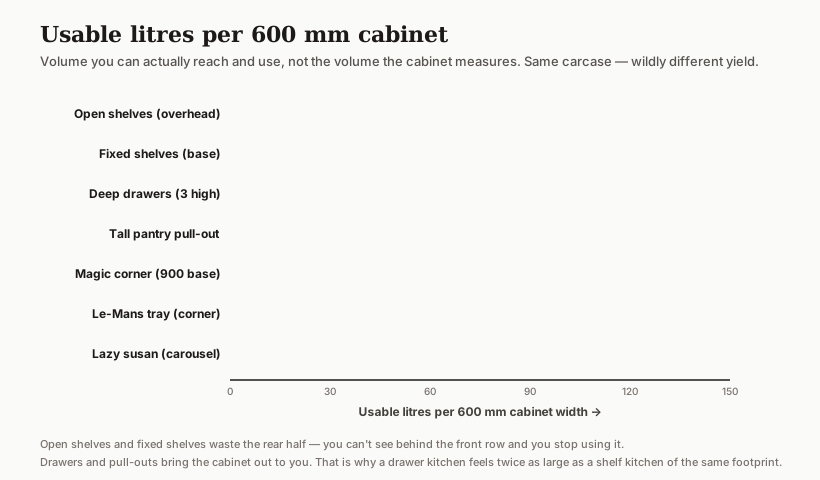
The cost difference is real — drawer hardware (tandem boxes or steel runners) costs roughly 2.5–3.5 times a fixed-shelf carcase — but it is the single highest-return upgrade in the kitchen.
A drawer kitchen feels twice as large as a shelf kitchen of the same footprint. The carcase volume is identical; the usable volume is not.
3. The must-have fitting list for an Indian kitchen
Western modular catalogues sell hardware for a kitchen of jars and pasta. Ours is a kitchen of dabbas and dals and a tawa as wide as a turntable. Plan these specific fittings into the carcase, by name:
- Tall pull-out (300–450 mm wide) for the atta dabba, rolling board, belan and dough container — set it next to the prep counter, not next to the hob.
- Masala dabba rack on the splashback rail — five steel containers within hand-reach at the hob, no opening of cabinets while a tadka is in progress.
- Pressure-cooker stack drawer under the hob — a 250–300 mm deep drawer that holds two pressure cookers nested, plus lids on a vertical rack.
- Kadhai and tawa drawer (250 mm deep) — flat-stack horizontal, never vertical-on-edge in a cabinet.
- Thali / plate drawer with peg dividers — 100 mm deep with steel pegs that keep the stack upright while the drawer slides.
- Cutlery drawer with adjustable dividers in the prep zone — not under the hob, where the heat warps plastic inserts.
- Mixie / grinder appliance garage — a roller-shutter or tambour unit on the counter that hides the mixer base when not in use, so the chord does not trail.
- Garbage segregation pull-out under the sink — two 8–12 L bins, wet and dry, on a sliding cradle.
- Spice-jar pull-out (150 mm tray) for the second-tier spices (chaat masala, kasoori methi, sambhar powder) — too many for the dabba, too daily for the loft.
Skipping any of these — especially the tall pull-out and the segregation bin — is the single most common storage regret we hear from Indian homeowners.
4. Corner solutions — the cabinet that usually becomes a black hole
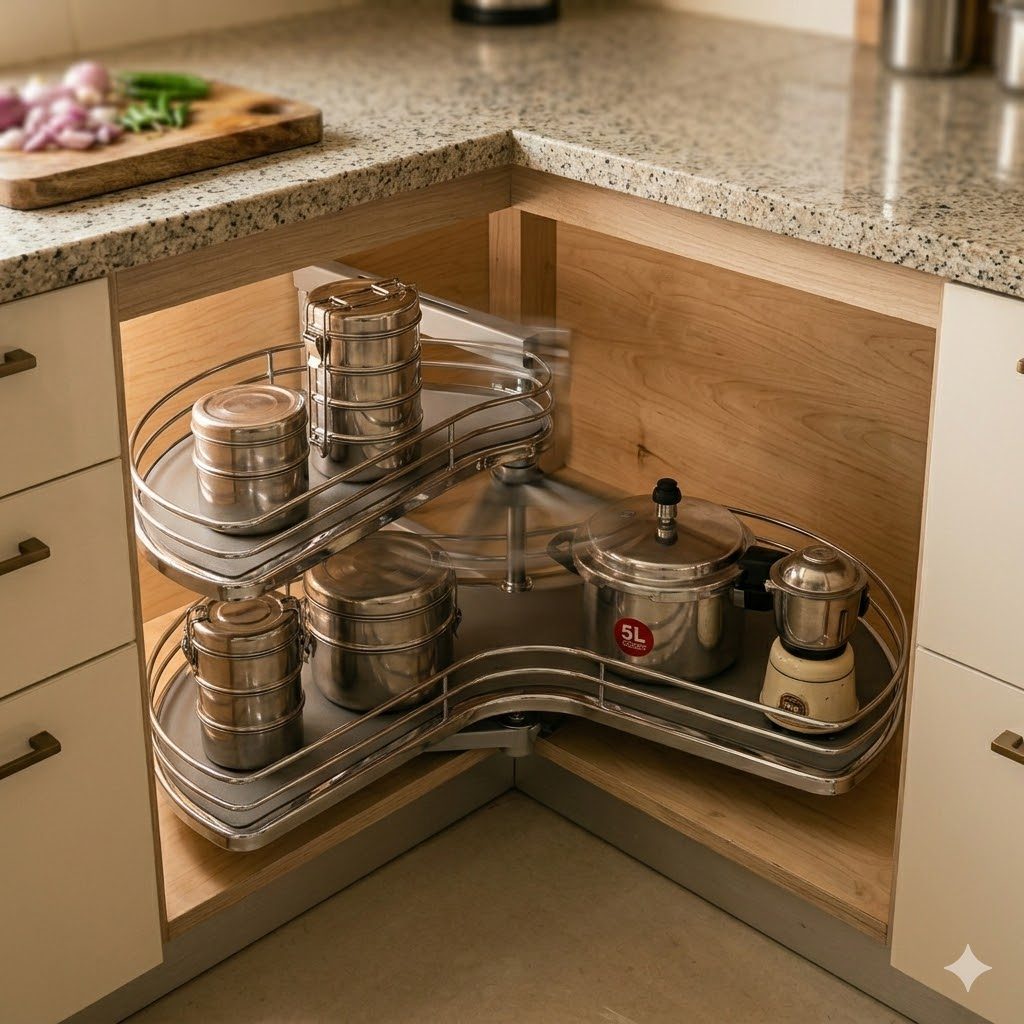
Every L-shape and U-shape kitchen has a corner where two runs meet. Without a fitting, that corner is a 900 × 900 mm cube of unreachable space. You can crawl half your shoulder in to retrieve a misplaced lid, and that is it.
There are four mainstream solutions, each suited to a different corner type:
| Fitting | Best for | Capacity (usable) | Indicative cost |
|---|---|---|---|
| Lazy susan (carousel) | True 90° corner | ~ 65 L | ₹4,000–9,000 |
| Magic corner | L-corner, blind side | ~ 80 L | ₹12,000–22,000 |
| Le-Mans tray | L-corner, blind side | ~ 70 L | ₹14,000–28,000 |
| Blind-corner pull-out | Galley dead-end | ~ 55 L | ₹8,000–16,000 |
The magic corner and the Le-Mans are the two that actually deliver in an Indian kitchen — they swing the entire cabinet contents out into the open, so you can see and reach without bending. A lazy susan is cheapest but only works at a true 90° corner with door-on-both-sides. A blind-corner pull-out is the budget compromise.
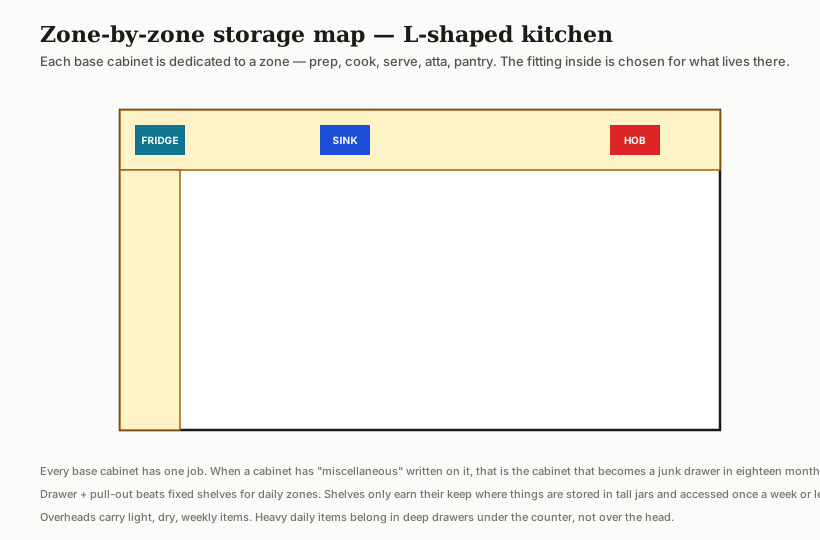
5. The zone-by-zone storage map
Every base cabinet should have one job. As soon as a cabinet is labelled miscellaneous in your head, it becomes the junk drawer of the kitchen — the place where the empty plastic bags, the spare mixer jar lid and the broken steel tumbler all live. Map the cabinets by zone before the carcases are cut.
| Zone | Cabinet contents | Hardware |
|---|---|---|
| Cold + drinks (beside fridge) | Bottles, water filter | 200 mm bottle pull-out |
| Sink base | Detergent, dishwash, segregation bins | U-pipe pull-out, 2-bin cradle |
| Prep zone | Cutlery, chopping boards, peeler, grater | Cutlery drawer, vertical board rack |
| Cook zone (under hob) | Masala rack on rail, oils, pressure cookers | 3-tier drawer set, oil-bottle pull-out |
| Atta zone (beside prep) | Atta dabba, dough box, belan, rolling board | Tall pull-out (300 mm) |
| Pantry / grains | Rice and dal jars (low), oils (mid), spices (high) | Fixed shelves with carousel jars |
| Serve zone (closer to dining) | Thalis, plates, tiffin stack, ladles | Thali drawer with pegs, tiffin shelf |
6. Pantry zoning — heavy low, light high
The pantry is the one place in the kitchen where fixed shelves still earn their keep, but they earn it only if you zone the shelves by weight, not by category.
- Bottom shelf: rice sacks, atta sacks, dal containers — heavy, infrequent access.
- Middle shelves: oils, ghee, the second pressure cooker — moderate weight, weekly access.
- Top shelves: spice jars on a removable tray, the festival serveware in a basket.
The trick is a slide-out tray on the top shelf — you pull the whole tray of spice jars towards you and pick the one you need, instead of reaching past three jars to grab a fourth.
7. Drawer depths matched to what is inside
A common mistake is to specify all base drawers at the same depth. Three 200 mm drawers waste space on top and crowd the bottom. The correct grading:
| Drawer | Depth | What it holds |
|---|---|---|
| Top | 100–120 mm | Cutlery, small tools, peelers |
| Middle | 200–250 mm | Daily masala rack, oils, spice jars |
| Bottom | 280–350 mm | Pressure cookers, kadhai, tawa, large lids |
| Toe-kick | 80–100 mm | Baking trays, flat lids, idli plates |
The toe-kick drawer is the unsung hero — it adds roughly 25 litres of flat-storage per metre of run, for a small hardware cost, and uses space that would otherwise be a kick-plate.
8. What NOT to put in overheads
Overheads are the most over-used cabinet type in Indian kitchens. The rule is harsh and worth memorising:
- Never put pressure cookers in overheads. A 5 L cooker weighs 3.5 kg; pulled down at an angle, it has injured shoulders.
- Never put glass crockery you use daily in overheads above shoulder height — it cracks the day it slips.
- Never put bulk grain jars in overheads — the weight is wrong for the carcase and you will hate the climb.
Overheads carry light, dry, daily-or-weekly items: cups, glasses, dry packets (poha, suji, cornflakes), the masala dabba on rail, daily plates. Everything heavy and daily belongs in deep base drawers.
The fix, in order
1. Map the zones to the layout before you mark a single cabinet — prep, cook, serve, atta, pantry.
2. Spec the tall pull-out for atta and the magic corner / Le-Mans for the L-corner — these two upgrades buy back 200+ litres of usable storage.
3. Default to drawers in every base cabinet you use daily. Use shelves only in the pantry.
4. Grade drawer depths — shallow top, deep bottom, plus a toe-kick drawer.
5. Move heavy items off overheads. Reserve the loft (above 2100 mm) for festival cookware only.
6. Add the splashback rail for the masala dabba and ladles. Frees the counter, halves the bend-count per recipe.
Prevent it / Plan it: Size your storage with the Storage Calculator and cost it with the Kitchen BOQ tool. Read the modular kitchen guide for layout fundamentals, storage solutions for compact apartments for small-flat tricks, why most wardrobes become inefficient for the same reach-zone logic applied beyond the kitchen, and the pillar — the best modular kitchen layout for Indian cooking.
References
- Grandjean, E. (1973) Ergonomics of the Home. London: Taylor & Francis.
- National Kitchen and Bath Association (2016) Kitchen and Bathroom Planning Guidelines with Access Standards. Hoboken, NJ: John Wiley & Sons.
- Panero, J. and Zelnik, M. (1979) Human Dimension and Interior Space. New York: Whitney Library of Design.
- Bureau of Indian Standards (2016) National Building Code of India 2016, Part 4: Fire and Life Safety, and Part 8: Building Services. New Delhi: BIS.
- Neufert, E. (2019) Architects' Data, 5th edn. Oxford: Wiley-Blackwell.
Part of the Studio Matrx Kitchen Design series.
Export this guide
Related Guides — Deep-dive reading
Best Modular Kitchen Layout for Indian Cooking
The complete layout guide — six kitchen types, the five-zone Indian work triangle, real clearances, and how to pick the right one for your flat
Kitchen DesignSmall Kitchen Design Ideas for Apartments
Squeezing a real Indian kitchen into a 1 BHK or studio — the irreducible minimum, the vertical stack, and the tricks that pay back
Kitchen DesignWhy Most Wardrobes Become Inefficient
How a wall of identical shelves wastes half your storage — and the zoning that fixes it
Mistakes & PitfallsRelated Tools — Try Free
Apartment Furniture Size Chart
Standard furniture dimensions for Indian apartments — sofas, beds, tables, dining, storage.
Reference ChartModular Kitchen Budget Calculator
Live breakdown by running feet, countertop area, material tier and city — with wastage, design fee, GST.
Kitchen CalculatorApartment Interior Planning Checklist
51-item checklist across structural, ceiling, lighting, furniture, storage, electrical, kitchen, bathroom.
Checklist