
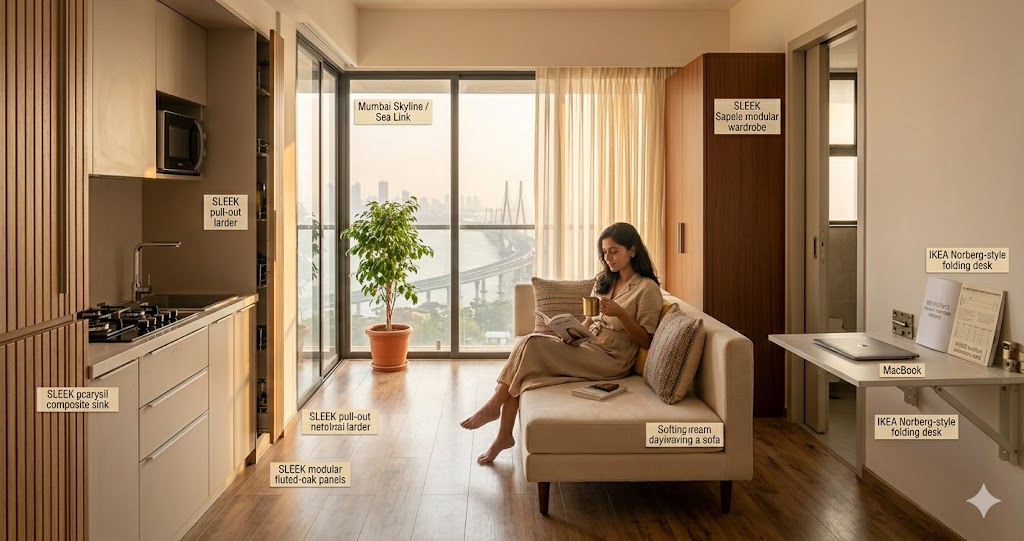
Studio Apartment Design — The 1RK 250-450 sqft Indian Cornerstone (2026)
1RK studio · 5 zones in 350 sqft · Bed-as-sofa · Co-living adjacent · Mumbai BKC ₹35K rent
A studio apartment in 2026 India is not a small 1BHK. It is a 1RK — one-room-kitchen — typically 250 to 450 square feet, where the bed, the kitchen, the work desk, and the sofa share a single volume separated only by a bathroom door. Designing it well means accepting the trade and engineering the room around it, not pretending it's something bigger. The Indian studio is a distinct real-estate tier, born in the last decade out of Mumbai's land scarcity, Bengaluru's young-tech in-migration, and Gurgaon's corporate corridor. It now has its own developer SKUs (Brigade Cornerstone Studios, DLF Capital Greens Studios, Lodha Crown), its own co-living adjacency (Stanza Living, Colive, Zolo Stays, Settl, OYO Life), and its own rental market that prices it 30 to 45 percent below the comparable 1BHK in the same building.
This guide is for the solo professional — the 24- to 35-year-old consulting analyst, product manager, junior architect, or PhD student — who has decided that the studio bargain is worth taking, and now wants to design the room rather than just furnish it. If you are weighing the studio against a true compact one-bedroom, read compact urban living and compact luxury apartment in parallel. For the engineering of the small-space tricks themselves — Murphy beds, transformable tables, bunk lofts — see space-saving furniture and the closely related smart storage interiors. For renters specifically, rental apartment interiors covers the no-drilling, deposit-safe variant.
The studio apartment is the only Indian housing typology where the bed is also the sofa, the kitchen is also the bar, and the answer to "where will my mother sleep when she visits" is "she will stay in a hotel." That is the bargain. Designing well means making the bargain comfortable, not invisible.
This guide refreshes every 12 months. Last verified: May 2026 · Next verify: May 2027.
What Studio Apartment Design Actually Means in 2026 India
A studio apartment in the Indian definition is a single self-contained habitable unit where the sleeping, living, cooking, and working functions occupy one continuous volume, with only the toilet-bath enclosed behind a door. The Indian carpet-area range is tight: most developer studios fall between 250 and 450 square feet (23 to 42 square metres), with a clustering around 300 to 380 sqft. Anything below 250 sqft is a "micro-unit" or "pod" — usually co-living rather than ownership — and anything above 450 sqft is typically marketed as a 1RK or "studio plus" but starts to behave like a small 1BHK.
The technical signature is the absence of a dividing wall between the sleeping zone and the living-cooking zone. The bathroom is always enclosed (NBC 2016 requires it). The kitchen is almost always an open or semi-open kitchenette — a single counter run of 6 to 9 feet against one wall — because a full modular kitchen island would consume a quarter of the floor plate.
Five things a studio is NOT:
1. Not a 1BHK. A 1BHK has a separate bedroom with a door. A studio does not. This is the load-bearing distinction, and it changes the resale, the rental yield, the lifestyle, and the design vocabulary entirely.
2. Not a "compact apartment" in the marketing sense. Developers sometimes badge 500 to 650 sqft 1BHKs as "compact" or "smart" homes. Those are small one-bedroom flats. A studio is smaller, with no bedroom partition.
3. Not a hostel room or PG. A studio has a private kitchen and a private bathroom. A PG room shares both. A co-living "studio" (Stanza, Colive, Zolo) is closer to a serviced studio — private bath, often a private kitchenette, but with shared common areas.
4. Not a service apartment. Service apartments (Oakwood, Ascott, The Address) are furnished, housekeeping-included, daily-or-monthly billed hospitality units. A studio is a residential unit you lease for 11 months or own freehold.
5. Not a loft. A loft has a double-height volume with an upper mezzanine — distinct typology, usually 700+ sqft, much rarer in India, mostly seen in converted industrial space in Lower Parel or Whitefield.
Hold these five distinctions and the design brief becomes specific: you are designing 300 to 400 sqft of single-volume living for one occupant, occasionally two, with a kitchenette, a private bath, and the understanding that sleep, work, and eat will time-share the same room.
Why Studio Apartments Matter Now
The Indian studio market did not exist as a real category before about 2014. It emerged from three forces converging in the same decade.
Mumbai land economics. When per-sqft prices in Lower Parel, Bandra-Worli, Andheri East, and Powai crossed ₹25,000 to ₹40,000 per sqft for new construction, the only way to deliver a habitable unit at a sub-₹1.5-crore price point was to shrink the carpet area below 450 sqft. Developers like Lodha, K Raheja, Oberoi, and Sunteck began offering studio SKUs in mixed-tower projects, often on lower floors.
Bengaluru's tech in-migration. Between 2015 and 2024, Bengaluru added an estimated 1.4 million tech workers, many of them single, between 24 and 32, drawing salaries of ₹12 to ₹35 lakh per year. They wanted to live close to Indiranagar, Koramangala, HSR Layout, or Whitefield, did not need a second bedroom, and were willing to trade space for location. Brigade Cornerstone Studios, Salarpuria Sattva East Crest, and a wave of co-living conversions filled the gap.
Delhi NCR's corporate corridor. Gurgaon Sectors 65 to 86, DLF Capital Greens, M3M Skywalk, and the Noida Expressway projects targeted single corporate transferees and consulting analysts with studio inventory priced 35 to 50 percent below the same building's 2BHK.
By 2026, studio inventory in the top six metros is estimated by Anarock and Knight Frank India at roughly 95,000 to 120,000 units, about 60 percent rental and 40 percent ownership. Studios consistently deliver 4.2 to 5.5 percent gross yield against the 2.8 to 3.5 percent typical for 2BHK and 3BHK stock in the same buildings, because they price at a discount but rent at near-parity per occupant.
Search interest is rising for three reasons. The work-from-home reset of 2020 to 2023 reshaped what a "home" needs to do — solo professionals now expect a desk, a call setup, and decent lighting in a unit they used to use only for sleep. Co-living brand fatigue is real: the cohort that lived in Stanza or Zolo from 2020 to 2024 is now graduating to private studios at ₹25K to ₹45K monthly rent, wanting their own kitchen and their own door. And the marriage-age shift — average urban Indian marriage age has moved from 24 to 28 over a decade — means the "solo professional in a studio" phase now lasts five to seven years rather than two.
The Five Defining Characteristics
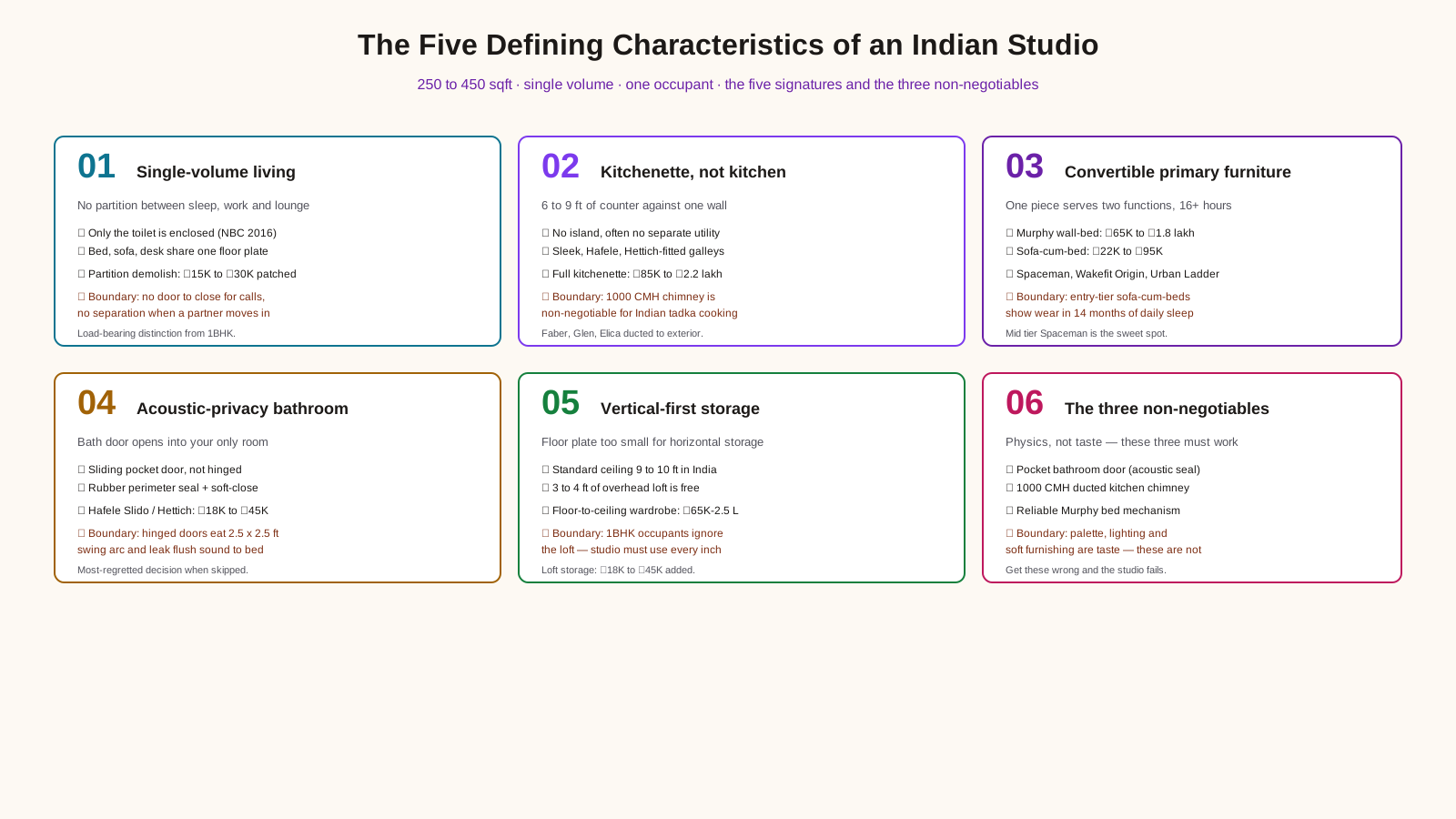
| Characteristic | What It Means | India-Specific Note | Typical Cost or Constraint |
|---|---|---|---|
| Single-volume living | No interior partition wall between sleep, work, and living zones | NBC 2016 requires only the toilet to be enclosed; everything else is the designer's call | Demolishing an existing partition: ₹15K to ₹30K including patch-up |
| Kitchenette, not kitchen | 6 to 9 ft of counter run against one wall, no island, often no separate utility | Indian cooking (oil, tadka, masala) needs a 800 to 1000 CMH chimney even in 7 ft kitchenettes — non-negotiable | ₹85K to ₹2.2 lakh for the full kitchenette including chimney, hob, sink, modular shutters |
| Convertible primary furniture | The bed is also the sofa OR the bed folds away — one piece of furniture serves two functions for 16+ hours daily | Murphy beds in India: Spaceman, Wakefit Origin, Sofa Cum Bed by Urban Ladder; quality gap is wide | Murphy wall-bed: ₹65K to ₹1.8 lakh; sofa-cum-bed: ₹22K to ₹95K |
| Acoustic-privacy bathroom | The bathroom door opens into the only room you have — so it must seal sound, smell, and visual line | Sliding pocket door with rubber seal + acoustic insulation in the wall; standard hinged doors fail here | Pocket door system (Hettich, Hafele): ₹18K to ₹45K installed |
| Vertical-first storage | Floor plate is too small for horizontal storage; everything goes up to ceiling | Standard Indian ceiling height 9 to 10 ft gives 3 to 4 ft of overhead storage that 1BHK occupants ignore | Floor-to-ceiling wardrobe: ₹65K to ₹2.5 lakh; loft storage: ₹18K to ₹45K |
These five characteristics, taken together, define the studio brief. Drop any one of them and you are designing something else — a compact 1BHK, a serviced apartment, or a hostel room. Carry all five and the floor plate becomes legible.
Every successful Indian studio fit-out treats the bathroom pocket door, the kitchen chimney, and the Murphy bed mechanism as the three non-negotiables. Everything else — palette, lighting, soft furnishing — is taste. These three are physics.
A Worked Example: 380 sqft Studio in Bandra-Worli, ₹3.5 Lakh Interior Budget
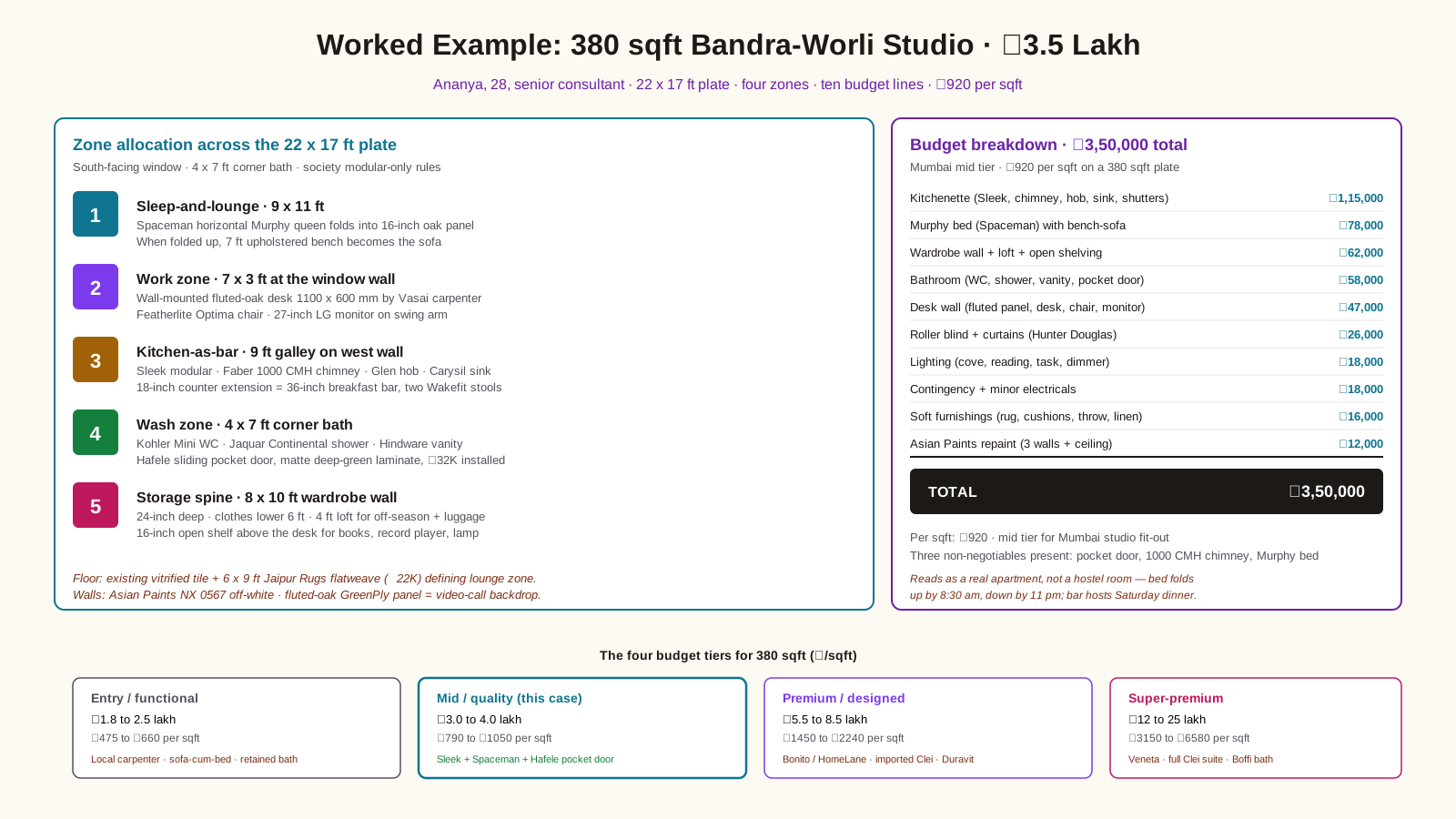
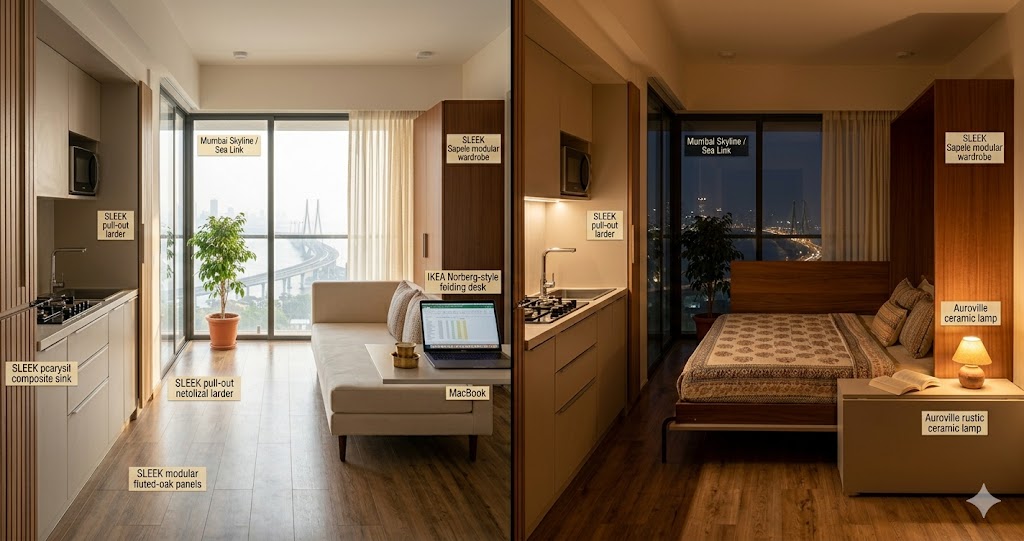
The client is Ananya, 28, a senior consultant at a Tier-1 strategy firm, drawing ₹42 lakh per year. She has just moved from a Zolo Stays co-living in Lower Parel to a 380 sqft studio in a 14-year-old society building near the Bandra-Worli Sea Link approach, paying ₹38,500 per month rent on an 11-month lease with the landlord's permission for modular work. Her interior budget is ₹3.5 lakh including labour, GST, and furniture. She wants a sleep-and-call setup that supports 12-hour weekdays, weekend hosting for two or three friends, and the visual register of "I am a 28-year-old professional, not a student."
The site. Long rectangle, 22 ft x 17 ft net, with a 4 ft x 7 ft bathroom carved out of one corner. Window on the long south wall facing the sea — strong glare from 11 am to 4 pm. Society rules: no chiselling, modular only, all work between 10 am and 5 pm weekdays.
The zone allocation. The 22 x 17 plate is split into four implicit zones without partitions:
- Sleep-and-lounge: 9 x 11 ft against the long wall opposite the window, hosting a Spaceman horizontal Murphy bed (queen) that folds into a 16-inch-deep oak-veneer panel. When folded up, the panel reveals a 7 ft upholstered bench underneath that becomes the sofa.
- Work zone: 7 x 3 ft against the window wall, with a wall-mounted fluted-oak desk (1100 x 600 mm) by a Vasai carpenter, a Featherlite Optima task chair, and a 27-inch LG monitor on a swing arm. The window above gives daylight; the swing arm clears the desk for video-call framing.
- Kitchen-as-bar: the existing 9 ft west-wall kitchen is rebuilt as a Sleek modular galley with a Faber 1000 CMH chimney, a Glen 2-burner hob, a Carysil quartz single-bowl sink, and floor-to-ceiling shutters in matte sage-green Greenlam laminate. The counter extends 18 inches as a 36-inch breakfast bar with two Wakefit stools — where she eats, pours wine for a guest, sets up a second laptop on weekends.
- Wash zone: the 4 x 7 bathroom gets a full redo — Kohler Mini WC, Jaquar Continental shower system, 1200 mm Hindware vanity with Carysil basin, 10 mm toughened glass partition, and a Hafele sliding pocket door in matte deep-green laminate (door + frame + soft-close: ₹32K installed). The pocket door is the single most important spend in the studio.
Storage strategy. A floor-to-ceiling wardrobe wall (8 x 10 ft, 24 inch deep) sits behind the Murphy bed when it is down — clothes in the lower 6 ft, off-season storage and luggage in the 4 ft loft above. A 16-inch-deep open shelf runs the desk wall above the desk, holding books, a record player, and a ceramic Bonsoir lamp. No freestanding storage anywhere else.
Materials and finishes.
- Floor: existing vitrified tile, retained, with a single 6 x 9 ft Jaipur Rugs flatweave (₹22K) defining the lounge zone.
- Ceiling: existing white POP, retained. One linear cove LED (4000K, 90 CRI) above the bed wall, one swing-arm reading lamp (Fabuliv) above the bed.
- Walls: Asian Paints Royale Aspira in warm off-white (NX 0567) on three walls, a single fluted-oak accent panel (3D Fluted MDF by GreenPly, oak veneer finish) on the wall behind the desk — 7 x 8 ft, this is the video-call backdrop.
- Window: motorised roller blind in textured linen-look from Hunter Douglas India dealer (₹26K) — critical for 11 am to 4 pm glare control on calls.
Budget breakdown (₹3.50 lakh total).
| Line item | Cost (₹) |
|---|---|
| Kitchenette (Sleek modular, chimney, hob, sink, shutters) | 1,15,000 |
| Murphy bed system (Spaceman) with bench-sofa | 78,000 |
| Wardrobe wall + loft + open shelving (local carpenter) | 62,000 |
| Bathroom redo (WC, shower, vanity, glass, pocket door) | 58,000 |
| Desk wall (fluted panel, desk, chair, monitor arm) | 47,000 |
| Lighting (cove, reading, task, dimmer) | 18,000 |
| Roller blind + curtains | 26,000 |
| Soft furnishings (rug, cushions, throw, bed linen) | 16,000 |
| Asian Paints repaint (3 walls + ceiling touch-up) | 12,000 |
| Contingency + minor electricals | 18,000 |
| Total | 3,50,000 |
Per square foot, this lands at ₹920 — middle-of-the-band for a quality studio fit-out in Mumbai. The unit reads as a real apartment, not a hostel room. The Murphy bed folds up by 8:30 am and the room becomes a workspace; folds down by 11 pm and the room becomes a bedroom. The breakfast bar is where the only weekly social ritual — Saturday dinner with one friend — happens.
For a moodboard equivalent of this brief before you commit a rupee, the Studio Matrx moodboard builder lets you pin the Sleek shutter, the GreenPly fluted panel, and the Jaipur Rugs flatweave on a single page and test the palette.
Studio Apartment Design vs Adjacent Categories
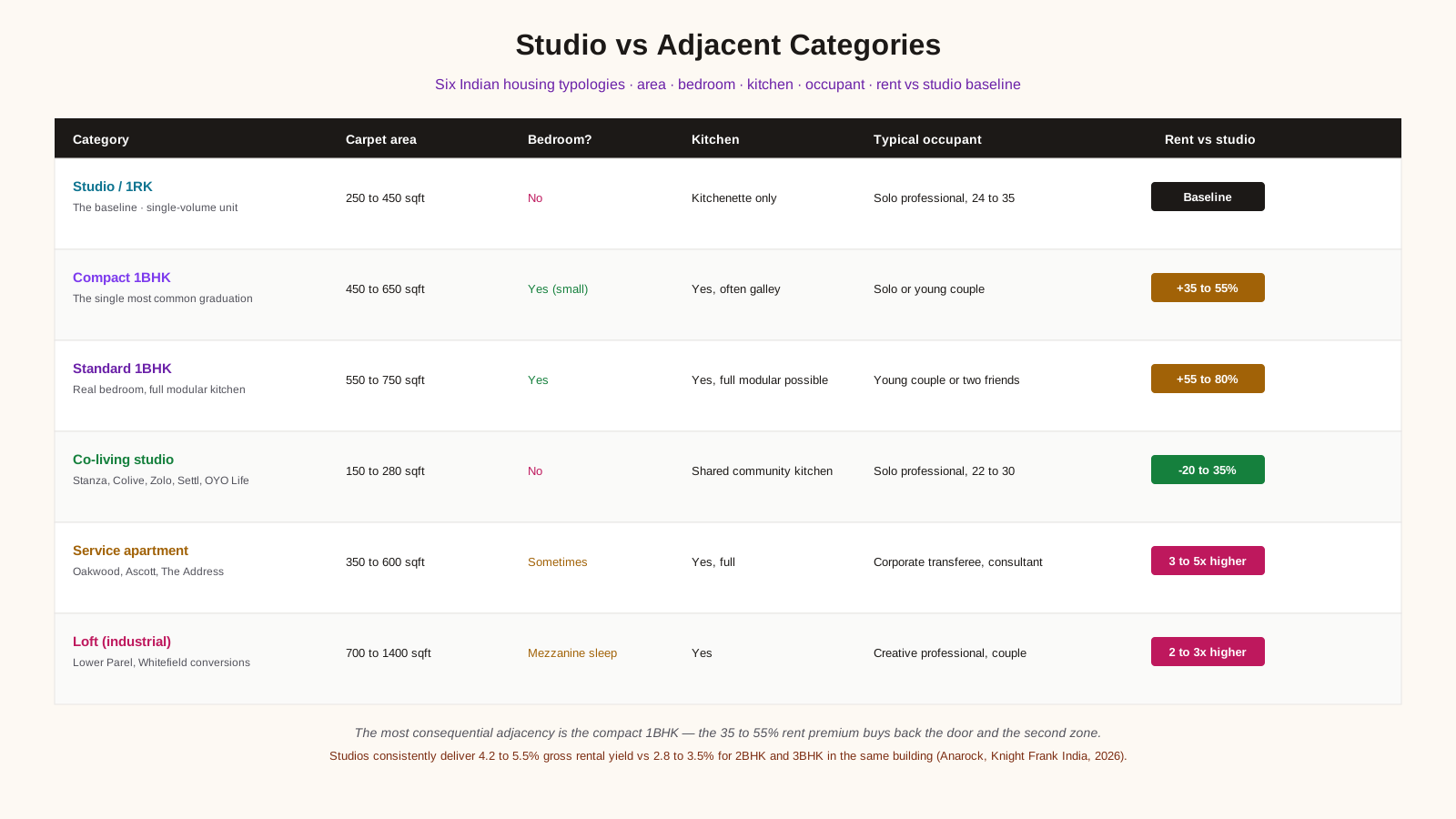
| Category | Carpet area | Has separate bedroom? | Has full kitchen? | Typical occupant | Rent vs studio in same building |
|---|---|---|---|---|---|
| Studio / 1RK | 250 to 450 sqft | No | Kitchenette only | Solo professional, 24-35 | Baseline |
| Compact 1BHK | 450 to 650 sqft | Yes (small) | Yes, often galley | Solo or young couple | 35 to 55 percent higher |
| Standard 1BHK | 550 to 750 sqft | Yes | Yes, full modular possible | Young couple or two friends | 55 to 80 percent higher |
| Co-living studio (Stanza, Colive, Zolo, Settl, OYO Life) | 150 to 280 sqft | No | Shared community kitchen | Solo professional, 22-30 | 20 to 35 percent lower, all-inclusive |
| Service apartment (Oakwood, Ascott) | 350 to 600 sqft | Sometimes | Yes, full | Corporate transferee, project consultant | 3 to 5x higher, daily-billed |
| Loft (industrial conversion) | 700 to 1400 sqft | Mezzanine sleep area | Yes | Creative professional, couple | 2 to 3x higher |
The most consequential adjacency is the compact 1BHK. The price jump from a 380 sqft studio at ₹38K rent to a 520 sqft compact 1BHK at ₹56K rent in the same Bandra society is the single decision most studio occupants revisit at lease renewal. The studio wins on cost; the 1BHK wins on the ability to host overnight guests, have a partner move in, or close a door for a call while the other person watches television.
The second adjacency is co-living. Stanza Living, Colive, Zolo Stays, Settl, and OYO Life all price studios at ₹22K to ₹32K all-inclusive (utilities, housekeeping, Wi-Fi, breakfast) in the same Mumbai-Bangalore-Gurgaon corridors. The trade is the loss of a private kitchen and the loss of solitude — the floor has 30 to 80 other residents and the common areas are loud at 9 pm. The graduation path from co-living to private studio is, in 2026, the dominant flow.
Materials, Finishes and Brand Landscape
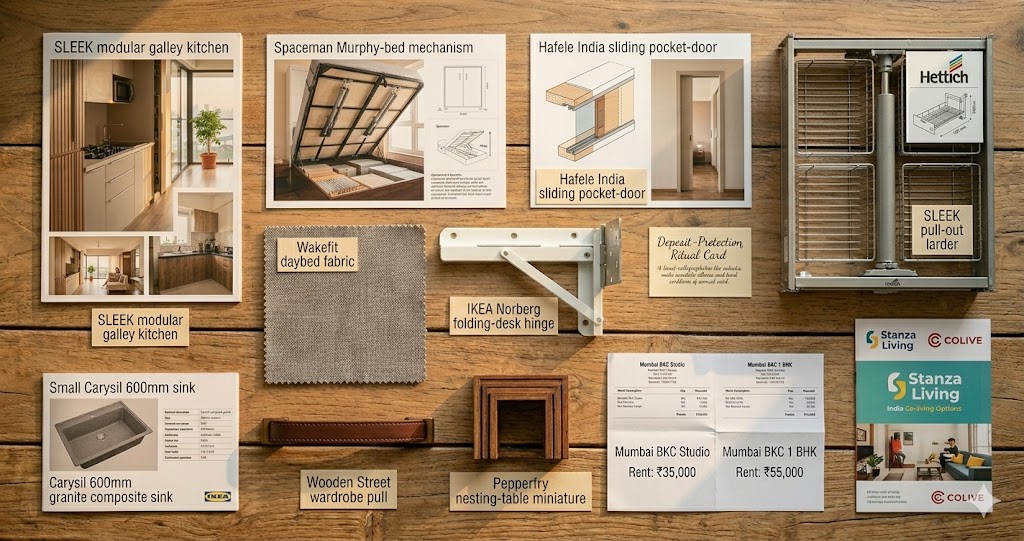
The brand landscape for a studio is narrower than for a 3BHK because the spend per category is small. The decisions concentrate on five line items: the Murphy or sofa-cum-bed, the kitchenette, the pocket door, the wardrobe, and the lighting.
| Category | Entry tier | Mid tier | Premium tier | Notes for studio context |
|---|---|---|---|---|
| Murphy / wall bed | Wakefit Origin (₹35K to ₹55K), HomeTown FoldAway | Spaceman India (₹65K to ₹1.2 lakh), Bonito Designs custom | Resource Furniture (Clei dealer, ₹1.5 to 3.5 lakh) | Mid tier (Spaceman) is the sweet spot for an Indian studio — Italian-mechanism reliability without the import duty |
| Sofa-cum-bed | Urban Ladder Apollo (₹22K to ₹38K), Pepperfry house brands | Wakefit, Sleepwell Recliners, Casacraft from Pepperfry (₹45K to ₹85K) | Stanley Lifestyles, Natuzzi India (₹1.2 to 2.8 lakh) | Mid tier matters because the sofa-cum-bed is used as both daily seat and bed — entry tier shows wear in 14 months |
| Modular kitchenette | Sleek by Asian Paints (₹85K to ₹1.4 lakh), Godrej Interio | Hafele, Hettich-fitted local fabricator (₹1.4 to 2.2 lakh) | Veneta Cucine India, Poggenpohl compact range (₹3 to 6 lakh) | For a 7 ft galley, mid tier with Hafele hinges and Blum drawers is the right call |
| Pocket door system | Local carpenter with Hettich pocket frame (₹18K to ₹28K) | Hafele Slido pocket system (₹32K to ₹55K) | Eclisse, FritsJurgens (₹85K to 2 lakh imported) | Mid tier (Hafele Slido) is non-negotiable for acoustic seal — entry tier rattles within 8 months |
| Wardrobe + loft | Local carpenter with Century Ply + Greenlam (₹45K to ₹85K) | Spacewood, Godrej Interio modular (₹85K to ₹1.6 lakh) | Bonito Designs, HomeLane premium (₹1.6 to 3 lakh) | Local carpenter wins on studio scale — modular brand overheads make small wardrobes uneconomic |
| Bathroom fixtures | Hindware, Cera (entry range) | Jaquar Continental, Kohler Mini, Roca (₹40K to 80K for full set) | Duravit, Villeroy and Boch, Hansgrohe (₹1.5 to 3 lakh) | Jaquar Continental and Kohler Mini are the Mumbai studio standard |
| Lighting | Wipro, Philips (₹3K to ₹15K per unit) | Fabuliv, Whitelogger, Beacon Lighting India (₹8K to ₹35K) | Klove, Sans Souci India, Foscarini India dealer (₹40K to 2 lakh) | Mid tier carries the design weight in a studio because there are only 4 to 6 fixtures total |
| Window treatment | Local stitched curtains (₹4K to ₹10K) | Hunter Douglas India, Vista roller blinds (₹18K to ₹40K) | Silent Gliss India, Lutron motorised (₹65K to 2.5 lakh) | A motorised roller blind earns its keep in a south- or west-facing studio because glare on calls is constant |
The hidden brand category is hardware — Hettich and Hafele drawer slides, hinges, and pocket-door rails make the difference between a wardrobe that works for 8 years and one needing the carpenter back at month 18. Spend the ₹4K to ₹6K extra on Blum or Hettich Quadro over the no-name alternatives.
Eight Pitfalls Common in 2026 India
1. Buying the bed-as-sofa decision wrong. The single most consequential furniture decision is whether to use a Murphy wall-bed (folds into the wall, frees the floor 100 percent during the day) or a sofa-cum-bed (always present, lower setup cost, slightly less daily friction). Many first-time studio occupants buy a sofa-cum-bed because it is cheaper and end up sleeping on a thin foam pad for 14 months. Mitigation: if you sleep more than 6 hours a night, buy the Murphy bed with a real mattress (Wakefit Dual or Sleepwell Nexa pocket-spring). The Spaceman Italian-mechanism beds are the right Indian mid-tier choice.
2. Skipping the kitchen chimney. A 700-CMH chimney is the bare minimum for Indian cooking; in a studio, where the kitchen vents directly into your sleeping zone, you need 1000 CMH and you need it ducted to an exterior vent, not recirculating. Mitigation: budget ₹18K to ₹35K for a Faber, Glen, or Elica 1000+ CMH chimney with a proper exterior duct; refuse any society's argument that ducting is not allowed (NBC 2016 supports kitchen ventilation).
3. Hinged bathroom door swinging into the room. A standard hinged bathroom door consumes 2.5 x 2.5 ft of swing arc and acoustically leaks. In a 380 sqft studio that's nearly 2 percent of your floor plate, plus you hear every flush from the bed. Mitigation: install a Hafele Slido or Hettich pocket-door system with a soft-close and a perimeter rubber seal. ₹32K well spent.
4. Open kitchen with no smoke containment. An open kitchenette without a chimney and without any partial separation means every dal tadka coats your bed linen and your work-desk monitor. Mitigation: install the 1000 CMH chimney AND add a single half-height (5 ft) glass partition between the kitchen counter and the sleeping zone — a Toughened 10mm glass screen with a stainless edge runs ₹18K to ₹32K and pays back in laundry alone.
5. Curtains on rods instead of motorised roller blinds. In a south- or west-facing studio with one window doing all the daylight work, a heavy curtain on a rod is opened twice a day and rarely fully — you lose half your daylight. Mitigation: invest in a Hunter Douglas or Vista motorised roller blind (₹22K to ₹45K) with a remote or HomeKit-Alexa control; you'll use it 6 times a day for video-call backdrop control.
6. Buying a 5-seater sofa "for guests." The studio resident who buys a 7 ft L-shaped sofa to "host friends" loses 40 sqft of floor that they need for daily life. The friends visit twice a quarter. Mitigation: a 2-seater plus two folding chairs (Wakefit, IKEA Navy folding) stored in the wardrobe loft handles the actual hosting frequency. Save the 40 sqft.
7. No acoustic treatment in the work zone. A single-volume studio echoes — every call sounds like you're in a parking garage. Mitigation: a single acoustic panel (Decibel India, Saint-Gobain Ecophon, or fabric-wrapped local foam) behind the desk plus the rug under the lounge zone plus heavy curtains on the window dampens the room enough for unproblematic video calls. Total spend ₹8K to ₹18K. See the acoustic privacy visualiser for the basic math.
8. Mixing a "guest bed" into the plan. The studio resident who tries to plan for occasional overnight guests — a daybed, a futon, a second Murphy bed — almost always regrets the floor cost. Mitigation: accept the studio bargain. When parents or friends visit, book them into a Treebo or OYO at ₹2200 to ₹3500 a night. Over a year of two visits that's ₹12K — less than the ₹35K daybed plus the 20 sqft of permanent floor cost.
India-Specific Considerations
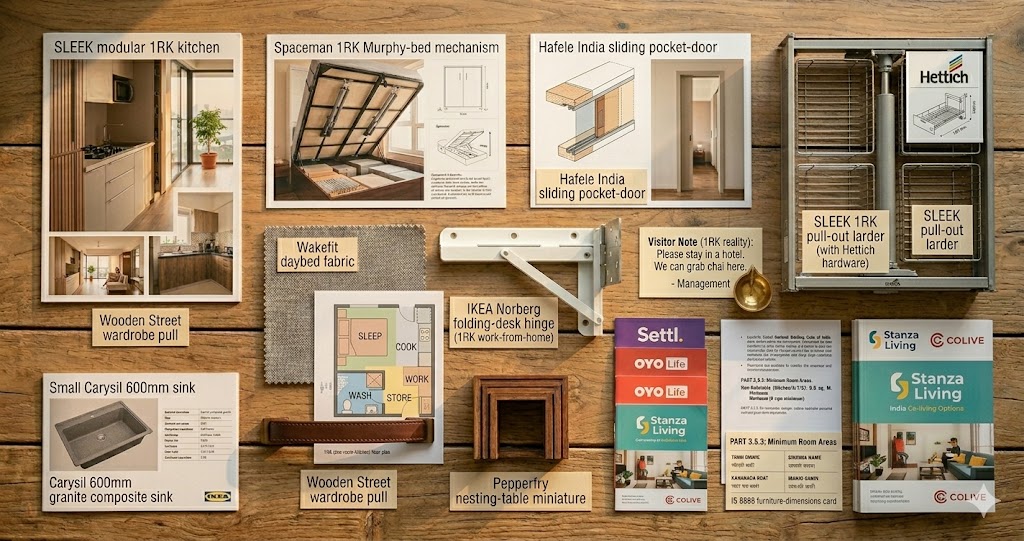
NBC 2016 and IS code compliance. The National Building Code 2016 sets minimum habitable room sizes (Part 3, Section 3.2): a habitable room must be at least 9.5 sqm (102 sqft) with a minimum width of 2.4 m (7.9 ft) and minimum ceiling height of 2.75 m (9 ft). Indian studios at 250+ sqft comfortably exceed this. The bathroom minimum is 2.2 sqm (24 sqft) with minimum width 1.0 m — a 4 x 7 ft studio bath at 28 sqft sits at the lower-mid end of acceptable. Kitchenettes are governed by Part 3 ventilation rules: any kitchen, whether 6 ft or 60 ft, requires a window or exhaust to outside air. This is why society objections to chimney ducting are usually overrulable on NBC grounds.
Society and RWA rules. Almost every Mumbai, Bangalore, and Pune society regulates modular interior work via a building NOC. The standard rules: work hours 9 am to 6 pm weekdays, no chiselling or core-cutting without committee approval, a ₹10K to ₹50K refundable deposit, and a written undertaking for waste removal. Older Mumbai societies (especially in Bandra, Khar, Juhu) sometimes restrict modular kitchen tear-outs of original tile dados — check before you sign the carpenter contract. New towers (Lodha, Oberoi, Hiranandani, Embassy, Brigade) have more permissive but more bureaucratic rules — expect a 2-week NOC turnaround.
DPDP Act 2023 and smart-device privacy. If your studio includes any smart cameras (a Mi Camera, an Aqara doorbell, an Alexa Show on the desk), you sit inside the Digital Personal Data Protection Act's data fiduciary obligations the moment any guest enters the unit. The practical implication: cover the camera lens when guests are over, disable the always-listening Alexa wake-word during calls with confidential information, and do not store cloud-camera footage for more than 30 days. See smart home design India for the broader DPDP context.
Vastu compatibility. Vastu Shastra is genuinely difficult to satisfy in a studio because the discipline assumes a multi-room dwelling — the bedroom in the south-west, the kitchen in the south-east, the pooja room in the north-east. In a single-volume studio you can only orient. The pragmatic compromises: the bed in the south or south-west corner with the head pointing east or south; the kitchenette ideally on the south-east or east wall (this works in most Mumbai and Bangalore studios); no mirror facing the bed; the bathroom not in the north-east (this is often a fixed constraint you cannot change). For deeper guidance, Vastu for bedroom and Vastu for kitchen carry the directional logic.
Climate-zone specifics. A Mumbai studio (warm-humid) needs serious dehumidification — a 5-star 1.0 ton split AC (Daikin, Voltas, LG dual-inverter) is the minimum, plus a small dehumidifier for the bathroom-adjacent wall. A Bengaluru studio (temperate) often runs comfortably without AC eight months a year — a 1.0 ton inverter for the April-to-June peak suffices. A Delhi NCR studio (composite) needs both AC and a small heater or reverse-cycle inverter; the Hitachi or Voltas hot-and-cold inverter at ₹52K to ₹68K is the right one-box solution. Pune sits between Bengaluru and Mumbai.
Regional vendor differences. Mumbai studios lean toward Sleek, Hafele, and Italian-mechanism brands. Bengaluru leans toward HomeLane, Livspace, and Wakefit — volume-buying, price-conscious. Delhi NCR over-indexes on Godrej Interio, Spacewood, and Asian Paints Beautiful Homes because developer-tie-in interior packages dominate. Pune sits closest to the Mumbai mix.
The Budget Bands for 2026 India
| Tier | Total budget (₹) | Per sqft (380 sqft) | What you get |
|---|---|---|---|
| Entry / functional | 1.8 to 2.5 lakh | ₹475 to ₹660 | Local-carpenter modular kitchenette (Century Ply + Greenlam), sofa-cum-bed (Urban Ladder Apollo), local wardrobe, retained bathroom, basic Wipro lighting, stitched curtains. Bare-bones move-in. |
| Mid / quality functional | 3.0 to 4.0 lakh | ₹790 to ₹1050 | Sleek or mid-tier modular kitchenette with Hafele fittings, Spaceman Murphy bed, full bathroom redo with Jaquar Continental + pocket door, fluted accent wall, motorised roller blind, Fabuliv lighting. The Bandra case study above. |
| Premium / designed | 5.5 to 8.5 lakh | ₹1450 to ₹2240 | Bonito or HomeLane premium kitchenette, Resource Furniture or imported Clei wall-bed system, full bathroom redo with Duravit or Hansgrohe, custom joinery throughout, Klove or imported lighting, full HomeKit / Alexa smart-home integration. |
| Super-premium / boutique | 12 to 25 lakh | ₹3150 to ₹6580 | Veneta or Poggenpohl compact kitchen, full Clei or Resource Furniture suite (wall-bed plus library wall plus dining table), Boffi or Antonio Lupi bathroom, motorised everything, designer-led project (₹1.5 lakh design fee), 18-month timeline. Rare in studios — most spend at this tier goes into 1BHK or larger. |
The mid tier (₹3 to 4 lakh on a 380 sqft Mumbai studio) is the dominant band in 2026, capturing roughly 55 to 60 percent of fit-outs based on Anarock dealer-channel data. The entry tier is the renter band — typically 11-month leases where the tenant funds basic move-in furniture and the landlord owns the kitchen and bathroom. The premium tier is the owner-occupier band, especially in Bandra, Indiranagar, and Gurgaon Sector 65.
When Studio Apartment Design Is NOT the Right Fit
The studio is the wrong unit, and studio-apartment design is the wrong design brief, in five specific situations.
You will marry or cohabit in the next 24 months. The studio is a solo unit. Two adults in 380 sqft strains the relationship — no door to close, no separate space for one to take a call while the other watches TV. If a partner could move in, design for a 1BHK now.
You work from home full-time AND your work requires extended concentration. A single-volume studio is acceptable for 4 to 6 hours of focused work daily with noise-cancelling headphones. For 9 to 12 hours of daily deep work — research, writing, software architecture, design — the lack of a door to close to the kitchen, the bed, and the laundry pile slowly degrades output. A 1BHK with a real workspace is the right call.
You have or want a child soon. A baby needs a separate sleep environment by month 4 to 6. A studio cannot provide that. The pre-pregnancy move to a 1BHK or 2BHK is the standard path.
You host more than once a month. The kitchenette won't support a real dinner for four; the single seating area becomes the dining area becomes the sleeping area in one evening. If you host weekly, a 1BHK or compact 2BHK is the right unit.
You have a pet larger than a cat or small dog (under 10 kg). A 380 sqft floor plate cannot absorb a Labrador or a Golden Retriever — the dog spends 20 hours a day on a 6 x 4 ft mat in a corner. Cats and small breeds (Pug, Shih Tzu, Indian Spitz) work; larger dogs do not.
In any of these cases, the right move is up — to a compact 1BHK at 480 to 580 sqft. The 35 to 55 percent rent or EMI premium buys back the door and the second zone. See compact urban home planning India.
The 5-Year Trajectory: 2030 Outlook
By 2030, three trends will reshape the Indian studio market.
Micro-studios go mainstream in Mumbai and Bengaluru. Already visible in Lower Parel and Whitefield, the sub-280 sqft micro-unit will become the dominant new-construction studio SKU as land prices push past ₹40K per sqft in Mumbai core. These units will rely heavily on transformable furniture (Resource Furniture, Clei, Spaceman) and price 25 to 35 percent below current 380 sqft rents. Expect Lodha, K Raheja, Brigade, and Prestige to lead.
Co-living rebounds as a hybrid model. The post-2024 co-living shakeout will reverse as brands relaunch with "private studio in a co-living building" — a 350 sqft private studio with a private kitchen and bath, in a building with shared lounge, gym, co-working, and rooftop. OYO Life and Settl are already piloting. Rent will sit at ₹32K to ₹42K all-inclusive in Mumbai.
Smart-home integration becomes table-stakes for premium studios. The 2030 premium studio will ship with native HomeKit or Matter support, voice control for blinds and lighting, an integrated HVAC panel, and a doorbell-camera tied to building access. The market is fragmented today (Aqara, Mi, Amazon, Apple, Google) — Matter-protocol convergence will let consumers mix brands without lock-in. Brigade, Embassy, and Oberoi are piloting this in 2026 tower launches.
A fourth, less certain trend: AI-driven floor-plan personalisation at developer handover. By 2030, expect some developers to offer a "configure your interior" flow at booking — Murphy-bed orientation, kitchenette length, bathroom door type — with cost rolled into the unit price. Tools like the Studio Matrx AI room planner point where this is heading.
Frequently Asked Questions
1. Is a studio apartment a good investment in India?
For rental yield, yes — studios consistently deliver 4.2 to 5.5 percent gross yield against 2.8 to 3.5 percent typical for 2BHK and 3BHK in the same building. For capital appreciation, the picture is mixed — studios in proven micro-markets (Bandra-Worli, Indiranagar, Gurgaon Sector 65) track building-level appreciation, but newer-market studios sometimes underperform 1BHKs because the resale pool is narrower. Net: good for income, mediocre for appreciation, location-dependent.
2. Can two people live in a 380 sqft studio?
For weeks, yes. For months, with effort and a strong relationship. For a year or more, almost always a mistake. The single-volume layout means you cannot have private time, cannot host a friend without the other person being present, and cannot work from home together without one person taking calls from the bed. If two adults are sharing for more than 6 months, a 1BHK at 35 to 55 percent more rent is the better choice.
3. What is the cheapest way to design a studio in India in 2026?
A ₹1.8 to ₹2.2 lakh entry-tier fit-out on a 380 sqft studio is the floor: local carpenter modular kitchenette (Century Ply + Greenlam), Urban Ladder sofa-cum-bed, a local wardrobe, retained bathroom, basic Wipro LED lighting, stitched curtains, an Asian Paints repaint. This delivers a functional, clean, move-in-ready unit. Below this, you are buying second-hand or accepting visible compromises in finish.
4. What is the most important single spend in a studio fit-out?
The bathroom pocket door. A Hafele or Hettich sliding pocket door (₹32K to ₹45K installed) with a soft-close and a perimeter acoustic seal is the single piece of hardware that makes a studio livable. A standard hinged bathroom door eats floor, leaks sound, and is the most-regretted decision in most studio post-occupancy reviews.
5. Should I buy a Murphy bed or a sofa-cum-bed?
If you sleep more than 6 hours a night and you want a real mattress, buy a Murphy wall-bed (Spaceman, ₹65K to ₹1.2 lakh) and use it as your primary bed. If you live in the studio only intermittently (project consultant, traveller, second-home use), a sofa-cum-bed (Urban Ladder, Wakefit, ₹22K to ₹85K) is the right call. The decisive question is "is this my primary sleep environment?"
6. Are co-living studios (Stanza, Zolo, Colive, Settl, OYO Life) a substitute for a private studio?
For occupants 22 to 28 transitioning out of hostel or PG, yes — co-living delivers 90 percent of the studio experience at 65 to 75 percent of the cost, with the trade being a shared kitchen and a noisy floor. For 28 to 35, with established careers and a desire for solitude, a private studio at ₹35K to ₹45K rent is almost always the better choice.
7. How do I handle visitors and overnight guests in a studio?
The honest answer: you don't. You book them into a nearby Treebo, OYO Townhouse, FabHotel, or Airbnb at ₹2200 to ₹4500 a night. Over a typical year of 2 to 4 visits, that's ₹15K to ₹40K — well below the cost of a daybed, a fold-out cot, or the floor space they would consume. The studio bargain is that you trade hosting capacity for cost and location. Embrace the trade.
8. What is the Vastu situation in a studio? Can I follow it at all?
Partially. You can orient the bed (head east or south, ideally south-west corner), the kitchenette (south-east wall if the existing plumbing allows it), and the desk (face east or north when working). You cannot relocate the bathroom (a fixed structural constraint), and you cannot create a dedicated pooja zone larger than a single shelf or a small wall niche. For a strict Vastu requirement, a studio is the wrong typology — consider a 1BHK or a Vastu-compliant 2BHK. See Vastu modern homes.
9. What ceiling height should I look for in a studio?
Minimum 9 ft (2.75 m) per NBC 2016. Ideal is 9.5 to 10 ft, which gives you 3 to 4 ft of overhead loft storage above wardrobes — critical in a studio. Anything below 8.5 ft (some 1980s and 1990s Mumbai buildings) makes the unit feel claustrophobic and eliminates the loft strategy.
10. How do I get good daylight and ventilation in a single-window studio?
The single window (typically 4 x 5 ft) is the only daylight source. Treat it as the most valuable real estate in the unit: place the desk under it, use a motorised roller blind not heavy drapery, and add a small mechanical exhaust in the bathroom and kitchenette for cross-ventilation when the window is closed. A ceiling fan plus a small Atomberg or Crompton wall fan handles air movement. See cross-ventilation analyzer.
References
1. National Building Code of India, 2016 (Bureau of Indian Standards). Part 3: Development Control Rules and General Building Requirements; Part 4: Fire and Life Safety; Part 8: Building Services. https://bis.gov.in/
2. Indian Standard IS 875 (Part 3): 2015 — Code of Practice for Design Loads (Other Than Earthquake) for Buildings and Structures, Wind Loads. Bureau of Indian Standards.
3. Indian Standard IS 4838 (Part 1 and 2) — Specification for Internal Doors, including pocket-door hardware standards.
4. Digital Personal Data Protection Act, 2023 (Government of India, Ministry of Electronics and Information Technology). https://www.meity.gov.in/
5. Anarock Property Consultants. "Indian Residential Real Estate Outlook 2026" — quarterly research note on micro-unit and studio inventory in top 6 metros. https://anarock.com/
6. Knight Frank India. "India Real Estate: Residential Markets H2 2025" report. https://content.knightfrank.com/
7. JLL India. "Residential Market Update: Mumbai, Bengaluru, Delhi NCR — Q1 2026." https://www.jll.co.in/
8. CBRE India. "India Living: Co-Living and Rental Housing Outlook 2026." https://www.cbre.co.in/
9. Magicbricks Research. "Rental Index Q4 2025 — Studio and 1BHK Yield Comparison Across Top 7 Cities." https://www.magicbricks.com/
10. 99acres Insite. "Studio Apartment Inventory Tracker: Mumbai, Bengaluru, Pune, Gurgaon — March 2026." https://www.99acres.com/
11. India Brand Equity Foundation (IBEF). "Real Estate Sector Report — March 2026." https://www.ibef.org/industry/real-estate-india
12. Houzz India. "Compact Living and Studio Apartment Trends 2026." https://www.houzz.in/
13. Resource Furniture (US) and Clei (Italy) product engineering documentation for transformable furniture mechanisms. https://resourcefurniture.com/ and https://www.clei.it/
14. Hafele India and Hettich India product catalogues for pocket-door systems, drawer slides, and modular hardware (2026 editions). https://www.hafeleindia.com/ and https://www.hettich.com/in_en/
15. ASHRAE Handbook — HVAC Applications (2023), Chapter 33: Residential Cooling and Heating Load Calculations — applicable to single-volume apartment design.
16. Bureau of Energy Efficiency (BEE). Star Rating Programme for Room Air Conditioners and Ceiling Fans. https://beestarlabel.com/
Related Guides
- Compact urban home planning India — the next-tier-up unit (450 to 650 sqft 1BHK) and when to graduate to it
- Compact luxury apartment — the premium-tier compact apartment brief
- Space-efficient homes — the small-space engineering vocabulary (Murphy beds, transformable furniture, loft storage)
- Smart storage interiors — vertical-first storage strategy for tight floor plates
- Rental apartment interiors — the no-drilling, deposit-safe variant for studio renters
- AI room planner — the Studio Matrx tool for testing a studio layout before you commit a rupee
Export this guide
Related Guides — Deep-dive reading
Space-Saving Furniture — The 12-Category Piece-by-Piece Indian Reference (2026)
Sofa-cum-beds · Murphy beds · Transformer dining · Modular wardrobes · IS 8888 · Indian brand+price tables
Design StylesSpace-Efficient Homes — A 2026 Working Reference for Compact Indian Apartments
Five spatial multipliers · Floor plan tricks · Dual-purpose furniture
Room PlanningPremium Apartment Interiors — The ₹15-40 Lakh Tier for Indian 3 BHKs (2026)
Above budget-luxury · Below super-luxury · Materials, brands, contractor-tier reality
Design StylesRelated Tools — Try Free
Acoustic Privacy (STC) Visualizer
Indian healthcare acoustic visualizer — compare wall assemblies and noise sources, see received SPL after STC attenuation, and check FGI 2018 / IS 1950 / NABH speech-privacy compliance with live dual-canvas waveform.
Acoustic ToolCross-Ventilation Analyzer
Estimate airflow and air changes per hour (ACH) from room size, window areas, layout, and local wind — with NBC 2016 Part 8 compliance check.
Ventilation CalculatorCircadian Light Meter
Patient-centric circadian lighting visualizer for Indian healthcare design — time-of-day × intensity → CCT, melanopic lux (EML / mEDI), melatonin suppression, and an alertness curve. Calibrated against WELL v2 L03 Circadian Lighting Design, CIE S 026:2018, Brainard 2001, and Lucas et al. 2014.
Circadian Tool