

Seasonal Storage Solutions
Razais in June, the cooler in December, Diwali décor for eleven months a year — a practical plan for storing everything your Indian home uses for only one season, and keeping it safe from the monsoon.
Walk into almost any Indian flat in June and open the box-bed: there sit the razais, flattened and slightly musty, waiting out the summer. By December the cooler has migrated from the balcony to the store room, the fan from the bedroom to the loft. Twice a year a quiet migration happens in every home — bulky, expensive things that are useless for six months and essential for the other six. Nobody planned for it; it just accreted.
The symptoms are familiar. A 2BHK where the second bedroom slowly became the dumping room. Festival décor — fairy lights, torans, the brass diyas, the Ganpati decorations — crammed into a torn carton on top of the wardrobe, half of it tangled and broken by the next Diwali. A guest dinner set that comes out twice a year emerging chipped because it shared a shelf with the pressure cooker. And the universal Indian heartbreak: a beautiful pashmina or a hand-stitched razai pulled out in winter speckled with mould or chewed by silverfish, because it was packed away damp into a sealed plastic bag.
The thing is, seasonal goods are the easiest storage to plan for, precisely because you touch them so rarely. They are the ideal candidates for the hard-to-reach, out-of-the-way places that would frustrate you for daily items.
Seasonal storage isn't about finding more space — it's about deciding, deliberately, where the things you use once a year will live, and protecting them so they survive the wait.
1. First, take a seasonal inventory
Before you decide where, list what. Indian homes accumulate a remarkably predictable set of seasonal goods, and once you name them you can size the storage they need. Pull everything out for one weekend and sort it into these buckets:
- Winter bedding & woollens — razais (quilts), blankets, woollen shawls, sweaters, thermals, monkey-caps, woollen socks. The single bulkiest category. A family of four easily owns 6–8 razais.
- Cooling appliances (off-season) — desert cooler, table and pedestal fans, the AC's winter dormancy, room heaters and blowers in summer. Heavy, awkward, and damaged by dust.
- Festival goods — diyas, fairy lights and serial lights, torans, rangoli stencils and colours, idols and their decorations, the special pooja thali, gift-wrapping. Fragile and emotionally precious.
- Guest & function crockery — the dinner set kept for visitors, the steel thalis for functions, the casserole sets, the good glasses. Heavy, breakable, used twice a year.
- Luggage & travel gear — suitcases (which themselves become storage), trolley bags, trekking gear, the holiday cooler-box.
- School-holiday & hobby items — sports kit, cycles, board games, the inflatable pool, project materials.
- Monsoon gear — umbrellas, raincoats, gumboots, door mats, the bucket-and-mop army that multiplies in July.
Write quantities next to each. A capacity tool such as the storage calculator turns that list into shelf-metres so you stop guessing whether the loft will actually hold it all.
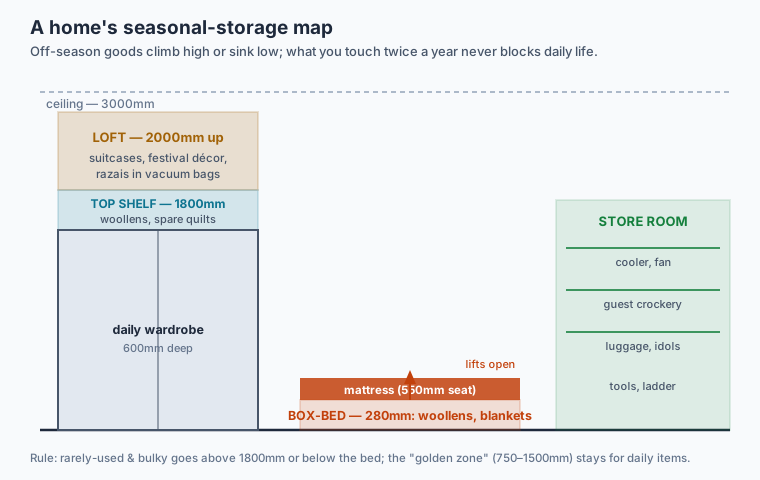
Figure 1: A home's seasonal-storage map. The principle is the inverse of daily storage — rarely-used and bulky goods deliberately go high (loft, 2000mm up), low (box-bed), or out of the way (store room), freeing the comfortable 750–1500mm "golden zone" for things you reach for every day.
2. Where each thing should live
Match the access frequency of an item to the effort of its location. Festival décor needed once a year belongs at the very top of the loft; the cooler, which you'll fetch the moment summer arrives, wants to be reachable without a ladder. Below is the rule-of-thumb map most Indian homes can use.
| Seasonal item | Off-season store location | Why it works |
|---|---|---|
| Razais, blankets, woollens | Box-bed (280mm clear) or vacuum bags on top shelf | Bulky, soft, compress well; box-bed swallows volume |
| Sweaters, shawls (delicate) | Breathable box on top-of-wardrobe shelf | Need air, not crushing; off the floor |
| Desert cooler | Store room / utility, under a dust cover | Heavy, awkward; needs floor space, returns annually |
| Pedestal & table fans | Loft or store-room shelf, bagged | Light enough to lift up; dust is the enemy |
| Room heaters | Top-of-wardrobe shelf | Compact, used only Dec–Feb |
| Festival décor & lights | Loft, in labelled transparent crates | Once-a-year access; fragile, so rigid box not soft bag |
| Idols & pooja items | Dedicated padded box, store-room shelf | Fragile and revered; never with general clutter |
| Guest dinner set & crockery | Closed lower cabinet or store-room shelf | Heavy — keep low; protect from chipping |
| Suitcases & luggage | Loft (nest small inside large) | Bulky but light; double as storage for off-season clothes |
| Monsoon gear | Entry/foyer cupboard or hooks | Needed at the door, in season for months |
Notice the logic: weight goes low, lightness goes high, fragility gets a rigid box, and anything you'll grab the instant the season turns stays within arm's reach. For the wardrobe-top and loft sizing, the wardrobe storage capacity calculator helps you confirm a 1800mm-high shelf will take your razai count before you commit the carpentry.
"A building or town will only be alive to the extent that it is governed by the timeless way." Christopher Alexander's argument in A Pattern Language extends neatly to storage: rooms work when their parts answer real, recurring patterns of life — and the seasonal swap is one of the most reliable patterns an Indian household has.
3. The four storage homes — loft, top-of-wardrobe, box-bed, store room
Four places do almost all the heavy lifting for seasonal goods. Knowing the strengths and the dimensions of each lets you assign items without trial and error.
The loft (attic shelf). Built above wardrobes or over doorways, the loft sits roughly 1800–2000mm off the floor with 450–600mm of depth. It is the natural home for things touched once a year — festival crates, nested suitcases, spare razais in vacuum bags. Keep the things you'll need first near the front, and always store light up high: lifting a heavy box overhead is how backs and crockery both get broken.
Top-of-wardrobe shelf. The 300–400mm zone above the hanging rail, around 1800mm up, suits medium-weight, medium-frequency goods — folded woollens, blankets you'll want by November, the room heater. Reachable on a low stool.
The box-bed. A hydraulic-lift bed gives roughly 280mm of clear internal depth across the whole mattress footprint — easily 0.7–1.0 cubic metres. It is the best volume-to-effort store in the house for soft bulk: razais, blankets, spare pillows. Line it, keep it dry, and never store anything you need weekly there.
The dedicated store room. A blessing builder flats rarely give you, but joint families and independent houses often have one. The discipline that makes it work is the same as any utility space — shelving to the ceiling, clear floor, labelled zones. For laying it out properly, the principles in designing utility rooms apply directly, and the broader habit of home organisation through design keeps it from silting up again.
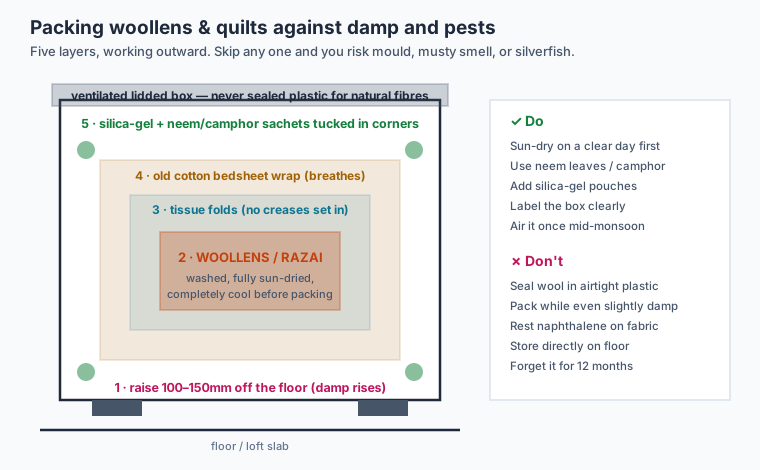
Figure 2: How to pack woollens and quilts so they survive the off-season. Work outward from the fibre: clean and fully dry the textile, fold in tissue, wrap in breathable cotton, add neem or camphor and silica gel, and raise the whole box 100–150mm off the floor. The one rule people break — sealing natural fibres in airtight plastic — is the one that grows mould.
4. The monsoon problem — damp, mould, silverfish and pests
This is where Indian seasonal storage is genuinely different from anywhere temperate. From June to September, relative humidity in much of the country sits at 70–90%. Anything organic — wool, silk, cotton, cardboard, leather, paper-wrapped idols — is under attack from three directions at once: mould (which needs only moisture and stillness), silverfish (which eat starch and cellulose), and the musty smell that means spores are already growing.
The defence is layered, and most of it is cheap:
| Threat | What it ruins | Defence |
|---|---|---|
| Rising damp | Boxes on the floor; lower shelves | Raise everything 100–150mm; use plastic crates not cardboard |
| Trapped moisture | Sealed plastic bags of wool | Pack only fully dry; use breathable cotton, add silica gel |
| Mould / musty smell | Razais, leather, books | Air boxes once mid-monsoon; a few naphthalene balls or camphor |
| Silverfish | Cotton, paper, starched fabric | Neem leaves, clove, lavender; no food residue nearby |
| Moths | Woollens, shawls | Naphthalene/camphor not touching fabric; vacuum bags |
| Rust | Tools, cooler body, fan blades | Wipe with light oil; silica in the box; dust cover |
Conservation and textile-care guidance is consistent on the fundamentals: store clean, store dry, allow air movement, and keep pest deterrents near but never against natural fibres. Naphthalene resting on wool can stain and weaken it; a sachet in the corner protects without contact.
A practical monsoon-damp protection checklist to run before the rains:
- Everything organic is clean and bone-dry — sun-dry on a clear day, let it cool fully, then pack.
- No cardboard on the floor or in damp-prone lofts; switch to lidded plastic crates.
- Silica-gel pouches in every box of textiles, books or electronics (recharge them in the sun mid-season).
- Neem leaves, camphor or clove sachets in fabric boxes; naphthalene only where it won't touch cloth.
- Boxes raised off the slab on a batten or pallet.
- One mid-monsoon airing — open the box, check, re-pack on a dry day.
- Electronics and appliances wiped, dried, covered, and ideally with a silica pouch inside.
5. How to pack: moisture control, pests, labelling and compression
Good packing is half the battle. The order of operations matters more than the spend.
Clean before you store. A food crumb, a sweat-soaked collar, a speck of last year's rangoli — each is a meal for a pest or a seed for mould. Wash or dry-clean woollens, wipe down appliances, empty and dry the cooler tank completely.
Compress what compresses — gently. Vacuum compression bags shrink razais and blankets to a third of their volume, which is transformative on a loft. But there is a caveat: do not vacuum-pack delicate natural fibres like pure wool, silk, feather or down for the whole season. Long-term flattening crushes the loft (the trapped air) that makes them warm, and zero airflow can encourage mildew if a trace of moisture is present. Vacuum bags are ideal for cotton-filled razais, synthetic blankets and pillows; for pashmina and pure wool, use a breathable box instead.
Deter pests without contact. Camphor, naphthalene balls, neem leaves and clove all work; the rule is proximity, not contact. Tuck them in corners and folds of the box, never directly on the fibre.
Label everything — visibly. Future-you, on a stool reaching into the loft next November, should be able to read "WINTER — razais ×4" without opening three boxes. Transparent crates beat opaque ones for exactly this reason. A simple front-facing label with contents and the date packed turns a guessing game into a thirty-second job.
Build in rotation. Decide which box comes out first and store it at the front. This single habit — sequencing by season — is what separates a working store from an archaeological dig.
6. The twice-a-year rotation ritual
Seasonal storage isn't a one-time set-up; it's a rhythm. The homes that stay organised treat the swap as a fixed appointment, not a someday-job. Tie it to dates you'll never forget — the weekend after Holi for the summer swap, the weekend after Diwali for the winter one.
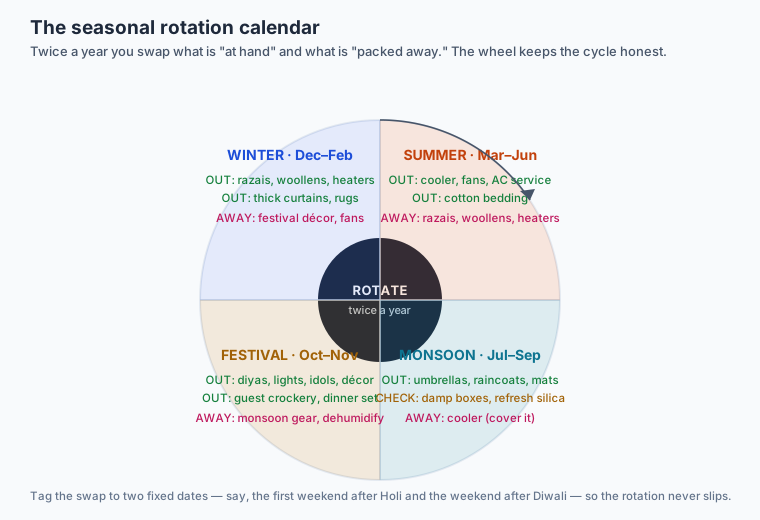
Figure 3: The seasonal rotation wheel. Each quarter, something comes out and something goes away — the cooler arrives as the razais retreat, festival décor surfaces as monsoon gear is dried and stored. Anchoring the two big swaps to fixed dates keeps the cycle from slipping.
Use each swap as a natural editing moment. As Julie Morgenstern argues in Organizing from the Inside Out, the act of putting something away is the right time to ask whether it earns its place at all. The razai nobody used, the cooler that died, the dinner set you've outgrown — the rotation is when you let them go, so storage doesn't simply grow forever. Marie Kondo's test in The Life-Changing Magic of Tidying Up — does it spark joy, or merely habit — is a quick filter for the festival box that's three-quarters broken lights.
If your seasonal goods are overflowing every store you have, the problem may be upstream: storage that was never planned into the home in the first place. That is exactly the gap addressed in storage planning before interior design, the cluster's pillar — and where lofts, box-beds and other concealed volume can be designed in rather than improvised, see hidden storage solutions. For sizing any new built-in before the carpenter cuts a single board, the storage calculator keeps you honest about how much these seasonal mountains really need.
7. A simple seasonal storage budget
You don't need bespoke joinery to solve this. Most of the win comes from cheap, repeatable kit deployed consistently.
| Item | Typical cost (₹) | What it solves |
|---|---|---|
| Vacuum compression bags (set) | 600–1,500 | Razais/blankets shrink to a third on the loft |
| Stackable transparent crates (each) | 300–700 | Rigid, visible, rodent-resistant festival/crockery storage |
| Silica-gel pouches (bulk) | 200–500 | Moisture control in every box |
| Breathable garment/storage bags | 150–400 each | Woollens that mustn't be vacuum-sealed |
| Dust covers (cooler/fan) | 200–600 | Appliances emerge clean, not grimy |
| Loft shelf (carpentry, per running ft) | 1,200–2,500 | Permanent high storage where there was none |
| Box-bed upgrade (over plain bed) | 8,000–18,000 | The single best volume-to-effort store |
The striking thing is how little the protective layer costs relative to what it saves — a ₹500 set of silica and breathable bags routinely rescues woollens worth many thousands. The expensive end is built-in volume, and even that pays back across a decade of use.
Sources & further reading
- National Building Code of India 2016 (Bureau of Indian Standards) — Part 4 and habitable-space guidance informing room and storage heights.
- Christopher Alexander, Sara Ishikawa & Murray Silverstein, A Pattern Language (Oxford University Press, 1977) — patterns for storage and the rhythms of domestic life.
- Julie Morgenstern, Organizing from the Inside Out (Owl Books, 2004) — sorting, zoning and the discipline of putting things away.
- Marie Kondo, The Life-Changing Magic of Tidying Up (Ten Speed Press, 2014) — editing belongings during the seasonal swap.
- India Meteorological Department — seasonal and monsoon humidity ranges relevant to textile storage.
- The Textile Institute & general conservation guidance — clean-dry-ventilated principles for storing natural fibres and using pest deterrents safely.
Seasonal goods are only one slice of the storage picture. If your woollens and festival crates are crowding lofts that were never meant to hold them, start with the cluster pillar storage planning before interior design, borrow the concealed-volume tricks in hidden storage solutions, and — if a store room or utility is where most of this ends up — plan it properly with designing utility rooms. Keeping it all from silting up again is the ongoing work of home organisation through design.
Export this guide
Related Guides — Deep-dive reading
Storage Planning Before Interior Design
Why storage must be planned first — audited, budgeted and given its floor area — before a single layout, colour or sofa is chosen. The homeowner's plan-it-first master guide for Indian homes.
StorageZones of Retreat: Designing Spaces for Rest and Privacy
Why every Indian home needs protected nooks for solitude, focus and recovery — and how prospect-refuge theory helps you carve them from shared, crowded flats.
Design PrinciplesSmart Storage Interiors — A 2026 Working Reference for Indian Homes
Inventory-driven · Floor-to-ceiling · Hardware-engineered · Zone-mapped
Room PlanningRelated Tools — Try Free
Cross-Ventilation Analyzer
Estimate airflow and air changes per hour (ACH) from room size, window areas, layout, and local wind — with NBC 2016 Part 8 compliance check.
Ventilation CalculatorWardrobe Storage Capacity Calculator
India-specific garment math — sarees, lehengas, kurtas, shirts, shoes. Pick a layout (2-door → walk-in), see live fill and saturation gauges.
Capacity CalculatorApartment Interior Planning Checklist
51-item checklist across structural, ceiling, lighting, furniture, storage, electrical, kitchen, bathroom.
Checklist