
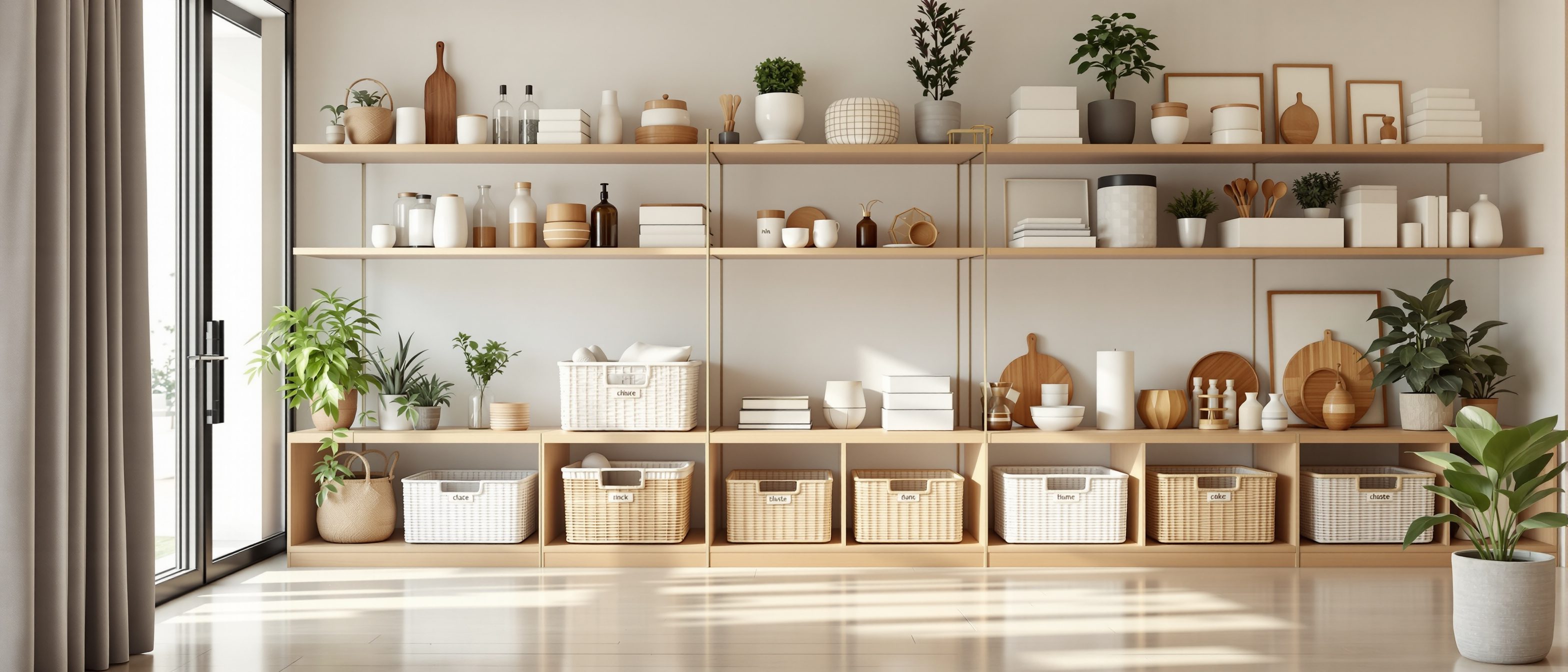
Home Organization Through Design
Why a tidy home is built, not willed. The Indian guide to making order the path of least resistance — through point-of-use storage, drop-zones and design that maintains itself.
A 2BHK in Thane that was perfectly tidy on possession day is, eighteen months and one baby later, an obstacle course. The dining table is the family inbox: school diaries, an Amazon return, two phone chargers, a half-eaten packet of biscuits. Footwear breeds at the door. The single storeroom that the builder generously labelled 'utility' is now a place where things go to be forgotten. Nobody in this house is lazy. The mother runs a clinic; the father is up at 6 for a 90-minute commute. They are tidy people living in an untidy home — and they blame themselves for it.
They shouldn't. Walk into ten 'messy' Indian flats and you will find the same nine or ten clutter hotspots in almost the same places, because they are caused by the same design gaps. The keys land on the dining table because there is no hook by the door. The festival decorations live in a gunny bag on top of the wardrobe because nobody designed a home for things used once a year. The mess is repeatable, and anything repeatable is a system — which means it can be redesigned.
A home stays organized not because the people in it are disciplined, but because its design makes putting things away easier than leaving them out. Order should be the path of least resistance, not an act of daily willpower.
1. Why most homes get messy: design failures, not character failures
Clutter is what happens when an object has no home, or its home is harder to reach than the nearest flat surface. Behavioural designers call this friction: every extra second, step or decision between you and 'putting it away' makes the floor, the chair or the dining table win instead. A wardrobe shelf you can only reach on a stool will collect nothing; the chair beside the bed will collect everything.
Indian homes carry extra friction by default. Builder flats arrive with almost no built-in storage — perhaps one wardrobe niche and a loft — so families improvise with freestanding almirahs and cartons. We accumulate fast: wedding gifts, inherited steel, festival goods, a decade of children's outgrown clothes kept 'for the next baby' or the cousin's child. Joint families share storerooms across three generations with no agreed system. And we have, culturally, almost no decluttering habit — throwing things away can feel wasteful or even inauspicious, so stuff only ever flows in.
The fix is not a motivational reset. It is to read each chronic mess as a design brief: name the hotspot, find the design cause, prescribe the design fix.
| Clutter hotspot | Design cause | Design fix |
|---|---|---|
| Keys, wallet, masks on the dining table | No catch-point at the entrance | Drop-zone: hooks + a 200mm tray at the door |
| Pile of footwear at the threshold | No shoe storage where shoes come off | Vented shoe rack/bench, 300mm deep, at entry |
| Post, bills, school circulars everywhere | No single inbox for paper | One labelled tray or wall-slot in the drop-zone |
| Clothes draped on a chair ('the chairdrobe') | No home for once-worn-not-yet-dirty clothes | Valet hooks or an open rail inside the wardrobe |
| Kitchen counter buried in jars & gadgets | Daily items stored away from the hob | Point-of-use: masala & oil within arm's reach |
| Toys colonising the living room floor | Toy home is a closed box across the house | Low open bins the child can reach in the play zone |
| Festival décor in bags on the wardrobe top | No home for once-a-year goods | Labelled loft boxes or a dedicated seasonal shelf |
| Cartons of 'might need' under the bed, unsorted | Storage exists but isn't categorised | Under-bed boxes by category, labelled |
| Charging cables snaking across the sofa | No home for daily electronics | A single charging drawer with a power strip |
Notice that not one of these fixes is 'try harder'. Each is a small piece of built or bought design that removes friction.
'You cannot organise clutter. You can only get rid of it.' Julie Morgenstern, Organizing from the Inside Out, makes the case that organisation is a skill of systems, not a personality trait — which is precisely why design can supply it.
2. Store it where you use it: the point-of-use principle
The single most powerful organising rule is also the simplest: things should live where you use them, not where there happens to be space. A torch belongs near the front door and the meter, not in a bedroom drawer. The pressure cooker belongs beside the hob, not in the loft. Spare bedsheets belong in or under the bed they dress.
This sounds obvious, yet the default Indian instinct — to consolidate everything into one storeroom or one tall almirah — does the opposite. Centralised storage minimises the number of cupboards but maximises the walk to every object, and a long walk is friction. Distributed, point-of-use storage means more small homes for things, each a few steps from where the action happens.
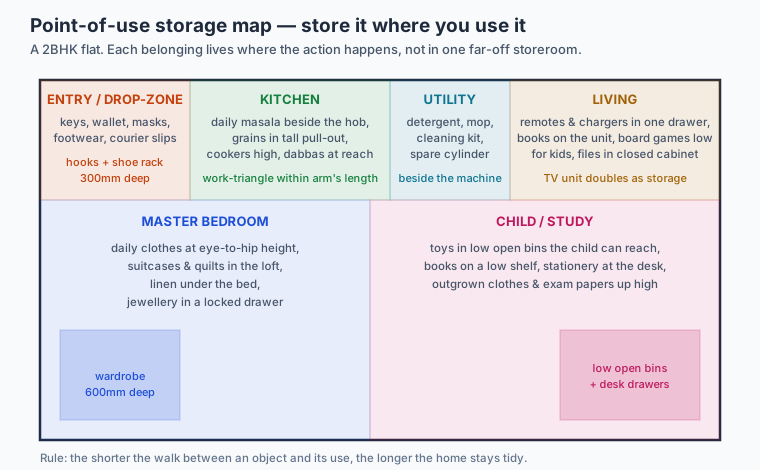
Figure 1: A point-of-use storage map for a 2BHK. The shorter the distance between an object and its use, the longer the home stays tidy.
Layered onto location is zoning by frequency. Within any cupboard or room, the prime real estate — roughly 600–1700mm off the floor, the band you can reach without bending or stretching — should hold what you touch daily. Weekly items go just above or below. Seasonal and rarely-used goods go to the extremes: lofts above 1800mm, the back of deep shelves, under-bed boxes. A wardrobe that puts everyday shirts in the loft and the once-a-year sherwani at eye level is fighting you every morning.
| Frequency of use | Where it should live | Indian examples |
|---|---|---|
| Daily | Eye-to-hip height, front, point of use | Worn clothes, daily masala, phone chargers, school bag |
| Weekly | Just above/below prime band, easy reach | Iron, party-wear, cleaning kit, extra grains |
| Monthly / seasonal | High loft or low drawers | Winter quilts, monsoon gear, festival utensils |
| Yearly / archival | Deepest, highest, least accessible | Diwali décor, exam papers, baby clothes kept for later |
If you are not sure how much your wardrobes and shelves can actually hold for each band, the storage capacity calculator and the dedicated wardrobe capacity tool will turn 'it feels full' into running-metres of hanging and shelving — the number that tells you whether your design has the headroom this method needs.
3. The one-touch principle: make putting away a single move
Every time you handle an object on its way home, you create a chance for it to be set down somewhere else. The wet umbrella that has to be carried through the living room, shaken on the balcony and then placed in a cupboard will, on a busy evening, simply be propped against the wall. The one-touch principle says: design so that putting a thing away takes one motion, from where you naturally are, with the door or lid already open or absent.
This is why open and semi-open storage beats fully closed storage for high-frequency items. A hook is one-touch; a hanger behind a cupboard door is three. An open shoe rack is one-touch; a closed shoe cabinet whose flap you must lift is two and, on a tired evening, two too many. The design move is to match the number of touches to the frequency of use: daily things get zero- or one-touch homes (hooks, open bins, pull-out trays); rarely-used things can afford the extra touches of a lid, a loft or a sealed box, because the friction only bites a few times a year.
| Item | One-touch home (daily) | Avoid for daily use |
|---|---|---|
| House keys | Open hook or wall tray at the door | A drawer across the room |
| Worn-once shirt/kurta | Valet hook or open rail in wardrobe | Folding back onto a high shelf |
| Children's toys | Low open bin, no lid | A toy box across the flat |
| Daily masala & oil | Pull-out shelf or counter caddy by the hob | A high closed cabinet |
| TV remotes & chargers | A single shallow open drawer in the unit | Scattered on sofa & table |
| Dirty laundry | Open basket in the bathroom/bedroom | A bin behind a door |
4. Drop-zones: stopping clutter at the source
Most household clutter is created in the first ninety seconds after someone walks through the door, carrying keys, a bag, footwear, post, a phone, sometimes groceries. If the home offers no place to set these down, they migrate to the nearest horizontal surface — and that surface becomes the permanent inbox of the house. A drop-zone is a deliberately designed catch-point at the threshold that intercepts this daily tide.
In an Indian flat the drop-zone does double duty, because the entrance is also where we manage the boundary between outside and inside: footwear comes off, and increasingly, a place to wash hands or set down deliveries matters. A complete drop-zone has a row of hooks at about 1500mm for bags and masks, a shallow tray for keys and wallets, a slot or tray for incoming post and courier slips, a bench at seat height (around 450mm) to sit and remove shoes, and a vented shoe rack below it. None of it is large — a 900–1200mm stretch of wall does it — but it converts a chaos point into a system.
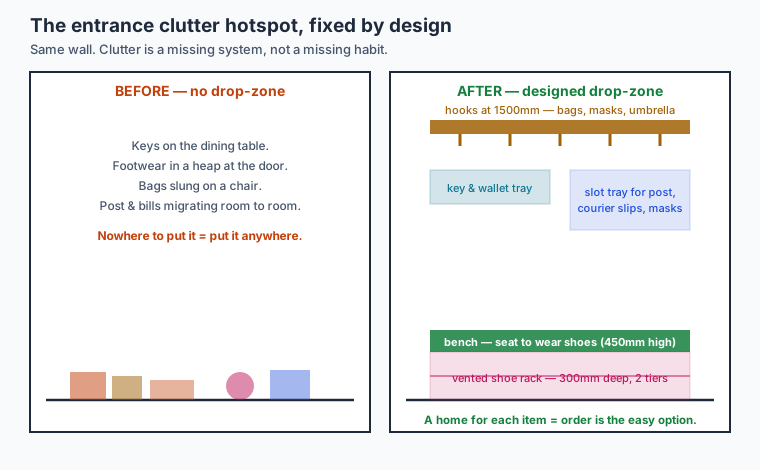
Figure 2: The entrance clutter hotspot, fixed by design. When every arriving item has a one-touch home at the door, order stops being a decision.
Drop-zones are not only for the front door. A small one in the kitchen — a basket for the day's vegetables and a hook for the apron — keeps the counter clear. One in the bedroom — the valet hook and a tray for watch, ring and spectacles — kills the chairdrobe. For the full arrival-design treatment, including lighting, mirrors and threshold detailing, see the entry and foyer design guide; this section is only about the storage that intercepts clutter.
5. Decluttering is the foundation — do it before you design
Here is the order most people get wrong. Faced with mess, the instinct is to buy containers — a new set of dabbas, more under-bed boxes, another almirah. But containerising clutter you should have removed merely organises the clutter; you end up storing, dusting and paying for things you do not use. Decluttering must come first, because every storage decision downstream — how many running-metres of wardrobe, how deep the kitchen pulls-outs, whether you even need that extra cupboard — depends on how much you actually keep.
Two schools of thought are worth knowing, honestly. Marie Kondo's The Life-Changing Magic of Tidying Up asks you to handle each item and keep only what 'sparks joy', working by category (all clothes together, then all books, and so on) rather than room by room — a useful jolt for sentimental over-keepers. Julie Morgenstern's Organizing from the Inside Out is more pragmatic and, for many Indian homes, more workable: she treats organising as analysing what you have, deciding what stays, then assigning everything a logical home — a method that maps cleanly onto storage design. Neither is gospel. The honest takeaway is shared: decide what stays before you decide where it goes.
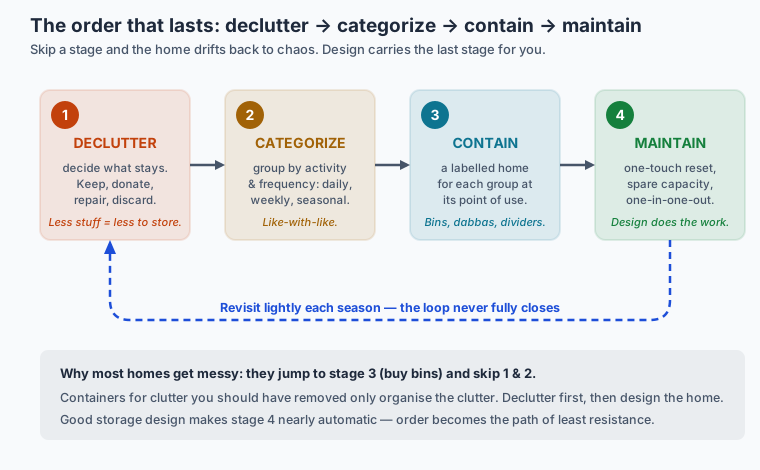
Figure 3: The declutter → categorize → contain → maintain cycle. Skip the first two stages and no amount of containers will save you.
| Stage | What you do | The trap to avoid |
|---|---|---|
| 1. Declutter | Sort everything into keep / donate / repair / discard | Keeping 'just in case' items that never get used |
| 2. Categorize | Group what stays by activity and frequency | Mixing daily and yearly items in the same place |
| 3. Contain | Give each group a labelled home at its point of use | Buying bins before stages 1–2 are done |
| 4. Maintain | One-touch resets, one-in-one-out, seasonal review | Treating order as a one-time event, not a loop |
A blunt Indian reality check: the 'might need it later' carton is where decluttering goes to die. If you have not used something in two years and it is not genuinely seasonal, sentimental or a safety/legal document, it is taking up storage you are paying for in rent or EMI. Donate it, gift it within the family, or sell it — and design for the home you actually live in, not the warehouse you have accidentally become.
6. Categorize, label and containerize — but only after decluttering
Once you have decided what stays, grouping like with like is what makes a system legible to everyone in the house, not just the person who built it. In a joint family this is the difference between order and daily friction: if the grandmother, the help and the teenager all know that batteries live in the labelled box in the second drawer, the system survives. If only one person knows, it collapses the moment they are travelling.
Containerisation is the tool, with a few India-specific notes. Use clear or labelled containers so contents are visible without opening — opacity is friction. Size containers to the shelf, not the other way round; a shelf full of mismatched cartons wastes the corners. For anything stored in lofts, balconies or against external walls, choose lidded, moisture-resistant boxes and tuck in silica or neem to fight the monsoon and silverfish — damp is the quiet destroyer of stored Indian linen and paper. And label generously: a label is a design instruction that tells future-you and the rest of the household where a thing belongs.
Christopher Alexander, in A Pattern Language, observes that things people use need a place that is theirs, visible and close to where the activity happens — storage that is hidden, distant or undifferentiated quietly stops being used. Labels and like-with-like grouping are how you make storage visible again.
Good categorisation is also family-shaped: who owns what, who reaches what, whose things share a cupboard. That allocation deserves its own thinking, especially in joint households — the family-based storage planning guide works through dividing storage by person and generation, which is the layer that sits directly beneath this one.
7. Designing for maintenance: the order that keeps itself
Setting up an organised home is the easy part; staying organised is where most systems quietly fail. The secret is that maintenance should be designed in, not relied upon as a virtue. Three design moves carry most of the load.
First, build in spare capacity. A storage system filled to 100% on day one has nowhere to put the next purchase, gift or grown-out garment, so the overflow lands on surfaces. Design wardrobes, kitchens and shelving to sit at roughly 80% full when you move in; that 20% headroom is what absorbs the natural inflow of a living household. Second, adopt one-in-one-out as a design-supported habit: a fixed-size container (a single shoe rack, one toy bin, one box of cables) creates a natural ceiling — when it is full, something leaves before something new arrives. Third, make the reset cheap: a five-minute evening tidy only works if every stray object has a one-touch home to return to. If putting away is hard, the reset will not happen.
| Maintenance design move | What it looks like in the home | Why it works |
|---|---|---|
| Spare capacity (80% rule) | Wardrobe shelf with one empty slot per family member | Absorbs new purchases without overflow |
| One-in-one-out | Fixed-size shoe rack, toy bin, cable box | Hard ceiling forces ongoing decluttering |
| One-touch reset | Hooks, open bins, pull-out trays for daily items | Putting away takes one move, so it happens |
| Seasonal review | Twice-a-year loft & storeroom check at festival cleaning | Catches drift before it becomes a backlog |
| Visible, labelled homes | Clear boxes, labels, like-with-like grouping | Whole household can maintain, not just one person |
This is also where decluttering stops being a once-a-year heroic purge and becomes a gentle, designed loop — the dashed return arrow in Figure 3. You declutter lightly each season because the system makes it visible when a category has outgrown its home, not because you have summoned fresh willpower.
8. Putting it together: a room-by-room organising brief
Translate the principles into a brief you can hand a carpenter or a modular vendor. The numbers below are practical Indian working dimensions; verify against your own room measurements before committing.
| Zone | Daily-reach home (600–1700mm) | High / loft (above 1800mm) | Low / under | Key one-touch piece |
|---|---|---|---|---|
| Entry | Hooks at 1500mm, key tray | — | Vented shoe rack, 300mm deep | Hook + tray drop-zone |
| Kitchen | Masala & oil by hob, daily dabbas | Cookers, party crockery | Grain pull-outs, heavy vessels | Counter caddy / pull-out |
| Master bedroom | Daily clothes in wardrobe, 600mm deep | Suitcases, quilts, festival wear | Under-bed linen boxes, 280mm clear | Valet hook |
| Child / study | Books low, stationery at desk | Outgrown clothes, papers | Low open toy bins | Reachable open bin |
| Living | Remotes & chargers in one drawer | — | Board games, files in closed cabinet | Charging drawer |
| Utility | Detergent, daily cleaning kit | Spare/bulk supplies | Mop, bucket, spare cylinder | Tall pull-out / pegboard |
If your flat is tight on built-ins, the storage solutions for compact apartments guide and our hidden-storage solutions guide cover how to win running-metres from beds, staircases, headboards and dead corners — the raw capacity this organising method then puts to work. And before any of it, the discipline of planning storage before the interiors are designed is what guarantees the homes-for-things exist at all, rather than being squeezed in as an afterthought.
Sources & further reading
- Julie Morgenstern, Organizing from the Inside Out (Henry Holt & Co.) — the analyse / decide / assign-a-home method underpinning sections 5–6.
- Marie Kondo, The Life-Changing Magic of Tidying Up (Ten Speed Press) — category-based decluttering and the keep-what-you-value test.
- Christopher Alexander et al., A Pattern Language (Oxford University Press) — patterns on activity-adjacent, visible storage.
- Bureau of Indian Standards / National Building Code of India 2016 — habitable-space and clearance references for fitting storage without crowding circulation.
- Julius Panero & Martin Zelnik, Human Dimension & Interior Space — anthropometric reach bands (the 600–1700mm prime zone) used throughout.
- Studio Matrx storage capacity calculator and room measurement tool — to size the homes-for-things this guide assumes.
If this guide helped, read its companions: the cluster pillar on storage planning before interior design for the discipline that makes organising possible, family-based storage planning for dividing storage across a joint household, hidden-storage solutions for finding the capacity, and why wardrobes become inefficient for the most common point-of-use failure in any Indian home.
Export this guide
Related Guides — Deep-dive reading
Mudrooms for Indian Homes
The threshold where the outside is left behind — designing a real shoes, dust and wet-weather drop-zone, from a slim niche in a flat to a proper mudroom in a house.
StorageStorage Design for Small Apartments
How to build real storage into a 1RK, 1BHK or 2BHK builder flat from the layout stage — not by buying more boxes, but by designing for height, dead space and double-duty furniture.
StorageStorage Planning Before Interior Design
Why storage must be planned first — audited, budgeted and given its floor area — before a single layout, colour or sofa is chosen. The homeowner's plan-it-first master guide for Indian homes.
StorageRelated Tools — Try Free
Wardrobe Storage Capacity Calculator
India-specific garment math — sarees, lehengas, kurtas, shirts, shoes. Pick a layout (2-door → walk-in), see live fill and saturation gauges.
Capacity CalculatorApartment Furniture Size Chart
Standard furniture dimensions for Indian apartments — sofas, beds, tables, dining, storage.
Reference ChartApartment Interior Planning Checklist
51-item checklist across structural, ceiling, lighting, furniture, storage, electrical, kitchen, bathroom.
Checklist