
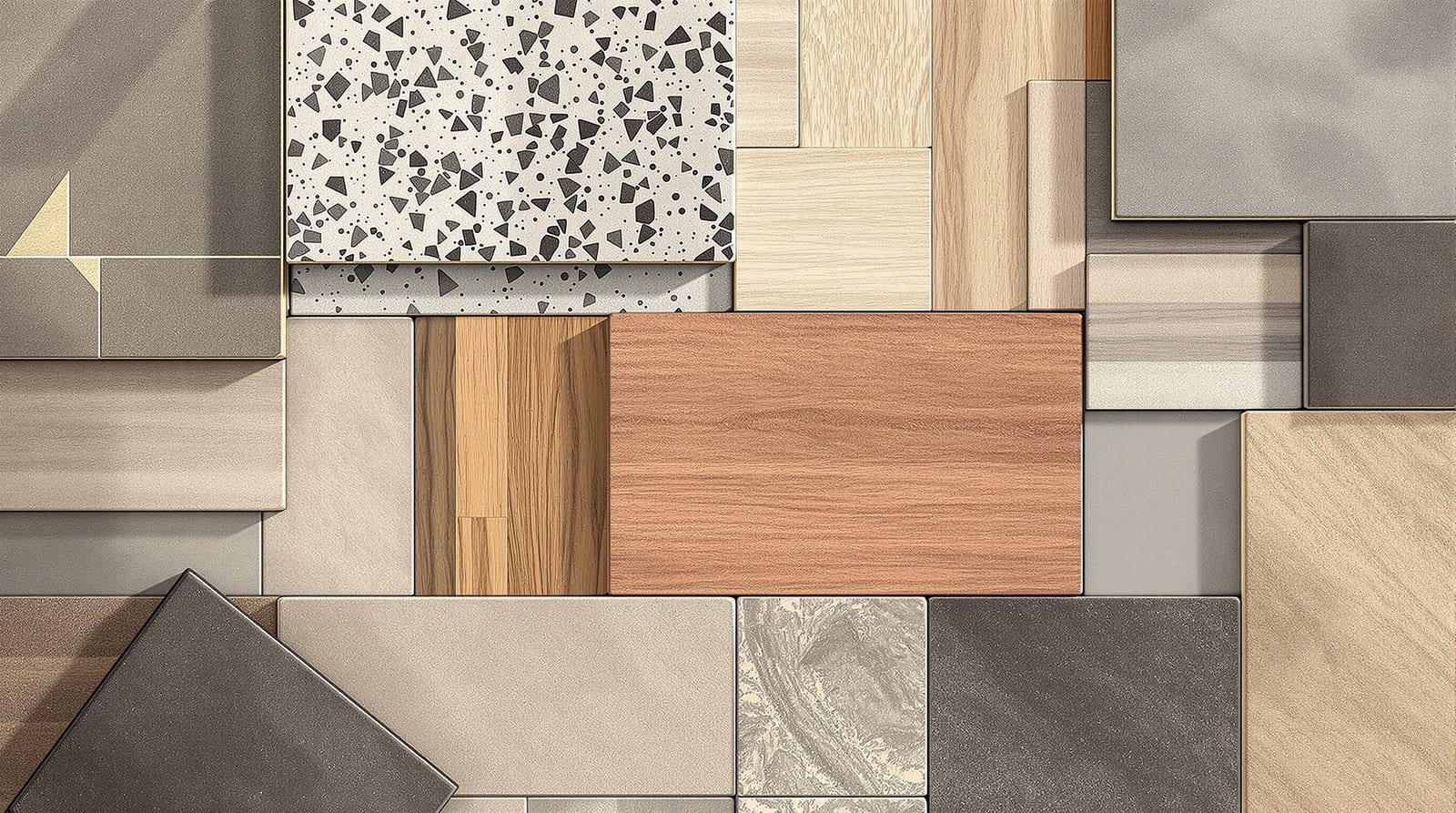
Specialty Flooring Guide India: Alternative & Specialty Floors Beyond Tiles, Stone and Wood
The complete decision map of alternative floors — extra natural stone, traditional cementitious and seamless surfaces, resilient and soft floors, paving and pattern floors, and technical industrial systems — with India ₹/sq ft and best-use guidance.
Most flooring decisions in India start and stop at three families: vitrified tiles, natural stone like granite or marble, and wood or its vinyl look-alikes. But beyond that mainstream lies a far larger world of floors — riven slate that grips underfoot in the monsoon, hand-poured red-oxide that glows in a Kerala courtyard, polished concrete that turns a slab into a finished surface, rubber that cushions a home gym, paver blocks that carry a car, and raised-access panels that hide a data centre's cables. This pillar is the complete map of those alternative and specialty floors: what each one is, what it costs per square foot in 2026, and — most importantly — when and why you would choose it over a tile.
How to use this guide
Think of specialty flooring as five big families. You rarely compare a slate floor against an epoxy floor directly; instead you first decide which family your situation belongs to, then pick within it. The five families are:
1. Additional natural stone — slate, limestone, travertine, basalt, Shahabad, plus paving stones like cobblestone, flagstone and pebble. Chosen for natural character, coolness and outdoor toughness.
2. Traditional, cementitious and seamless — IPS, red oxide, athangudi, cement and mosaic tiles, terrazzo tiles, polished concrete, screed and lime. Chosen for craft, heritage, minimalist seamless looks and value.
3. Resilient and soft — rubber, carpet, coir, PVC sheet, foam, anti-static and sports floors. Chosen for comfort underfoot, acoustics, hygiene and specific commercial functions.
4. Patterns, modular and paving — parquet, herringbone, chevron, brick, paver blocks, deck tiles, grass pavers. Chosen for visual rhythm, driveways, terraces and removable outdoor decks.
5. Technical and specialty — glass, metal, raised-access, PU resin, industrial and vacuum-dewatered concrete. Chosen for engineering performance: structural feature floors, factories, server rooms and warehouses.
All costs below are material-only, indicative for 2026 and vary by city, vendor and grade; laying labour is extra (typically ₹25-120/sq ft depending on the craft) and add 18% GST. For a deeper view of the mainstream families this guide deliberately skips, read Flooring materials explained and the Complete home flooring guide.
A decision framework: six questions before you choose
Before browsing samples, answer these six questions. They narrow forty-odd options down to a shortlist of three or four.
| Question | If the answer is... | Lean toward |
|---|---|---|
| Look | Raw and minimalist | IPS, polished concrete, screed, microcement |
| Heritage and crafted | Red oxide, athangudi, cement tiles, lime, mosaic | |
| Natural and textured | Slate, basalt, Shahabad, brick, pebble | |
| Budget | Tight (under ₹100/sq ft) | IPS, Shahabad, brick, China mosaic, paver blocks |
| Mid | Slate, limestone, terrazzo tiles, polished concrete | |
| Premium | Travertine, parquet, glass, lime, designer cement tiles | |
| Use / traffic | Light residential | Carpet, coir, parquet, red oxide |
| Heavy / commercial | Granolithic, industrial, VDF, raised access, rubber | |
| Indoor or outdoor | Outdoor / wet | Slate, basalt, paver blocks, exposed aggregate, grass pavers |
| Indoor dry | Parquet, carpet, terrazzo, polished concrete | |
| Heritage / restoration | Conserving an old home | Lime, red oxide, athangudi, in-situ mosaic |
| Commercial function | Factory, lab, IT, sports | Industrial, PU, anti-static, raised access, sports floor |
Two questions deserve special weight in India. First, climate: monsoon and wet zones demand anti-skid riven or matte surfaces (slate, Shahabad matte, exposed aggregate) over polished stone, and terraces benefit from heat-reflective finishes — see Heat-reflective terrace flooring and Anti-slip flooring for wet areas. Second, craft availability: red oxide, athangudi and lime floors live or die by the artisan. A brilliant red-oxide floor in Coimbatore can be impossible to replicate in Gurugram simply because the masons who know it are scarce.
The specialty-floor family map
The diagram below maps the five families and their headline members at a glance — use it to locate your situation before reading the detailed sections.
Family 1: Additional natural stone
Beyond the granite, marble, Kota, Tandur and sandstone covered elsewhere lies a second tier of Indian and imported stones that excel at character, coolness and outdoor durability. They share one rule: most are porous and must be sealed (see Floor resealing guide).
Slate is a riven, layered metamorphic stone in grey, black, green and multicolour, quarried in Rajasthan (Kund, Markino), Andhra and Himachal. Its naturally textured riven face is excellent anti-skid, which makes it a favourite for verandahs, courtyards, feature walls and rustic floors — but it is porous, splits in thin layers and must be sealed. Limestone (sedimentary, beige/grey/blue — Indian Kota, Shahabad and Cuddapah are themselves limestones) takes a beautiful honed matte finish but is acid-sensitive and porous. Travertine, a banded cream limestone with natural pits left filled or open, is mostly imported from Turkey and Iran and reads as Mediterranean luxury. Basalt is the workhorse: a dense, hard, low-porosity black volcanic stone common across South and West India, equally happy indoors honed or outdoors flamed.
Shahabad stone deserves a special mention — a Karnataka grey-blue limestone that is the default floor across vast swathes of Maharashtra and Karnataka for floors, verandahs and stairs. It is budget-friendly, durable, naturally cool, and available either matte (anti-skid) or polished. For decorative and paving members of this family — pebble floors set in cement or epoxy, cobblestone setts for driveways, irregular flagstone crazy-paving, natural-stone pavers and exposed-aggregate concrete — see the detailed Slate flooring guide and the live Outdoor flooring guide.
| Stone | ₹/sq ft (material) | Character | Best use |
|---|---|---|---|
| Slate | 50-150 | Riven, textured, anti-skid | Verandahs, courtyards, feature floors |
| Limestone | 40-150 | Cool, honed matte, elegant | Living rooms, lobbies (sealed) |
| Travertine | 150-500 | Banded, pitted, luxe | Premium interiors, baths (sealed) |
| Basalt | 80-250 | Dense black, very durable | Indoor + outdoor, modern homes |
| Shahabad | 35-90 | Cool, durable, value | Floors, stairs, verandahs |
| Exposed aggregate | 60-180 | Pebbled, anti-skid | Driveways, pool decks, paths |
Family 2: Traditional, cementitious and seamless
This family is where Indian craft and modern minimalism meet — cement-based floors that are poured, troweled or hand-pressed rather than laid as machine tiles. They are cool underfoot, often the cheapest durable option, and increasingly fashionable.
IPS (Indian Patent Stone) is an in-situ cement floor — plain grey or pigmented — troweled smooth and grooved into panels (with brass or glass dividers) to control cracking. It is cheap, durable, naturally cool and enjoying a strong minimalist revival; it can even be polished. Governed by IS 1443 and IS 2571. Red oxide is IPS tinted with red iron-oxide pigment — the glossy, handcrafted deep-red floor of traditional Kerala, Karnataka, Tamil Nadu and Maharashtra homes that develops a patina over decades but needs genuinely skilled artisans and turns slippery when wet and polished.
Athangudi tiles are handmade cement tiles from Athangudi in Chettinad (Tamil Nadu), cast on glass plates with coloured cement to produce vivid, one-of-a-kind patterns — a true heritage craft. Cement (encaustic) tiles are hydraulically pressed, through-body patterned tiles in the Bharat Floorings & Tiles tradition: retro, colonial, durable and hand-laid. Mosaic flooring (in-situ marble-chip or tile mosaic) is terrazzo's predecessor, while China mosaic — broken white glazed-tile pieces over terrace waterproofing — is one of the most common Indian terrace finishes: cheap, waterproof, heat-reflective and anti-skid.
On the modern end, polished concrete mechanically grinds and polishes the slab itself into a seamless, industrial-chic, low-maintenance floor; terrazzo tiles are the precast cousin of in-situ terrazzo; screed flooring leaves a sand-cement screed exposed as a raw finish; and lime floors (araish / lime concrete) are breathable, eco and heritage-grade. Granolithic (cement plus hard granite/basalt chips, IS 5491) handles heavy industrial wear. Deep-dive into the two most-requested: IPS flooring and Polished concrete flooring; for the precast and microcement relatives see Terrazzo flooring and Microcement flooring.
| Floor | ₹/sq ft | Why choose it | Watch out for |
|---|---|---|---|
| IPS (grey/pigmented) | 40-120 | Cheap, cool, minimalist | Hairline cracks; needs grooves |
| Red oxide | 60-150 | Handcrafted heritage glow | Skilled artisans scarce; slippery wet |
| Athangudi tiles | 80-250 | Vivid artisanal patterns | Lead times; sealing |
| Cement / encaustic tiles | 120-400 | Retro durable patterns | Must seal; hand-laying cost |
| China mosaic | 40-90 | Waterproof cool terrace | Look is utilitarian |
| Polished concrete | 100-400 | Seamless, low maintenance | Needs a good slab; cracks show |
| Lime (araish) | 150-500 | Breathable, eco, heritage | Very skill-dependent |
Family 3: Resilient and soft
Resilient and soft floors trade hardness for comfort, acoustics and hygiene. They rarely suit an entire Indian home, but they are the right answer for specific rooms and commercial settings.
Rubber flooring (recycled or virgin, in rolls or tiles) is the default for gyms, play areas, hospitals and utility rooms — slip-resistant, cushioned, sound-absorbing and easy to clean. Carpet (broadloom wall-to-wall, or modular 50x50 cm carpet tiles) brings warmth and acoustic softness to bedrooms, hospitality and offices, but India's dust, humidity and dust-mite allergy concerns make it a considered choice. Coir and natural fibre mats and rolls — coir (Kerala is a global hub), jute, sisal and seagrass — are eco, rustic and warm, though they stain and dislike wet areas. PVC roll/sheet flooring (homogeneous or heterogeneous, distinct from LVT or SPC planks) gives hospitals, labs and schools a seamless, hygienic, anti-bacterial — even anti-static — surface. Foam interlocking tiles are the DIY answer for kids' play and home gyms, while anti-static (ESD) and sports floors are engineered for server rooms and courts respectively (Duroflex, Responsive, Gerflor are common sports brands). Start with Rubber flooring.
Family 4: Patterns, modular and paving
Some floors are defined less by their material than by how the pieces are arranged, or by their job outdoors. Parquet sets small hardwood blocks into geometric patterns; herringbone (a zig-zag laying pattern adding 15-20% wastage and labour) and chevron (angled planks meeting in a continuous V, the most wasteful) are pattern choices applicable to wood, tile or brick. Brick flooring lays clay or terracotta pavers flat for a rustic, warm interior or a durable exterior.
Outdoors, paver blocks (precast interlocking concrete in zigzag, I-section or Uni shapes, IS 15658, 60/80 mm grades by load) carry driveways and parking; interlocking paver tiles in rubber, plastic or stone-composite suit terraces and utility zones; outdoor deck tiles (WPC, wood, porcelain or stone on pedestals) click together over balconies and pool decks and lift off for cleaning; and grass pavers (concrete or HDPE grids) create permeable green driveways that cut runoff and heat. Read Parquet flooring and Paver blocks, and estimate quantities with the Paver block calculator and Parquet flooring calculator.
Family 5: Technical and specialty
These are engineered floors specified for performance, almost never for a home's living areas. Glass flooring (₹1,500-4,000+) uses structural toughened-laminated panels with anti-slip ceramic frit for feature walkways and stair treads. Metal flooring — steel or aluminium chequered plate, gratings and perforated panels — serves mezzanines, lofts and wet, heavy industrial areas. Raised-access flooring drops removable 600x600 mm panels onto adjustable pedestals to route cables and air-conditioning beneath data centres, IT offices and control rooms. PU (polyurethane) resin floors give food, pharma and cold-storage plants a seamless surface that beats epoxy on flexibility, thermal-shock and chemical resistance. Broad industrial flooring spans floor hardeners, trowel finishes and epoxy/PU toppings, while vacuum-dewatered concrete (VDF / Tremix) produces dense, dust-free, high-strength warehouse and parking floors. For the two most-specified, see Raised access flooring; for the chemical-resistant comparison set, complement with Epoxy flooring.
| Floor | ₹/sq ft | Specified for |
|---|---|---|
| Glass | 1,500-4,000+ | Feature walkways, stair treads |
| Metal (chequered / grating) | 200-900 | Mezzanines, lofts, wet/heavy zones |
| Raised access | 150-600 | Data centres, IT offices, control rooms |
| PU resin | 150-500 | Food, pharma, cold storage, kitchens |
| Industrial (hardener/topping) | 80-400 | Factories, warehouses, parking |
| VDF / Tremix concrete | 60-200 | Warehouses, parking, heavy slabs |
Putting it together
A useful instinct: the further left in this guide you go, the more the floor is a finish you live on every day (stone, IPS, carpet); the further right, the more it is an engineered system you specify for a function (raised access, PU, VDF). For a whole house, you will usually mix — perhaps polished concrete or IPS in living areas, Shahabad on the stairs, brick or paver blocks outdoors, and carpet only in a bedroom. To benchmark any of these against mainstream options on cost, use the Flooring cost calculator and the Specialty flooring selector, and pressure-test your shortlist against How to choose flooring.
Frequently asked questions
Which specialty floor is cheapest and still durable?
For bulk areas, plain grey IPS (₹40-120/sq ft), Shahabad stone (₹35-90), brick (₹50-150), China mosaic on terraces (₹40-90) and precast paver blocks (₹30-90) are the most cost-effective durable options. IPS and Shahabad in particular give you a cool, hard-wearing finish for less than most vitrified tiles once laying is included.
Are seamless floors like IPS and polished concrete prone to cracking?
Some hairline cracking is normal in any large cement floor as it cures and the slab moves. Good practice controls it: IPS is divided into panels with brass or glass grooves, polished concrete relies on a well-cured slab with saw-cut control joints, and both benefit from a densifier or sealer. Cracks rarely affect performance but are visible, so choose these floors knowing they read as honest rather than perfect.
Can I get a heritage red-oxide or athangudi floor anywhere in India?
Material is available almost everywhere, but the craft is not. Red oxide, lime and athangudi floors depend heavily on artisans who learned the technique, concentrated in Kerala, Tamil Nadu and parts of Karnataka and Maharashtra. Outside those regions, insist on a contractor who can show you completed work and a sample panel before committing, as a poorly laid red-oxide floor is difficult to rescue.
Which specialty floors are safest for the monsoon and wet areas?
Naturally textured stones — riven slate, flamed basalt, matte Shahabad — plus exposed-aggregate concrete, brick and rubber are inherently anti-skid. Avoid highly polished red oxide, travertine or glossy stone in bathrooms, around pools and on open verandahs. For any floor in a wet zone, pair it with the advice in the anti-slip and wet-area guides and consider an anti-skid treatment.
Do I need an architect or specialist for technical floors?
Yes. Glass, metal, raised-access, PU-resin, anti-static and industrial floors are engineered systems with load, safety and code implications, and should be designed and installed by specialist contractors — not a general tiling crew. For these, the cost and the consequences of getting it wrong are high enough that professional specification pays for itself.
Export this guide
Related Guides — Deep-dive reading
Limestone Flooring India: Honed Matte Stone, Colours, Cost and Care
The soft sedimentary stone family — beige, grey, blue and cream limestone with an elegant honed matte look, cool underfoot — plus its porosity, sealing needs, ₹/sq ft cost and where it suits Indian homes.
Flooring & SurfacesTerrace Flooring in India: Best Heat-Reflective, Waterproof Rooftop Options (2026)
An Indian terrace takes full sun, heavy monsoon and daily thermal expansion, so the floor is the second line of defence over a sound waterproofing layer and slope: cool-roof china mosaic, heat-reflective and anti-skid vitrified pavers, Kota and Tandur, deck and WPC tiles, pedestal pavers and artificial grass, with ₹/sq ft, expansion joints and the waterproofing-first rule.
Flooring & SurfacesSlate Flooring in India: Riven Stone, Colours, Cost & Sealing Guide
Indian slate is a layered, naturally anti-skid metamorphic stone for rustic interiors, courtyards, bathrooms and feature walls — here is how to choose, finish, seal and budget it.
Flooring & SurfacesRelated Tools — Try Free
Flooring Cost Calculator
Estimate the all-in cost of a floor — material, laying, wastage, skirting and GST — by area and material.
Flooring CalculatorSpecialty Flooring Selector
Find the right specialty floor for your use — gym, data centre, factory, hospital, heritage home, driveway and more.
Flooring ToolModular Kitchen Budget Calculator
Live breakdown by running feet, countertop area, material tier and city — with wastage, design fee, GST.
Kitchen Calculator