
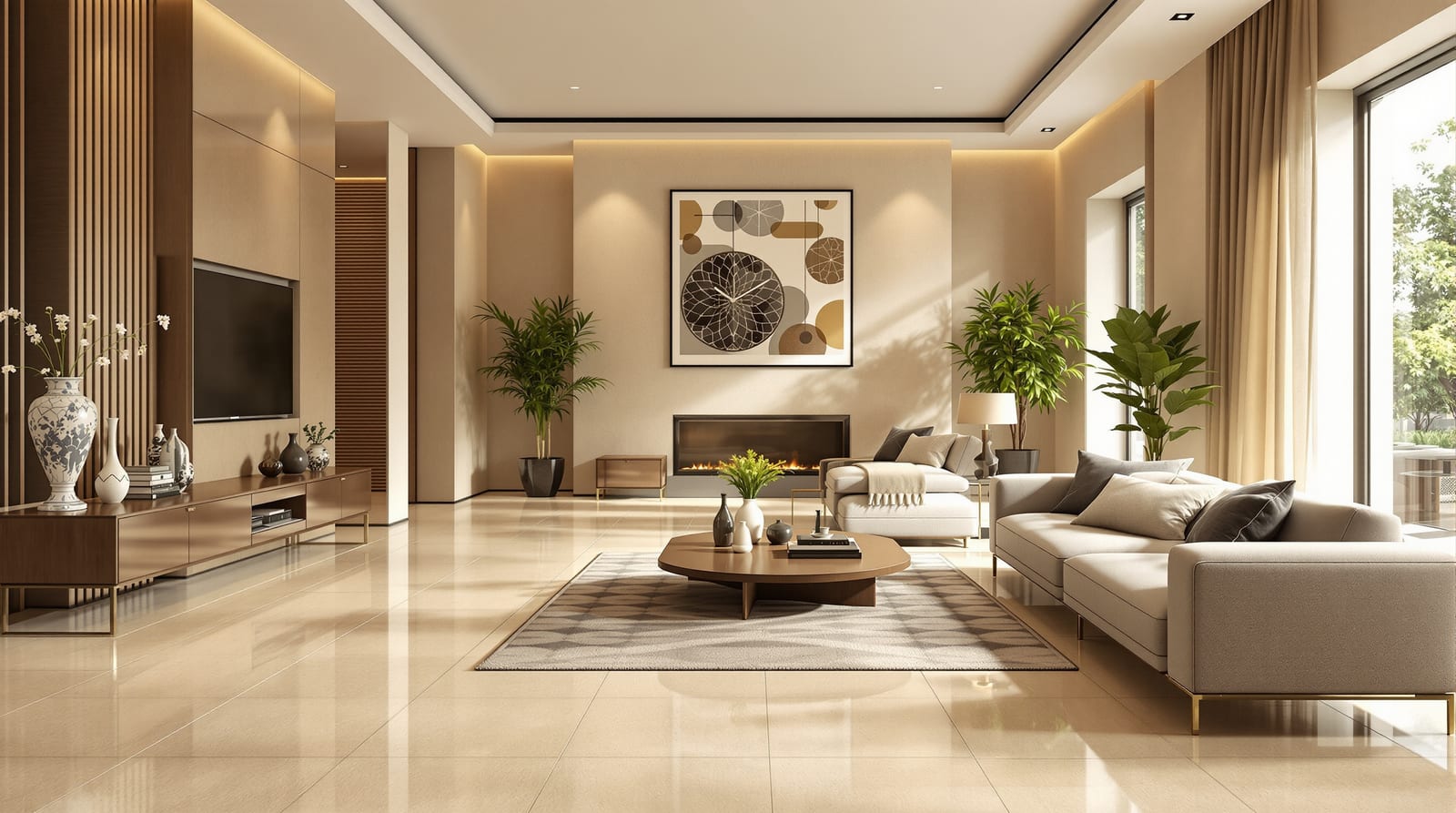
Limestone Flooring India: Honed Matte Stone, Colours, Cost and Care
The soft sedimentary stone family — beige, grey, blue and cream limestone with an elegant honed matte look, cool underfoot — plus its porosity, sealing needs, ₹/sq ft cost and where it suits Indian homes.
Limestone is the quiet aristocrat of natural-stone floors: a soft sedimentary stone with a velvety matte surface, gentle earth colours and a cool, calming feel underfoot that suits the Indian climate beautifully. It does not shout like polished marble or glossy granite — it whispers. But that softness is also its catch: limestone is porous and acid-sensitive, so it rewards a homeowner who seals it and treats it kindly, and punishes one who mops it with vinegar or lets a lime pickle sit overnight. This guide explains the stone family, its colours and finishes, what it costs in India, where it belongs in your home, and how to keep it looking serene for decades.
What limestone actually is
Limestone is a sedimentary rock formed over millions of years from compacted calcium carbonate — sea shells, coral, lime mud settling on ancient sea beds. That origin matters for everything: it is softer than granite, more porous than marble, and it reacts chemically with acids. On the Mohs hardness scale limestone sits around 3-4 (granite is 6-7), which is why it scratches and etches more easily but also why artisans can dress and hone it into silky, low-sheen surfaces.
Here is the part most Indian homeowners do not realise: many of India's most familiar "stone" floors are limestones. Kota stone, Shahabad stone, Tandur stone and Kadappa (Cuddapah) stone all belong to the limestone family. So if you have ever walked barefoot across a cool green-grey Kota verandah on a Rajasthan afternoon, you already know how limestone feels. This guide focuses on limestone as a category — its honed, elegant, beige-to-blue interior expression — while pointing you to the dedicated guides on each named Indian variety.
If you want to see how limestone sits among all the alternative and specialty floors, the specialty flooring guide maps the full landscape; for the broader stone family see flooring materials explained.
Colours and the honed matte look
Limestone's palette is its signature — soft, organic, never garish:
- Beige and cream — the classic, warm, French-château or Mediterranean look; extremely popular in light-filled living rooms.
- Grey — cool, contemporary, pairs with modern minimalist and industrial interiors.
- Blue and blue-grey — denser, sophisticated, often used as a feature or with paler walls.
- Buff, gold and brown tints — earthier, rustic, good with wood and brass.
The defining surface is the honed finish: ground smooth but stopped short of a mirror polish, leaving a soft, matte, satin sheen. This is what gives limestone its calm elegance and, crucially, its grip — honed limestone is far less slippery than polished marble. Add the fact that the stone stays naturally cool, and you have a floor that feels superb against bare feet through an Indian summer.
Finishes you can specify
The same slab can be presented several ways, each changing look, grip and cost:
| Finish | How it looks | Grip / slip | Best for |
|---|---|---|---|
| Honed | Smooth satin matte, low sheen | Good (drier areas) | Living rooms, bedrooms, the standard interior choice |
| Natural / cleft | Textured, slightly riven, rustic | Very good, anti-skid | Courtyards, verandahs, outdoor-feel zones |
| Brushed / antiqued | Lightly weathered, soft texture | Good | Heritage, rustic and farmhouse interiors |
| Polished | Higher sheen, shows colour depth | Slippery when wet | Feature areas only; rare and not advised for wet zones |
| Tumbled | Rounded edges, aged, casual | Good | Smaller-format tiles, period and cottage looks |
For interiors in India, honed is the default and best all-rounder. Reserve polished limestone for dry feature areas, and choose natural or brushed for courtyards and any zone that gets occasional water. For wet-area logic across materials, see anti-slip flooring for wet areas.
Cost in India
Limestone is one of the more affordable natural stones, especially in its Indian forms. Costs are indicative for 2026, vary by city, vendor, colour, slab size and finish, and exclude laying and 18% GST unless stated.
| Type / origin | Look | ₹ per sq ft (material) | Best use |
|---|---|---|---|
| Indian limestone (Kota, Shahabad family) | Grey, green, blue, matte | ₹35-90 | Living, verandahs, stairs, budget elegance |
| Indian beige / cream limestone | Warm beige, honed | ₹60-120 | Living rooms, bedrooms |
| Indian blue / grey limestone | Cool grey-blue, honed | ₹70-140 | Contemporary interiors, features |
| Imported limestone (French, Portuguese, etc.) | Premium beige / cream | ₹150-400+ | Luxury interiors |
| Limestone as a category (this guide's range) | Varies | ₹40-150 | General interior + courtyard use |
Laying adds roughly ₹40-90 per sq ft depending on substrate, pattern and polishing on site, and you should budget for sealing (₹10-30 per sq ft of impregnator) from day one — it is not optional. For a full cost picture across materials use the flooring cost per square foot guide, and to estimate slab quantity and wastage try the natural stone slab calculator.
Type, look, cost and use at a glance
| Limestone variety | Typical look | ₹ per sq ft | Where it suits |
|---|---|---|---|
| Beige / cream honed | Warm, soft, elegant matte | ₹60-120 | Living rooms, bedrooms, hallways |
| Grey honed | Cool, contemporary matte | ₹70-140 | Modern living, studies |
| Blue-grey honed | Dense, sophisticated | ₹80-150 | Feature floors, foyers |
| Kota / Shahabad (Indian limestone) | Green-grey, blue, durable | ₹35-90 | Verandahs, courtyards, stairs, kitchens |
| Natural / cleft limestone | Rustic textured | ₹50-120 | Courtyards, low-traffic outdoor-feel zones |
Porosity and acid-sensitivity — read this before you buy
This is the single most important section. Limestone is porous and acid-sensitive, and ignoring either ruins the floor.
Porosity means the stone has tiny interconnected voids that drink up liquids. Spilt coffee, oil, wine or even water left standing can soak in and stain. The defence is an impregnating (penetrating) sealer applied at installation and re-applied periodically — it lines the pores so spills sit on top long enough to be wiped.
Acid-sensitivity (etching) is different from staining and catches people out. Because limestone is calcium carbonate, any acid dissolves its surface on contact, leaving a dull, rough mark called an etch — even on a sealed floor, because etching is a chemical reaction with the stone itself, not a stain. The everyday culprits in an Indian home are lemon and lime, tamarind, vinegar, tomato, curd, pickle brine, and — the big one — ordinary acidic toilet and floor cleaners. Never use acidic cleaners on limestone. Use only a pH-neutral stone cleaner and plain water.
The diagram below shows why a honed limestone floor needs sealing — the open pore structure beneath a thin sealed surface.
For the practical re-sealing routine — products, frequency and method — follow the floor resealing guide, and for routine cleaning the floor cleaning guide.
Where limestone suits — and where it does not
Best fits
- Living and dining rooms — the honed matte beige look is its showcase, and these rooms see foot traffic but rarely acids.
- Bedrooms and studies — cool, calm, low-traffic, easy to keep beautiful.
- Courtyards and verandahs — using natural/cleft finish; limestone's heritage home is the Indian courtyard, and Kota and Shahabad have done this job for generations.
- Low-traffic elegant interiors — foyers, hallways, formal spaces where you want understated luxury without marble's slip and cost.
Use with care or avoid
- Kitchens — only the tougher Indian limestones (Kota, Shahabad) and even then keep acids off; beige imported limestone etches quickly near a busy Indian cooktop.
- Bathrooms — possible with natural/honed finish and diligent sealing, but soap, hard-water and acidic cleaners make it high-maintenance.
- High-traffic commercial floors — softer beige limestones wear; choose granite or porcelain instead.
For room-by-room logic see living room flooring and bedroom flooring.
Limestone vs marble vs travertine
These three are easy to confuse because travertine is itself a type of limestone, and marble is metamorphosed limestone. Here is how they differ for a buyer.
| Property | Limestone | Marble | Travertine |
|---|---|---|---|
| Rock type | Sedimentary | Metamorphic (recrystallised limestone) | Sedimentary (a porous limestone) |
| Look | Soft matte, uniform earth tones | Veined, can be high-gloss | Banded beige/cream with natural pits |
| Typical finish | Honed matte | Polished or honed | Honed, often pit-filled |
| Hardness | Softer (Mohs 3-4) | Slightly harder | Soft, similar to limestone |
| Porosity | Porous — seal | Porous — seal | Very porous, pitted — fill + seal |
| Acid-sensitivity | High (etches) | High (etches) | High (etches) |
| ₹ per sq ft | ₹40-150 | ₹80-400+ | ₹150-500 |
| Feel | Calm, understated | Luxurious, formal | Classic Mediterranean |
The short version: marble is the showpiece (more cost, more sheen, more glamour and slip), travertine is marble's pitted cousin with a rustic Mediterranean character and a higher price because much of it is imported, and limestone is the calm, affordable middle path with the most natural matte elegance. Compare deeper with marble flooring and travertine flooring.
The Indian limestone family — link up
If your budget or brief leans practical, India's own limestones do the same elegant-cool-stone job at lower cost and with more durability for traffic and outdoors:
- Kota stone flooring — green-grey limestone, the workhorse for verandahs, kitchens and courtyards.
- Tandur stone (Telangana) — grey/blue limestone, fine matte, popular in the Deccan.
- Kadappa (Cuddapah) stone — dark grey-black limestone, dense and budget-friendly.
- Shahabad stone — Karnataka grey/blue limestone, hugely popular across Maharashtra and Karnataka; covered within the regional and Indian-stone guides.
For where these fit regionally, see regional flooring traditions.
Care and maintenance
Limestone is low-effort if you respect its two weaknesses:
- Seal at installation, re-seal periodically. Test with the water-drop method: if a drop soaks in and darkens the stone within a couple of minutes, it is time to re-seal. High-use floors may need it every 1-2 years, light-use every 3-5.
- Use only pH-neutral stone cleaners. No vinegar, no lemon, no acidic toilet/floor cleaners, no generic "tile" cleaners that are often acidic.
- Wipe spills immediately — especially anything acidic (citrus, curd, pickle, tomato, wine, soft drinks).
- Sweep or dust-mop regularly. Grit is abrasive and dulls a honed surface over time; use felt pads under furniture.
- Damp-mop with plain water for routine cleaning; avoid soaking the floor.
- Etch and scratch repair — minor etches and scratches in a honed floor can be re-honed and re-polished by a stone restorer, one of limestone's quiet advantages over a manufactured floor.
Is limestone right for you?
Choose limestone if you want a natural, understated, matte stone floor that feels cool and serene, you love beige-to-blue earth tones over high gloss, your priority rooms are living, dining and bedrooms rather than busy kitchens, and you are willing to seal it and keep acidic cleaners away. If you want a low-maintenance, acid-proof, high-traffic floor, look at granite, vitrified tiles or the tougher Kota stone instead.
Frequently asked questions
Does limestone flooring really need sealing?
Yes — it is essential, not optional. Limestone is porous and will absorb stains from everyday spills without an impregnating sealer applied at installation and re-applied periodically. Note that sealing blocks staining but does not stop acid etching, which is a separate chemical reaction with the stone surface. See the floor resealing guide for the routine.
Why can't I use normal floor cleaner on limestone?
Most ordinary floor and toilet cleaners are acidic, and limestone is calcium carbonate, which acids dissolve on contact — leaving dull, rough etch marks even on a sealed floor. Always use a pH-neutral stone cleaner and plain water, and wipe acidic spills like lemon, curd, pickle and tomato immediately.
Is limestone the same as Kota or Shahabad stone?
They belong to the same family. Kota, Shahabad, Tandur and Kadappa are all Indian limestones — denser, more durable and far cheaper than imported beige limestone, which is why they have served Indian verandahs and courtyards for generations. This guide covers limestone's elegant honed beige-to-blue interior expression; the named Indian varieties have their own dedicated guides.
Is limestone good for Indian kitchens and bathrooms?
With caution. The tougher Indian limestones such as Kota and Shahabad handle kitchens and wet areas reasonably well with diligent sealing and a natural or honed (non-slip) finish, but you must keep acids off. Soft imported beige limestone etches quickly near a busy Indian cooktop and is high-maintenance in bathrooms; choose it for living and bedroom areas instead.
How much does limestone flooring cost in India?
Indian limestones run roughly ₹35-90 per sq ft, beige and grey honed interior limestone around ₹60-150, and imported premium limestone ₹150-400+ — all material only, before laying (about ₹40-90 per sq ft), sealing and 18% GST. Use the natural stone slab calculator to estimate quantity and the flooring cost per square foot guide for the full picture.
Export this guide
Related Guides — Deep-dive reading
Slate Flooring in India: Riven Stone, Colours, Cost & Sealing Guide
Indian slate is a layered, naturally anti-skid metamorphic stone for rustic interiors, courtyards, bathrooms and feature walls — here is how to choose, finish, seal and budget it.
Flooring & SurfacesShahabad Stone Flooring India: Grey-Blue Karnataka Limestone, Finishes, Cost and Care
The dense grey-blue limestone from Shahabad in Gulbarga, Karnataka — the budget workhorse floor of Maharashtra and Karnataka homes, verandahs, stairs and temples — its natural matte anti-skid look, polished black-ish finishes, ₹/sq ft cost, sizes, sealing and where it suits.
Flooring & SurfacesMarble Flooring in India: Indian vs Italian, Types, Cost & Care (2026)
Marble is India's aspirational natural-stone floor — cool underfoot, luxuriously veined and re-polishable. Here is the homeowner's honest guide to Makrana and the popular Indian types, Indian vs Italian marble, ₹/sq ft costs, the staining and etching downsides, where to use it and how it is laid and polished.
Flooring & SurfacesRelated Tools — Try Free
Flooring Cost Calculator
Estimate the all-in cost of a floor — material, laying, wastage, skirting and GST — by area and material.
Flooring CalculatorFull-Room BOQ — Living, Bedroom, Kitchen, Bath
Room-wise BOQ across living, bedrooms, kitchen, utility, and bathrooms with line-item pricing.
Full-Room BOQMarble Flooring Cost Calculator
Estimate installed marble-floor cost — material, laying, grinding and polishing, sealing, wastage and GST.
Flooring Calculator