
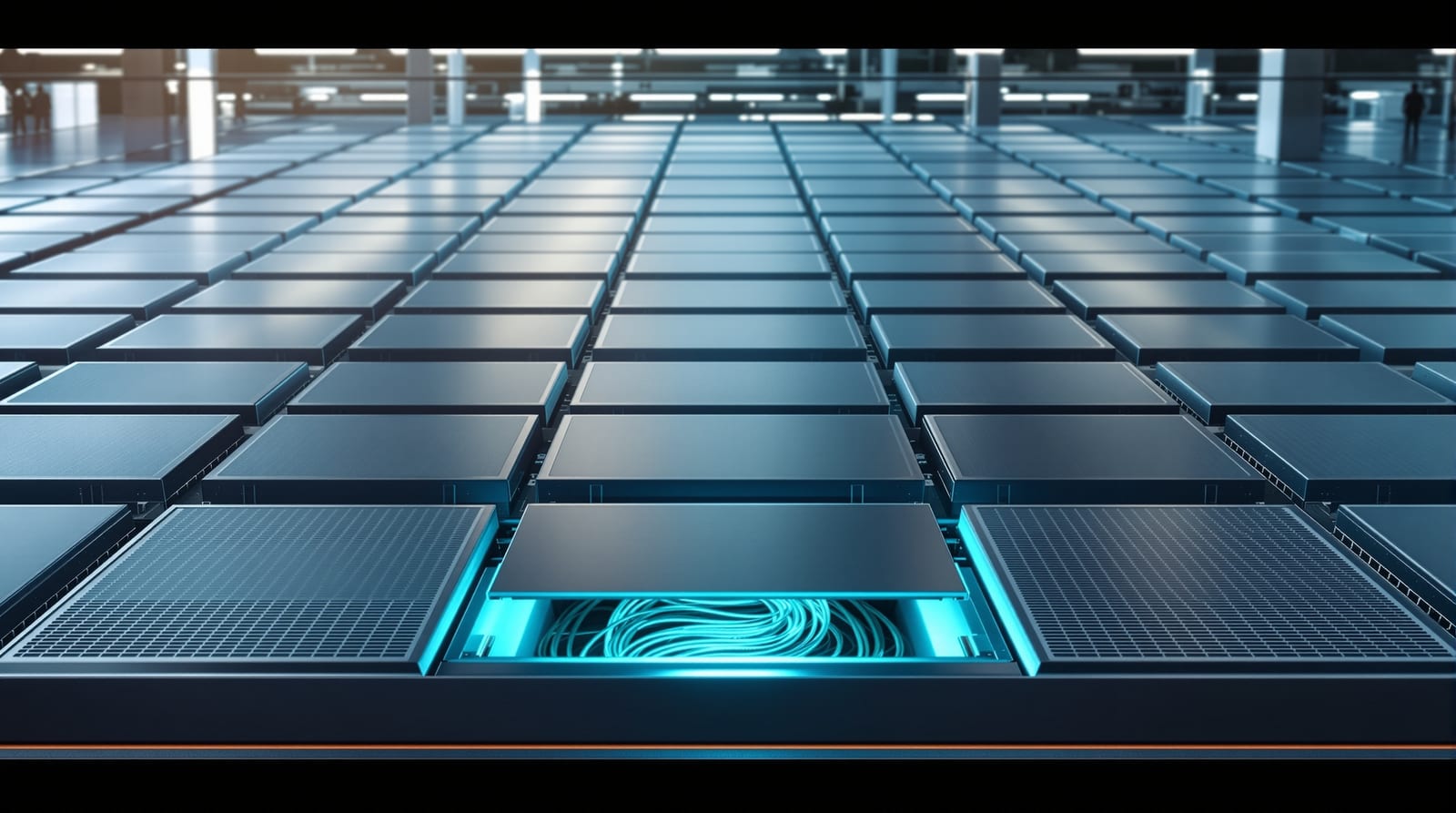
Raised Access Flooring in India: Data Centre & IT Office Floor Panels Guide (2026)
Removable 600x600 mm panels on adjustable pedestals create a service void under the floor for power, data cabling and cooling air — the standard floor for data centres, server rooms, IT offices, control rooms, labs and trading floors. Panel types, pedestal heights, load classes, install and ₹150-600 per sq ft.
Raised access flooring is the floor that hides the building's nervous system underneath it. Instead of casting cables into walls and ceilings, you set the finished floor on a grid of adjustable metal pedestals, lifting it 150 mm to a metre or more above the structural slab — and that gap becomes a service void you can route power, data and chilled air through, then reach by simply lifting a panel. It is the default floor of data centres, server rooms, IT offices, control rooms, laboratories and stock-exchange trading floors, because in those spaces the cabling changes constantly and downtime is expensive. At ₹150–600 per sq ft for the panel-and-pedestal system, it buys you a floor you can reconfigure for years without breaking concrete.
This guide explains what raised access flooring is, why mission-critical spaces use it, the panel types and finishes sold in India, pedestal heights, load classes from light office to heavy server, how it is installed, where it suits, its honest pros and cons, and what it costs.
What raised access flooring is
A raised access floor — also called a raised floor, access floor, or in data-centre jargon a computer-room floor — is a modular floor built from two parts: removable square panels and the adjustable pedestals that hold them up. The panels are almost always 600 x 600 mm (the global standard module; older imperial floors are 24 x 24 inches, near-identical), and they drop into a grid of pedestals screwed or glued to the structural slab. Many systems add horizontal stringers between pedestal heads to brace the grid and carry rolling loads.
The whole point is the empty space the system creates — the plenum or service void between the finished floor and the slab. That void does the work:
- Cabling. Power, data, fibre and control cabling run loose or on cable trays in the void, separated and easy to add, move or remove.
- Cooling air. In data centres the void becomes a pressurised supply plenum: CRAC or CRAH units push chilled air under the floor, and perforated or grille panels in front of the server racks let it rise through the equipment.
- Access. Lift one panel with a suction-cup tool and you reach everything below — no chasing walls, no false ceilings, no shutdown to re-route a circuit.
Studio Matrx groups raised access flooring with the technical and specialty floors — the engineered systems you specify for a function the floor itself must perform, rather than for looks alone. For the full map of these floors, see the specialty flooring guide.
Why mission-critical spaces use it
A normal screeded floor is permanent: once the cables are cast in or buried, changing them means breaking the floor. Raised access flooring solves four problems at once, which is why it dominates technology spaces.
| Need | How a raised floor meets it |
|---|---|
| Constant cable change | Servers, desks and machines move and multiply; lift a panel and re-route in minutes, no civil work |
| Under-floor cooling | The void is a chilled-air plenum feeding cold air up through perforated panels to the racks |
| Clean, safe walkways | No trailing cables across the floor; power and data stay hidden and protected |
| Future-proofing | Add capacity, change layouts and upgrade cabling for years without rebuilding the floor |
In a data centre the cooling role is decisive: the under-floor plenum is the most common way to deliver chilled air to server racks in a hot-aisle / cold-aisle layout. In an IT office or open-plan workspace, the same void carries power and network drops to floor boxes anywhere on the grid, so desks can be re-planned without an electrician chasing conduits. Control rooms, broadcast suites, labs and trading floors use it for the same flexibility plus tidy, accessible service runs.
How the system goes together
The diagram below shows a section through a raised access floor: the structural slab at the bottom, the adjustable pedestals that set the height, the service void with cabling and cooling air, and the removable panel on top with its finish.
Panel types: the core of the floor
The panel is the part that carries load, so it is specified by what is inside it. Four constructions dominate the Indian market.
| Panel type | Construction | Strengths | Best for |
|---|---|---|---|
| Steel-encased, cement-filled | Welded top and bottom steel shells filled with lightweight cementitious core | High strength, fire-resistant, good acoustics, the data-centre workhorse | Data centres, server rooms, heavy IT |
| Calcium sulphate (anhydrite) | Dense anhydrite core, steel-clad or foil-backed | Very high load and rigidity, excellent fire rating, dimensionally stable, low dust | High-density data centres, labs, control rooms |
| Woodcore (chipboard core) | High-density particleboard core in a steel or galvanised tray | Lighter, cheaper, good acoustics, easy to cut | IT offices, open-plan workspaces, light commercial |
| All-steel / hollow steel | Welded steel shell, hollow or honeycomb | Light, strong, common in cleanrooms; can ring underfoot | Cleanrooms, semiconductor, some data halls |
Steel-encased cement-filled and calcium sulphate panels are the heavy-duty choices for data centres, where load, fire performance and stability matter most. Woodcore panels are the value choice for IT offices and workspaces, where loads are lighter and budget matters. Whatever the core, panels are typically 600 x 600 mm and 28–45 mm thick.
Finishes on the panel
The structural panel is finished on top, factory-bonded or laid loose, to suit the room:
- Bare / unfinished panel — used under a carpet or where a separate floor covering goes on top.
- HPL (high-pressure laminate) — hard-wearing, easy-clean, the common data-centre and lab top, available in anti-static grades.
- Vinyl (PVC) facing — smooth, hygienic, available conductive/dissipative for ESD control.
- Carpet tiles — laid loose on bare panels in offices for warmth, acoustics and an office look; individually liftable to match the panel grid (see carpet tiles in India).
- ESD / anti-static facing — conductive or dissipative HPL or vinyl that drains static charge to earth, essential where electronics are handled (see below).
Pedestal heights and load classes
Two specs define the floor: how high it sits, and how much it carries.
Pedestal (finished floor height). Pedestals are threaded so the installer dials each one to a laser-levelled height. Typical ranges:
- 150–300 mm — IT offices and workspaces, just enough for cabling and floor boxes.
- 300–600 mm — server rooms and small data halls, room for cabling plus a cooling-air plenum.
- 600 mm to 1 m or more — large and high-density data centres, where a deep plenum delivers high cooling-air volumes and busbar/containment.
Load class. The system is rated by the load a panel can take — a concentrated point load (a rack foot or castor) and a uniform distributed load. Indian suppliers usually quote against international classes (broadly aligned to the European EN 12825 grades and US PSF ratings):
| Class | Typical concentrated load | Suits |
|---|---|---|
| Light commercial | ~3.0–4.0 kN | Light offices, low foot traffic |
| Medium / general office | ~4.0–6.7 kN | IT offices, control rooms, workspaces |
| Heavy commercial | ~6.7–8.0 kN | Server rooms, heavier equipment |
| Extra-heavy / data centre | ~8.0–11+ kN | Data centres, dense racks, rolling heavy loads |
Always size the floor for the heaviest concentrated load it will ever see — a fully loaded server rack on small castors, or a wheeled trolley moving across the grid — not the average. Under-specifying load is the costliest mistake, because the racks are already in before the floor flexes.
Anti-static and ESD options
Wherever live electronics are handled — server halls, electronics manufacturing, telecom, labs and operating theatres — static discharge can destroy components or trip equipment, so the floor must drain charge safely to earth. Raised access floors meet this with conductive or static-dissipative HPL/vinyl facings, copper earthing tapes between panels and bonding straps to a grounding grid. The pedestal-and-stringer steel grid itself helps bond the system. Where ESD control is the priority over flexibility, specifiers compare a raised ESD floor against a poured conductive floor; the dedicated anti-static and ESD flooring guide covers both routes and the resistance ranges to specify.
How raised access flooring is installed
Installation is a dry, fast, controlled process and one of the system's advantages — there is no wet trade once the slab is ready.
1. Prepare and set out. The structural slab is cleaned, sealed against dust, and surveyed; the 600 mm grid is set out from a datum so panels run square to the room and the racks.
2. Fix pedestals. Pedestal bases are bonded (epoxy) and/or mechanically fixed to the slab on the grid, then each threaded head is dialled to the laser-set finished-floor level. Stringers clip between heads where rolling loads or extra rigidity demand.
3. Lay panels. Panels drop onto the pedestal heads. Edges and any non-modular cut panels are trimmed to fit walls, columns and openings, and cut edges are sealed and edged.
4. Cut service openings. Perforated or grille panels go where cooling air or floor boxes are needed; cut-outs for cable risers and floor boxes are made and edge-trimmed.
5. Earth and commission. ESD bonding and earthing are completed, levels and load checks done, and the floor is cleaned for handover. Perimeter trims and ramps or steps manage the step-up at doorways.
A clean, dry slab and an accurate datum matter most; the system tolerates a slightly out-of-level slab because each pedestal is independently adjustable. Allow for the step-up at room entries with ramps or thresholds for trolleys and accessibility.
Cost of raised access flooring in India
Raised access flooring is priced per square foot of the panel-and-pedestal system; finishes, perforated panels, deep pedestals and ESD bonding add to it. The figures below are indicative for 2026 and vary by city, brand, panel grade and pedestal height.
| System / specification | Indicative cost (₹/sq ft) | Best use |
|---|---|---|
| Woodcore panels, low pedestals (150–300 mm), bare/carpet | ₹150–280 | IT offices, workspaces, light commercial |
| Steel-encased cement-filled, medium pedestals, HPL/vinyl | ₹280–450 | Server rooms, control rooms, labs |
| Calcium sulphate / heavy-duty, deep plenum, data-centre grade | ₹400–600+ | Data centres, high-density halls |
| ESD / anti-static facing & bonding (add-on) | +₹50–150 | Server, electronics, OT, lab zones |
| Perforated / grille cooling panels (per panel premium) | +₹30–120 | Cold-aisle cooling positions |
Loose carpet-tile or vinyl finishes, ramps, perimeter trims and earthing are usually quoted separately. For a panel-count and area estimate use the Studio Matrx raised access floor calculator, and for the wider picture see the flooring cost per square foot in India guide and the flooring cost calculator.
Pros and cons of raised access flooring
| Pros | Cons |
|---|---|
| Lift a panel to reach cables and air — easy access and re-routing | Higher upfront cost than a finished screed floor |
| Reconfigure power, data and layout for years without civil work | Eats floor-to-ceiling height (the plenum can be 150 mm to 1 m) |
| Under-floor plenum delivers efficient data-centre cooling | Needs a step-up ramp at doorways and accessibility planning |
| Tidy, safe floors with no trailing cables | Hollow void can ring or feel bouncy if panels/load are under-specified |
| Dry, fast install — no wet trade once the slab is ready | Heavy equipment demands correct load class or panels deflect |
| Adjustable pedestals absorb slab unevenness | Voids need fire-stopping, sealing and clean-down to control dust |
| ESD and fire-rated grades available for critical rooms | Overkill for ordinary homes and most retail or hospitality |
Where raised access flooring suits — and where it does not
It is the right floor wherever cabling density, change and under-floor cooling justify the cost and the lost height: data centres, server and computer rooms, IT and software offices, control and command rooms, broadcast and trading floors, telecom exchanges, electronics labs and cleanrooms. In these spaces the access and flexibility pay for themselves many times over.
It is not the floor for ordinary homes, most retail or hospitality, or anywhere the cabling is fixed and light — there a conventional vitrified tile or vinyl floor is cheaper and keeps full ceiling height. For office floors that want only modular, replaceable comfort without a plenum, loose carpet tiles over a normal slab do the job at a fraction of the cost. Where a clean, seamless and easily-disinfected surface matters more than under-floor access — labs, server-room finishes and hygienic zones — a homogeneous PVC roll floor is often laid as the finish, and for industrial mezzanines and plant-room walkways that need open service space below, metal gratings and chequered plate are the rugged alternative.
Frequently asked questions
Why do data centres use raised access flooring?
Two reasons: cabling and cooling. The under-floor void lets technicians re-route power, data and fibre to constantly-changing racks by lifting a panel, with no breaking of concrete. Just as importantly, the void doubles as a pressurised cold-air plenum: CRAC units push chilled air under the floor, and perforated panels in the cold aisles let it rise through the servers. That combination of flexible cabling and efficient cooling is hard to match any other way.
What size are raised access floor panels?
The global standard is 600 x 600 mm, typically 28–45 mm thick, dropped onto a grid of adjustable pedestals at the same 600 mm spacing. Older imperial floors use 24 x 24 inch panels, which are practically the same size. The consistent module is what lets any panel — bare, finished, perforated or with a floor box — be swapped into any grid position.
How much does raised access flooring cost in India?
As a system (panels plus pedestals), expect roughly ₹150–280 per sq ft for woodcore office floors with low pedestals, ₹280–450 for steel-encased cement-filled panels in server rooms, and ₹400–600+ for calcium-sulphate data-centre grade with a deep plenum. ESD bonding, perforated cooling panels, finishes, ramps and earthing add to this. Always price against the load class and pedestal height you actually need.
Which panel type should I choose?
Match the panel to the load and the room. Steel-encased cement-filled panels are the data-centre workhorse for strength, fire performance and acoustics. Calcium sulphate panels suit the highest-density, most demanding halls for their rigidity and fire rating. Woodcore panels are the value choice for IT offices and workspaces with lighter loads. Add an ESD-rated facing wherever live electronics are handled.
Does raised access flooring need anti-static (ESD) treatment?
In server rooms, electronics manufacturing, telecom, labs and operating theatres, yes — static discharge can destroy components, so specify a conductive or static-dissipative HPL or vinyl facing with proper earthing and bonding between panels. In an ordinary IT office carrying only desk power and network drops, standard panels are usually fine. See the anti-static and ESD flooring guide for the resistance ranges and bonding details.
Export this guide
Related Guides — Deep-dive reading
Anti-Static & ESD Flooring in India: Conductive vs Dissipative Floors, Resistance Ranges, IEC 61340, Cost & Earthing
Anti-static and ESD flooring — conductive or static-dissipative vinyl, epoxy/PU, rubber and raised-access panels that drain electrostatic charge safely to earth — is mandatory in electronics and semiconductor plants, data centres, telecom, labs, operation theatres, cleanrooms and explosive-risk areas. Here are the types, resistance ranges, IEC 61340 standards, install and earthing, testing, costs of ₹150–600 per sq ft and care.
Flooring & SurfacesData Centre Flooring in India: Raised Access & Anti-Static Systems
How raised-access floors with ESD finishes route cooling air, power and data under heavy server racks — plus a simpler ESD path for small server rooms.
Flooring & SurfacesCarpet Tiles in India: Modular 50x50 cm Carpet Squares for Offices, Co-working & Commercial Floors — Types, Backing, Cost & Install
Carpet tiles — modular 50x50 cm (and 25x100 cm) backed carpet squares — are the go-to soft floor for offices, co-working spaces, IT and retail because a single stained tile can be lifted and swapped instead of recarpeting the whole room. Here are the backing types, install methods, acoustic and anti-static options, costs of ₹60–300 per sq ft, pros, cons and how they compare with broadloom carpet.
Flooring & SurfacesRelated Tools — Try Free
Raised Access Floor Calculator
Estimate raised access floor panels, pedestals and cost for a data centre, server room or IT office.
Flooring CalculatorFlooring Cost Calculator
Estimate the all-in cost of a floor — material, laying, wastage, skirting and GST — by area and material.
Flooring CalculatorFalse Ceiling Cost Estimator
Live ₹/sqft across 8 ceiling types — POP, gypsum, designer, metal, PVC, wooden — with cove and spot lighting for 20 Indian cities.
Cost Calculator