
Parquet Flooring in India: Patterns, Woods, Cost & Care Guide
Small hardwood blocks laid in geometric patterns — herringbone, chevron, basketweave, brick and Versailles — are the classic, elegant, refinishable wood floor; here are the woods, patterns, costs of ₹150–600 per sq ft, installation and care.
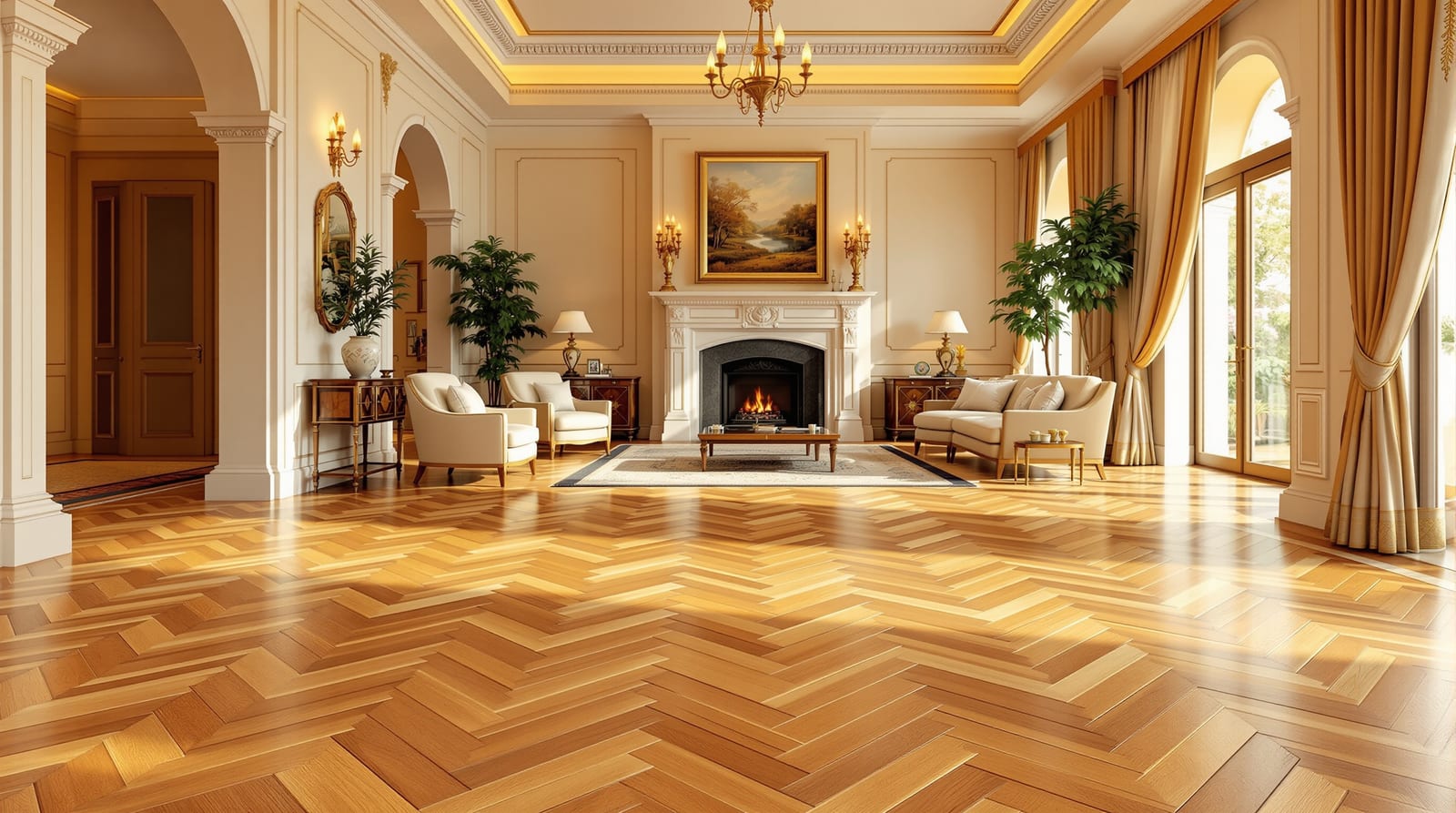
Parquet is wood flooring's most decorative form: instead of long planks running end to end, small hardwood blocks are laid in repeating geometric patterns — the zig-zag of herringbone, the continuous V of chevron, the woven look of basketweave, or the framed squares of the classic Versailles panel. It is the floor of old colonial bungalows, heritage hotels and palace ballrooms, and it has come roaring back into fashion in Indian homes that want a wood floor with genuine character. At roughly ₹150–600 per sq ft for the wood, parquet sits between a plain laminate and a premium hardwood plank — and unlike laminate, a real wood parquet can be sanded and refinished for generations.
This guide covers solid versus engineered parquet, the woods that suit India, every major pattern, what it costs, how it is laid and finished, where it belongs in a home, and how to keep it beautiful.
What parquet flooring actually is
The word "parquet" describes a method, not a material. You take small pieces of solid hardwood — historically little blocks or "fingers" a few inches long — and arrange them so the grain of each piece runs at an angle to its neighbour, building a pattern. Because the grain direction keeps changing, parquet catches light differently across the floor, giving it a shimmering, three-dimensional quality that no straight-laid plank can match.
Traditional Indian parquet from the bungalow era used solid teak or rosewood fingers, often individually nailed to wooden battens or bedded in bitumen over a screed. Today you will find parquet in two broad forms:
- Solid parquet — each block is a single piece of solid hardwood, typically 8–16 mm thick. It is glued or nailed down, can be sanded many times, and lasts generations. It is the most authentic and the most demanding of skilled labour, and it moves with humidity.
- Engineered parquet — each block (or a pre-assembled pattern tile/panel) is built from a hardwood wear layer bonded over plywood or HDF. It is far more dimensionally stable in India's humidity swings, faster to lay, and still refinishable a limited number of times (depending on wear-layer thickness). Most new parquet sold in India today is engineered.
For the broader wood-floor family — planks, finishes and species — see wooden-flooring-india and engineered-wood-flooring-india. Parquet is essentially those same woods, cut small and laid in a pattern, and it sits within the wider map of alternative floors covered in our specialty-flooring-guide-india pillar.
The woods: teak, oak, walnut, merbau and more
Pattern gives parquet its geometry; the wood gives it its colour, hardness and price. The species you choose decides how the floor ages, how it handles foot traffic, and what it costs.
| Wood | Colour & character | Hardness | Cost (₹/sq ft, wood) | Notes for India |
|---|---|---|---|---|
| Indian teak | Golden-brown, oily, classic | High | 300–600+ | The heritage choice; naturally stable, termite- and water-resistant |
| Burma / imported teak | Deeper honey-brown | High | 400–600+ | Premium; tight grain, prized for old-world parquet |
| European / American oak | Pale to mid honey, prominent grain | High | 200–450 | The global parquet favourite; takes stains beautifully |
| Walnut | Rich chocolate-brown | Medium | 300–550 | Luxurious, dark, dramatic; softer than oak |
| Merbau | Reddish-brown, very dense | Very high | 200–400 | Hardwearing, good for high-traffic; can bleed colour if wet |
| Rubberwood / acacia | Light, variegated | Medium | 150–300 | Budget-friendly engineered parquet wear layers |
| Maple / ash | Pale, fine, clean | Medium-high | 250–450 | Light, modern, Scandinavian look |
Teak remains the sentimental and practical king in India — its natural oils make it the most stable and moisture-tolerant of the lot, which matters in our humidity. Oak is the international standard and the most versatile for stains, from pale natural to smoked and fumed greys. Walnut delivers instant luxury but is softer. For high-traffic family homes, merbau and oak are the most resilient. For solid versus engineered trade-offs by species, solid-hardwood-flooring-india goes deeper.
Patterns: herringbone, chevron, basketweave, brick and Versailles
This is where parquet earns its name. The pattern transforms the same wood into wildly different floors, and it also drives the cost — more cutting and more careful setting-out means more labour and more wastage.
| Pattern | Look | Wastage / labour | Best for |
|---|---|---|---|
| Herringbone | Interlocking broken zig-zag of rectangular blocks | +15–20% wastage, high labour | Living rooms, hallways, heritage homes |
| Chevron | Angled-cut blocks meeting point-to-point in a continuous V | Highest cutting & wastage | Statement floors, formal rooms |
| Basketweave | Pairs of blocks woven at right angles, like a basket | Moderate | Studies, dining rooms, retro interiors |
| Brick / stack bond | Blocks offset like brickwork; simplest geometric lay | Lowest | Calmer, contemporary spaces |
| Versailles / Chantilly | Large square panels of interlaced diagonal blocks within a border | High; pre-made panels help | Grand rooms, palaces, luxury suites |
Herringbone and chevron are the two most asked-for patterns, and they are often confused. In herringbone, rectangular blocks are laid whole and staggered so each block's end butts against the side of the next, creating a broken zig-zag. In chevron, the block ends are cut at an angle (typically 45° or 60°) so they meet point-to-point in a clean, continuous V that runs in unbroken lines down the room. Chevron looks more formal and tailored; herringbone looks more woven and traditional — and because chevron needs every block angle-cut, it is the more expensive of the two. We cover each in its own depth in herringbone-flooring-india and chevron-flooring-india.
How the main patterns are set out
The diagram below contrasts the two most popular geometries — the staggered zig-zag of herringbone against the angle-cut, point-to-point V of chevron — plus the woven squares of basketweave.
Cost in India (2026, indicative)
Parquet pricing has three parts: the wood, the pattern premium, and the laying-plus-finishing. Rates are indicative and vary by city, species, pattern and vendor; add 18% GST.
| Item | Rate (₹ per sq ft) | Notes |
|---|---|---|
| Engineered oak/acacia parquet (material) | 150–350 | Stable, most popular for new homes |
| Solid teak / oak / walnut parquet (material) | 300–600+ | Heritage-grade, fully refinishable |
| Herringbone laying premium | +30–80 over straight | More cutting, careful set-out, +15–20% wastage |
| Chevron laying premium | +50–120 over straight | Highest cutting and wastage |
| Glue-down / nail-down labour (over ply) | 60–150 | Skilled carpenter; pattern adds to this |
| Plywood sub-floor (18 mm BWP) | 60–120 | Needed for nail/glue-down over rough screed |
| Sanding + finishing (oil or polyurethane) | 50–120 | Site-finished floors; multiple coats |
A practical benchmark: an engineered oak herringbone floor laid over ply and finished typically lands around ₹300–500 per sq ft installed; a solid teak Versailles or chevron floor in a heritage restoration can climb well past ₹700–900 per sq ft installed. To size a job and estimate pattern wastage, use the Studio Matrx /utilities/parquet-flooring-calculator, and for the wider picture see flooring-cost-per-square-foot-india.
Installation: glue-down or nail-down over a sound base
Parquet is unforgiving of a bad base. Because the pattern is built from many small pieces, even a slightly uneven or damp sub-floor will telegraph through as lifting blocks and opening joints. The sequence in Indian practice usually runs:
1. Prepare the base. The screed must be flat, fully cured and dry — trapped slab moisture is the single biggest killer of wood floors in India. A damp-proof membrane is essential over ground-floor slabs. Our floor-screed-and-mortar-bed-india guide covers getting the base right.
2. Lay a plywood sub-floor (usually). Over a rough or slightly damp screed, an 18 mm BWP/marine plywood layer is fixed down to give a stable, dry, nail-able and glue-able surface. Many engineered parquet systems can glue straight to a perfect screed, but ply is the safe Indian default.
3. Set out the pattern from the centre. The carpenter snaps centre lines and dry-lays the pattern so it runs true and symmetrical, with cut blocks falling evenly at the edges — never a thin sliver against one wall.
4. Glue or nail the blocks. Solid parquet is typically secret-nailed or bonded with flooring adhesive; engineered blocks and panels are usually glued, sometimes click-fit. The angle-cuts of chevron must be perfectly consistent or the V will wander.
5. Sand, fill and finish. Solid and many engineered floors are site-sanded flat, gaps filled, then finished with hardwax-oil (matte, easily spot-repaired) or polyurethane lacquer (tougher, glossier). Pre-finished engineered parquet skips this step.
Always acclimatise the wood in the room for several days before laying so it reaches the home's humidity. Leave an expansion gap at the perimeter, hidden by the skirting, because wood moves with the seasons.
Where parquet suits an Indian home
Parquet is a dressy, refined floor — it rewards rooms where you want warmth and elegance and where moisture is controlled.
- Living and dining rooms. The natural home for herringbone and chevron — the pattern reads beautifully across an open floor and lifts a formal space instantly.
- Bedrooms and studies. Warm and quiet underfoot; basketweave and brick patterns suit calmer, smaller rooms.
- Heritage homes and restorations. Solid teak or rosewood parquet is often original to old bungalows and is the authentic repair-and-match choice.
- Luxury suites and boutique hospitality. Versailles panels and dark walnut chevron signal old-world luxury.
Where parquet is a poor fit: bathrooms, kitchens and any wet zone — wood and standing water do not mix; choose tile or stone there and compare in kitchen-flooring-india and bathroom-flooring-india. Balconies, terraces and outdoor areas are also out — see balcony-flooring-india and our outdoor flooring guide for India instead. Parquet also dislikes prolonged direct harsh sun, which can fade and dry it, so use blinds on large south- and west-facing windows.
Parquet vs plank wood vs laminate
Parquet, straight plank and laminate are easy to confuse on a price list. The difference is in the pattern, the material and the lifespan.
| Parquet (solid/engineered) | Plank wooden flooring | Laminate | |
|---|---|---|---|
| What it is | Small hardwood blocks in a pattern | Long boards of solid/engineered wood | Photo-printed decor over HDF core |
| Look | Geometric, decorative, light-catching | Linear, classic | Wood-look print |
| Refinishable | Yes (solid many times; engineered limited) | Yes (solid; engineered limited) | No — replace when worn |
| Cost (₹/sq ft) | 150–600+ | 200–700+ | 80–250 |
| Labour | High — pattern set-out and cutting | Moderate | Low — click-fit |
| Lifespan | Decades to generations | Decades | 10–20 years |
If you love the wood look but the budget is tight or the room sees heavy traffic and spills, a wood-look laminate or vinyl plank is the pragmatic alternative — see laminate-flooring-india, luxury-vinyl-tile-lvt-india and spc-flooring-india. But nothing reproduces the depth and refinishability of a real parquet floor; that is what you pay for.
Care and maintenance
A finished parquet floor is straightforward to live with. Sweep or dry-mop daily to keep grit off the finish, since grit is what scratches wood. Damp-mop occasionally with a barely-wet, well-wrung mop and a wood-floor cleaner — never flood the floor or use a soaking mop, as water creeping into the block joints is the main cause of lifting and cupping. Wipe spills at once. Use felt pads under furniture legs and rugs in high-traffic paths.
Manage humidity: India's monsoon-to-summer swing makes wood expand and contract, so good cross-ventilation and, in very humid coastal homes, occasional dehumidifying keep the floor stable. Re-oil a hardwax-oiled floor every year or two in busy areas; a polyurethane-lacquered floor can be screened and re-coated when it dulls. The great advantage of solid and thick-wear-layer engineered parquet is that when the surface eventually shows wear, the whole floor can be sanded back and refinished — bringing it back to new and even letting you change the stain colour. Our floor-cleaning-guide-india and floor-resealing-guide-india set out the routines.
Frequently asked questions
What is the difference between herringbone and chevron parquet?
In herringbone, rectangular blocks are laid whole and staggered so each block's end meets the side of the next, making a broken zig-zag. In chevron, the block ends are cut at an angle so they meet point-to-point in a continuous, unbroken V running down the room. Chevron looks more formal and tailored but costs more, because every block must be angle-cut, adding cutting and wastage.
How much does parquet flooring cost in India?
The wood typically runs ₹150–350 per sq ft for engineered parquet and ₹300–600+ per sq ft for solid teak, oak or walnut. Patterns add a laying premium — roughly ₹30–80 per sq ft for herringbone and ₹50–120 for chevron — plus plywood, labour and finishing. Installed, a typical engineered herringbone floor lands around ₹300–500 per sq ft; rates are indicative and vary by city and vendor.
Can parquet flooring be refinished?
Yes — that is one of parquet's biggest advantages over laminate. Solid parquet can be sanded and refinished many times over its life, and engineered parquet can be refinished a limited number of times depending on how thick its hardwood wear layer is. Refinishing removes scratches, lets you change the stain colour, and brings the floor back to like-new.
Is parquet flooring suitable for India's humid climate?
Yes, with the right choice and base. Engineered parquet is more dimensionally stable than solid and is the safer pick for humid and coastal homes; teak is the most moisture-tolerant solid wood. The keys are a dry, damp-proofed sub-floor, acclimatising the wood before laying, leaving a perimeter expansion gap, and controlling indoor humidity. Keep parquet out of bathrooms, kitchens and outdoor areas.
Solid or engineered parquet — which should I choose?
Choose solid parquet (teak, oak, walnut) for heritage authenticity and the longest refinishable life, accepting that it costs more, moves with humidity and needs the most skilled laying. Choose engineered parquet for better stability in Indian humidity, faster installation and a lower price, while still getting a real-wood surface that can be refinished a few times. Most new Indian homes are best served by quality engineered parquet.
Export this guide
Related Guides — Deep-dive reading
Engineered Wood Flooring in India: Layers, Wear Layer, Install & Cost (2026)
Engineered wood is a real-wood top veneer bonded over a cross-laminated plywood or HDF core, which makes it far more dimensionally stable than solid wood in Indian humidity — the practical way to get a genuine timber floor here. This guide covers the layer build-up, wear-layer thickness, click vs glue-down install, where it suits, ₹/sq ft, brands and maintenance.
Flooring & SurfacesSolid Hardwood Flooring in India: Species, Cost, Refinishing & the Humidity Caveats (2026)
Real solid timber planks of teak, oak, merbau or walnut give the deepest premium feel and can be sanded and refinished for decades — but in India's humidity they need acclimatisation, expansion gaps and the right rooms. Here is the honest homeowner's guide, with species, Janka hardness, ₹/sq ft and how it compares with engineered wood.
Flooring & SurfacesWooden Flooring in India: Solid, Engineered, Laminate & Wood-Look SPC Compared (2026)
The decision-oriented hub for wood floors in Indian homes — the three families plus wood-look SPC, the warm look, honest monsoon-and-termite caveats, where wood works, finishes, installation types, ₹/sq ft ranges and maintenance.
Flooring & SurfacesRelated Tools — Try Free
Cross-Ventilation Analyzer
Estimate airflow and air changes per hour (ACH) from room size, window areas, layout, and local wind — with NBC 2016 Part 8 compliance check.
Ventilation CalculatorParquet Flooring Calculator
Estimate parquet or patterned wood flooring and cost, with herringbone and chevron pattern wastage.
Flooring CalculatorApartment Furniture Size Chart
Standard furniture dimensions for Indian apartments — sofas, beds, tables, dining, storage.
Reference Chart