
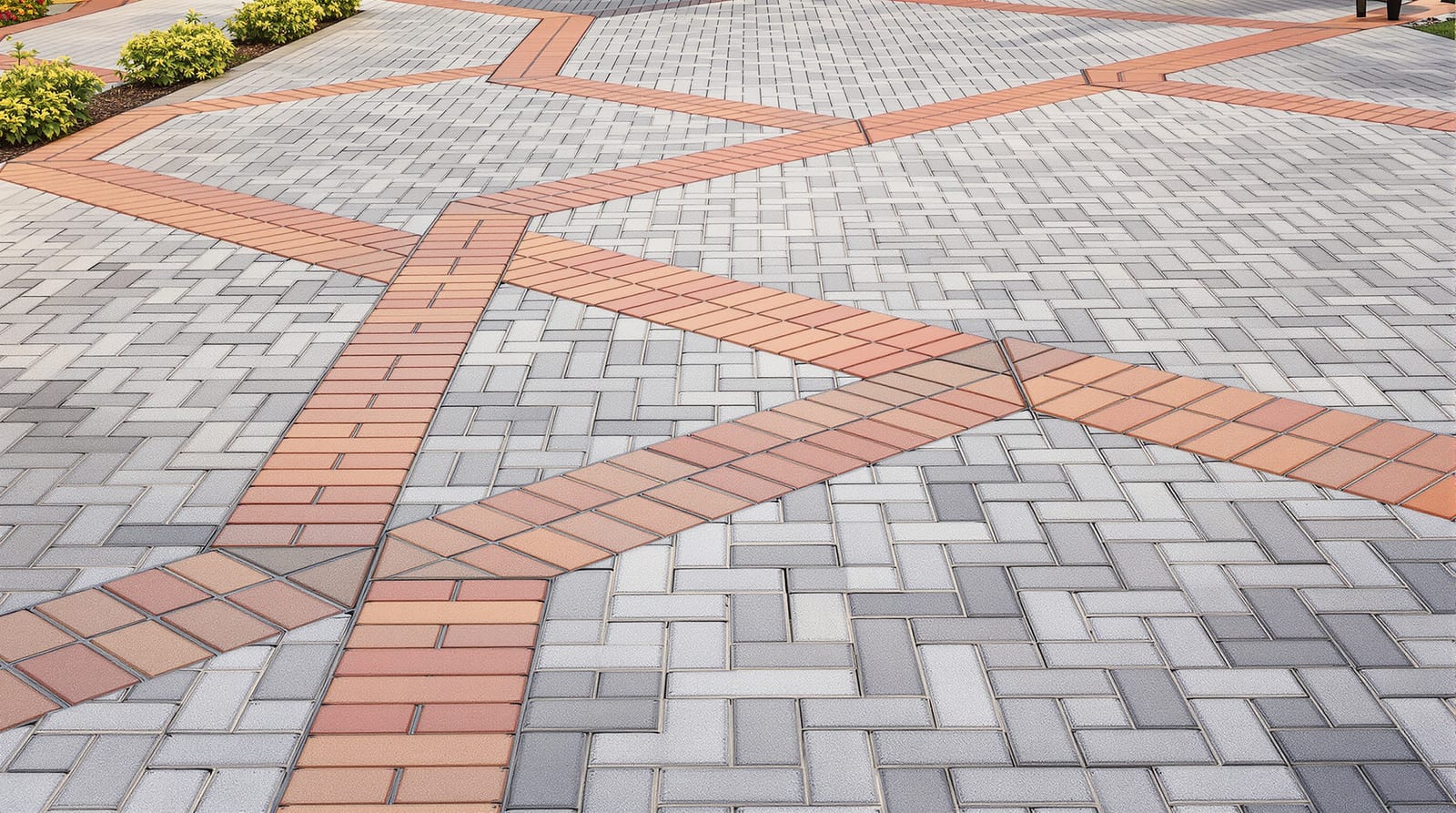
Paver Blocks in India: Shapes, Thickness Grades, Strength & ₹30–90 per Sq Ft Cost Guide
Precast interlocking concrete paver blocks for driveways, parking, footpaths, society roads, gardens and terraces — how to pick the shape, the right thickness (60/80/100 mm) and strength grade (M30–M50) for the load, IS 15658, sand-bed laying, finishes and ₹30–90 per sq ft pricing.
Paver blocks are the small, precast interlocking concrete units you see surfacing driveways, parking aprons, footpaths, society internal roads, garden paths and terraces across India. Each block is a moulded piece of high-strength concrete, shaped so its edges lock into its neighbours, and the whole field is laid dry over a compacted base and sand bed — no mortar, no curing wait, and any block can be lifted and reset years later. This guide covers the shapes, the thickness grades that match the load, the M30–M50 strength bands, IS 15658, how the blocks are laid the right way, finishes and colours, and what to budget at ₹30–90 per sq ft before laying.
Where our natural stone pavers guide covers cut-stone paving, this one is about the cheaper, uniform, factory-made concrete alternative — the workhorse of Indian outdoor paving.
What a paver block is — and why it interlocks
A paver block (the industry also calls it a Concrete Block Paving unit, or CBP) is a precast concrete unit made by vibro-compacting a stiff cement-and-aggregate mix in steel moulds, often with a stronger, denser face layer cast on top for wear and colour. The blocks are cured, then stacked dry on site and laid in a pattern with tight 2–3 mm joints filled with fine sand.
The magic is the interlock. Because the blocks are shaped to grip each other and the joints are packed with sand, a load pressing on one block is shared sideways across its neighbours rather than punching straight down. The whole surface behaves as a flexible, load-spreading mat. That is why a properly laid paver field carries cars and even trucks without an RCC slab underneath — the interlock plus a good compacted base does the structural work. It is also why a poorly laid field fails: skip the edge restraint or the compaction and the blocks creep apart, the interlock is lost, and you get rutting and settlement.
Shapes: more than just looks
The shape decides how well blocks interlock, how much they resist sideways creep under braking and turning vehicles, and the laying pattern.
| Shape | Description | Interlock strength | Best suited to |
|---|---|---|---|
| Zigzag | Wavy S-edges that lock on all sides | High — resists vehicle creep | Driveways, parking, society roads |
| I-section (dog-bone) | Dumbbell/H profile gripping front and back | High | Driveways, heavy parking, internal roads |
| Uni / Unipaver | Hexagonal dentated edges, all-round lock | Very high | Heavy-duty parking, ports, industrial yards |
| Rectangular / brick | Plain rectangles, laid stretcher or herringbone | Medium (high if herringbone) | Footpaths, patios, paths, decorative areas |
| Dumbbell | Symmetric waisted block | High | Driveways, parking |
| Square / cosmic / cobble | Decorative squares and faux-cobble | Low–medium | Gardens, patios, light foot traffic |
| Grass paver | Cellular block with open pockets for grass | Light loads | Green parking, eco driveways |
A simple rule: for anything a vehicle drives on, choose an interlocking shape (zigzag, I-section, Uni or dumbbell) and lay it in a herringbone bond, which locks the field against the twisting forces of turning and braking wheels. Plain rectangular blocks and decorative squares are fine for footpaths, patios and gardens where loads are light. Grass pavers are a special case — open cellular blocks that grow grass through them for a permeable green driveway; we cover those in the grass pavers and permeable flooring guide.
Thickness and strength: match the block to the load
This is the specification that matters most, and the one cheap jobs get wrong. Paver blocks are sold by thickness (which governs load capacity) and compressive strength grade (M30 to M50), both standardised by IS 15658:2006, the Indian Standard for precast concrete blocks for paving. Pick the thickness for the traffic, not the price.
| Thickness | Strength grade | Traffic / load class | Typical use | ₹/sq ft (material) |
|---|---|---|---|---|
| 50–60 mm | M30 | Non-traffic / light pedestrian | Footpaths, garden paths, patios, building margins | 30–45 |
| 65–80 mm | M35–M40 | Light to medium vehicle | Home driveways, society roads, car parking | 40–65 |
| 80–100 mm | M40–M45 | Medium to heavy vehicle | Bus stops, commercial parking, mandi/loading areas | 55–80 |
| 100–120 mm+ | M45–M50 | Heavy / industrial | Container yards, ports, factory roads, truck terminals | 70–90+ |
The headline numbers most homeowners need: 60 mm for footpaths and pedestrian areas, 80 mm for a car driveway or parking, and 100 mm and above for anything carrying trucks or industrial loads. IS 15658 sets the minimum average 28-day compressive strength (commonly M30, M35, M40, M45 and M50 grades, i.e. 30–50 N/mm²) and also limits water absorption to around 6 percent and abrasion resistance — so a block stamped to the standard genuinely carries its rated load. Ask your supplier for the IS 15658 grade and a test certificate; a surprising amount of cheap local paving is under-strength.
How paver blocks are laid
The blocks are only as good as the base under them. A correct flexible-paving build-up, from the bottom up, is: compacted earth (subgrade), then a compacted granular sub-base (GSB / crushed aggregate, typically 100–200 mm deep depending on traffic), then a 30–50 mm screeded sand bedding layer, then the paver blocks, with fine joint sand brushed in and the whole surface vibrated with a plate compactor.
Three things make or break the job:
- Edge restraint. The perimeter of every paver field must be held by a kerb, concrete edge beam or restraining course. Without it, the outer blocks creep outward under load, joints open, and the interlock unravels from the edges inward. This is the single most common cause of paver failure in India.
- Joint sand and compaction. Fine sand brushed into the 2–3 mm joints, then plate-compacted, is what locks the blocks together. The field is compacted twice — once to seat the blocks, then again after sanding. Skipping this leaves a loose, rocking surface.
- Falls for drainage. Slope the surface at least 1 in 50 to 1 in 80 (about 1.5–2%) away from the building so monsoon water sheds to a drain or channel rather than pooling and washing out the bedding sand.
Done correctly, the surface is usable immediately — there is no curing wait as with poured concrete, which is one of the big practical advantages of paver blocks for occupied homes and busy society compounds.
Finishes, colours and the wearing face
Most quality paver blocks are two-layer: a stronger, denser top face (with finer aggregate and often colour pigment) cast over a structural backing. That face is what wears and what you see. Common finishes:
- Plain / smooth — the standard moulded face, grey or coloured; economical, slightly slippery when wet and polished, fine for parking.
- Shot-blasted / matt — a textured anti-skid surface, the safest for monsoon and ramps.
- Exposed-aggregate face — the top washed to reveal decorative aggregate, a premium look that overlaps with exposed aggregate flooring.
- Coloured — integral iron-oxide pigments give red, terracotta, yellow, charcoal, green and tan. Colour is in the face layer, so heavy traffic can fade or expose the grey base over years — a real trade-off versus through-body natural stone.
For wet ramps, footpaths and any sloping drive, choose a shot-blasted or textured face (roughly DIN R11–R12) over a smooth glossy one; our anti-slip flooring for wet areas guide explains slip ratings.
Pros and cons
| Pros | Cons |
|---|---|
| No curing wait — usable immediately after laying | Settling, rutting and weeds if base, edge restraint or compaction are skimped |
| Any block can be lifted and reset (utilities, repairs) | Surface colour can fade or wear to expose grey base |
| Permeable joints aid drainage and groundwater recharge | Joint sand needs occasional topping up; weeds in joints if neglected |
| Cheaper than natural stone; uniform sizing | Looks more industrial / uniform than natural stone |
| Semi-DIY for small light-duty areas | Vehicle areas need proper sub-base + plate compactor (not a true DIY job) |
| Durable, IS 15658 load-rated, repairable | Cheap under-strength local blocks crack and dust |
The headline failure mode is worth repeating: paver blocks almost never fail because the block is weak — they fail because the base was not compacted, the edge was not restrained, or the falls were wrong, so the field settles and the joints open and weeds and water get in. Spend on the base and the edges, not just the blocks.
Where each thickness suits
- Garden paths, patios, building margins, footpaths — 60 mm, M30, plain or decorative shape, sand-set. The classic semi-DIY job.
- Home driveway and car parking — 80 mm, M35–M40, zigzag or I-section in herringbone bond, on a properly compacted GSB base with a kerb restraint.
- Society internal roads and visitor parking — 80 mm (cars) to 100 mm (mixed light vehicles), Uni or I-section.
- Commercial parking, bus bays, loading areas — 100 mm, M40–M45, Uni-shaped.
- Industrial yards, ports, truck terminals — 100–120 mm+, M45–M50, on an engineered base.
Paver blocks vs natural stone pavers
This is the real choice most Indian homeowners face for a driveway. Both are lift-and-reset modular paving; they trade cost against character.
| Concrete paver blocks | Natural stone pavers | |
|---|---|---|
| Material | Precast cement + aggregate | Real quarried stone |
| Cost (material) | ₹30–90/sq ft | ₹60–250/sq ft |
| Strength | Graded by thickness, IS 15658 | Very high (granite/basalt) |
| Look | Uniform, industrial; colour can fade | Unique, natural, ages gracefully |
| Interlock | Engineered shapes self-lock | Plain units rely on bedding |
| Best for | Driveways, parking, society roads, footpaths | Premium patios, entrance courts, pool decks |
In short, concrete paver blocks are the value workhorse for large vehicle areas and footpaths, and natural stone pavers are the showpiece for areas that are seen. Many homes mix them — paver blocks for the bulk parking and a band of stone for the entrance.
To size a job, our paver block calculator turns area into block count, sand and base quantities. For where paving sits among all the alternative outdoor and specialty floors, see the specialty flooring guide and the broader outdoor flooring guide. If you want a permeable green driveway, compare grass pavers and permeable flooring; for terraces and utility areas, interlocking paver tiles are a quicker dry-lay alternative.
Frequently asked questions
What thickness of paver block should I use for a driveway?
Use 80 mm thick blocks of M35–M40 grade for a home car driveway or parking, laid in a herringbone bond on a properly compacted granular sub-base with a kerb edge restraint. 60 mm blocks are only for footpaths, patios and pedestrian areas. For trucks and industrial yards, step up to 100 mm or more at M45–M50. Match the thickness to the heaviest vehicle that will use it, not to the budget.
What is IS 15658 and why does it matter?
IS 15658:2006 is the Indian Standard for precast concrete paver blocks. It defines the strength grades (M30 to M50), the minimum 28-day compressive strength, water absorption limits (around 6 percent) and abrasion resistance. A block made to IS 15658 genuinely carries its rated load, while cheap under-strength local blocks crack and dust under traffic. Always ask your supplier for the grade and a test certificate.
Why do paver block driveways sink or develop weeds?
Almost always because the base or the edges were skimped, not because the block was weak. A paver field needs a well-compacted granular sub-base, a level sand bed, joint sand vibrated in, and — critically — a kerb or concrete edge restraint around the perimeter. Without edge restraint the blocks creep apart, joints open, water and weed seeds get in, and the surface ruts. Get the base, compaction and edging right and the field stays tight for decades.
How much do paver blocks cost in India?
Material runs roughly ₹30–45 per sq ft for 60 mm footpath blocks, ₹40–65 for 80 mm driveway blocks, and ₹55–90+ for 100 mm+ heavy-duty blocks, plus 18 percent GST. Laying — base preparation, sand bedding, blocks and compaction — typically adds ₹25–60 per sq ft depending on the sub-base depth and area. Prices are indicative and vary by city, brand and order size.
Can I lay paver blocks myself?
For a small light-duty area — a garden path or patio in 60 mm blocks over a sand bed — it is a realistic semi-DIY job. A driveway or parking area is not, because it needs a properly compacted granular sub-base, a plate compactor for seating and re-compaction, accurate falls and a solid edge restraint, all of which are easy to get wrong and expensive to redo. For vehicle areas, use an experienced paving contractor and specify the IS 15658 grade and thickness in writing.
Export this guide
Related Guides — Deep-dive reading
Natural Stone Pavers in India: Cost, Thickness & Laying Guide for Driveways & Patios
Cut-to-size sandstone, granite, limestone, basalt and cobble paving units for driveways, patios, garden paths and pool decks — how to pick the stone, the right thickness for the load, anti-skid finishes, sand-set vs mortar vs pedestal laying, and ₹60–250 per sq ft pricing.
Flooring & SurfacesDriveway Flooring in India: Best Surfaces for Load, Wet Grip & Drainage
How to choose a driveway floor that carries vehicle weight, grips in the monsoon, sheds water and still adds kerb appeal to your home.
Flooring & SurfacesHome Parking Flooring in India: Best Surfaces for Car Porch, Driveway & Garage
How to choose a parking floor that takes vehicle load, resists tyre marks and oil drips, drains the monsoon and still looks good.
Flooring & SurfacesRelated Tools — Try Free
Paver Block Calculator
Estimate concrete paver blocks, bedding sand and cost for a driveway, path or parking by area and thickness.
Flooring CalculatorDriveway Flooring Cost Calculator
Estimate driveway surfacing cost — paver blocks, exposed aggregate, stamped concrete, cobblestone or grass paver.
Flooring CalculatorModular Kitchen Budget Calculator
Live breakdown by running feet, countertop area, material tier and city — with wastage, design fee, GST.
Kitchen Calculator