
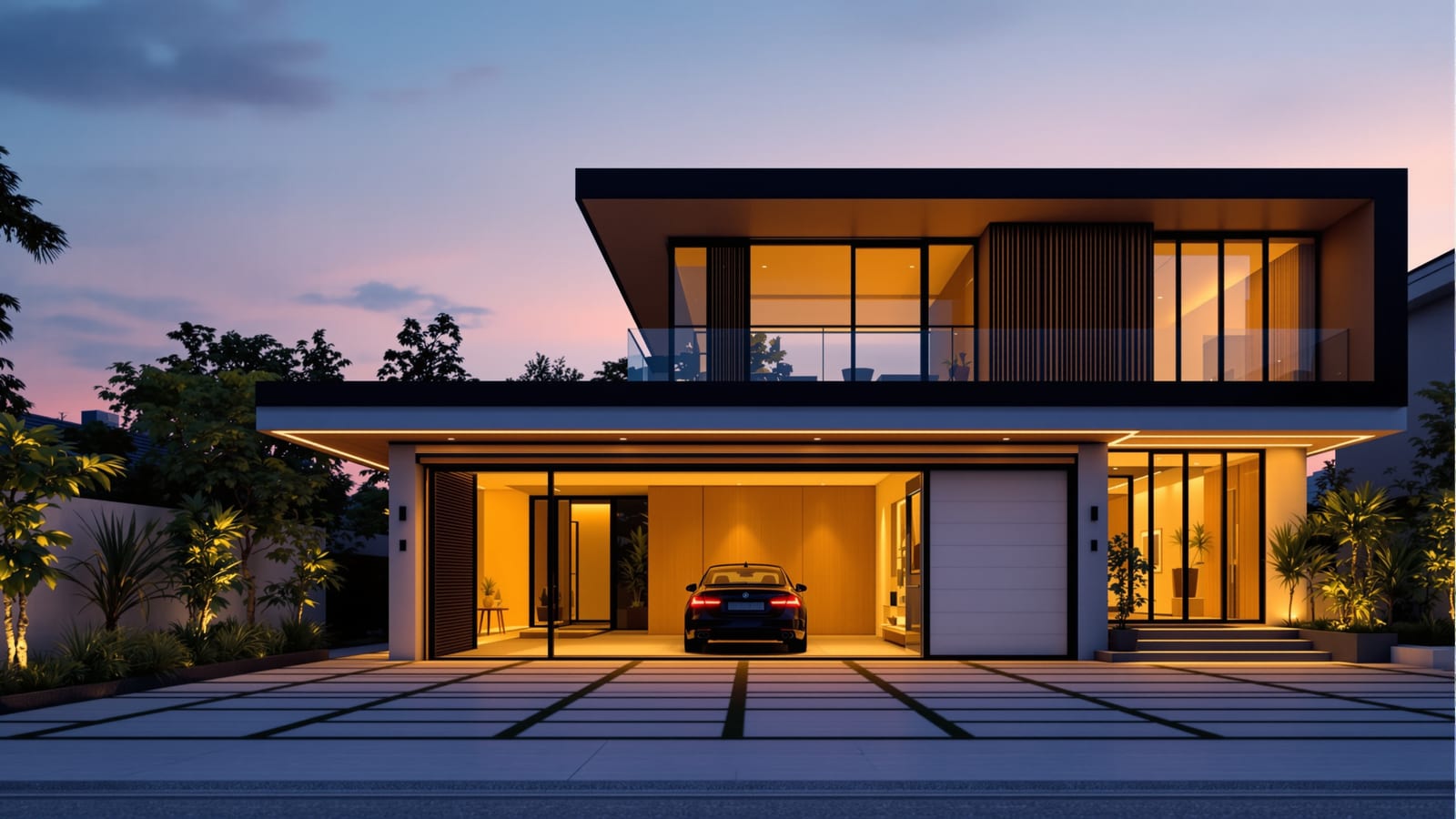
Smart Garage Doors & Openers for Indian Homes (2026 Guide)
A garage door is the largest moving object in most homes, and a heavy one. This guide covers smart garage doors and openers for Indian homes end to end — motorised sectional, roller and sliding doors; what a smart opener actually adds; retrofit controllers versus smart openers; the safety sensors you must never skip; rolling-code security; the manual release for power cuts; integration with cameras and your wider smart home; and real brands with ₹ prices.
The garage door is the one part of a smart home that can genuinely hurt someone. It is the heaviest moving object in the house, it runs on a powerful motor, and it is often the door people use most — arriving tired at night, hands full of shopping, a child or a scooter passing underneath. Making it "smart" is wonderful when it means you never again wonder whether you left it open, and dangerous when a cheap kit skips the safety sensors that stop it crushing whatever is in its path. This guide treats both halves seriously: the convenience that makes a smart garage door worth it, and the safety and security that make it worth trusting. It sits alongside our ultimate guide to smart homes in India and, for the boundary wall, our guide to motorised gate automation.
A smart garage door should do exactly two things flawlessly: close when you forget, and refuse to close on a person, a pet or a car. Every app, every voice command and every arrival trigger is a bonus stacked on top of those two duties — and worthless if either one fails.
What "smart" actually adds to a garage door
A plain motorised garage door already opens and closes from a remote clipped to your car's visor. "Smart" is the layer that connects that motor to your phone and your home network. In practice it buys you a specific, useful set of things.
| Smart feature | What it does | Why it matters in India |
|---|---|---|
| App open/close | Operate the door from your phone anywhere with internet | Let in the maid, a delivery or a relative when you are not home |
| Status alerts | Push notification when the door opens, closes or stays open | The single most valued feature — "did I leave it open?" answered instantly |
| Auto-close timer | Shuts the door automatically after a set time if left open | Guards against the classic "drove off with it open" mistake |
| Voice control | Open or close via Alexa or Google (usually PIN-gated) | Hands-free when arriving; the close command needs no PIN, open should |
| Geofencing | Opens automatically as your phone approaches home | No fumbling for a remote in the rain; convenient but use with care |
| Scheduling | Close every night at 11 pm regardless | Backstop for a forgetful household |
| Sharing | Give family members or guests app access, revoke anytime | Better than copying physical remotes |
Notice what is missing from that list: none of it makes the door itself safer or stronger. Smart is about awareness and remote control. The mechanical safety — that the door reverses off an obstruction — comes from the opener and its sensors, not the app, and it must be there whether the door is smart or not.
Door types and openers
Before you go smart, get the door type right, because the opener and the automation depend on it. Indian homes use three broad styles.
| Door type | How it moves | Best for | Typical bare door cost |
|---|---|---|---|
| Sectional | Hinged panels roll up along a ceiling rail | Standard garages with headroom; most common premium choice | ₹45,000 – ₹1,50,000 |
| Roller shutter | A curtain of slats coils into a drum above the opening | Low-headroom garages, shopfront-style openings, tight sites | ₹25,000 – ₹90,000 |
| Sliding / side-hinged | Slides sideways along a track or swings out | Wide openings, sheds, where ceiling space is used | ₹30,000 – ₹1,20,000 |
Each pairs with a matching opener (the motor unit): a trolley/rail opener for sectional doors, a tubular or side-mount motor for roller shutters, and a sliding-gate-style motor for sliding doors. Opener drive types matter for noise and maintenance: belt drive is quietest (good if a bedroom sits over the garage), chain drive is cheapest and noisiest, and screw/DC direct drive sits in between and is common on modern smart units. For a heavy door, motor torque and duty cycle matter more than any app feature — undersize the motor and it will strain, overheat and fail early.
Retrofit controller versus a smart opener
There are two honest routes to a smart garage, and the right one depends on what you already own.
Retrofit smart controller — a small Wi-Fi bridge (the category the American Chamberlain myQ made famous) that wires into your existing opener's terminals and adds a door-position sensor. It gives you app control, alerts and auto-close without replacing the motor. It is the cheaper, less disruptive path and ideal when your current opener is healthy but "dumb."
Smart opener — a new motor unit with Wi-Fi built in. You get one clean app, better warranty coverage and native voice integration, but you are replacing the whole opener. This is the right choice when the door is new, the old motor is dying, or you want everything from one brand.
| Retrofit controller | Smart opener | |
|---|---|---|
| Works with | Your existing motor | Replaces the motor |
| Typical cost | ₹4,000 – ₹12,000 | ₹18,000 – ₹55,000 (motor + smarts) |
| Disruption | Wire in, mount a sensor, an afternoon | Full opener swap and re-tension |
| Best when | Motor is fine, you want smarts cheaply | New door, dying motor, one-brand tidiness |
| Watch-out | Must be compatible with your opener's logic and safety wiring | More cost; commit to one ecosystem |
A crucial note: whichever route you take, the safety sensors are part of the opener, not the smart layer. A retrofit controller must never bypass or disable the opener's own photo-eyes to force a close. If a kit offers "close even when the beam is blocked," walk away.
Sensors and safety — the part you never skip
This is the section that matters more than any other in the guide. A powered garage door can exert enough force to injure a child or crush a bumper. Every properly built opener carries two independent safety systems, and international safety codes (UL 325 in the US, the EN 13241 / EN 12453 family that Indian premium brands design to) require them.
- Photo-electric eyes (photo-eyes) — a pair of sensors mounted low on each side of the opening, projecting an invisible beam across the threshold. If anything breaks the beam while the door is closing, the door must stop and reverse. This is why the sensors sit near the floor: that is where a child or pet would be.
- Auto-reverse on contact (force sensing) — the motor monitors resistance. If the door meets an obstruction on the way down — a car roof, a bicycle — it senses the extra force and reverses before it can crush.
Two practical rules follow. First, test the auto-reverse every month: place a roll of cloth or a plank flat under the closing door — it should reverse the moment it touches, or the moment the photo-eye beam is broken. If it does not, stop using the automatic close until it is fixed. Second, never let remote convenience defeat safety. Auto-close timers and geofencing are safe only because the photo-eyes will still stop the door — they must never be paired with a controller that ignores the beam. Because a smart door can be triggered when you are not standing there watching, working sensors matter more on a smart door than on a manual one, not less.
Security: rolling codes and app access
An old garage remote sent a fixed radio code that a cheap scanner could capture and replay. Modern openers use rolling code (each press uses a new, one-time code from a synchronised sequence — Chamberlain's Security+, Hörmann's BiSecur, Somfy's RTS/io), which defeats replay attacks. Insist on a rolling-code opener; a fixed-code unit is a security hole on your home's biggest door.
The smart layer adds its own surface to secure:
- Voice open should require a PIN. Alexa and Google can close a garage without a code, but opening by voice should demand a spoken PIN — otherwise anyone shouting through a window could open it.
- Use a strong, unique app password and enable two-factor on the manufacturer account. The garage app is a key to your house.
- Revoke shared access when a helper or tenant leaves, and audit who has app access periodically.
- Keep firmware updated — updates patch the openers and bridges against known flaws.
Treat the garage as one entry in a layered home defence. Pair it with the wider smart home security system and the smart door locks on the door between the garage and the house — that internal door, not the big garage door, is often the softest point once someone is inside.
Power cuts and the manual release
India's realities demand this: every powered garage door must have a manual release, a red-corded lever that disengages the trolley from the opener so you can lift the door by hand during a power cut. Know where it is and how it works before you need it — being stuck outside a jammed garage in a downpour is a bad time to learn. Two protections make outages livable:
- Battery backup opener — a built-in battery runs the motor for a number of cycles during an outage, so the door still works normally. Worth paying for in areas with frequent cuts.
- External manual release kit — for detached garages with no internal door, a lock-and-cable release lets you disengage the trolley from outside, so a power cut does not lock you out entirely.
If you add battery backup or an inverter feed, size it for the motor's surge current, not just its running watts — a garage motor draws a heavy spike at start.
Integrating with your smart home and cameras
A smart garage becomes far more useful when it talks to the rest of the home. The pairing that pays off most is a camera at the garage: link the opener to a CCTV or a smart camera so that an "opened" alert arrives with a clip of who opened it. Beyond that, useful automations include closing the garage when your home switches to "Away," turning on the garage light for a few minutes whenever the door opens after dark, and announcing on your speakers if the door has stayed open past a set time. Most smart openers and myQ-style bridges work with Alexa and Google; native cross-brand control through Matter is still limited for garage openers in 2026, so check compatibility before assuming your door will sit neatly in one dashboard. If you are planning the whole system, our home automation platform choices guide covers how these pieces fit, and you can size the spend with the smart home cost calculator. Even a well-wired garage door and a fully automated home theatre setup can share the same "Away" and "Home" scenes, so arriving home can open the garage and warm up the media room in one trigger.
Brands and pricing in India
The Indian market spans imported premium systems and capable local motors. Prices below are installed ballparks for 2026 and vary with door size, weight and city.
| Brand / system | What they offer | Indicative installed price |
|---|---|---|
| Hörmann | Premium German sectional doors + smart openers (BiSecur) | ₹1,20,000 – ₹4,00,000+ |
| Gliderol | Roller and sectional doors, motorised, widely serviced in India | ₹55,000 – ₹1,80,000 |
| Chamberlain / LiftMaster (myQ) | Openers and the myQ smart bridge/controller (grey-market and integrator supplied) | Controller ₹6,000 – ₹15,000; opener ₹30,000+ |
| Somfy | Tubular/roller motors + RTS/io smart control and hubs | ₹22,000 – ₹90,000 |
| Roll-A-Door / local fabricators | Motorised roller shutters, budget-friendly, add-on Wi-Fi module | ₹30,000 – ₹90,000 |
A realistic split: a good motorised sectional door with a smart opener lands around ₹1.2–2.5 lakh installed; a motorised roller shutter with a Wi-Fi module can be done for ₹40,000–₹90,000; and a retrofit smart controller on an existing motor is ₹4,000–₹15,000 plus fitting. Spend first on a sound door, a right-sized rolling-code opener and working photo-eyes; add the smart layer once the mechanical core is solid.
Buying and installation checklist
- Confirm the door type and headroom before choosing an opener.
- Insist on rolling-code security and UL 325 / EN 13241-style photo-eyes plus auto-reverse.
- Match motor torque and duty cycle to the door's real weight, with margin.
- Add battery backup or an external manual release if power cuts or a detached garage apply.
- Choose retrofit controller versus smart opener based on your existing motor's health.
- Verify voice-open PIN, app two-factor and firmware update support.
- Get the manual release demonstrated at handover and test auto-reverse yourself.
- Plan camera integration at the garage so alerts arrive with footage.
Done right, a smart garage door is one of the most satisfying upgrades in the house: it ends the nagging "did I close it?" anxiety, lets in the people you trust when you are away, and — most important — reliably refuses to close on anything that should not be under it.
References
- BIS IS 4351: Steel door frames and IS standards for doors and shutters — Bureau of Indian Standards
- UL 325: Standard for door, drapery, gate, louver and window operators and systems
- EN 13241 / EN 12453: Safety in use of power-operated doors — European standard
- Hörmann India — garage doors and BiSecur operators
- Somfy India — motorisation and smart control for doors and shutters
- Chamberlain myQ — smart garage technology and safety documentation
Export this guide
Related Guides — Deep-dive reading
Security Gate Automation Integration in India (2026): Making the Entry One Coordinated Control Point
How to tie an automatic gate into the wider security and smart-home system so the entry becomes one coordinated point of access, camera, intercom and automation — with the honest limits, the convenience that is genuinely risky, and the safety and life-safety essentials you must never skip.
SecuritySmart Home Maintenance & Troubleshooting for Indian Homes
A smart home is not a one-time purchase — it is a small fleet of computers that needs firmware updates, fresh batteries, occasional reboots and a plan for the day a manufacturer switches off the cloud. This guide gives you a maintenance calendar, a troubleshooting flow for the failures Indian homes actually see, and the UPS and security hygiene that keep it all running through power cuts and voltage swings.
Smart HomeSmart Garage Locks in India (2026): Securing the Door and the Car Park
How to secure a home garage or stilt parking in India: smart control of the roller shutter or sectional garage door itself, plus a smart lock on the pedestrian side-door, with pinch-protection and manual-release safety flagged throughout.
SecurityRelated Tools — Try Free
CCTV Camera Coverage & Count Calculator
Estimate how many CCTV cameras you need, the NVR channels, storage in TB for your retention period, and an indicative all-in cost with GST.
CCTV CalculatorGarage Door Cost Calculator
Estimate a home garage door cost by size and type — sectional overhead, roller shutter or side-hinged, with motorisation.
Door CalculatorMotorized Curtain Cost Calculator
Estimate the all-in cost to motorise curtains — motors, tracks, hub and installation.
Cost Calculator