
Industrial CCTV in India: Securing Factories, Warehouses and Plants
How to plan surveillance for large industrial sites — long perimeters, harsh dust-and-heat environments, thermal and PTZ cameras, ANPR at gates, control-room monitoring and the safety-security overlap — and when to bring in a qualified security consultant.
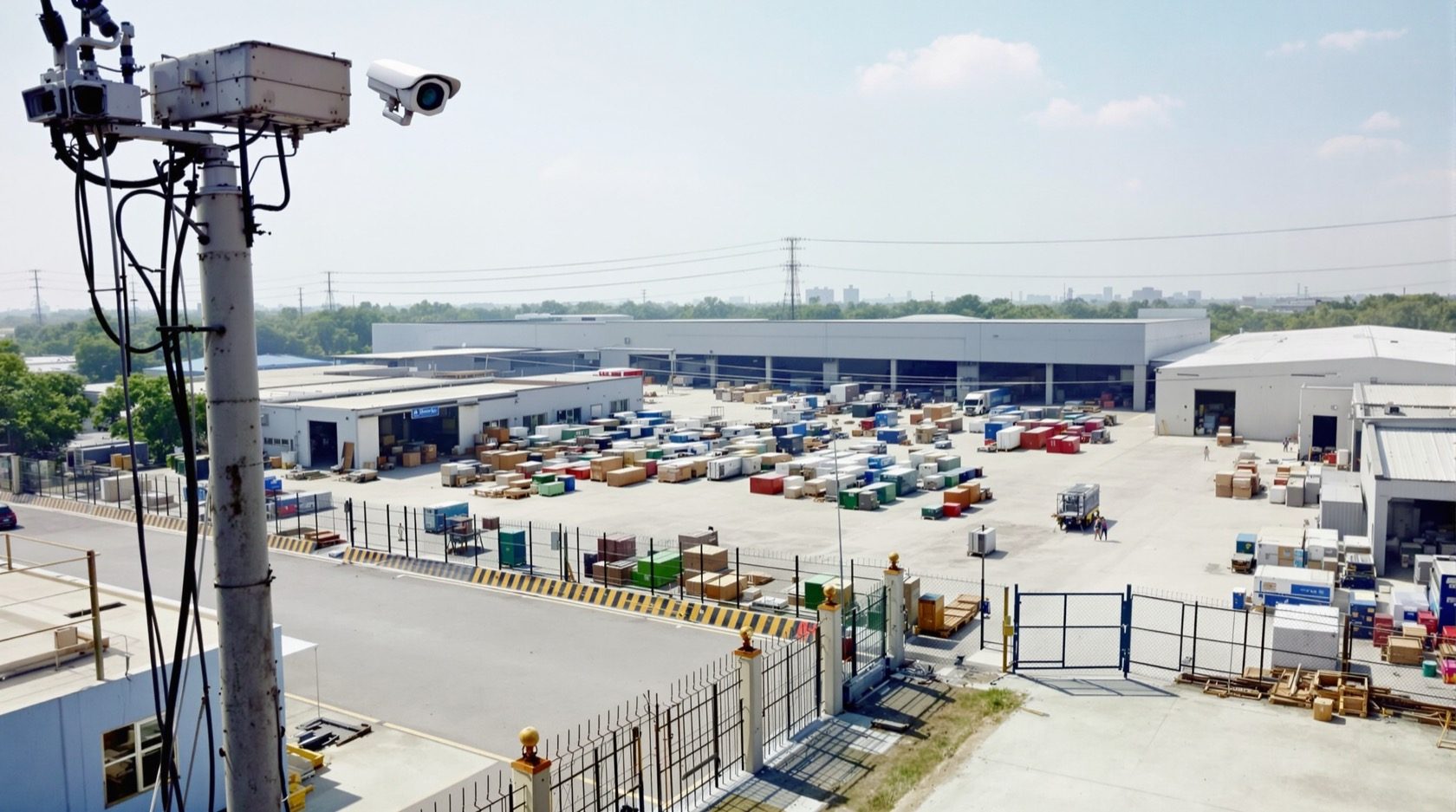
A factory, warehouse or process plant is not a big house — and it cannot be secured like one. The site is measured in acres, not rooms; the boundary is a kilometre of fence, not a front gate; and the cameras live outdoors in heavy dust, monsoon and machine heat all year. Industrial CCTV is a distinct discipline, closer to critical-infrastructure security than to home cameras, and it rewards planning that starts at the perimeter and works inward.
This guide is written for plant and facility managers, project engineers and security consultants planning surveillance for an Indian industrial site. It is the setting-specific companion to the residential CCTV guide and the commercial CCTV guide in Studio Matrx's CCTV hub, and it assumes you already understand the basics from the complete guide to CCTV systems. Here we focus on what makes industrial sites different.
Scope & safety. This guide helps you plan, specify and coordinate. Mains-electrical work, structured cabling, working at height on poles and towers, fire-detection integration and anything in a hazardous (flammable/explosive) atmosphere are strictly licensed-professional tasks — engage the right certified specialists. Surveillance hardware must never obstruct a fire-exit, muster route or safety interlock. Cameras must respect worker privacy and the DPDP Act 2023: monitor operational and security zones with a legitimate purpose, never rest-rooms, changing areas or medical bays.
Why industrial sites are a different problem
Four things set an industrial site apart, and each one reshapes the camera plan.
- Scale. Perimeters run hundreds of metres to kilometres, with open yards, storage areas and vehicle movement. You cannot flood this with fixed cameras alone — you need long-range and PTZ (pan-tilt-zoom) optics and layered detection.
- Harsh environment. Cement and mineral dust, foundry and boiler heat, machine vibration, monsoon moisture and — in some units — corrosive fumes or flammable atmospheres. Consumer cameras die here. You need ruggedised, high-rated housings.
- The safety-security overlap. On a plant, CCTV is not only about intruders. The same cameras help spot accidents, unsafe acts, missing PPE, people straying into restricted or moving-machinery zones, and — with thermal — early fire and equipment hot-spots. This is where surveillance meets life-safety.
- High camera counts and evidentiary duty. Fifty, a hundred, several hundred cameras feeding a control room running 24x7, with footage that may be needed for insurance, statutory investigation or an industrial-dispute inquiry. Storage, redundancy and retention become engineering problems in their own right.
Zones and threats — matching cameras to the site
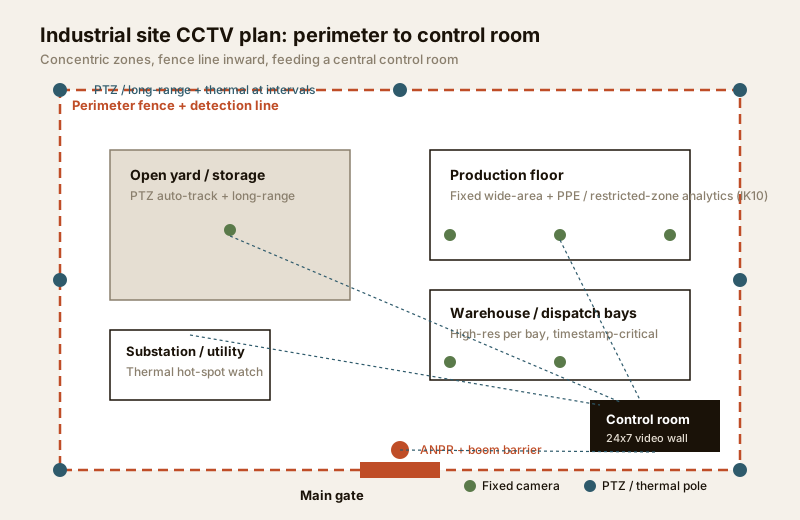
Plan an industrial site as a set of concentric zones, from the fence line inward, and choose the camera type by what each zone must achieve — detect movement, recognise a person or vehicle, or identify a face or number plate. Before you place a single camera, walk the site with a security risk assessment and map the blind spots and lighting gaps.
| Zone / area | Threat | Camera solution |
|---|---|---|
| Perimeter fence | Intrusion, climb-over, cut-through | Fixed bullet/long-range at intervals + thermal for detection in dark; perimeter-detection analytics |
| Open yard / storage | Theft, pilferage, wandering | PTZ for wide coverage + auto-tracking; long-range for the far end |
| Main gate | Unauthorised vehicles, tailgating | ANPR camera for number-plate logging + overview camera; integrate with boom barrier |
| Loading / dispatch bays | Cargo theft, mis-loading, disputes | Fixed high-resolution covering each bay + gate; timestamp-critical |
| Production floor | Accidents, unsafe acts, sabotage | Fixed wide-area + PPE/restricted-zone analytics; vandal-rated (IK10) where reachable |
| Restricted / hazardous zones | Unauthorised entry, ignition risk | Fixed cameras in special-rated housings; integrate with access control |
| Substations / utility | Tamper, fire, overheating | Fixed + thermal for electrical hot-spot detection (life-safety) |
| Control room / server | Tamper with the security system itself | Fixed cameras + strict access; protect the recorder |
The special tools of the industrial site
- PTZ cameras cover large open areas one camera can watch actively — the operator (or an auto-tracking rule) pans and zooms to follow a vehicle across a yard. The catch: a PTZ pointed one way is blind everywhere else, so pair each PTZ with fixed cameras that always watch, and let the PTZ be the "zoom in and follow" tool.
- Long-range cameras with powerful optical zoom and long IR reach read detail across a wide compound or down a long fence line where a normal lens would only see a smudge.
- ANPR (Automatic Number Plate Recognition) cameras at gates log every vehicle in and out — invaluable for a plant with constant truck movement, and for reconciling gate registers with dispatch records. These are purpose-built cameras aimed and lit for plate capture, not general-view cameras.
- Thermal cameras see heat, not light. They detect an intruder in total darkness, smoke or fog far better than optical cameras, making them the backbone of serious perimeter protection — and, pointed at electrical panels, transformers, motors or material stockpiles, they flag hot-spots before a fire starts. That fire/life-safety role makes thermal specification and any linked alarm a certified-professional matter, not a DIY add-on.
For the underlying technology — how these cameras form an image and stream it — see how CCTV systems work; nearly every serious industrial deployment is IP-based for the resolution and analytics, usually wired on fibre and copper for reliability.
Perimeter protection — layers, not a fence
Serious industrial security treats the boundary as layers of detection, so a single failure never means a silent breach. The idea is to detect early, assess, and respond — cameras are the "assess" layer that turns a sensor alarm into a decision.
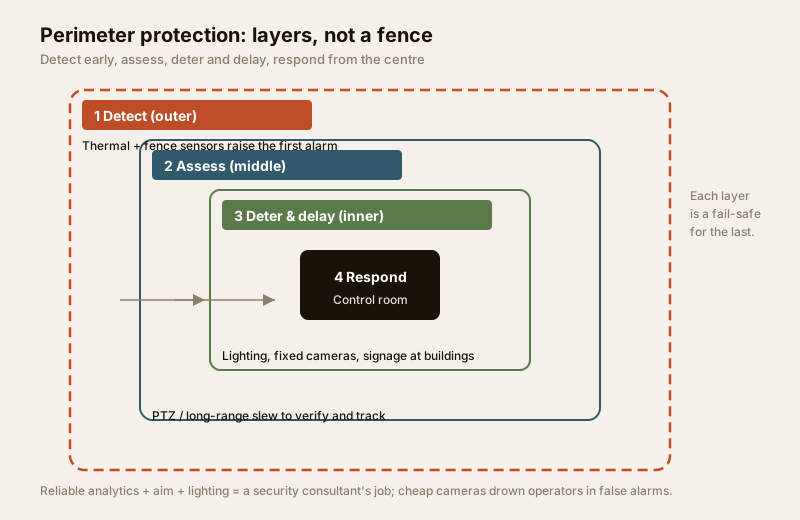
1. Detect (outer). Thermal cameras with intrusion analytics, plus physical fence sensors, raise the first alarm the moment the line is crossed.
2. Assess (middle). A PTZ or long-range camera auto-slews to the alarm point so an operator can verify — real intruder, or a stray dog — before rolling a response.
3. Deter and delay (inner). Good security lighting, prominent fixed cameras and signage at the buildings discourage anyone who gets past the fence and buy time. See the lighting and visibility assessment.
4. Respond (centre). The control room ties it together, logs the event and dispatches guards.
Perimeter analytics on cheap cameras produce endless false alarms from wind, birds and headlights until operators ignore them. Getting the detection line reliable — the right thermal/analytics mix, well aimed, well lit — is exactly what a qualified security consultant earns their fee for.
The harsh environment — ratings that actually matter
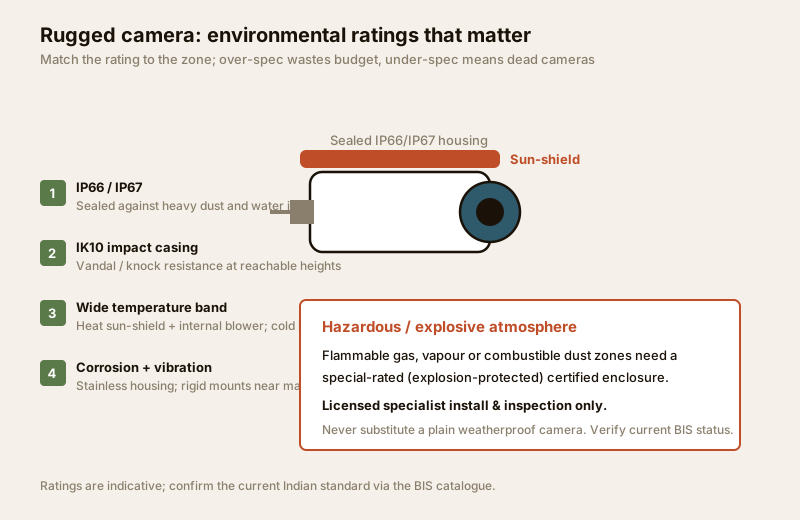
An industrial camera's spec sheet lives or dies on its environmental ratings. Match the rating to the zone; over-specifying everywhere wastes budget, under-specifying means dead cameras within a monsoon.
| Environmental demand | What to look for | Where it applies |
|---|---|---|
| Dust & water ingress | IP66 / IP67 sealed housing | All outdoor cameras; cement, mining, foundry dust |
| Impact / vandalism | IK10 impact-rated casing | Reachable heights, loading bays, production floor |
| Heat | Wide operating range, sun-shield, internal blower | Yards, near boilers/furnaces, rooftop poles |
| Cold / condensation | Built-in heater, anti-condensation | Cold stores, high-altitude sites, monsoon damp |
| Corrosion | Stainless-steel / powder-coated housing | Chemical, coastal, marine, effluent areas |
| Vibration | Rigid mounts, vibration-rated units | Near heavy rotating machinery, presses |
| Flammable / explosive atmosphere | Special-rated (explosion-protected) certified enclosures | Solvent, gas, grain-dust, fuel zones — licensed specialist only |
A word on the last row: any camera in a hazardous atmosphere — where flammable gas, vapour or combustible dust can be present — must use a housing certified for that classified area, installed and inspected by a competent licensed specialist under the applicable statutory scheme. This is not an area to substitute a "weatherproof" camera or improvise. Treat area classification and certified installation as a hard prerequisite, and verify the current Indian standard status via the BIS catalogue rather than trusting a datasheet claim.
Storage, redundancy and the control room
High camera counts at high resolution generate enormous data, and industrial footage often has an evidentiary or statutory retention duty far beyond a home's fortnight. This makes storage an engineering decision, not an afterthought.
- Right-size the recorder(s). Multiple NVRs or a server-based VMS (video management system), not a single 4-channel box. Size disks from bitrate, camera count and required retention days — the cloud-vs-local cost calculator helps compare approaches.
- Build in redundancy. RAID storage so one failed disk does not lose footage, redundant recorders or failover for critical cameras, and dual power paths. A security system that dies with the disk is not evidence-grade.
- Retention and export. Set retention to meet insurance and statutory needs, keep exports timestamped and tamper-evident, and control who can export.
- The control room. A 24x7 monitored site needs a proper control room: a video wall, operators trained on the analytics, an alarm-handling procedure, and integration with the site's other systems.
Integration is where industrial CCTV pays off most. Tie cameras to access control (a card swipe pops the matching camera), to fire and process alarms (an alarm auto-displays the relevant view), and to the ANPR/gate system. Design this integration deliberately — and route the fire-system tie-in through a certified fire specialist, since it touches life-safety. For the wider four-block picture — cameras, alarms, access and resilience — see the building security systems guide.
When to bring in a professional. For anything above a small go-down, engage a qualified security consultant to run the risk assessment, design the zoning and camera plan, and specify the analytics and storage. Then use licensed contractors for the physical work: structured cabling and fibre, pole and tower mounting and any work at height, mains power and UPS/backup, fire-system integration, and — non-negotiable — any camera in a hazardous/explosive area or any thermal fire-detection function. Mains and electrical work belongs to a licensed electrician (see the electrical hub). Self-designing an industrial system is how sites end up with blind spots, false-alarm fatigue and footage that fails when it is finally needed.
Indicative cost bands (India)
Industrial CCTV is quoted per site because scale, environment and integration vary enormously. Treat these as ballparks to sanity-check a proposal, not fixed rates — size your own with the security system cost estimator.
| Item | Typical range (₹) | Notes |
|---|---|---|
| Rugged IP66 fixed camera (4–8MP) | ₹5,000 – ₹18,000 | Volume driver; more for long-range optics |
| Outdoor PTZ camera | ₹35,000 – ₹1,50,000+ | Optical zoom, auto-tracking; yard/perimeter |
| Thermal perimeter camera | ₹1,00,000 – ₹5,00,000+ | Detection range drives price; life-safety spec |
| ANPR gate camera + software | ₹40,000 – ₹1,50,000 | Purpose-built for plate capture |
| Server VMS + RAID storage | ₹1,50,000 – ₹10,00,000+ | Scales with channels and retention |
| Control-room video wall + fit-out | ₹2,00,000 – ₹15,00,000+ | Displays, operator desks, integration |
A mid-size factory perimeter-plus-yard-plus-buildings system routinely runs into several lakh to tens of lakh rupees once thermal, PTZ, ANPR, redundant storage and a control room are included. Plan the cost properly with the consultant rather than chasing the lowest per-camera price.
Key takeaways
- Industrial CCTV is a distinct discipline — plan from the perimeter inward in concentric zones, and match camera type to what each zone must achieve.
- Cover scale with the right tools: long-range and PTZ cameras for open areas, ANPR at gates for vehicle logging, and fixed cameras that always watch behind every PTZ.
- Thermal cameras are the backbone of dark-and-fog perimeter detection and flag electrical/material hot-spots before fire — a certified, life-safety specification.
- Match environmental ratings to the zone: IP66/IP67 for dust and water, IK10 for impact, heat/cold/corrosion measures as needed — and certified special-rated housings, licensed-installed, for any hazardous atmosphere.
- Engineer storage and redundancy (RAID, failover, retention) and run a proper 24x7 control room integrated with access, fire and process systems.
- Engage a qualified security consultant for the design, and licensed professionals for cabling, height work, mains, fire integration and hazardous-area installation.
References
- Digital Personal Data Protection Act, 2023 — monitor operational and security zones with a legitimate purpose; signpost surveillance to workers and visitors; avoid capturing rest-rooms, changing and medical areas.
- Bureau of Indian Standards (BIS) — verify the current Indian standard status for enclosure ingress/impact ratings, hazardous-area equipment classification and electrical installation via the official catalogue: https://www.services.bis.gov.in/
- National Building Code of India (SP 7), BIS, and local factory/fire regulations for the structural, electrical, fire and life-safety aspects of an install — confirm the current edition before relying on it.
This is an educational overview for planning and coordination. Risk assessment and system design should be led by a qualified security consultant; structured cabling, work at height, mains power, fire-system integration and any hazardous-area or thermal fire-detection work are licensed-professional tasks. Verify any standard's current status via the BIS catalogue before relying on it.
Export this guide
Related Guides — Deep-dive reading
How to Choose a CCTV Camera (2026): The Homeowner's Decision Guide for India
Cut through the spec-sheet noise and choose the right CCTV camera for each spot around an Indian home. What actually matters — sensor and low-light performance, lens and field of view, form factor, IP and IK ratings, honest smart features — and the marketing claims to ignore.
SecurityThermal Cameras for CCTV in India: See Heat, Not Light, Explained
How a thermal camera images the warmth of people, animals and vehicles to detect an intruder across a large dark plot, why it cannot show a face or a number plate, and where it fits on an Indian property.
SecurityVisitor Vehicle Management in India: A Professional Guide
The everyday weak point of every society and office gate is not the resident's car — it is the visitor, the cab, the delivery rider and the contractor who must be let in without opening the whole park to anyone. This is the process, not just the hardware: verify at the gate before the boom lifts, park visitors away from resident bays, and never jam the gate a fire tender needs.
SecurityRelated Tools — Try Free
CCTV Camera Coverage & Count Calculator
Estimate how many CCTV cameras you need, the NVR channels, storage in TB for your retention period, and an indicative all-in cost with GST.
CCTV CalculatorCCTV Cloud vs Local Cost Calculator
Compare cloud CCTV subscription against a local NVR + HDD — upfront, 5-year total, monthly fee and break-even.
Cloud vs LocalSecurity System Cost Estimator
Estimate the all-in capex with GST, annual running cost and 5-year total cost of ownership of a home or building security system.
Cost Estimator