
Home Security Risk Assessment Guide for Indian Homes
How to assess your own security risk methodically — a simple Assets x Threats x Vulnerabilities model, a defender's walk-around self-audit, and a likelihood-x-impact matrix that turns worries into a ranked, phased action plan.
Most home-security spending is backwards. People buy the camera they saw an ad for, add a smart lock because a neighbour got one, then still feel uneasy — because none of it was aimed at their actual risk. A good assessment flips the order: understand what you are protecting, from whom, and through which gaps, and only then decide what to buy. This guide teaches you to run that assessment yourself, calmly and methodically, and to turn it into a ranked plan.
It is the front door to security planning within the Home Security Hub. It will not make you a security consultant, but it will let you see your home the way a professional does — as a set of assets, threats and fixable weaknesses — and decide where your first ten thousand rupees should go. When you are ready to score it interactively, the Home Security Risk Scorecard walks the same logic question by question and prints your priority list.
Scope & safety. This is a defensive planning guide. It teaches you to spot and fix weaknesses in your own home — never how to defeat, bypass or exploit any security measure. Life-safety-critical work (fire and alarm systems, mains electrical, electric locks and access control, and any structural perimeter like grilles, gates or a safe room) is qualified work: specify it, then have a licensed professional install and certify it.
The simple risk model: Assets x Threats x Vulnerabilities
Every serious assessment rests on three questions, and risk only exists where all three overlap.
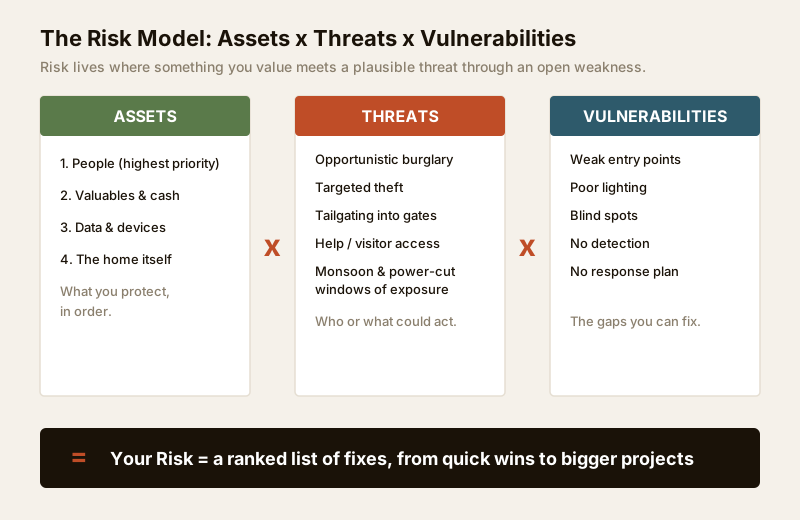
Assets — what you protect, in order. Put them in priority sequence, because that order decides everything downstream:
1. People first. The safety of everyone in the home, always the top asset. Every other measure is secondary to not putting a person in harm's way.
2. Valuables and cash. Jewellery, gold, documents, cash — the classic burglary target in Indian homes.
3. Data and devices. Laptops, phones, the home network, and the personal data on them.
4. The home itself. The structure, fittings and the disruption and cost of a break-in even when little is taken.
Threats — who or what could act. Be honest and specific to your context, not to headlines:
- Opportunistic burglary — the most common by far. An unlocked gate, an open ground-floor window, a dark side passage, a home visibly empty during a festival trip.
- Targeted theft — someone who knows there is gold in the house or that you travel on fixed days. Higher effort, needs planning to defeat.
- Tailgating into gated communities — an outsider following a resident or a delivery rider through the gate, so the "secured" compound is bypassed entirely.
- Domestic help and visitor access — the everyday reality of staff, drivers, delivery agents and tradespeople with routine access. This is about controlled access and accountability, not suspicion.
- Windows of vulnerability — monsoon nights when everyone is indoors and noise is masked, power cuts that kill cameras and lights, and long absences during holidays.
Vulnerabilities — the gaps you can actually fix. These are the only part of the model fully in your control:
- Weak entry points — flimsy doors, cheap locks, ground-floor windows without grilles, a low or climbable boundary wall.
- Poor lighting — dark approaches, gates and side passages where someone can work unseen.
- Blind spots — corners no camera or neighbour can see; the classic rear service yard.
- No detection — nothing that notices an intrusion early: no sensors, no video door phone, no alarm.
- No response plan — even if something is detected, no one knows what to do, whom to call, or how fast the RWA or police can arrive.
Risk is the product, not the sum: a valuable asset (gold) with a plausible threat (opportunistic burglary) through an open vulnerability (an unlatched rear window) is a real risk today. Remove any one factor and the risk collapses — which is why fixing a five-hundred-rupee latch can matter more than a fifty-thousand-rupee camera.
The walk-around: doing your own self-audit
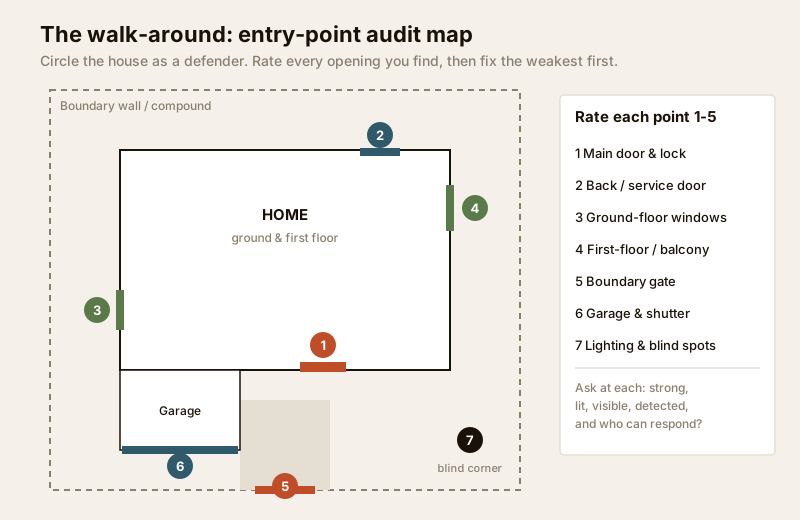
The heart of an assessment is a slow, deliberate lap of your property, viewed as a defender looking for weaknesses to fix. Pick a time you can concentrate — ideally once in daylight and once after dark, because lighting gaps only show at night. Carry your phone to note and photograph each issue.
Approach it from the outside in
Start at the street. How visible is the house? Is it isolated or overlooked by neighbours? Is the approach lit? Then move to the boundary and work inward, opening by opening. At each point ask the same five questions: is it strong, is it lit, is it visible, would an intrusion be detected, and who could respond?
Entry-point-by-entry-point survey
Go around methodically so nothing is skipped:
- Main door. The lock grade, the frame and hinges, whether there is a peephole or video door phone, and whether the door is solid or hollow. This is where you and visitors meet, so it carries both security and daily convenience.
- Back / service door. Often the weakest link — cheaper, less watched, opening to a dark yard. Burglars prefer the door no one sees.
- Ground-floor windows. The most common forced entry. Check grilles, latches and whether an open window is reachable from outside.
- First-floor windows and balconies. Do not assume height protects them — a boundary wall, a drainpipe, a parapet or a neighbour's roof can create a climb.
- Boundary wall and gate. Height, climbability, whether the gate actually locks, and whether it is left open for convenience during the day.
- Garage and shutters. An internal door from the garage into the house is a hidden entry point; the shutter lock is often an afterthought.
- Lighting and blind spots. Walk the dark corners. Any place you cannot be seen from the street or a neighbour is a place worth lighting or covering.
Neighbourhood and context factors
Your home does not sit in isolation. Note the honest answers: How far and how fast is the nearest help — a neighbour, the RWA guard, the local police station? Is the street lit and busy, or dark and quiet at night? In a gated community, how disciplined is gate access, and is tailgating routine? These context factors change how much detection and response you need to build yourself.
Current-measures inventory
Finally, list what you already have and whether it works: locks, grilles, alarm, cameras, lighting, guards, insurance. A camera that no one monitors, or an alarm no one responds to, counts as a gap, not a measure. This inventory becomes your baseline — the "before" you will improve.
The room and zone audit checklist
Use this table to score each zone on a simple 1-to-5 scale (1 = strong, 5 = wide open). Anything you rate 4 or 5 is a candidate for your action plan. This is the same structure the scorecard tool automates.
| Zone / entry point | What to check | Common weakness in Indian homes | Your score (1-5) |
|---|---|---|---|
| Main door | Lock grade, frame, hinges, peephole / VDP | Hollow shutter, single ordinary lock | |
| Back / service door | Lock, visibility, yard lighting | Cheap latch, dark unwatched yard | |
| Ground-floor windows | Grilles, latches, reachability | No grille, weak latch, screen only | |
| First-floor / balcony | Climb routes, grille, door lock | Reachable via wall or drainpipe | |
| Boundary wall & gate | Height, climbability, gate lock | Low wall, gate left open by day | |
| Garage & internal door | Shutter lock, door into house | Unlocked internal door | |
| Lighting | Approach, gate, side passages | Dark side and rear passages | |
| Detection | Sensors, VDP, alarm, cameras | No early warning at all | |
| Access control | Help / visitor entry, keys | Shared keys, no log of who enters | |
| Response | Who is alerted, how fast help comes | No plan, no numbers, no drill |
The point of scoring is not precision — it is to move from a vague "I feel unsafe" to a specific, ranked list you can act on.
Scoring and prioritisation: likelihood x impact
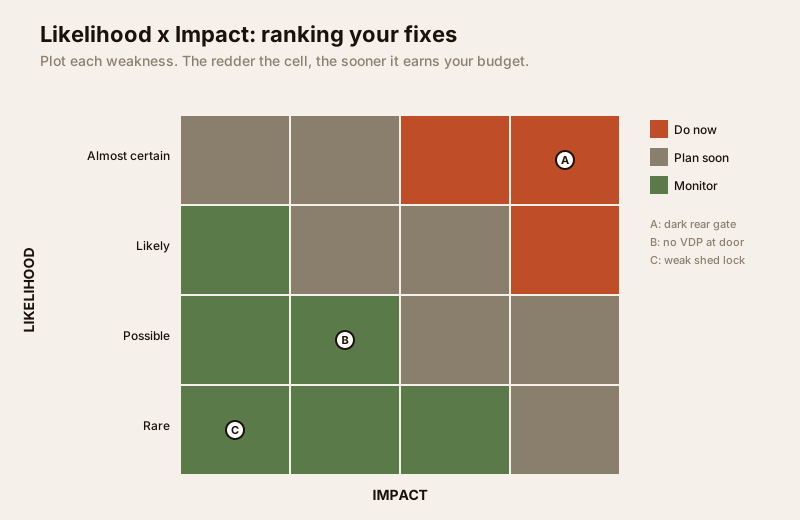
Once you have a list of weaknesses, you cannot fix them all at once, so rank them. The tool professionals use is a likelihood-x-impact matrix. For each weakness, ask two questions: how likely is it to be exploited (given your context), and how bad would the outcome be (given the asset behind it)? Plot the two and the colour tells you the priority.
| Priority | Likelihood x Impact zone | What it means | Typical action |
|---|---|---|---|
| 1 — Do now | High likelihood, high impact | An easy, damaging break-in path | Fix this week, often a quick win |
| 2 — Plan soon | Mixed high / medium | A real gap, but needs budget or a trade | Schedule within the quarter |
| 3 — Monitor | Low likelihood or low impact | Unlikely or minor | Note it; revisit at re-assessment |
Two principles make this practical:
- Separate quick wins from projects. A high-priority fix that is also cheap and fast — a better latch, a motion-sensor light, latching the rear window every night — should jump the queue regardless of anything else. Do the free and near-free items first; they often cut risk more than the expensive ones.
- Weight by asset. A weakness that exposes people (a door that does not lock at night) outranks one that only risks a replaceable device, even at similar likelihood. Let your asset order from the model steer ties.
From assessment to a phased action plan
Turn the ranked list into three honest phases so it feels achievable rather than overwhelming:
- Phase 1 — Quick wins (this month, low cost). Habits and small fixes: lock every gate and door, latch windows nightly, add motion-sensor lights to dark corners, cut the garden that hides the boundary, brief your family and help on routines. Much of this is free.
- Phase 2 — Core upgrades (this quarter, moderate cost). Upgrade weak locks and doors, add grilles where missing, install a video door phone and a basic alarm or camera, and tighten access control for help and visitors. This is where planning pays off — see the guide to upgrading security in existing homes.
- Phase 3 — Bigger projects (this year, higher cost). A fuller CCTV layout, integrated access control, perimeter improvements, or smart-home security integration. If you are building or renovating, fold security into the design from the start with the security planning guide for new homes — retrofitting later always costs more.
Costs vary widely, but as rough Indian ranges to sequence your budget: quick-win habits and a couple of sensor lights, under Rs 5,000; a good main-door lock upgrade and a video door phone, roughly Rs 8,000 to Rs 25,000; a modest multi-camera CCTV and alarm setup, from about Rs 20,000 upward depending on scale. Spend from the top of your priority list down, not from the shiniest product up.
When to bring in a professional
Do the assessment yourself — you know your home best. But hand the work to qualified people wherever life-safety or structure is involved: fire and alarm systems, mains electrical wiring, electric locks and electronic access control, and any structural perimeter such as grilles, gates or a safe room. Specify what you want and why, then let a licensed installer size, fit and certify it. Housing societies and larger properties should consider a one-off professional survey; architects planning new homes can build security in from first principles using the security design guide for architects.
Re-assess periodically
An assessment is a snapshot, not a certificate. Your risk changes — a new gadget worth stealing, a child now home alone after school, a spate of break-ins in the colony, a camera that quietly stopped recording. Re-run the walk-around at least once a year, and always after any incident nearby, any renovation, or any change in who lives in or accesses the home. The scorecard tool makes re-scoring quick, so you can see whether last year's plan actually moved the needle.
Key takeaways
- Risk = Assets x Threats x Vulnerabilities — protect people first, be honest about your real threats, and fix the weaknesses only you control.
- Walk your home as a defender, entry point by entry point, once in daylight and once after dark, scoring each opening 1 to 5.
- Rank with likelihood x impact, then do the cheap, high-priority quick wins before any expensive purchase.
- Phase the plan — habits this month, core upgrades this quarter, bigger projects this year — and spend from the top of the list down.
- Route life-safety and structural work to licensed professionals, and re-assess at least once a year or after any change.
Start your assessment now with the Home Security Risk Scorecard, then browse the full security guides collection to plan each fix in depth.
This is an educational planning guide. It is strictly defensive and does not describe how to defeat any security measure. Fire, alarm, electrical, electronic-lock and structural work is qualified professional work — engage licensed installers and verify any applicable National Building Code or municipal bye-law requirement for your project.
Export this guide
Related Guides — Deep-dive reading
Entry and Exit Assessment for Indian Homes
How to audit every way IN and OUT of your home or building — a complete inventory of doors, gates, windows, balconies and forgotten access points, rated for how easily each could be used to get in and how well it serves escape in an emergency, turned into a hardening priority list.
SecurityHome Lighting and Visibility Security Assessment for Indian Homes
How to assess your home's security lighting after dark — checking every entry, path and boundary for coverage, uniformity and glare, testing what each camera can actually see at night, and turning the findings into a simple lighting plan.
SecuritySecurity for People Living Alone in India (2026): Calm, Practical Habits When There Is No Second Person to Notice
Living alone is an ordinary and growing part of Indian life - the student in a new city, the working single, the elder whose children are abroad, the person after a separation. It does not call for fear. It calls for a few deliberate habits, because there is no second person in the home to notice trouble, raise the alarm, or catch an accident. This is calm self-reliance, layer by layer.
SecurityRelated Tools — Try Free
Security System Cost Estimator
Estimate the all-in capex with GST, annual running cost and 5-year total cost of ownership of a home or building security system.
Cost EstimatorHome Security Risk Scorecard
Score your home across six security layers — perimeter, entry points, lighting, detection, alarm and habits — and get a prioritised action plan.
Security ScorecardSite & Perimeter Security Assessment
Rate your site across five areas — site, neighbourhood, perimeter, entry/exit and lighting — for a readiness score and prioritised fixes.
Site Assessment