

HVAC Operation & Maintenance for Facilities: Keeping It Performing
A commissioned system only stays efficient if it's operated and maintained well — the O&M regime for facility managers: planned preventive maintenance, service contracts, documentation, energy monitoring, and the difference from homeowner upkeep.
A building's HVAC is commissioned to perform on day one — but without ongoing operation and maintenance (O&M), that performance quietly erodes: filters clog, coils foul, controls drift, efficiency slips and comfort complaints rise, until the "new" system runs like an old one. For a facility manager, good O&M is what protects the investment, holds the energy bill down, and keeps occupants comfortable for the system's full life. It's a more structured discipline than homeowner upkeep — planned schedules, contracts, records and monitoring. This guide covers HVAC O&M for buildings.
It builds on the HVAC Design Process Guide and complements the homeowner-focused HVAC Maintenance Guide, part of the HVAC Knowledge Hub.
Scope. An orientation for facility teams. Servicing plant is qualified technician work; this covers the management of O&M, not hands-on repair.
The building blocks of HVAC O&M
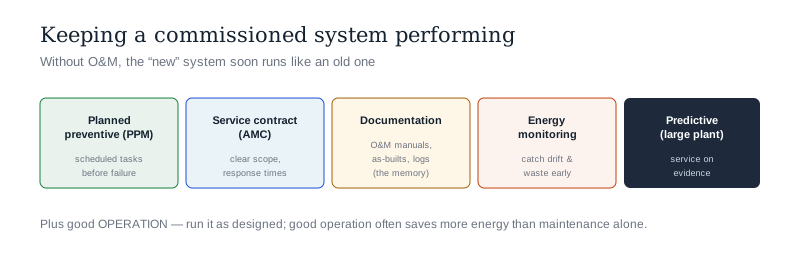
Facility HVAC O&M rests on a few pillars:
- Planned Preventive Maintenance (PPM) — a scheduled regime of tasks by frequency: filter changes, coil cleaning, belt/bearing checks, refrigerant/charge checks, control calibration, chiller and AHU servicing — done before things fail (see maintenance).
- Service contracts (AMC) — an Annual Maintenance Contract with a competent provider, with a clear scope, response times and deliverables; comprehensive vs non-comprehensive (parts included or not).
- Documentation — the O&M manuals, as-built drawings, commissioning records, asset register and maintenance logs — the memory of the system.
- Energy monitoring — tracking consumption (via the BAS/meters) to catch drift and waste early (see efficiency).
- Condition-based / predictive maintenance — on larger plant, monitoring to service on evidence rather than only a calendar.
Together these keep a commissioned system performing rather than degrading.
Operation, not just maintenance
- Run it as designed — correct setpoints, schedules and sequences; an overridden or badly-scheduled BAS wastes energy even on well-maintained plant.
- Respond to the seasons — changeover between cooling and heating, monsoon humidity management, and demand-following operation.
- Handle complaints systematically — comfort/IAQ complaints are data; log, diagnose and resolve them (often a balancing, control or filter issue, not a capacity one).
- Keep IAQ in view — fresh-air rates, filter condition and cleanliness are operational responsibilities, not just comfort.
Good operation often saves more energy than good maintenance alone.
How facility O&M differs from homeowner upkeep
- Scale & criticality — many units and central plant, where downtime and inefficiency have real cost, so it's managed, not ad-hoc.
- Documentation & compliance — records, statutory checks (fire dampers, approvals), and energy reporting matter.
- Contracts & teams — AMCs, in-house teams, and specialist vendors, coordinated.
- Data-driven — monitoring and, increasingly, analytics/predictive maintenance, not just reactive fixes.
- The homeowner version — a single home's maintenance is simpler: clean filters, service the AC, watch for warning signs — the right level for one split.
The one-line answer
A commissioned HVAC system only stays efficient and comfortable with ongoing operation & maintenance — without it, filters clog, coils foul, controls drift and the "new" system soon runs like an old one. Facility O&M rests on Planned Preventive Maintenance (a scheduled regime of filter changes, coil cleaning, servicing and control calibration done before failure), service contracts (AMCs) with clear scope and response times, thorough documentation (O&M manuals, as-builts, commissioning records, asset register, logs — the system's memory), energy monitoring (via the BAS/meters to catch drift early), and, on larger plant, condition-based/predictive maintenance. But it's operation, not just maintenance: running the system as designed (correct setpoints, schedules and sequences), managing seasonal changeover and monsoon humidity, resolving comfort complaints systematically, and keeping IAQ in view — good operation often saves more than maintenance alone. It differs from homeowner upkeep by its scale, documentation, contracts and data-driven management — where a single home just needs filters cleaned, the AC serviced and warning signs watched, a building's HVAC must be managed to protect the investment and hold the energy bill down for the system's full life.
Where to go next
- The homeowner version: HVAC Maintenance Guide.
- Smarter upkeep: HVAC Predictive Maintenance.
- The efficiency lens: HVAC Energy Efficiency Guide.
- Where it starts: HVAC Commissioning Guide · HVAC Design Process Guide.
References
- ISHRAE — HVAC operation & maintenance guidance; ASHRAE Standard 180 (Standard Practice for Inspection & Maintenance of Commercial HVAC Systems).
- National Building Code of India, SP 7 : 2026 (building-services operation); statutory maintenance requirements (fire, safety).
- Bureau of Energy Efficiency (BEE) — building energy monitoring & management: https://beeindia.gov.in/
An orientation for facility teams on managing O&M. Servicing plant is qualified technician work. Verify current standards and statutory requirements before relying on them.
Export this guide
Related Guides — Deep-dive reading
Security System Maintenance Guide (2026): Keeping a Home Security System Working the Night It Matters
The master framework for maintaining a home or building security system in India — the layers to keep working, a daily-to-annual master schedule, the DIY-safe versus professional-only split, when an AMC earns its keep, statutory life-safety servicing, and the discipline of records that ties the whole maintenance library together.
SecuritySmart Home AMC & Servicing in India: Keeping Systems Alive
Why a smart home rots without service — firmware, cloud changes, device end-of-life, dead batteries and network drift — and how to scope an AMC that actually holds: what it covers, realistic ₹ pricing, preventive versus breakdown, SLAs and response times, remote monitoring, integrator versus brand versus third-party, DIY versus AMC, and the contract red flags to refuse.
Smart HomeSprinkler System Maintenance in India (2026): Keeping a Life-Safety System Ready
A fire sprinkler system is a life-safety installation that must work on the one day it is needed — this professional guide covers the scheduled checks, statutory tests and record-keeping that keep a wet, dry or pre-action system live: water supply and pressure, valves in the correct open position, control and alarm valves, sprinkler heads kept clear, and the roles of the competent fire contractor versus the facility manager.
SecurityRelated Tools — Try Free
CPCB Compliance Checklist for STPs
Tick off CPCB/SPCB outlet standards, monitoring duties and record-keeping to score your sewage treatment plant's compliance readiness.
ChecklistBuilding Plan Approval Roadmap
Step-by-step building plan approval process by city with documents, timelines, and fees.
ArchitectAIMonsoon-Readiness Checklist
Pre-rain home audit across 9 categories — terrace, drains, waterproofing, electrical, HVAC, pest, vehicles, documents.
Seasonal Audit