
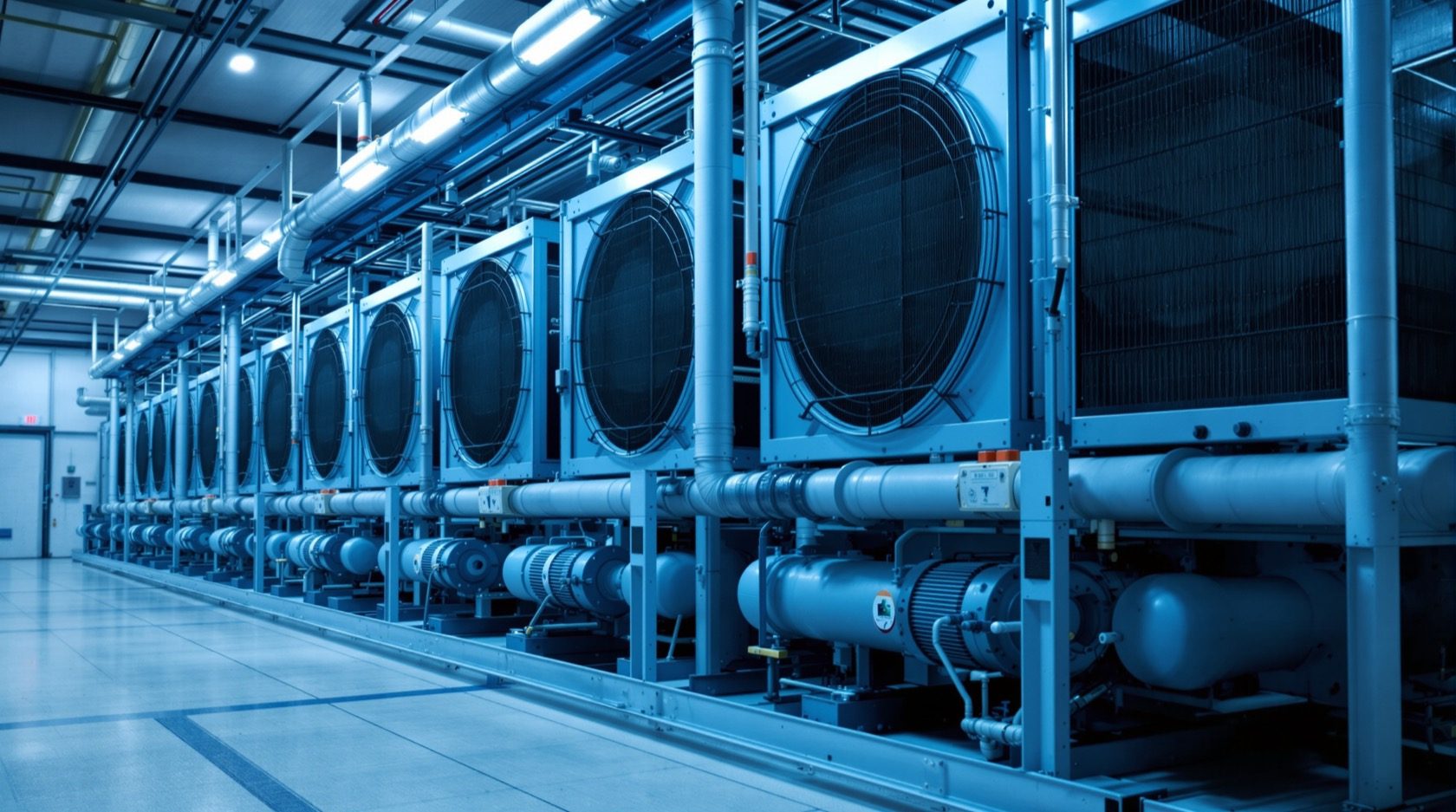
Chillers: How Big Buildings Make Chilled Water for Cooling
The heart of a central plant — what a chiller is, how it makes chilled water, the difference between air-cooled and water-cooled, the compressor types (scroll, screw, centrifugal, absorption), and how to read efficiency (kW/TR, IPLV) when specifying one.
When a building is too big for split ACs or VRF, its cooling comes from a chiller — a large refrigeration machine that doesn't cool air directly but makes chilled water, which is then piped to AHUs and fan-coil units all over the building to cool the air locally. The chiller is the heart of a central air-conditioning plant. This guide explains what a chiller is, how it works, air-cooled vs water-cooled, the compressor types, and how to read chiller efficiency when specifying one.
It builds on the HVAC Equipment Guide, part of the HVAC Knowledge Hub.
The safety line & scope. Chillers are major engineered plant — selection, sizing, installation, commissioning and servicing are qualified MEP/HVAC engineering work. This guide informs understanding and specification.
What a chiller is and how it works
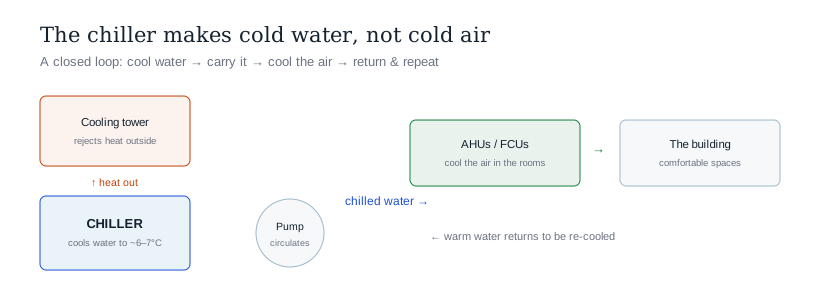
A chiller runs the same refrigeration cycle as an AC, but instead of cooling air over its evaporator, it cools water:
- The chiller's evaporator cools water to ~6–7°C ("chilled water").
- Pumps circulate this chilled water to AHUs/FCUs around the building, whose coils cool the air.
- The warmed water returns to the chiller to be re-cooled — a closed loop.
- The heat the chiller absorbs is rejected outside — either straight to the air (air-cooled) or via a cooling tower (water-cooled).
So the chiller makes cold water; the AHUs make cold air from it. This "central plant + water distribution" is what makes cooling entire large buildings practical.
Air-cooled vs water-cooled
The biggest chiller decision:
| Aspect | Air-cooled | Water-cooled |
|---|---|---|
| Heat rejection | Fans blow air over the condenser | Water + a cooling tower on the roof |
| Efficiency | Lower (uses more energy per TR) | Higher (better at rejecting heat) |
| Water use | None | Uses water (evaporation, blowdown) |
| Cost / upkeep | Lower first cost, simpler | Higher cost + tower & water treatment |
| Best for | Small–mid loads, water-scarce sites | Large loads where efficiency pays back |
Rule of thumb: water-cooled for large plants where efficiency dominates the life-cycle cost; air-cooled for smaller loads or where water is scarce or a cooling tower is impractical.
Compressor types
Chillers are classified by their compressor, which suits different sizes:
- Scroll — smaller chillers; multiple scrolls for staging.
- Screw — mid-range; robust, good part-load with variable-speed.
- Centrifugal — large chillers (hundreds to thousands of TR); very efficient at scale, especially with magnetic-bearing/oil-free and variable-speed drives.
- Absorption — driven by heat (waste heat, gas or solar) instead of much electricity; niche, used where cheap heat is available.
Reading chiller efficiency
How chillers are compared — worth understanding when specifying:
- kW/TR — kilowatts of electricity per ton of refrigeration of cooling. Lower is better (a good water-cooled centrifugal chiller can be well under 0.6 kW/TR; air-cooled is higher).
- COP / EER — coefficient of performance; higher is better.
- IPLV / NPLV — Integrated Part-Load Value — a weighted efficiency across typical part-load operation, which matters because chillers rarely run at full load. Often more meaningful than the full-load figure.
- ECBC (BEE) sets minimum chiller efficiency requirements for commercial buildings — see efficiency.
Because a chiller plant is a building's biggest energy user, small efficiency gains compound into large savings — which is why variable-speed drives and good controls matter so much.
The one-line answer
A chiller is a large refrigeration machine that makes chilled water rather than cooling air directly: it runs the refrigeration cycle to cool water to ~6–7°C, which pumps circulate to AHUs and fan-coil units all over a building to cool the air locally — the heart of a central plant. The heat it absorbs is rejected either straight to air (air-cooled — lower cost, no water, less efficient) or via a cooling tower (water-cooled — more efficient, uses water, best for large loads). Chillers are classified by compressor — scroll (small), screw (mid), centrifugal (large, most efficient) and absorption (heat-driven) — and compared by efficiency: kW/TR (lower is better), COP/EER (higher is better) and IPLV (part-load efficiency, often the most meaningful). Because it's a building's biggest energy user, chiller efficiency and controls dominate running cost — all specified, sized and commissioned by qualified MEP/HVAC engineers.
Where to go next
- The system it serves: Central Air Conditioning Guide.
- What it feeds: Air Handling Unit (AHU) Guide.
- The equipment overview: HVAC Equipment Guide.
- The efficiency angle: HVAC Energy Efficiency Guide.
References
- Bureau of Energy Efficiency (BEE) — Energy Conservation Building Code (ECBC), minimum chiller efficiency: https://beeindia.gov.in/
- ASHRAE Standard 90.1 (energy standard, chiller efficiency & IPLV); ISHRAE — chiller plant design guidance.
- National Building Code of India, SP 7 (Part 8 — Building Services; verify current edition), Bureau of Indian Standards.
Chiller selection, sizing, installation, commissioning and servicing are qualified MEP/HVAC engineering work. Verify any standard's current status via the BIS catalogue before relying on it.
Export this guide
Related Guides — Deep-dive reading
Central Air Conditioning & Chilled Water Systems: Cooling at Building Scale
How the biggest buildings are cooled — the chilled-water plant of chillers, air-handling units, cooling towers and pumps that air-conditions malls, hotels, hospitals and towers, how it differs from unitary and VRF systems, and when a building needs it.
HVAC & CoolingHVAC Equipment: The Components That Make Up a Cooling System
A tour of the machinery behind comfort — the refrigeration components (compressor, condenser, evaporator), the air-side equipment (AHUs, fan-coil units, fans, ducts, dampers, filters) and the plant-side (chillers, cooling towers, pumps), what each does, and how they fit together across systems.
HVAC & CoolingBuilding HVAC Design Guide: From Apartments to Hospitals
How HVAC scales and changes across building types — the systems, loads and priorities for apartments, villas, offices, hotels, hospitals, schools and industrial buildings, and why a hospital's air is designed on utterly different principles from an office's.
HVAC & CoolingRelated Tools — Try Free
Window Energy Savings Calculator
Compare standard glazing vs Low-E and DGU windows — annual cooling savings, 10-year savings and payback.
Window CalculatorApartment Video Door System Planner
Enter flats, entrances, floors and guard desk for a first-pass building intercom plan — door stations, indoor monitors, guard station, the right architecture and an indicative cost band.
Building PlannerLift Running Cost Calculator
Monthly and yearly electricity cost of a home lift by type, trips per day and city.
Lift Calculator