
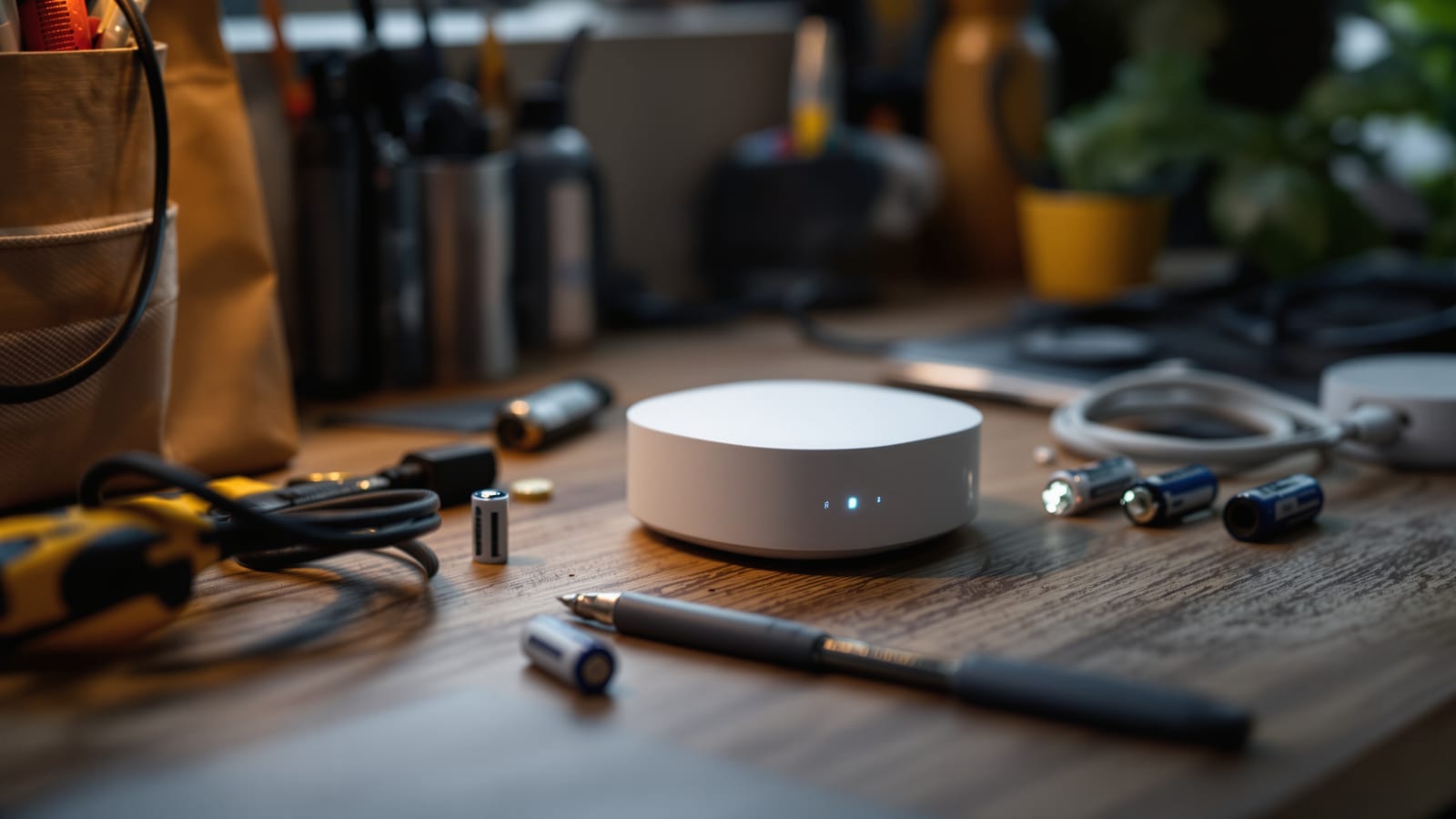
Smart Home AMC & Servicing in India: Keeping Systems Alive
Why a smart home rots without service — firmware, cloud changes, device end-of-life, dead batteries and network drift — and how to scope an AMC that actually holds: what it covers, realistic ₹ pricing, preventive versus breakdown, SLAs and response times, remote monitoring, integrator versus brand versus third-party, DIY versus AMC, and the contract red flags to refuse.
A smart home is not an appliance you buy once and forget — it is a living system of software, cloud services, radios and batteries, all decaying on their own timelines. Firmware ships with new bugs, manufacturers sunset the cloud your app depends on, sensors run flat, and the Wi-Fi mesh that was perfect on handover day drifts as furniture, neighbours and new devices crowd the airwaves. Without a plan to service all of that, even a beautifully commissioned home degrades into "half the automations stopped working and nobody knows why". This guide is the practitioner's view of Annual Maintenance Contracts (AMC) and servicing for Indian smart homes — what to cover, what to charge, and what to refuse.
Hardware is bought once; a smart home is maintained forever. The question is never whether it needs service — only whether that service is planned and paid for, or improvised in a panic at the worst possible moment.
Read this after the smart home maintenance guide for India, which covers the hands-on tasks, and after commissioning and handover, because a good AMC starts from the handover pack. It connects to the smart home installation guide and the smart home regulations guide. For the full context, see the ultimate guide to smart homes in India.
Why smart homes need ongoing service
A conventional electrical installation is largely static — copper does not update itself overnight. A smart home changes underneath you constantly, from five directions at once.
| Decay vector | What happens | Typical interval |
|---|---|---|
| Firmware | Updates fix bugs but also break integrations | Monthly to quarterly |
| Cloud changes | Vendor changes API, app, or shuts a service | Unpredictable |
| Device EOL | Hardware discontinued, no more updates/spares | 3-7 years |
| Batteries | Sensors, locks and remotes go flat | 1-2 years |
| Network drift | New devices and interference erode Wi-Fi/mesh | Continuous |
Any one of these can take down an automation silently. A door sensor with a flat battery does not announce itself — it simply stops arming the alarm. A cloud API deprecation can kill a voice routine overnight with no local symptom. Ongoing service exists precisely because these failures are invisible until someone needs the feature.
What a good AMC covers, and typical pricing
A credible AMC is scoped, not vague. It names the systems covered, the tasks performed, the response commitments, and the exclusions. Below is a realistic scope-and-schedule matrix for an Indian residential AMC.
As a rule of thumb, an Indian smart-home AMC runs at roughly 8 to 15 per cent of the installed system value per year, with parts and end-of-life replacements typically billed on top. A modest two-bedroom automation at around ₹2.5 lakh installed might carry a ₹20,000-35,000 basic-to-standard AMC; a large villa system at ₹15-25 lakh installed can see ₹1.5-3 lakh premium AMCs with monitoring. Use the smart home cost calculator to estimate installed value first, then reason about the AMC as a percentage of it.
| System size | Installed value (indicative) | Typical AMC / year |
|---|---|---|
| Apartment, essentials | ₹1.5-3 lakh | ₹15,000-35,000 |
| Villa, full automation | ₹6-12 lakh | ₹60,000-1.4 lakh |
| Luxury, monitored | ₹15-25 lakh+ | ₹1.5-3 lakh+ |
Preventive versus breakdown
Every service model is a mix of two philosophies. Preventive maintenance is scheduled work that stops failures — firmware review, battery swaps, mesh health checks, backup verification. Breakdown (reactive) service fixes things after they fail. A good AMC weights toward preventive, because in a smart home the reactive failures are the ones that strand a family with no lights or a dead lock at an inconvenient hour.
| Model | What it is | Best for |
|---|---|---|
| Preventive | Scheduled proactive tasks | Keeping systems alive; batteries, firmware, backups |
| Breakdown | Fix after failure | Rare hardware faults, unpredictable events |
| Hybrid (recommended) | Preventive base + reactive cover | Almost every residential smart home |
SLAs and response times
The single most negotiated clause in any AMC is the Service Level Agreement. Define response time (how fast someone acknowledges and diagnoses) and resolution time (how fast it is fixed) separately, and split by severity — a dead front-door lock is not the same priority as a flickering mood scene. Insist that SLAs are written with clock definitions (business hours versus 24x7) and remedies for breach, or they are decoration.
| Severity | Example | Response | Resolution target |
|---|---|---|---|
| Critical | Locks, security, no power control | 4-24 h | Same/next day |
| Major | A room or subsystem down | 24-48 h | 2-3 days |
| Minor | Single scene misbehaving | 48-72 h | Next scheduled visit |
Remote support and monitoring
The most efficient AMCs resolve most issues without a truck roll. Remote monitoring watches hub health, device availability and backup status, and often catches a flat sensor or a failed update before the client notices. Remote support — secured VPN or vendor cloud access — lets a technician reboot a hub, reapply a config, or push firmware from their desk. Both are worth the premium in cities where a physical visit means a half-day lost to traffic. Insist that remote access is secured to CERT-In hygiene: named accounts, MFA, and access revocable by the client.
Who provides AMC: integrator vs brand vs third-party
There is no single right answer; each provider type has a distinct trade-off.
| Provider | Strengths | Weaknesses |
|---|---|---|
| Original integrator | Knows the build; has the as-builts | May be small; risk if they close |
| Brand / OEM | Deep product knowledge, genuine spares | Only covers their own devices |
| Third-party specialist | Multi-brand, broad availability | Must relearn the system; needs good docs |
The original integrator is usually the best first choice because they hold the commissioning knowledge — which is exactly why the handover pack matters: good documentation is what lets any of these three take over cleanly if the first one exits.
DIY versus AMC
Not every home needs a paid contract. A technical owner running a self-hosted, largely local system may reasonably self-service. The decision turns on complexity, the owner's skill, and how costly downtime is.
| Factor | Lean DIY | Lean AMC |
|---|---|---|
| System complexity | Simple, few brands | Multi-brand, integrated |
| Owner skill | Technical, hands-on | Non-technical |
| Downtime tolerance | High (hobby home) | Low (security, elders) |
| Cloud dependence | Local-first | Heavy cloud reliance |
| Documentation | Self-maintained | Needs professional records |
Even committed DIY owners should keep a break-glass arrangement — a known integrator who can step in — because the failure that beats you is always the one you did not anticipate.
The preventive-maintenance annual calendar
A well-run AMC follows a rhythm, not a scramble. This annual calendar is the backbone of a preventive schedule for an Indian home, with the monsoon and summer peaks flagged because heat and humidity drive most hardware failures here.
What to document
Service without records is guesswork. Every AMC visit should log firmware versions, batteries replaced, faults found and cleared, backup verification, and any device flagged as approaching end-of-life. This service log lives alongside the handover pack and is what lets a new provider — or the owner — reconstruct the system's history. Maintain a rolling EOL register so discontinued devices are replaced on a plan, not in an emergency when a burnt-out module has no spare.
Red flags in AMC contracts
Read the contract as carefully as the quote. Refuse or renegotiate any AMC that shows these signs.
| Red flag | Why it is a problem |
|---|---|
| No written scope | "Everything" means nothing when a bill arrives |
| No SLA / response times | Support becomes best-effort, i.e. whenever |
| Locks you to one vendor's app | Cloud shutdown strands your whole home |
| No config backups clause | A hub failure can wipe the system |
| Parts always "extra", undefined | Open-ended cost with no cap |
| No exit / handover clause | You cannot switch providers cleanly |
| Auto-renew with steep escalation | Price creeps beyond fair market |
A clean AMC is specific, time-bound, documents everything, and lets you leave. Anything vaguer is a liability dressed as a service.
Onboarding an existing home onto an AMC
Not every AMC starts at handover. A large share of Indian service work is taking over a home that someone else built, often badly documented. Before quoting an ongoing contract on such a home, run a one-time onboarding audit: inventory every device, capture current firmware versions, map the network, test failover, take a first config backup, and log everything approaching end-of-life. Only then can you price the AMC honestly, because you finally know what you are agreeing to keep alive. Quoting a recurring fee on a system you have never audited is how integrators lose money on the third breakdown call.
Treat the onboarding audit as a paid, deliverable-bearing engagement in its own right, separate from the AMC fee. It produces the same artefacts a proper commissioning and handover would have — as-built map, inventory, backups — and it gives the owner a clear-eyed picture of what they actually own, including any devices that are already unsupported and living on borrowed time.
Budgeting the AMC over the system's life
Homeowners routinely budget for the install and forget the decade that follows. A useful framing for clients is total cost of ownership: over a typical seven-year horizon, cumulative AMC and replacement spending can approach or exceed the original install value, driven mostly by batteries, firmware-forced upgrades and end-of-life hardware swaps. Presenting this honestly at the quoting stage — rather than after the first surprise bill — builds the trust that makes an AMC renew year after year. Pair a well-scoped AMC with the routine tasks in the smart home maintenance guide, and a commissioned home stays a working home for years.
References
- Bureau of Indian Standards — IS 732: Code of Practice for Electrical Wiring Installations
- Central Electricity Authority — CEA Safety Regulations and consumer guidance
- CERT-In — Guidelines for securing connected and IoT devices
- Consumer Protection (E-Commerce) Rules and warranty guidance — Department of Consumer Affairs
- Schneider Electric — Home automation service and support documentation
Export this guide
Related Guides — Deep-dive reading
Smart Home Maintenance & Troubleshooting for Indian Homes
A smart home is not a one-time purchase — it is a small fleet of computers that needs firmware updates, fresh batteries, occasional reboots and a plan for the day a manufacturer switches off the cloud. This guide gives you a maintenance calendar, a troubleshooting flow for the failures Indian homes actually see, and the UPS and security hygiene that keep it all running through power cuts and voltage swings.
Smart HomeCCTV Maintenance and AMC in India (2026): Keeping the System Alive
How to keep a CCTV system actually working after install: clean lenses and housings, check every camera still records, watch drive health and retention, update firmware, and decide whether an Annual Maintenance Contract (AMC) is worth it.
SecurityFirmware Updates for Security Systems in India (2026): Patch the Known Holes, Retire What Cannot Be Patched
Firmware is the software inside every camera, DVR, lock, hub and router — and keeping it current is one of the most neglected yet most important home defences. This guide shows homeowners how to update every device and the router, use automatic updates safely, install only authentic firmware, update without bricking, and retire abandoned end-of-life gear.
SecurityRelated Tools — Try Free
Electrical Safety & Load Audit
Home electrical audit — 10 categories, 65+ checkpoints across earthing, RCCB, MCB, wiring, switchboards, appliance circuits, DG/inverter backup.
Safety AuditAccess-Control Battery-Backup Calculator
Size the standby battery so an access system keeps running through a power cut, with an egress life-safety note.
Battery BackupWindow Hardware Cost Calculator
Estimate window hardware cost — hinges, handles, locks, rollers and multipoint gears.
Window Calculator