

HVAC Predictive Maintenance: Catching Faults Before They Become Failures
The shift from fixing HVAC after it breaks to predicting problems before they happen — how connected sensors, remote monitoring and analytics catch a failing part early, the payoff in uptime and energy, and where it fits from data centres to smart homes.
Most HVAC maintenance is still either reactive (fix it when it breaks — usually on the hottest day, at the worst time) or preventive (service on a fixed calendar, whether the equipment needs it or not). Predictive maintenance is the smarter third way: use connected sensors and analytics to watch equipment health continuously and act just before a fault becomes a failure. For anything where downtime is expensive — a data centre, a hospital, a commercial building — and increasingly for homes, it turns HVAC from a source of nasty surprises into something managed. This guide explains how it works and where it pays.
It builds on the HVAC IoT & Sensors Guide and HVAC Maintenance Guide, part of the HVAC Knowledge Hub.
Scope. This explains the strategy to inform planning. Deploying monitoring and doing the resulting repairs is qualified controls/MEP/technician work.
Three maintenance strategies
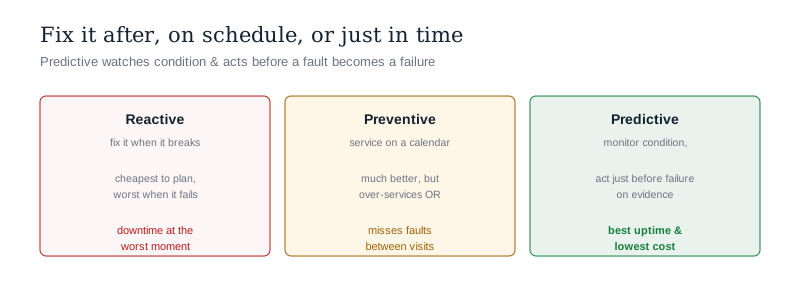
Understanding predictive maintenance means placing it against the alternatives:
- Reactive ("run to failure") — fix it when it breaks. Cheapest to plan, most expensive when it fails: unplanned downtime, emergency call-outs, collateral damage, and always at the worst moment.
- Preventive (scheduled) — service on a fixed calendar (the standard maintenance approach). Much better, but you either over-service (replacing parts with life left) or still miss faults that develop between visits.
- Predictive (condition-based) — monitor the actual condition and act only when the data says a fault is developing. Best uptime and lowest lifecycle cost — you fix the right thing at the right time.
Predictive doesn't replace basic servicing; it targets it, catching what a calendar can't.
How predictive maintenance works
The chain from sensing to a well-timed repair:
- Continuous sensing — IoT sensors track temperatures, pressures, power draw, vibration, runtime and efficiency across the equipment.
- Baselining — the system learns each machine's normal signature.
- Anomaly & fault detection — analytics (and increasingly AI/FDD) flag drift from normal: a compressor drawing more power, a coil fouling, efficiency slipping, a bearing vibrating — early, before failure.
- Remote monitoring & alerts — a facilities team (or a service provider) watches many sites from one dashboard and gets alerted to developing issues.
- Timely intervention — the part is cleaned, adjusted or replaced before it fails and when convenient, not during a breakdown.
The essence: watch continuously, act early, on evidence.
The payoff
- Uptime — the big one for critical facilities: no surprise failure of the cooling a data centre or hospital depends on.
- Energy — a fouling coil or a drifting system wastes energy silently; catching it early keeps the plant running efficiently (efficiency).
- Longer equipment life — problems caught early cause less collateral damage; the compressor or chiller lasts longer.
- Lower total cost — fewer emergencies, less over-servicing, better efficiency — often outweighing the monitoring cost on large plant.
- Better planning — parts and labour scheduled in advance, not scrambled for in a crisis.
Where it fits — and where it's overkill
- Clear payoff — data centres, hospitals, large commercial buildings, chiller plants: high downtime cost, expensive equipment, and rich sensor data make predictive maintenance an easy case (see special buildings).
- Emerging for homes — some smart ACs and controllers now flag "service due," filter status or performance drops — a light form of predictive maintenance that catches, say, a failing unit before a total breakdown.
- Overkill — a single home split doesn't need an analytics platform; regular servicing plus attention to warning signs (weak cooling, noises, leaks) is the right level.
- The prerequisite — like all smart HVAC, it needs a solid sensing layer; without data there's nothing to predict from.
The one-line answer
Predictive maintenance is the smarter third way between reactive (fix it when it breaks — cheapest to plan, most expensive when it fails at the worst moment) and preventive (service on a fixed calendar — better, but over-services or still misses faults between visits): it uses connected sensors and analytics to monitor equipment condition continuously and act just before a fault becomes a failure. The chain runs sense → baseline normal → detect drift early (a compressor drawing more power, a fouling coil, slipping efficiency) → alert a remote team → fix the right thing at a convenient time. The payoff is uptime (no surprise failure of critical cooling), sustained energy efficiency (catching silent degradation), longer equipment life, and lower total cost — which makes it an easy case for data centres, hospitals, large buildings and chiller plants where downtime is expensive and data is rich. For a single home split it's overkill — regular servicing plus attention to warning signs is the right level — though smart ACs now offer a light version by flagging service-due and performance drops. Like all smart HVAC, it needs a solid sensing layer: no data, nothing to predict.
Where to go next
- The data foundation: HVAC IoT & Sensors Guide.
- The intelligence: AI in HVAC Guide.
- The baseline it targets: HVAC Maintenance Guide.
- Home-level warning signs: AC Not Cooling · Refrigerant Leak Guide.
References
- ASHRAE — Guideline 36 & FDD research; condition-based maintenance practice for building HVAC.
- ISHRAE — HVAC O&M guidance; Bureau of Energy Efficiency (BEE) — monitoring & analytics for building energy: https://beeindia.gov.in/
- Industry literature on IoT-based condition monitoring and predictive maintenance for chillers and HVAC plant.
This guide informs maintenance planning. Deploying monitoring and performing repairs is qualified controls/MEP/technician work.
Export this guide
Related Guides — Deep-dive reading
Predictive Maintenance for STPs: Fixing Equipment Before It Fails
How sensor data and analytics let you catch a failing pump or blower weeks before it dies — the shift from calendar-based servicing to condition-based, predictive STP maintenance, and how an Indian building can actually start.
Sewage Treatment PlantsSmart Water Purifiers (RO) for Indian Homes: A Buyer's Guide
India's water is as varied as its geography — hard borewell in one city, chlorinated municipal supply in the next. This guide explains what makes an RO purifier smart, how to choose between RO, UV and UF by your actual water quality, the truth about water wastage, the maintenance and AMC reality, and which brands earn their price against IS 10500.
Smart HomeSmart Home AMC & Servicing in India: Keeping Systems Alive
Why a smart home rots without service — firmware, cloud changes, device end-of-life, dead batteries and network drift — and how to scope an AMC that actually holds: what it covers, realistic ₹ pricing, preventive versus breakdown, SLAs and response times, remote monitoring, integrator versus brand versus third-party, DIY versus AMC, and the contract red flags to refuse.
Smart HomeRelated Tools — Try Free
Acoustic Privacy (STC) Visualizer
Indian healthcare acoustic visualizer — compare wall assemblies and noise sources, see received SPL after STC attenuation, and check FGI 2018 / IS 1950 / NABH speech-privacy compliance with live dual-canvas waveform.
Acoustic ToolBefore & After Studio
Generate AI before-and-after renders to preview how your redesign could look.
DesignAIApartment Video Door System Planner
Enter flats, entrances, floors and guard desk for a first-pass building intercom plan — door stations, indoor monitors, guard station, the right architecture and an indicative cost band.
Building Planner