
Building Automation (BMS/BAS): The Brain That Runs a Building's HVAC
How large buildings run their plant automatically — what a Building Automation / Management System does, the sensors-controllers-actuators loop, protocols like BACnet and Modbus, and the efficiency and comfort it delivers when the plant is too big to run by hand.
A home has one thermostat. A large building has thousands of things to control — dozens of AHUs, chillers, pumps, dampers, fans and sensors — far too many to run by hand. That's the job of a Building Automation System (BAS), also called a Building Management System (BMS): the central brain that senses conditions everywhere, decides what the plant should do, commands it, and lets facility managers monitor and tune it all from one screen. This guide explains what a BAS does, how it works, the protocols involved, and the efficiency it delivers.
It builds on the HVAC Equipment Guide, part of the HVAC Knowledge Hub.
The safety line & scope. A BAS is engineered controls integration — design, programming, installation and commissioning are qualified controls/MEP engineering work. This guide informs understanding and specification.
What a BAS does
A BAS is a hierarchy of control over the building's services:
- It monitors — temperature, humidity, air quality, pressure, energy use, equipment status, everywhere.
- It controls — starts/stops and modulates chillers, AHUs, pumps, fans and dampers to hold conditions efficiently.
- It schedules — runs plant only when and where spaces are occupied.
- It optimises — sequences chillers, resets setpoints, staggers start-up to trim energy.
- It alarms — flags faults, filter changes and out-of-range conditions to facility staff.
- It reports — logs data for energy management and maintenance.
While mostly HVAC, a full BMS often also covers lighting, fire, access and lifts — one pane of glass for the building.
How it works — the control loop
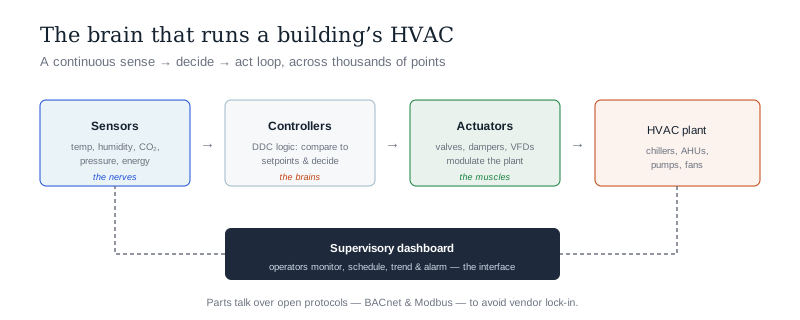
Every BAS is built from a repeated sense → decide → act loop:
- Sensors — measure temperature, humidity, CO₂, pressure, flow, power (the building's nerves).
- Controllers (DDC) — Direct Digital Controllers run the logic: compare readings to setpoints and decide the response (the brains).
- Actuators — valve motors, damper motors and variable-frequency drives (VFDs) carry out the commands, modulating the plant (the muscles).
- Supervisory software — the dashboards, schedules, trends and alarms operators use (the interface).
This loop runs continuously across thousands of points, keeping the building comfortable and efficient without anyone turning a dial.
Protocols — how the parts talk
For all this equipment to work together, it speaks common languages:
- BACnet — the dominant open protocol for building automation (widely used, vendor-neutral).
- Modbus — a simple, common protocol for connecting meters, drives and devices.
- LonWorks, KNX, MQTT — other protocols in the mix.
- Open vs proprietary — insisting on open protocols (BACnet/Modbus) avoids lock-in to one vendor's ecosystem and eases future upgrades — a key specification point.
Integration across protocols is much of the skilled work in a BAS project.
Why it matters — efficiency and comfort
A BAS earns its cost through what it enables:
- Energy savings — optimised sequencing, scheduling and setpoint resets cut a big building's biggest cost. Often required to meet ECBC/energy codes.
- Consistent comfort — conditions held steadily across every zone.
- Fault detection — problems caught early, before occupants complain or equipment fails.
- Fewer staff, better data — one operator manages what would take many, with data to prove performance.
- Foundation for "smart buildings" — analytics, IoT and fault-detection-and-diagnostics (FDD) build on the BAS.
For any building large enough to have a chiller plant, a well-designed BAS is not a luxury — it's how the plant is made to run efficiently at all.
The one-line answer
A Building Automation System (BAS/BMS) is the central brain that runs a large building's HVAC — dozens of AHUs, chillers, pumps and dampers that are far too many to run by hand. It works as a continuous sense → decide → act loop: sensors measure temperature, humidity, CO₂ and energy everywhere; DDC controllers compare them to setpoints and decide; actuators and variable-speed drives modulate the plant; and supervisory software lets operators monitor, schedule and tune it all from one screen. The parts talk over protocols — BACnet and Modbus dominant — and insisting on open protocols avoids vendor lock-in. Its payoff is energy savings (optimised sequencing and scheduling cut a building's biggest cost, often required by ECBC), consistent comfort, early fault detection and the foundation for smart-building analytics. Design, programming and commissioning are qualified controls/MEP engineering work.
Where to go next
- The home-scale version: Smart Thermostat Guide.
- The equipment it runs: HVAC Equipment Guide · Chiller Guide.
- The efficiency payoff: HVAC Energy Efficiency Guide.
- The big picture: Building HVAC Design Guide.
References
- ASHRAE — Guideline 13 (specifying DDC control systems), Standard 90.1 (controls requirements); ISHRAE — BMS/controls guidance.
- Bureau of Energy Efficiency (BEE) — ECBC controls & building automation provisions: https://beeindia.gov.in/
- BACnet (ASHRAE Standard 135) and Modbus — open building-automation communication protocols.
Building automation design, programming, installation and commissioning are qualified controls/MEP engineering work. Verify any standard's current status via the BIS catalogue before relying on it.
Export this guide
Related Guides — Deep-dive reading
HVAC Energy Efficiency: Cutting the Biggest Energy Bill in the Building
HVAC often runs half a building's electricity, so trimming it saves the most — the practical measures that cut HVAC energy without cutting comfort: right-sizing, inverter and efficient plant, smart controls and zoning, recovery, good maintenance and sensible set-points.
HVAC & CoolingDoor Automation AMC & Maintenance Contracts India 2026
Why automatic and access-controlled doors need a service contract, what comprehensive vs non-comprehensive AMC covers, SLAs and annual cost.
Home Doors & EntrancesAccess Control Testing Checklist for India (2026): Every Door Opens and Locks as Designed
A ready-to-adapt per-door and system checklist to verify an access-control installation at commissioning and as a periodic check, with the egress and fire-to-release life-safety tests that must always pass before sign-off.
SecurityRelated Tools — Try Free
Circadian Light Meter
Patient-centric circadian lighting visualizer for Indian healthcare design — time-of-day × intensity → CCT, melanopic lux (EML / mEDI), melatonin suppression, and an alertness curve. Calibrated against WELL v2 L03 Circadian Lighting Design, CIE S 026:2018, Brainard 2001, and Lucas et al. 2014.
Circadian ToolWindow Cleaning Cost Calculator
Estimate professional window cleaning cost per visit and per year by access and frequency.
Window CalculatorWindow Energy Savings Calculator
Compare standard glazing vs Low-E and DGU windows — annual cooling savings, 10-year savings and payback.
Window Calculator