
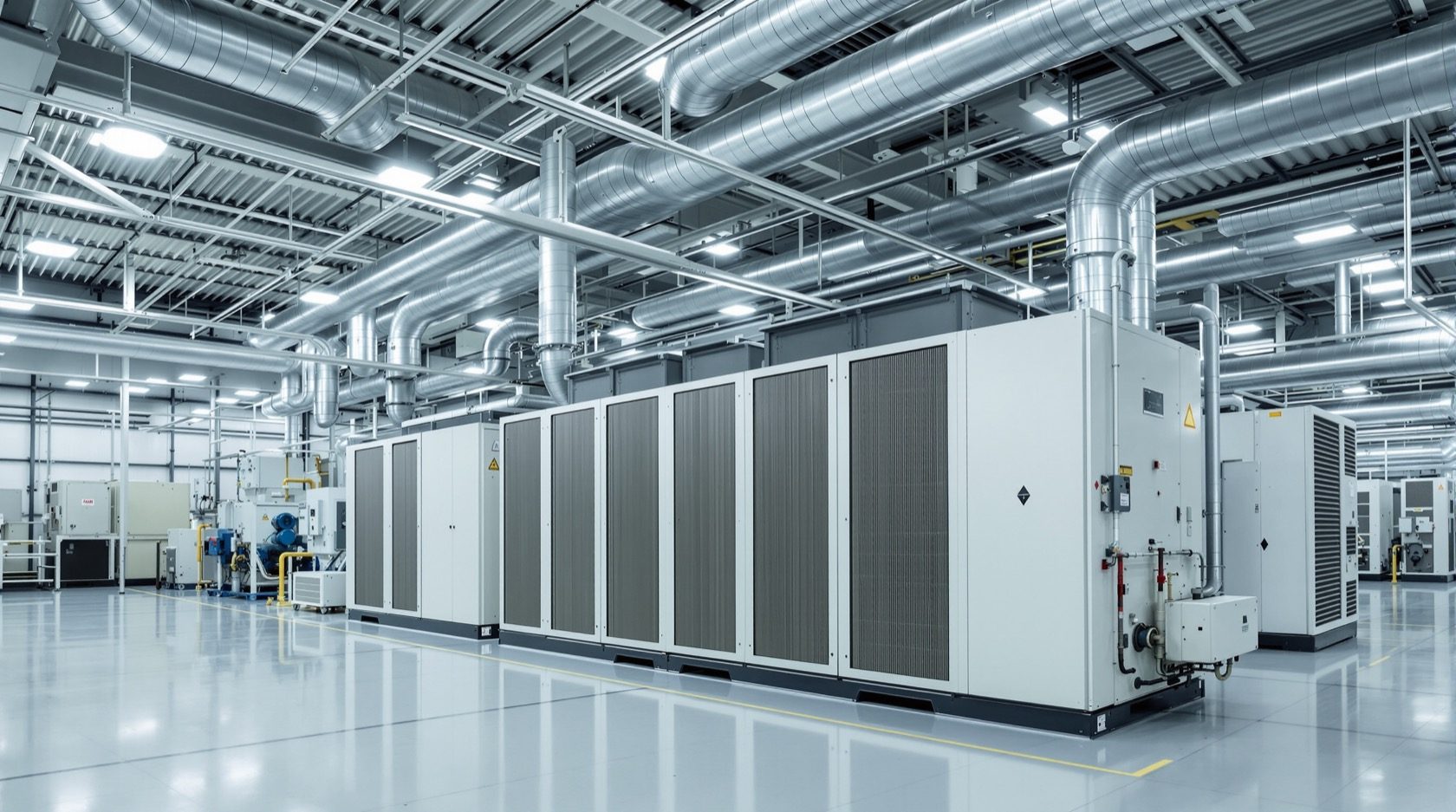
HVAC Equipment: The Components That Make Up a Cooling System
A tour of the machinery behind comfort — the refrigeration components (compressor, condenser, evaporator), the air-side equipment (AHUs, fan-coil units, fans, ducts, dampers, filters) and the plant-side (chillers, cooling towers, pumps), what each does, and how they fit together across systems.
Behind the cool, comfortable air in a building sits a lot of machinery — and knowing what each piece does turns HVAC from a black box into an understandable system. Whether it's a bedroom split or a hospital's central plant, the equipment falls into three families: the refrigeration components that move heat, the air-side equipment that conditions and distributes air, and the plant-side that generates and rejects the cooling at scale. This guide is a tour of HVAC equipment — what each does and how they fit together.
It builds on the Ultimate HVAC Guide and Building HVAC Design, part of the HVAC Knowledge Hub.
The safety line & scope. This guide explains the equipment to inform understanding and specification. Selection, sizing, installation and servicing are qualified MEP/HVAC engineering work.
The three families of equipment
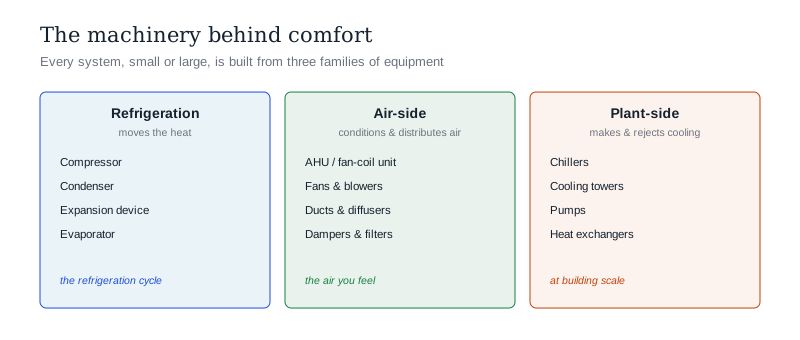
Every system, small or large, is built from three groups working together:
- Refrigeration components — move heat via the refrigeration cycle.
- Air-side equipment — condition and distribute the air you feel.
- Plant-side (water-side) — generate and reject cooling at building scale.
The refrigeration components
The heart of any cooling — the four parts of the refrigeration cycle:
- Compressor — compresses the refrigerant, raising its pressure and temperature; the "pump" and the biggest energy user. Types (scroll, rotary, screw, centrifugal) suit different scales.
- Condenser — rejects the absorbed heat to the outside (air-cooled or water-cooled), condensing the refrigerant to liquid.
- Expansion device — drops the refrigerant's pressure, cooling it sharply.
- Evaporator — absorbs heat from the space's air (or water), cooling it, and evaporates the refrigerant back to gas.
In a split AC these are packaged into the indoor and outdoor units; in a building they scale up into chillers.
The air-side equipment
What conditions and moves the air you actually feel:
- Air Handling Unit (AHU) — a box housing a fan, cooling coil, filters and dampers that conditions air and pushes it through ducts — the workhorse of ducted and central systems.
- Fan Coil Unit (FCU) — a smaller AHU-like unit (fan + coil) serving a single zone/room, fed with chilled water.
- Fans and blowers — move the air (supply, return, exhaust).
- Ducts — the channels carrying air around the building (to IS 655).
- Diffusers and grilles — deliver and return air to/from spaces, shaping the throw.
- Dampers — regulate and balance airflow (and fire/smoke dampers for safety).
- Filters — clean the air, from basic to HEPA (see air quality).
The plant-side (water-side)
At building scale, the central plant that generates and rejects cooling:
- Chillers — large refrigeration machines that produce chilled water for the whole building; the heart of a central system.
- Cooling towers — reject heat from water-cooled chillers to the outside air (the evaporative towers on rooftops).
- Pumps — circulate chilled water (to AHUs/FCUs) and condenser water (to towers).
- Heat exchangers — transfer heat between circuits, including energy recovery.
- Expansion tanks, valves and piping — the hydronic distribution.
Controls tie it all together
Equipment is only as good as its control:
- Thermostats and sensors — sense and command.
- Variable-speed drives (VSDs) — modulate fans, pumps and compressors for efficiency.
- A Building Automation System (BAS) — orchestrates the whole plant.
Good controls are what turn a collection of equipment into an efficient, comfortable system.
How it fits together by system
- Split/window AC — the refrigeration components packaged into indoor + outdoor units; minimal air-side, no plant.
- VRF — refrigeration components distributed as outdoor + many indoor units.
- Ducted/packaged — an AHU + ducts + diffusers.
- Central chilled-water — the full stack: chillers + cooling towers + pumps (plant) feeding AHUs/FCUs + ducts (air-side).
The bigger the building, the more the equipment separates into distinct plant, air-side and distribution systems.
The one-line answer
HVAC equipment falls into three families that work together. The refrigeration components move heat via the cycle — the compressor (the pump and biggest energy user), condenser (rejects heat outside), expansion device (drops pressure to cool) and evaporator (absorbs heat from the space). The air-side equipment conditions and distributes the air you feel — AHUs and fan-coil units (fan + coil + filters), fans, ducts, diffusers, dampers and filters. And the plant-side generates and rejects cooling at scale — chillers (make chilled water), cooling towers (reject heat) and pumps (circulate it). Controls and variable-speed drives tie it into an efficient system. A split AC packages the refrigeration components into two units; a big building separates everything into distinct plant, air-side and distribution — all selected, sized and installed by qualified MEP/HVAC engineers.
Where to go next
- The air-side workhorse: Air Handling Unit (AHU) Guide.
- The plant heart: Chiller Guide.
- The distribution: HVAC Duct Design Guide.
- The controls: Smart Thermostat Guide · Building Automation System Guide.
References
- National Building Code of India, SP 7 (Part 8 — Building Services, air conditioning & ventilation; verify current edition, SP 7 : 2026), Bureau of Indian Standards.
- IS 655 : 2006 (reaffirmed) Air Ducts; IS 1391 (Parts 1 & 2 : 2023) Room Air Conditioners; IS 8148 : 2018 Ducted & Package Air-Conditioners, BIS.
- ISHRAE — HVAC equipment & system design guidance; Bureau of Energy Efficiency (BEE) — ECBC: https://beeindia.gov.in/
HVAC equipment selection, sizing, installation and servicing are qualified MEP/HVAC engineering work. Verify any standard's current status via the BIS catalogue before relying on it.
Export this guide
Related Guides — Deep-dive reading
Central Air Conditioning & Chilled Water Systems: Cooling at Building Scale
How the biggest buildings are cooled — the chilled-water plant of chillers, air-handling units, cooling towers and pumps that air-conditions malls, hotels, hospitals and towers, how it differs from unitary and VRF systems, and when a building needs it.
HVAC & CoolingAir Handling Units (AHU): The Workhorse of Building Air Conditioning
The box that conditions a building's air — what an AHU actually contains (fan, cooling coil, filters, dampers), how it takes in fresh and return air, conditions it and pushes it through the ducts, the main types, and how it differs from a fan-coil unit.
HVAC & CoolingChillers: How Big Buildings Make Chilled Water for Cooling
The heart of a central plant — what a chiller is, how it makes chilled water, the difference between air-cooled and water-cooled, the compressor types (scroll, screw, centrifugal, absorption), and how to read efficiency (kW/TR, IPLV) when specifying one.
HVAC & CoolingRelated Tools — Try Free
Cross-Ventilation Analyzer
Estimate airflow and air changes per hour (ACH) from room size, window areas, layout, and local wind — with NBC 2016 Part 8 compliance check.
Ventilation CalculatorRainwater Tank Sizer
How big should your rainwater tank be? Computes annual harvest, recommended tank capacity in litres, water-bill savings, and payback — for 10 Indian cities.
RWH CalculatorWindow Grill Design Selector
Pick a window grille style and material by priority — security, looks, budget, view — and estimate cost.
Window Tool