
Thermostats & Smart HVAC Control: Getting Comfort Without Waste
The brain you actually touch — how a thermostat works, what makes one 'smart' (scheduling, sensors, app and voice control, geofencing), why setpoint and scheduling drive your bill more than anything, and how it fits Indian split ACs and central systems.
Of all the HVAC equipment in a building, the one you actually touch is the thermostat — the control that decides when the cooling runs and to what temperature. It's also, dollar for dollar, the piece with the biggest influence on your comfort and your bill. A "smart" thermostat adds scheduling, sensors, app and voice control and automation on top. This guide explains how thermostats work, what makes one smart, why setpoint and scheduling matter more than any gadget, and how it all fits Indian ACs.
It builds on the HVAC Equipment Guide, part of the HVAC Knowledge Hub. Choosing settings and off-the-shelf smart controls is genuinely a homeowner task — this guide is for you.
The safety line & scope. Setting your thermostat, scheduling and using app/plug controls are safe homeowner tasks. Wiring a hard-wired thermostat into central plant is electrical/HVAC work — leave that to a professional.
How a thermostat works
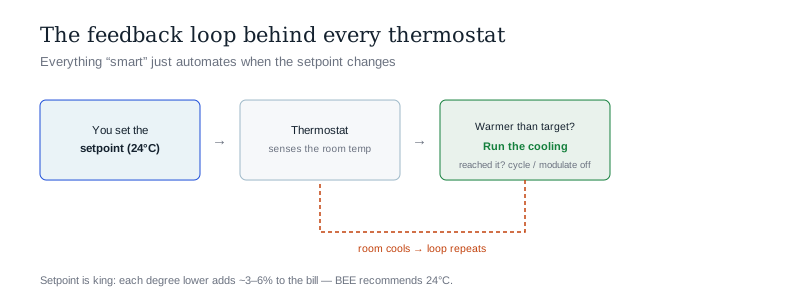
At heart, a thermostat is a simple feedback loop:
- You set a target temperature (the setpoint).
- The thermostat senses the room temperature.
- If the room is warmer than the setpoint, it runs the cooling; when it reaches the setpoint, it cycles off.
- Modern inverter ACs modulate (slow down) rather than switch fully off, holding the setpoint smoothly — see inverter vs non-inverter.
Everything "smart" is built on this basic loop — it just automates when the setpoint changes.
What makes a thermostat "smart"
Beyond the basic dial/remote, a smart thermostat (or smart AC controller) adds:
- Scheduling — automatically warmer when you're out/asleep, cooler when you're home. This is where the savings are.
- App control — set and monitor from your phone, anywhere.
- Voice control — via Alexa/Google Assistant, tying into a smart home.
- Geofencing — cools as you approach home, eases off when you all leave.
- Sensors — remote room sensors, occupancy, sometimes humidity — to control the right room.
- Usage feedback — reports that show what your habits cost.
- In India specifically — many homes use a smart AC controller (an IR blaster that learns your split AC's remote) rather than a wired wall thermostat, since most homes have split ACs, not ducted central systems.
Why setpoint and scheduling beat every gadget
The unglamorous truth: how you set it matters more than what you buy.
- Setpoint is king. Every degree lower roughly adds 3–6% to cooling energy. BEE recommends 24°C as the default for comfort and efficiency — setting 18°C doesn't cool faster, it just runs longer and costs more. See running cost.
- Don't cool empty rooms/hours. Scheduling the AC off (or warmer) when you're out or asleep is the single biggest saving — and the whole point of a smart control.
- Let it modulate. With an inverter AC, set a sensible temperature and leave it; constant on-off-on defeats the efficiency.
- Pair with fans. A ceiling fan lets you sit comfortably a degree or two warmer (see passive comfort).
A ₹3,000 smart controller used well saves more than a ₹30,000 AC upgrade used carelessly.
Fitting it to Indian systems
- Split AC (most homes) — a smart AC controller (IR) adds scheduling, app and voice to your existing remote; cheapest smart upgrade.
- Ducted/central home system — a wired smart thermostat (Nest-style) controls the AHU; installation is HVAC/electrical work.
- VRF / commercial — controllers integrate into the manufacturer's system or a Building Automation System.
- Compatibility first — check the controller supports your AC/brand before buying.
The one-line answer
A thermostat is the control you actually touch: it senses the room, compares it to your setpoint, and runs the cooling until the room reaches the target — a simple feedback loop. A smart thermostat (or, for India's split ACs, a smart AC controller that learns your remote) adds scheduling, app and voice control, geofencing and sensors on top — but the real savings come not from the gadget but from how you set it: setpoint is king (every degree lower adds ~3–6% to your bill, so BEE recommends 24°C), and not cooling empty rooms or hours (scheduling) is the single biggest win. Setting temperatures, schedules and off-the-shelf smart controls is a safe homeowner task; wiring a thermostat into central plant is professional work. A cheap smart controller used well beats an expensive AC used carelessly.
Where to go next
- The equipment overview: HVAC Equipment Guide.
- The bigger brain: Building Automation System Guide.
- What it costs: AC Running Cost Calculator.
- The wider home: Smart Home Guide · HVAC Energy Efficiency Guide.
References
- Bureau of Energy Efficiency (BEE) — 24°C default setpoint recommendation for air conditioners: https://beeindia.gov.in/
- ASHRAE Standard 55 — Thermal Environmental Conditions for Human Occupancy; ISHRAE — controls guidance.
- Ministry of Power / BEE public advisories on AC temperature setting and energy savings.
Setting your thermostat and using off-the-shelf smart controls are safe homeowner tasks. Wiring a thermostat into central HVAC plant is qualified electrical/HVAC work.
Export this guide
Related Guides — Deep-dive reading
Smart Thermostats in India: Do You Actually Need One?
The smart thermostat is the crown jewel of the Western smart home — and in most Indian homes it controls nothing at all. An honest deep-dive into where thermostats fit in a split-AC country, why an IR controller is usually the right answer, and the handful of homes where a real thermostat earns its price.
Smart HomeSmart HVAC & Climate Control for Indian Homes: Thermostats, AC, Fans & Air Quality
In a country where cooling is the biggest slice of a home's electricity bill, climate control is where a smart home earns its keep. A hot-climate, honest playbook for smart ACs, BLDC fans, ventilation and air quality — with real brands and rupee costs.
Smart HomeHVAC Energy Efficiency: Cutting the Biggest Energy Bill in the Building
HVAC often runs half a building's electricity, so trimming it saves the most — the practical measures that cut HVAC energy without cutting comfort: right-sizing, inverter and efficient plant, smart controls and zoning, recovery, good maintenance and sensible set-points.
HVAC & CoolingRelated Tools — Try Free
Smart Curtain Compatibility Checker
Check whether a motorised curtain will work with Alexa, Google, Apple Home, SmartThings or Home Assistant — and what you need.
CheckerSmart Curtain ROI Calculator
Estimate the energy savings and payback of motorising and automating curtains on harsh-sun windows.
ROI CalculatorStyle & Budget Compatibility Calculator
Check whether your target interior style fits your budget and get tier-appropriate recommendations.
Style Calculator