
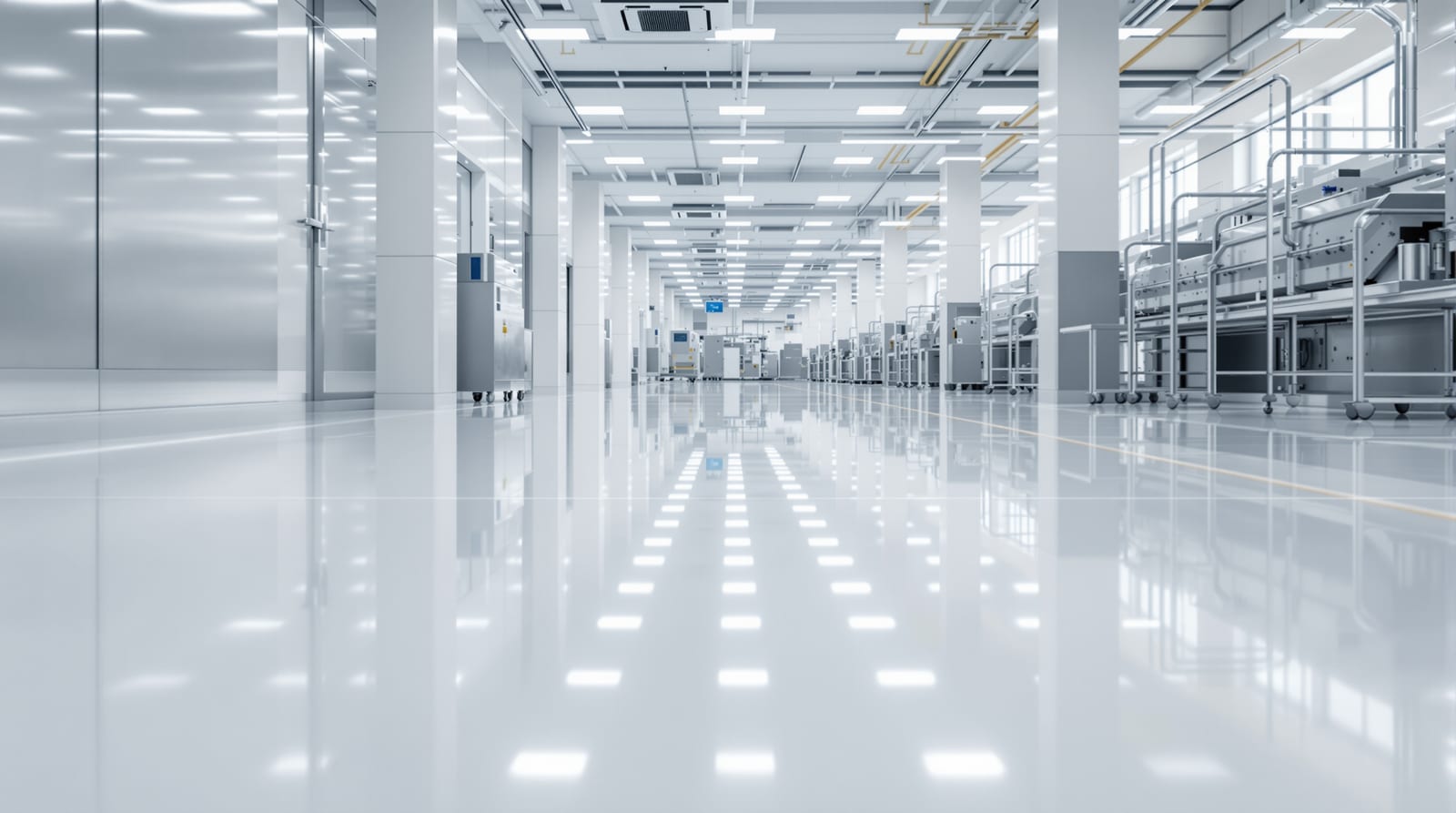
PU Flooring in India: Polyurethane Resin & PU-Cement Floors, Types, Thickness, Cost & vs Epoxy
Seamless polyurethane (PU) and PU-cement screed floors are the hygienic, thermal-shock-proof, flexible alternative to epoxy for food, dairy, brewery, pharma, cold storage and commercial-kitchen floors in India — here are the types, thickness, anti-slip and coving detail, install and cure, ₹150–500 per sq ft costs, and an honest PU-vs-epoxy comparison.
When a floor has to survive boiling wort sloshing across it one minute and an ice-cold wash-down the next, epoxy cracks and PU does not. Polyurethane (PU) resin flooring is the seamless, jointless, hygienic floor built for exactly that abuse — thermal cycling, steam cleaning, impact, aggressive chemicals and constant wet processing. It is the floor of choice for food and beverage factories, dairies, breweries, pharma cleanrooms, cold stores and commercial kitchens across India, and it is a genuinely different material from the epoxy floors it is often confused with.
This guide explains what PU and PU-cement floors actually are, the main types and thicknesses, why you would specify PU over epoxy, where it suits, the anti-slip and hygienic coving detail that makes or breaks a food floor, how it is installed and cured, the honest pros and cons, and an India-grounded cost picture at ₹150–500 per sq ft.
What PU resin flooring is
Polyurethane flooring is a seamless resin floor formed in place. A liquid resin and a hardener are mixed on site and trowelled, poured or rolled onto a prepared concrete base, where they cure into a continuous, jointless plastic surface bonded to the slab. There are no tiles and no grout lines — the whole floor is one monolithic sheet that curves up the walls as a coved skirting, so there is nowhere for water, bacteria or spilt product to hide. That seamlessness is the entire point in a hygiene-driven plant.
PU sits in the same family of seamless industrial resin floors as epoxy, and for an overview of where all these technical and specialty floors fit, see the specialty flooring pillar guide. But the chemistry is different. Where epoxy is hard, rigid and glassy, cured polyurethane is tougher and more elastic — it flexes slightly with the slab and absorbs impact instead of shattering. The two headline grades you will specify in India are:
- PU resin (pure polyurethane) — flexible, abrasion- and UV-resistant coatings and self-smoothing floors, often used where epoxy would chalk in sunlight or crack under impact.
- PU-cement (polyurethane concrete / PU screed) — a heavy-duty hybrid of PU resin, cement and graded aggregate, laid 4–9 mm thick, that takes thermal shock and wash-down better than any other resin floor. This is the workhorse of food and beverage plants.
The main types of PU floor
PU is not one product but a thickness-and-duty ladder. Choosing the right rung is the most important decision you will make.
| PU floor type | Thickness | What it is | Best use | Indicative cost (₹/sq ft)* |
|---|---|---|---|---|
| PU coating / sealer | 0.1–0.5 mm | Thin roller-applied flexible coat over sound concrete or epoxy | Light-duty, UV-exposed, refresh coats, mild chemical areas | 150–250 |
| Self-smoothing PU | 1.5–3 mm | Flowable self-levelling PU resin, smooth seamless finish | Pharma, electronics, light food prep, clean rooms | 250–400 |
| PU-cement screed (medium) | 4–6 mm | Trowelled PU + cement + aggregate, matte anti-slip | Commercial kitchens, dairies, bakeries, bottling | 300–450 |
| PU-cement screed (heavy) | 6–9 mm | Thick trowelled PU-cement for extreme duty | Breweries, abattoirs, cold stores, wet processing, forklift traffic | 350–500+ |
*Costs are indicative, vary by city, system brand and area, and exclude 18% GST. Substrate repair, coving, primer and anti-slip aggregate are usually quoted on top.
A useful rule: the wetter, hotter, more chemically aggressive and more thermally cyclic the process, the thicker the PU-cement you specify. A dry pharma packing hall is happy on 2 mm self-smoothing PU; a brewery floor that meets boiling water and caustic CIP wash every shift needs 6–9 mm PU-cement.
Why PU over epoxy
This is the question every Indian specifier asks, because epoxy is cheaper and far more widely installed. Epoxy is an excellent floor — covered in detail in our epoxy flooring guide and epoxy floor application guide — but it has real limits that PU is designed to beat.
| Property | Epoxy | PU / PU-cement | Why it matters in India |
|---|---|---|---|
| Flexibility | Rigid, glassy, brittle | Elastic, flexes with slab | PU resists cracking from impact, vibration and slab movement |
| Thermal shock | Poor — cracks/debonds under hot/cold cycling | Excellent — handles −40°C to +120°C+ (PU-cement) | Steam, boiling water, cold-room cycling, hot oil spills |
| Steam & wash-down | Softens, can blister | Withstands daily steam/pressure wash | Hygiene wash-down in food/dairy plants |
| Impact resistance | Lower, chips | High, absorbs blows | Dropped tools, drums, forklift knocks |
| Chemical resistance | Good (acids/alkalis) | Very good, broader, better with lactic/organic acids | Dairy lactic acid, brewery, food acids |
| UV resistance | Yellows/chalks in sunlight | Stable, non-yellowing | Areas with skylights or daylight |
| Cure speed | Slower, sensitive to humidity | Faster, tolerant of damp/cool | Quicker plant turnaround |
| Cost | Lower | Higher (roughly 1.3–2x) | Epoxy still wins on dry, mild, budget floors |
The short version: choose epoxy for dry warehouses, parking, showrooms and mild factory floors where budget matters. Choose PU when heat, thermal shock, steam-cleaning, impact or organic acids are in play — which is precisely the food, beverage and pharma world.
Where PU flooring suits
PU and PU-cement earn their premium in process environments:
- Food and beverage factories — bottling, canning, sauces, snacks, ready-meals; constant spillage, wash-down and forklift traffic.
- Dairies — lactic acid, milk fats and aggressive CIP chemicals destroy epoxy; PU-cement is the standard.
- Breweries and distilleries — boiling wort, hot water, caustic cleaning and thermal cycling.
- Pharma and nutraceutical — self-smoothing PU for cleanrooms needing seamless, chemically resistant, easy-clean floors.
- Cold storage and blast freezers — PU-cement stays bonded and crack-free at sub-zero temperatures where epoxy fails.
- Commercial and institutional kitchens — hotel, hospital, canteen and cloud kitchens with hot grease, water and impact.
- Wet processing, abattoirs and seafood plants — the most punishing wash-down and organic-acid environments.
For broader heavy-duty contexts beyond hygiene — warehouses, foundries, parking and dust-proofing — see our industrial flooring guide. For static-controlled electronics, labs and server areas, the conductive cousin is covered in the anti-static and ESD flooring guide.
Anti-slip, hygiene and coving detail
In a wet plant the floor is a slip hazard and a contamination risk, so two details are non-negotiable.
Anti-slip aggregate. A smooth resin floor is lethal when wet. PU floors are textured by broadcasting graded silica, aluminium-oxide or bauxite aggregate into the surface, then sealing over it. The grade is matched to the process: a fine non-slip for a packing hall, a coarse heavy texture for a brewery floor that is permanently wet. Specify the slip rating to DIN 51130 — typically R10–R11 for kitchens and R12–R13 for wet processing — and remember that coarser textures grip better but are harder to clean, so it is a deliberate trade-off.
Coved skirting and falls. The defining hygienic detail is the cove: the floor curves up the wall in a smooth radius (usually 25–50 mm) instead of meeting it in a square 90° corner. This kills the dirt-trapping junction and lets water and cleaning run off cleanly. The floor is also laid to falls towards drains so nothing ponds. Get the coving and the drainage right and you have a floor that passes audits; skip them and even the best PU-cement will fail a hygiene inspection.
The section below shows the PU-cement build-up and the coved skirting that turns floor and wall into one washable surface.
Install and cure
A PU floor is only as good as the prep beneath it. The sequence on an Indian site runs:
1. Substrate preparation. The concrete must be sound, structurally sized and shot-blasted or diamond-ground to a clean, open profile (typically CSP 3–4). Oil, laitance and old coatings are removed. Cracks and spalls are repaired. PU-cement is forgiving of slightly damp concrete — a real advantage over epoxy in humid Indian conditions — but the slab must still be cured and free of rising damp; a damp-proof membrane is checked first.
2. Saw-cut anchor grooves. Around the perimeter, at drains and at day-joints, anchor grooves are cut and the resin keyed in so the floor cannot lift or curl.
3. Priming. A compatible primer or scratch coat is applied to bond the system to the concrete.
4. Laying the body coat. Self-smoothing PU is poured and spread to a level finish with a notched trowel and spiked roller. PU-cement screed is trowelled out by skilled applicators to the specified thickness — this is hand-laid, fast-setting work that demands experienced crews, not general masons.
5. Anti-slip and coving. Aggregate is broadcast into the wet surface for grip, and the coved skirting is formed by hand up the walls.
6. Seal coat. One or two PU seal coats lock in the aggregate, set the final texture and gloss, and close the surface.
7. Curing. PU cures faster than epoxy — typically foot traffic in 12–24 hours and full chemical and mechanical service in 3–7 days depending on system and temperature. Plan plant shutdowns around this; PU's quicker turnaround is a real commercial benefit.
Always install through a manufacturer-approved applicator (Sika, BASF/MBCC, Fosroc, Flowcrete, Dr. Fixit/Pidilite and Ardex all market PU-cement systems in India) and insist on a written warranty tied to correct substrate prep.
Pros and cons
Pros
- Outstanding thermal-shock resistance — survives steam, boiling water and freezer cycling that crack epoxy.
- Flexible and impact-resistant — bends with the slab, absorbs knocks, resists cracking.
- Broad chemical resistance, including the organic and lactic acids of food and dairy plants.
- Seamless, jointless and coved — hygienic, easy to wash down, audit-friendly.
- Anti-slip texture engineered to the process; UV-stable grades available.
- Tolerant of slightly damp substrates and fast to cure — shorter plant downtime.
Cons
- Higher cost than epoxy — roughly 1.3 to 2 times for equivalent area.
- Demands specialist, manufacturer-approved applicators; fast set leaves little margin for error.
- Heavy PU-cement has a matte, utilitarian, sometimes orange-peel look — it is a process floor, not a designer finish.
- Aggressive coarse anti-slip textures are harder to deep-clean.
- Overkill (and a waste of money) for dry, mild, low-traffic floors where epoxy or polished concrete would do.
How PU fits the wider flooring picture
PU is a specialist, not an all-rounder. For dry industrial and warehouse floors, weigh it against the broader options in the industrial flooring guide, and against epoxy in the epoxy flooring guide and epoxy floor application guide. For static-sensitive environments, look at anti-static and ESD flooring. And to see where every seamless, resilient, paving and technical floor sits relative to mainstream tiles, stone and wood, start at the specialty flooring pillar. To budget a project quickly, the Studio Matrx flooring cost calculator and specialty flooring selector help you sense-check area, system and cost before you brief a contractor.
Frequently asked questions
Is PU flooring better than epoxy?
Not universally — they suit different jobs. PU is better wherever heat, thermal shock, steam-cleaning, impact, vibration, UV or organic/lactic acids are involved, which is why food, dairy, brewery, pharma and cold-storage plants specify it. Epoxy remains the smarter, cheaper choice for dry warehouses, parking, showrooms and mild factory floors. Match the floor to the process, not to a slogan.
What does PU flooring cost per square foot in India?
Roughly ₹150–500 per sq ft before 18% GST, depending on type and thickness. Thin PU coatings run ₹150–250, self-smoothing PU ₹250–400, and heavy-duty PU-cement screed ₹300–500 or more. Substrate repair, priming, anti-slip aggregate and coved skirting are usually quoted on top, so always get a system-and-area quote rather than a bare per-foot rate.
How thick should a PU floor be?
It depends on duty. Thin sealer or refresh coats are 0.1–0.5 mm; self-smoothing PU for pharma and light food prep is 1.5–3 mm; medium PU-cement for kitchens and dairies is 4–6 mm; heavy PU-cement for breweries, cold stores and wet processing with forklift traffic is 6–9 mm. The wetter, hotter, more chemically aggressive and more thermally cyclic the process, the thicker you go.
Can PU flooring handle steam-cleaning and hot wash-down?
Yes — that is its signature strength. PU-cement systems tolerate repeated steam and hot-water wash-down and thermal cycling from sub-zero cold rooms up to around 120°C or higher, without the cracking and debonding that destroy rigid epoxy. This is exactly why hygiene-driven food, dairy and brewery plants choose PU over epoxy.
Is PU flooring anti-slip and food-safe?
It can be both, by design. Anti-slip texture is created by broadcasting graded aggregate into the surface, with the grade and DIN 51130 slip rating (R10–R13) matched to how wet the area is. PU-cement systems are formulated for food and beverage environments — seamless, hygienic, chemically resistant and washable — and approved systems carry the relevant food-contact and hygiene certifications.
Export this guide
Related Guides — Deep-dive reading
Industrial Flooring in India: Floor Hardeners, VDF, Epoxy & PU Systems for Factories, Warehouses & Parking — Method, Flatness & Cost
Industrial flooring is the family of heavy-duty floor systems built for factories, warehouses, godowns, workshops, parking and logistics — dry-shake floor hardeners, vacuum-dewatered concrete, granolithic, epoxy and PU toppings, and polished concrete, all rated for forklift traffic, point loads, abrasion, chemicals and dust control at roughly ₹80–400 per sq ft. Here is how to choose the right system by use, with the joints, curing, flatness and cost detail.
Flooring & SurfacesCommercial Kitchen Flooring in India: PU Resin, R11-R12 Anti-Slip & FSSAI Hygiene
The most demanding floor in any building — anti-slip under grease and water, thermal-shock proof, seamless and coved for food-safety, with R-ratings, FSSAI hygiene and cost per square foot for Indian restaurants, hotels, cloud kitchens and food factories.
Flooring & SurfacesEpoxy Floor Application in India: Substrate Prep, Coats and Curing Step-by-Step
How a resin epoxy floor is actually laid in India — moisture testing and mechanical grinding, crack repair, primer, self-leveling vs broadcast vs coating systems, mixing ratios, pot life, coats and a full 7-day cure.
Flooring & SurfacesRelated Tools — Try Free
Flooring Cost Calculator
Estimate the all-in cost of a floor — material, laying, wastage, skirting and GST — by area and material.
Flooring CalculatorSpecialty Flooring Selector
Find the right specialty floor for your use — gym, data centre, factory, hospital, heritage home, driveway and more.
Flooring ToolHealing View Impact Calculator
Evidence-Based Design dashboard quantifying the recovery impact of nature view + daylight factor on analgesic use, length of stay, and HCAHPS patient-experience uplift. Calibrated against Ulrich 1984 (Science), Park & Mattson 2008, and the CHD EBD evidence base.
EBD Calculator