
Restaurant Flooring in India: Dining vs Kitchen Floors, Slip Safety & Costs
Zone-by-zone flooring for Indian restaurants — anti-slip kitchen resin, easy-clean dining floors, R-ratings, hygiene and cost per square foot.
A restaurant floor is two completely different problems wearing one roof. The dining room is judged by your guests — it has to look right, feel inviting, take the scrape of a thousand chairs and wipe clean before the next sitting. The kitchen is judged by an EHS inspector and an injury lawyer — it has to grip underfoot when it is slick with oil and water, survive boiling spills and grease, and never harbour bacteria. Specify one floor for both and you will overpay in the dining room and put your staff at risk in the kitchen. This guide splits the restaurant zone by zone, ranks the right floor for each, and grounds it in Indian costs, R-ratings and hygiene practice.
Why restaurant flooring is a zone problem, not a material problem
Walk a busy Indian restaurant during a Saturday dinner rush and you cross at least five distinct floor conditions in two minutes: a wet, monsoon-tracked entrance; a dry, high-footfall dining hall; a spill-and-trolley service corridor; a greasy, steamy, water-flooded kitchen; and a wet, chemical-heavy washroom. Each has a different dominant risk, so each deserves a different floor.
The drivers, ranked by how often they cause real cost:
- Slip safety — the single biggest injury and liability risk, concentrated in the kitchen and entrance where oil and water meet a hard floor. A back-of-house slip is the most common serious staff injury in food service, and a customer slip at a wet entrance is the most common claim against the restaurant.
- Grease, spill and heat resistance — kitchen floors face hot oil, boiling water, acidic sauces and dropped pans daily; the floor must shrug all of it off without staining, softening or cracking.
- Hygiene and FSSAI compliance — food-business licensing under the FSSAI Schedule 4 expects floors that are impervious, non-absorbent, washable, free of cracks and crevices, and coved (curved) up to the wall so there is no dirt-trapping junction.
- Durability under chairs and trolleys — point loads from chair legs, bar stools, service trolleys and bin wheels chew through soft floors fast in a commercial setting.
- Ambience — in the dining room the floor is a third of the visual design and sets the price perception of the whole venue.
- Fast cleaning — every floor in the building gets mopped or pressure-washed at least daily; anything that holds dirt costs labour forever.
- Cost per square foot — kitchens justify a premium floor; dining rooms balance looks against budget.
The DINING zone: looks, comfort and easy-clean
The dining room is dry-but-spill-prone. The brief is: handsome, hard-wearing, scratch-tolerant under chairs, and quick to wipe between sittings — without the cold, clinical feel of a kitchen floor. Four families do this well in India.
Large-format vitrified (GVT/PGVT) and double-charged tiles are the workhorse — affordable, near-zero water absorption, available in convincing marble, stone, concrete and wood looks, and tough enough for footfall. Specify a matt or lappato (semi-polished) finish for slip safety rather than full-gloss, which gets dangerous near the kitchen pass. Read vitrified tile flooring and polished glazed vitrified tiles (PGVT) for the finish trade-offs.
Wood-look LVT, SPC and WPC give the warmth of timber for a fraction of the cost and none of the moisture worry — ideal for cafes, bistros and casual-dining where a softer, quieter, more residential feel sells the food. They are resilient underfoot, easy on dropped glassware, and the planks can be swapped if one gets damaged. See luxury vinyl tile (LVT) flooring.
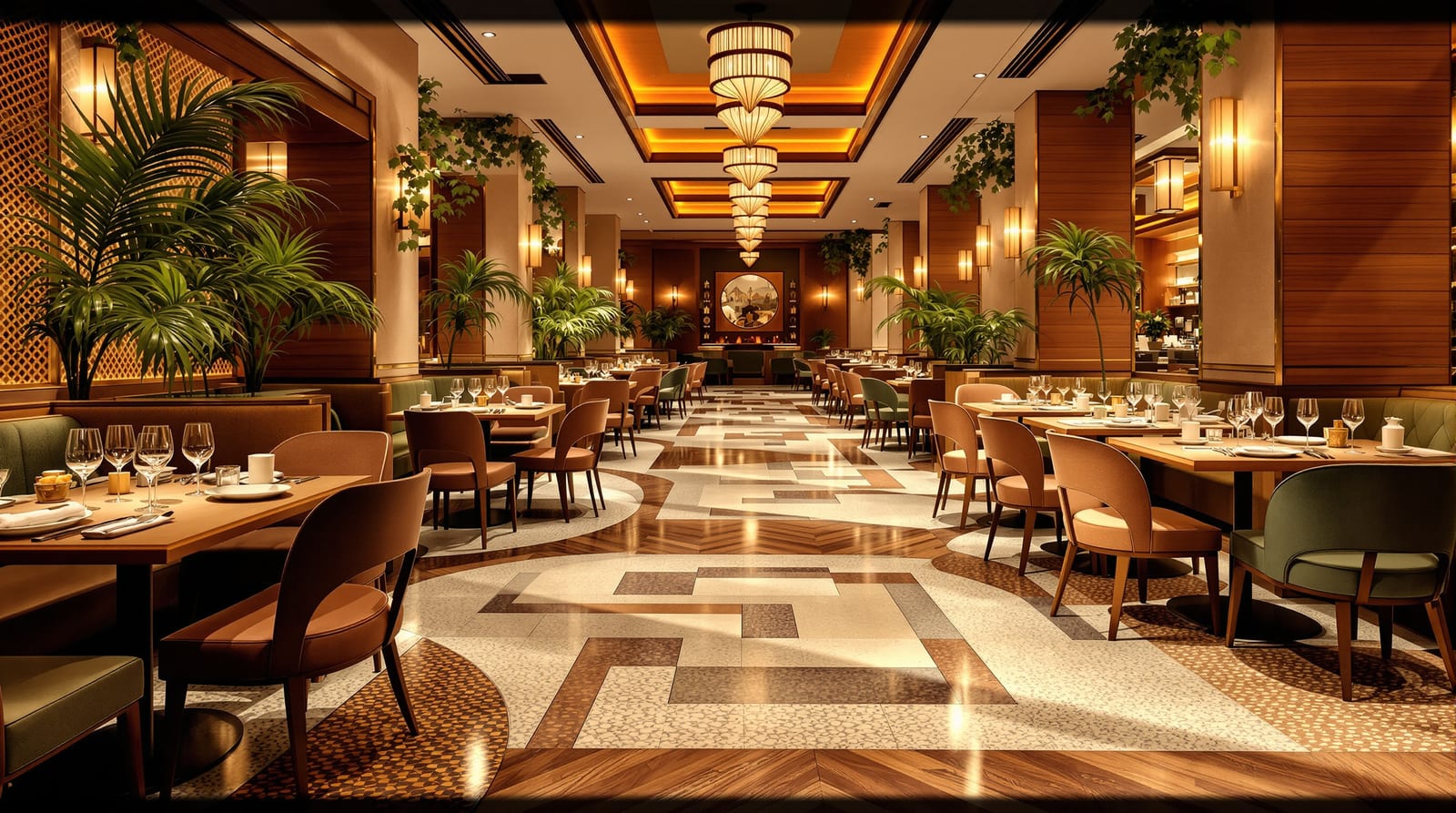
Terrazzo — newly fashionable in India's design-led restaurants — is seamless, monolithic, endlessly customisable in chip and colour, and lasts decades. It reads as premium, hides crumbs in its speckle, and a single poured floor flows from entrance through dining without grout lines. See terrazzo flooring.
Polished concrete suits the industrial, brewpub and speciality-coffee aesthetic — a sealed, ground concrete floor is seamless, hard-wearing and cheap to maintain, though hard underfoot and unforgiving on dropped crockery. See polished concrete flooring.
For dining, avoid: high-gloss polished marble or PGVT in service paths (slip risk when wet), carpet (stains, odour, hygiene), and anything with deep textured relief that traps food.
The KITCHEN zone: the floor that actually matters
This is where a wrong floor injures staff and fails inspection. A commercial kitchen floor is wet and greasy for most of its working life, takes thermal shock, and must be deep-cleaned daily. The non-negotiables:
- Slip resistance of R11 to R12 (DIN 51130, the ramp test) — R11 is the practical minimum for a commercial kitchen, R12 for heavy wet/greasy zones around fryers and dishwash. Many specifiers also call for a surface profile classification (the V4-V10 displacement-space rating) so spills drain off the contact patch.
- Grease, water, heat and chemical proof — the surface must not absorb oil or soften under hot spills and aggressive degreasers.
- Seamless and coved — no open grout joints or 90-degree wall junctions; a curved cove skirting up the wall lets you hose the floor without water and grease lodging in a crack.
- Impervious and hygienic — non-porous, washable, bacteria-resistant.
The materials that meet this, ranked:
PU resin (polyurethane screed) is the gold standard for serious commercial kitchens. Trowel-applied 4-9 mm thick, it is fully seamless, integrally coved, withstands thermal shock from steam and boiling water, resists grease and food acids, and is supplied with an anti-slip aggregate broadcast to hit R11-R12. It is the floor most QSR chains, hotel kitchens and cloud kitchens now specify. See PU resin flooring and the full commercial kitchen flooring deep-dive.
Anti-slip quarry or unglazed vitrified tiles are the traditional, lower-capex route — dense, fired clay or full-body vitrified tiles in an R11-R12 textured finish, laid with epoxy grout and coved tile skirting. Robust and proven, but the grout joints are the weak point and demand disciplined cleaning. Pair with the techniques in anti-slip flooring for wet areas.
Epoxy resin is cheaper than PU and seamless, but is less heat-tolerant (it can soften and discolour under repeated boiling/steam spills) and is better suited to dry stores, prep rooms and bars than the hot wet line. Treat it as a budget back-of-house option, not the main cookline.
Never use: smooth glazed tiles, polished concrete without an anti-slip treatment, vinyl sheet that lifts at seams under heat, or any porous stone in a commercial kitchen.
Entrance, bar, service and washroom
- Entrance / lobby — first impression plus monsoon water tracked in. Use a durable, impressive but anti-skid floor: matt large-format vitrified, granite with a flamed/leathered (not polished) finish, or terrazzo, and always lay a recessed entrance matting well to trap water and grit. Anti-skid is mandatory in the monsoon.
- Bar — wet underfoot from ice, spills and washing; treat it like a mini-kitchen with R10-R11 anti-slip tile, sealed concrete or a resin floor behind the bar, and duckboards or anti-fatigue mats where staff stand for hours.
- Service corridor / pass — heavy trolley and staff traffic carrying spills both ways; specify the same anti-slip class as the kitchen so the transition zone is not the slip point.
- Washrooms — wet and chemical-cleaned; anti-skid vitrified or porcelain at R10-R11 with falls to a drain.
Zone-by-zone recommendation and cost table
The table below maps each restaurant zone to its recommended floor, the slip rating to specify, indicative installed cost (2026 India), and why. Costs are indicative — confirm against current local quotes.
| Zone | Recommended floor | Slip rating (DIN R) | Cost (₹/sq ft) | Why |
|---|---|---|---|---|
| Dining (mainstream) | Large-format matt vitrified / double-charged | R9-R10 | 80-220 | Tough, easy-clean, marble/wood/stone looks, value |
| Dining (warm / cafe) | Wood-look LVT / SPC / WPC | R9-R10 | 90-400 | Warm, quiet, resilient, swappable planks |
| Dining (design-led) | Terrazzo (poured or tile) | R10 | 90-250 | Seamless, premium, hides crumbs, decades of life |
| Dining (industrial) | Polished concrete (sealed) | R9-R10 | 130-420 | Seamless, low-maintenance, on-trend |
| Kitchen (cookline) | PU resin screed, coved | R11-R12 | 180-500 | Seamless, grease/heat/chemical proof, hygienic |
| Kitchen (budget) | Anti-slip quarry / unglazed vitrified, epoxy grout, coved | R11-R12 | 90-220 | Proven, robust; grout is the weak point |
| Prep / dry store / bar back | Epoxy resin | R10-R11 | 120-350 | Seamless, cheaper; not for hot wet cookline |
| Entrance / lobby | Matt large-format vitrified / flamed granite / terrazzo | R10-R11 | 130-350 | Impressive, anti-skid for monsoon water |
| Service corridor / pass | Anti-slip vitrified / resin | R11 | 90-260 | Trolley traffic, transition slip control |
| Washroom | Anti-skid vitrified / porcelain | R10-R11 | 80-220 | Wet, chemical-cleaned, falls to drain |
A simple zoning diagram
The plan below shows the principle: a warm, looks-led dining floor up front; a seamless, high-grip resin floor in the back-of-house; and a controlled transition through the pass so the slip-critical boundary is handled, not ignored.
Design and specification tips
- Match the slip rating to the spill, not the room name. Anywhere oil or water reaches the floor — kitchen, bar, dishwash, washroom, monsoon entrance — needs R10 minimum, R11-R12 on the hot greasy cookline.
- Cove everything in the back-of-house. A 100 mm curved skirting up the wall is what turns a tiled or resin floor into a hose-down, inspection-passing surface. Specify it from day one; retrofitting is painful.
- Lay falls to drains in wet zones — a 1:80 to 1:100 slope to floor gullies so water and grease leave the floor instead of pooling into a slip hazard.
- Don't run gloss into the service path. A polished marble or PGVT dining floor is beautiful until it meets the greasy traffic from the pass; transition to a matt, higher-grip finish before the kitchen door.
- Use epoxy grout, not cement grout, on kitchen tile. Cement grout is porous, stains, harbours bacteria and erodes under acidic cleaning. Epoxy grout is the difference between a tiled kitchen floor that passes inspection and one that fails it.
- Plan for trolleys. Castor wheels concentrate load; specify floors and joints rated for point loads in corridors and service routes.
- Budget the kitchen, value-engineer the dining. Spend on the resin cookline floor where failure is dangerous and expensive; save in the dining room with vitrified or LVT.
Do and don't
Do specify R11-R12 anti-slip and integral coving in the kitchen; do use a recessed entrance matting well for monsoon water; do choose matt or lappato finishes near service paths; do use epoxy grout on all kitchen tile; do lay falls to drains in wet zones.
Don't put smooth glazed tile, polished concrete (untreated) or vinyl sheet on the hot wet cookline; don't carry high-gloss dining floors into the pass; don't use cement grout in the kitchen; don't skip coving to save money; don't assume one floor suits the whole restaurant.
Care and maintenance
Dining floors need daily sweeping and damp mopping with a neutral cleaner; reseal terrazzo, polished concrete and natural stone periodically per their guides, and protect them from grit at the entrance with matting. Kitchen resin and tiled floors need daily deck-scrubbing with a degreaser and a stiff brush or scrubber-drier; rinse coving and drains thoroughly, and inspect grout joints and resin coving for cracks monthly — a single open crack is where contamination and a failed inspection begin. For the general routine, see the floor cleaning guide, and for resealing schedules the floor resealing guide.
For the wider picture across all commercial spaces see the commercial flooring guide, and for the casual end of food service compare with cafe flooring.
Frequently asked questions
What is the best flooring for a restaurant kitchen in India?
PU resin (polyurethane screed) is the strongest choice — it is seamless, integrally coved, withstands hot spills and steam, resists grease and food acids, and is finished to an R11-R12 anti-slip rating. Anti-slip quarry or unglazed vitrified tiles with epoxy grout and tile coving are the proven, lower-capex alternative. See the commercial kitchen flooring guide.
What slip rating should a restaurant floor have?
On the DIN 51130 ramp scale, a commercial kitchen cookline needs R11 as a minimum and R12 in heavy wet/greasy zones around fryers and dishwash. Entrances, bars and washrooms exposed to water need R10-R11. Dry dining areas can be R9-R10, but specify matt or lappato finishes rather than full gloss near any service path.
Can I use vitrified tiles in a restaurant kitchen?
Only anti-slip, unglazed or full-body vitrified tiles rated R11-R12, laid with epoxy grout and coved tile skirting. Smooth glazed vitrified tiles are dangerous when wet and greasy and should never be used on a cookline. Glazed vitrified is fine for dry dining areas in a matt finish.
How much does restaurant flooring cost per square foot in India?
Indicatively in 2026: dining vitrified ₹80-220, wood-look LVT ₹90-400, terrazzo ₹90-250, polished concrete ₹130-420 per sq ft; the kitchen costs more — PU resin ₹180-500 and anti-slip tile ₹90-220 per sq ft. Budget the kitchen as a safety investment and value-engineer the dining room.
What does FSSAI require of a restaurant floor?
Under FSSAI Schedule 4, floors in food-handling areas must be impervious, non-absorbent, washable, free of cracks and crevices, easy to clean and disinfect, and laid with falls to drains. In practice this means a seamless or epoxy-grouted, anti-slip, coved floor in the kitchen — the curved wall junction and absence of open grout joints are what an inspector looks for.
Export this guide
Related Guides — Deep-dive reading
Commercial Kitchen Flooring in India: PU Resin, R11-R12 Anti-Slip & FSSAI Hygiene
The most demanding floor in any building — anti-slip under grease and water, thermal-shock proof, seamless and coved for food-safety, with R-ratings, FSSAI hygiene and cost per square foot for Indian restaurants, hotels, cloud kitchens and food factories.
Flooring & SurfacesFoyer & Entrance Flooring in India: Best Materials, Anti-Skid Picks, Vastu & Cost
The floor that makes the first impression and takes the hardest hits — grit, monsoon mud and footfall — done durable, impressive and safe, with a dirt-trapping entry zone and Vastu welcome notes.
Flooring & SurfacesAnti Slip Flooring for Bathroom and Wet Areas in India: R-Ratings, Finishes and Genuinely Safe Tile Choices
How to choose genuinely safe flooring for bathrooms, kitchens, balconies, pools, entrances and elderly- or child-friendly homes — the R-rating system, finishes that grip wet feet, anti-skid natural stone, slope to drains and the tiles to avoid.
Flooring & SurfacesRelated Tools — Try Free
Flooring Cost Calculator
Estimate the all-in cost of a floor — material, laying, wastage, skirting and GST — by area and material.
Flooring CalculatorFlooring Material Selector
Get the best flooring material for your room, budget and climate, with anti-slip checks for wet areas.
Flooring ToolMaterial Schedule Generator
Generate a room-wise finish schedule — walls, floors, ceilings, trim, and joinery by location.
Material Schedule