
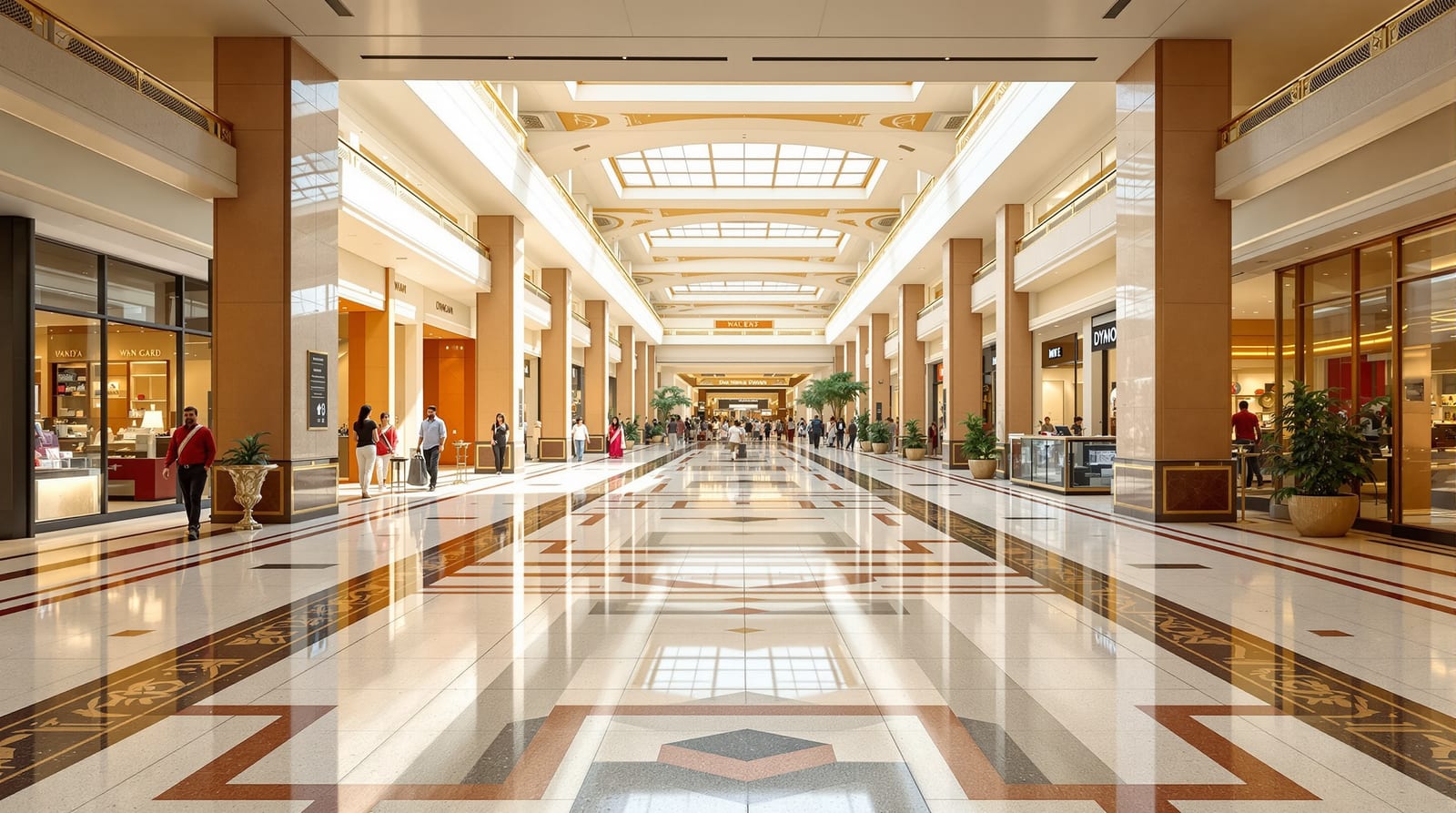
Mall Flooring in India: The Right Floor for Concourse, Atrium, Food Court and Anchor Stores, with Costs
Shopping malls floor millions of footfalls a year while projecting a premium image and passing slip checks — here is the floor, ₹/sq ft and key driver for the concourse, atrium feature, food court, entrance, anchor stores, lift lobbies, parking and washrooms.
A shopping mall is the most punishing floor brief in retail. The concourse outside the food court on a Sunday evening sees more foot passes in a day than a home floor sees in a decade, and it has to absorb stilettos, trolley wheels, dragged suitcases, spilled cola and monsoon mud while still photographing like a luxury arcade. Get the specification wrong and you are re-laying a 200,000 sq ft concourse mid-lease, closing zones at night and losing footfall to a competitor across the road. This guide maps the right floor, indicative ₹/sq ft and the single deciding driver for every zone of an Indian mall or commercial complex — from the showpiece concourse to the food court, atrium feature, entrances, anchor fit-outs, lift lobbies, parking and washrooms.
What makes mall flooring its own discipline
A mall floor is judged on six pressures at once, and the mix is harsher than almost any other commercial space covered in the commercial flooring guide.
Extreme footfall. A regional mall handles 10-30 million visitors a year; the main concourse carries a continuous stream plus service trolleys and housekeeping machines. This is the very top of the abrasion and traffic class — PEI Class V tile, full-body or double-charged vitrified, or natural granite — nothing softer survives.
Prestige image. The floor is the first surface a shopper touches and it signals where the mall sits in the market. A flamed-and-polished granite concourse with inlay borders reads premium; a basic ceramic floor reads bargain. Developers spend on the concourse and atrium precisely because the floor sets rental tone for every tenant.
Slip safety where it counts. Most of a mall is dry circulation, but the food court (grease and spills), the entrances and drop-off (monsoon water and tracked mud) and the washrooms are wet-risk zones that legally need a slip rating. The National Building Code (NBC 2016) and the Rights of Persons with Disabilities (RPwD) Rules govern anti-slip public surfaces, ramps at 1:12, thresholds under 12mm and tactile guiding indicators. See anti-slip flooring standards for the R-rating map.
Huge-area maintenance and lifecycle cost. When a floor covers hundreds of thousands of square feet, a few rupees per square foot on cleaning, polishing or early replacement multiplies into crores. The right mall floor is the one that auto-scrubs clean every night and almost never needs refinishing — lifecycle cost, not the day-one quote, decides it.
Feature patterns and wayfinding. Unlike a warehouse, a mall floor is designed. Borders, banding, a different field tile per zone and an inlaid atrium medallion guide shoppers, mark anchor thresholds and break the visual monotony of a long concourse. Pattern is functional wayfinding as much as decoration.
Fast tenant refit. Anchor and in-line store floors change with every new brand. The base-build floor must let a tenant overlay LVT, vitrified or polished concrete quickly, often overnight, without disturbing the mall floor underneath — so the concourse and the store interiors are usually different systems.
The mall floor by zone — recommendation and cost table
The table pairs each mall zone with the floor families that win in India, the indicative installed cost in 2026, and the one driver that should decide it. Costs are broad ranges for the finished floor; confirm with current quotes and the flooring cost per square foot guide.
| Mall zone | Recommended floors | ₹/sq ft (installed) | Key driver |
|---|---|---|---|
| Common concourse / circulation | Large-format vitrified (full-body/double-charged), granite, terrazzo | 130-350 | Extreme footfall durability + image |
| Atrium feature / medallion | Inlaid granite and marble, water-jet stone, terrazzo banding | 350-1500 | Showpiece prestige + wayfinding |
| Entrance / drop-off | Flamed/leathered granite or sandstone, anti-skid porcelain (R11) | 130-300 | Anti-skid in monsoon + impression |
| Food court | Anti-slip vitrified/porcelain (R10-R11), terrazzo | 110-260 | Slip + grease + easy daily wash |
| Anchor / store interiors (tenant fit-out) | LVT, large-format vitrified, polished concrete, porcelain | 90-420 | Brand image + fast refit |
| Escalator / lift lobbies | Granite, double-charged vitrified, terrazzo | 130-350 | Concentrated wear + transition grip |
| Parking (basement / podium) | Paver blocks, VDF concrete, epoxy | 60-200 | Vehicle load + tyre abrasion + drainage |
| Washrooms | Anti-slip vitrified/porcelain (R10-R11), small-format stone | 90-260 | Wet slip safety + hygiene |
| Service corridors / back-of-house | Vitrified anti-skid, kota, epoxy | 60-200 | Trolley traffic + low maintenance |
Zone notes that change the right answer
Common concourse — the durable showpiece. This is the heart of the spec. Large-format full-body or double-charged vitrified tile in 800x800mm or 1200x600mm is the workhorse: it survives Class V footfall, comes in stone-look finishes, and the bigger the format the fewer grout lines to dirty. Premium malls upgrade to granite flooring, which is effectively indestructible and ages without a wear layer to lose, or to terrazzo, now back in fashion for its seamless, repairable, designable surface. The concourse is almost always a combination — a field tile with a contrasting granite or terrazzo border and banding that runs the length of the mall.
Atrium feature — the prestige medallion. Under the central skylight, where photographs are taken and events are staged, malls splurge on an inlaid granite-and-marble or water-jet-cut marble medallion. This is the one place Italian marble or intricate stone inlay earns its cost — it is a small area with outsized image impact, and it doubles as a navigation landmark.
Food court — anti-slip and wash-down. The floor here meets grease, dropped food and constant spills, so it must be an R10-R11 anti-slip porcelain or vitrified tile or terrazzo that mops and machine-scrubs clean without trapping grease in deep texture. The same demands govern a supermarket floor and a stand-alone restaurant kitchen; treat the food court as a hybrid of public concourse and back-of-house kitchen.
Entrance and drop-off — the monsoon slip line. The first six metres inside any door is where tracked-in monsoon water causes the most slip claims. Specify flamed or leathered granite, anti-skid stone or an R11 porcelain at the threshold, and follow anti-slip flooring standards and NBC flooring requirements for ramps, tactile indicators and barrier matting recesses.
Anchor and in-line stores — tenant fit-out. The mall lays a level, durable base; tenants overlay their own brand floor — LVT and large-format vitrified for apparel and lifestyle, polished concrete for industrial-look brands, marble or PGVT for jewellery. The base-build choice should let this happen fast and overnight; that fast-refit logic is the same one in the retail store flooring guide.
Parking — the load floor. Basement and podium parking is a structural floor, not a finish one: interlocking paver blocks on the podium, or vacuum-dewatered/granolithic concrete and epoxy line-marked decks in the basement, all sized for vehicle load, tyre abrasion and drainage falls.
Lifecycle cost — why malls buy expensive concourse floors
A mall concourse lives 15-25 years under the harshest traffic in the building, and the buy price is often a fraction of the total cost of ownership across that life. Compare on lifecycle, not the day-one quote.
| Concourse option | Buy + install ₹/sq ft | Daily maintenance | Refresh cycle | Verdict over 15 years |
|---|---|---|---|---|
| Large-format vitrified | 130-220 | Auto-scrub, very low | Very long; replace odd tile | Excellent value at scale |
| Granite | 200-350 | Scrub; occasional re-polish | Effectively permanent | Highest image, lowest replacement risk |
| Terrazzo (poured) | 130-250 | Auto-scrub; reseal | Re-grind/re-polish, repairable | Seamless, designable, long life |
| Double-charged vitrified | 90-200 | Auto-scrub, very low | Long; wears through colour body | Strong value, fewer finish options |
| Ceramic (under-spec) | 50-110 | Low | Fails under Class V footfall | Avoid on concourse — false economy |
The pattern is the same one in the complete commercial flooring guide: floors that machine-scrub clean and almost never need refinishing — granite, full-body vitrified, terrazzo — beat cheaper ceramics over the life of the mall, because the cost of closing a zone to re-lay it dwarfs the original tile saving. Model your own numbers with the commercial flooring cost calculator or shortlist by zone with the space flooring selector.
Do and don't for mall floors
Do specify the concourse at the top abrasion and traffic class — full-body/double-charged vitrified, granite or terrazzo — and use large formats to cut grout lines. Do treat the food court, entrances and washrooms as wet-risk zones with an R10-R11 anti-slip rating and welded/coved detailing where water sits. Do design feature borders, banding and an atrium medallion as wayfinding, not just decoration. Do plan a separate, fast-overlay base for tenant fit-outs so anchor floors can change overnight. Do check the RPwD chain — ramp slope, threshold height, tactile indicators — at design stage.
Don't value-engineer the concourse to a soft ceramic to save a few rupees; it is the first floor to fail and the most expensive to re-lay live. Don't carry a polished, slippery concourse tile straight into the food court or entrance. Don't ignore machine-cleaning access — texture deep enough to trap food in a food court will defeat the night auto-scrubbers. Don't forget the transition strips and grip at escalator and lift-lobby mouths, where wear and slip concentrate.
Frequently asked questions
What is the best flooring for a shopping mall concourse in India?
For the main concourse, large-format full-body or double-charged vitrified tile is the workhorse — Class V durability, stone looks and fewer grout lines. Premium malls upgrade to granite for near-permanence or terrazzo for a seamless, designable, repairable surface. Most concourses combine a field tile with a contrasting stone border and banding for wayfinding.
How much does mall flooring cost per square foot in India?
Indicatively in 2026, the concourse runs ₹130-350/sq ft depending on whether it is vitrified, granite or terrazzo; the food court and washrooms ₹90-260/sq ft for anti-slip tile; the atrium feature medallion ₹350-1500/sq ft for inlaid stone; and parking ₹60-200/sq ft for pavers, VDF or epoxy. Lifecycle cost matters more than the day-one quote — model both with the commercial flooring cost calculator.
What anti-slip rating does a mall food court need?
Food courts meet grease and spills, so specify at least an R10-R11 anti-slip porcelain or vitrified tile or terrazzo per DIN 51130, machine-scrubbable so grease does not lodge in the texture. Entrances and drop-offs need an R11 anti-skid stone or porcelain for monsoon water, and washrooms need R10-R11. The full map is in the anti-slip flooring standards guide.
Why do malls use granite or terrazzo when vitrified is cheaper?
Because lifecycle cost, not buy price, decides a floor that covers hundreds of thousands of square feet and lives 15-25 years. Granite and poured terrazzo almost never need replacing, project the premium image that sets rental tone, and avoid the cost and disruption of closing a zone to re-lay a failed cheaper floor. Vitrified still wins for value at scale; the choice is image versus capital budget.
How is mall flooring different from a single retail store floor?
Scale, zoning and refit. A store is one space with one brand; a mall is a feature-patterned base-build concourse plus food court, atrium, entrances, lift lobbies, parking and washrooms, each with its own demand, that must also let dozens of tenant store floors be installed and changed overnight independently. The base-build and tenant fit-out are deliberately different systems, as the commercial flooring guide explains.
Export this guide
Related Guides — Deep-dive reading
Foyer & Entrance Flooring in India: Best Materials, Anti-Skid Picks, Vastu & Cost
The floor that makes the first impression and takes the hardest hits — grit, monsoon mud and footfall — done durable, impressive and safe, with a dirt-trapping entry zone and Vastu welcome notes.
Flooring & SurfacesRetail Store Flooring in India: Best Floors by Store Type, Footfall Durability & Cost
The floor sells the merchandise and survives the footfall — picked by store type from apparel and lifestyle to jewellery, supermarket and electronics, with entrance slip safety, zoning, ₹/sq ft and lifecycle.
Flooring & SurfacesSupermarket Flooring in India: Zone-by-Zone Floors for Aisles, Fresh & Wet Areas, Checkout, Cold Storage and Loading
How to specify a trolley-tough, anti-slip, fast-to-clean floor across every zone of a supermarket or hypermarket — large-format vitrified or polished concrete for the aisles, R11 anti-slip for fruit-veg and dairy, PU resin for cold rooms, and VDF for the back-of-house and loading bay — at the lowest lifecycle cost per square foot.
Flooring & SurfacesRelated Tools — Try Free
Flooring Cost Calculator
Estimate the all-in cost of a floor — material, laying, wastage, skirting and GST — by area and material.
Flooring CalculatorGranite Flooring Cost Calculator
Estimate installed granite-floor cost — material, cutting, laying, polishing, sealing, wastage and GST.
Flooring CalculatorMarble Flooring Cost Calculator
Estimate installed marble-floor cost — material, laying, grinding and polishing, sealing, wastage and GST.
Flooring Calculator