
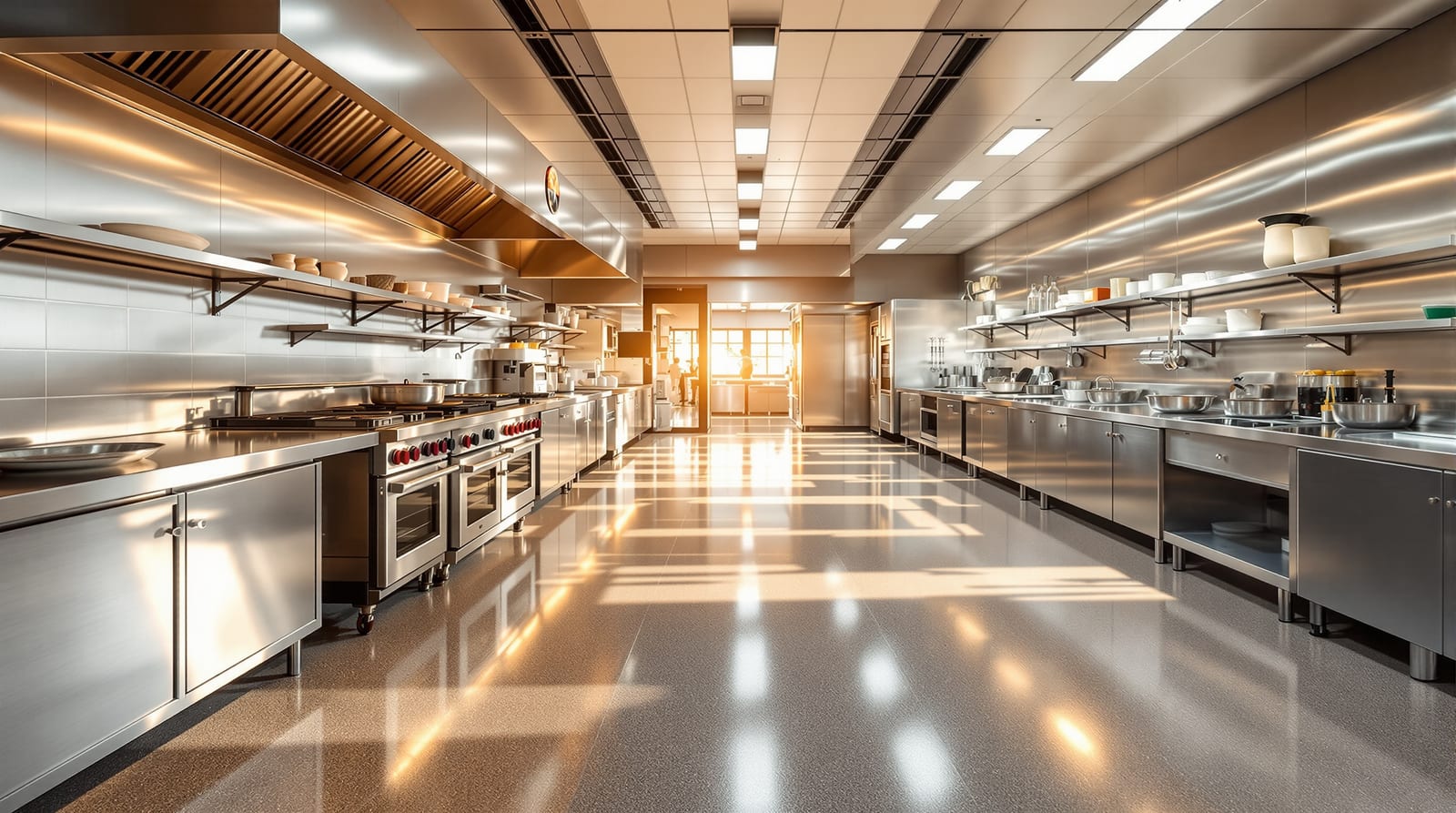
Commercial Kitchen Flooring in India: PU Resin, R11-R12 Anti-Slip & FSSAI Hygiene
The most demanding floor in any building — anti-slip under grease and water, thermal-shock proof, seamless and coved for food-safety, with R-ratings, FSSAI hygiene and cost per square foot for Indian restaurants, hotels, cloud kitchens and food factories.
A commercial kitchen floor is the hardest-working surface in any building. For twelve to eighteen hours a day it is wet, greasy, hot and chemically scrubbed all at once — and it has to grip a chef's foot the whole time, survive a kettle of boiling stock hitting it, shrug off oil and food acids, and present an unbroken, crack-free, coved surface that a food-safety inspector can pass. Get it wrong and you injure staff, fail an FSSAI audit, and re-lay the floor inside a year. This guide ranks the floors that actually survive an Indian restaurant, hotel, cloud-kitchen, canteen or food-factory cookline, and grounds every choice in R-ratings, hygiene code and honest cost per square foot.
Why the kitchen floor is the most demanding floor you will ever specify
Most floors face one or two dominant risks. A commercial kitchen floor faces all of them, simultaneously, every single shift. Ranked by how often they cause real cost and real injury:
- Slip safety under grease AND water — this is the headline risk. A back-of-house slip is the most common serious staff injury in food service. Oil and water on a hard floor destroy the contact patch under a rubber sole, so the floor itself must carry a deep anti-slip profile of R11 to R12 on the DIN 51130 ramp test — far beyond what an ordinary tile delivers.
- Thermal shock and heat — boiling water, hot oil from a fryer, steam from a combi-oven and the dumped contents of a stockpot all hit the floor near 100 degrees C, then cold-water mopping follows. Few materials survive that repeated hot-cold cycling without cracking or debonding. This single factor is why the cheapest "seamless" option fails.
- Grease, oil and chemical resistance — animal fats, vegetable oils, acidic tomato and tamarind sauces, dairy and aggressive caustic degreasers all attack the floor daily. It must stay non-porous and chemically stable through all of it.
- Hygiene and FSSAI compliance — under the FSSAI Schedule 4 food-business hygiene requirements, floors in food-handling areas must be impervious, non-absorbent, washable, free of cracks and crevices, easy to clean and disinfect, and laid so water drains away. In practice that means seamless and coved up the wall.
- Drainage — the floor must shed the litres of water and grease that hit it, with falls to gullies or channel drains so nothing pools into a slip hazard or a bacterial reservoir.
- Durability under point loads — trolley castors, range feet, dropped pans and the daily grind of a deck-scrubber chew through soft floors fast.
A floor that nails slip, heat, grease, hygiene and drainage at once is a narrow shortlist — and one material sits at the top of it.
The gold standard: PU / PU-cement resin screed
For a serious commercial kitchen — a hotel banquet kitchen, a multi-brand cloud kitchen, an institutional canteen, a food-processing plant — the default specification today is a polyurethane (PU) cement resin screed, often called PU-cement, PU screed or "polyurethane concrete". It is trowel-applied 4 to 9 mm thick over a primed concrete slab and is the only common floor that ticks every box on the list above at once.
Why it wins:
- Thermal-shock proof — PU-cement is formulated specifically to take steam-cleaning and boiling spills without cracking or debonding. Heavy-duty grades tolerate continuous temperatures and thermal cycling that crack epoxy. This is its single biggest advantage over every cheaper option.
- Seamless and integrally coved — it is poured and trowelled as a monolithic surface and turned up the wall as a curved cove skirting (typically 100-150 mm), so there is no open joint, no 90-degree wall junction, nowhere for grease and bacteria to lodge. This is exactly what FSSAI Schedule 4 and an inspector want to see.
- Anti-slip by design — a graded silica or aluminium-oxide aggregate is broadcast into the wet resin, then sealed, to hit a specified R11 or R12 (DIN 51130) and a high surface-water-displacement (V-rating). The grip is built into the floor, not a coating that wears off.
- Grease, oil, acid and chemical resistant — the cured surface is impervious and chemically stable against food fats, acids, dairy and caustic cleaners.
- Fast to install and return to service — many systems are trafficable in hours to a day, which matters when a kitchen cannot close for a week.
Full detail on grades, thickness and build-up is in the PU resin flooring guide. PU screed costs more up front — typically ₹180-500 per sq ft installed depending on thickness, anti-slip grade and coving — but on a hot, wet, heavily-used cookline it is the floor that does not have to be redone, which makes it the cheapest floor over a ten-year life.
Why epoxy alone fails on a hot wet cookline
Epoxy is the floor most clients ask for first, because it is seamless, cheaper than PU and looks the part. On a dry prep room, a dry store, a bakery cold section or a bar back, epoxy flooring is a perfectly good choice. On the hot wet cookline it is the classic false economy.
The problem is thermal shock. Standard epoxy has a far lower heat tolerance and a different thermal-expansion behaviour from the concrete beneath it. When boiling water, hot oil and steam hit it repeatedly, then cold mopping follows, the resin softens, discolours, blisters and eventually debonds and cracks — and once it cracks, water gets under it, hygiene is gone and the inspection fails. Epoxy is also more brittle under thermal cycling than the flexible PU-cement chemistry.
The honest rule: use epoxy for the DRY back-of-house — stores, prep, packing, dry bakery, bar back — and use PU-cement on anything that gets hot AND wet: the cookline, the wash-up, the steam and fryer zones, the wet pot-wash. Specifying epoxy on the cookline to save money is the single most common, most expensive mistake in Indian kitchen fit-outs.
The proven lower-capex route: anti-slip quarry and full-body vitrified tile
Before resin screeds became common, the traditional commercial kitchen floor in India was a heavy-duty tile — and it remains a valid, lower-capex choice when laid correctly. Two tile families work:
- Quarry tiles — dense, unglazed, vitrified-clay tiles fired to very low absorption, supplied in an R11-R12 textured anti-slip finish. They are robust, heat-tolerant and proven over decades in institutional kitchens.
- Full-body / unglazed vitrified tiles in a structured anti-slip finish, where the colour and texture run through the whole tile so wear does not expose a different body. See vitrified tile flooring for the tile families.
The tile itself is rarely the weak point — the GROUT is. The non-negotiables for a tiled kitchen floor:
- Epoxy grout, never cement grout. Cement grout is porous, stains, harbours bacteria and erodes under acidic and caustic cleaning; within months the joints become a hygiene failure. Epoxy grout is impervious and chemically resistant and is the difference between a tiled kitchen that passes inspection and one that fails it.
- Coved tile skirting — a curved cove-base tile up the wall to remove the dirt-trapping floor-to-wall junction.
- Falls to drains built into the screed before tiling, so water leaves the floor.
- R11-R12 anti-slip texture specified on the tile, plus the displacement profile for greasy zones.
The technique detail for grip is in anti-slip flooring for wet areas. A correctly laid quarry-tile kitchen floor lands around ₹90-220 per sq ft installed and is a sound choice for a budget-conscious restaurant — but it has many more joints than a poured floor, and disciplined daily cleaning of those joints is what keeps it compliant.
Coving, slope and drainage: the details that pass or fail inspection
The material matters, but two construction details decide whether a kitchen floor is hygienic and safe regardless of which surface you pick.
Coving. A flat floor that meets the wall at a right angle creates a crevice that traps grease and water and cannot be cleaned. The fix is a curved cove skirting — the floor turned up the wall as a continuous radius (100-150 mm high). In a PU screed it is formed integrally in the same pour; in a tiled floor it is a special cove-base tile. Specify coving from day one across the whole back-of-house; retrofitting it later means breaking out the floor edge.
Slope to drains. Wet kitchen zones must be laid to falls — typically a 1:80 to 1:100 slope — toward floor gullies or, better, a stainless channel drain (a long linear grated channel) running past the wet line. This keeps water and grease moving off the floor instead of pooling into a slip hazard and a bacterial reservoir.
The section below shows the principle: the slab is built to fall toward the channel drain, the resin (or tile) is laid over it with an anti-slip aggregate surface, and the floor turns up the wall as a coved skirting so there is no crack at the junction.
Zone-by-zone recommendation and cost table
A commercial kitchen is not one floor condition. The table maps each back-of-house zone to its recommended floor, the slip rating to specify, indicative installed cost (2026 India), and why. Costs are indicative — confirm against current local quotes.
| Zone | Recommended floor | Slip rating (DIN R) | Cost (₹/sq ft) | Why |
|---|---|---|---|---|
| Cookline / fryer / range | PU-cement resin screed, coved | R11-R12 | 180-500 | Thermal-shock proof, grease/acid resistant, seamless, hygienic |
| Wash-up / pot-wash / dishwash | PU-cement resin screed, coved | R12 | 200-500 | Constantly wet and hot; highest grip needed |
| Heavy-duty alternative (budget) | Anti-slip quarry / full-body vitrified, epoxy grout, coved | R11-R12 | 90-220 | Proven, robust; joints are the weak point |
| Prep / cold kitchen / bakery | Epoxy resin (or PU) | R10-R11 | 120-350 | Seamless, cheaper; fine where not hot-and-wet |
| Dry store / packing | Epoxy resin or sealed concrete | R10 | 120-350 | Dry, lower risk, easy-clean |
| Walk-in / cold room | PU-cement (low-temp grade) | R11 | 200-500 | Tolerates freezer temps without cracking |
| Food factory / process hall | PU-cement resin screed, coved | R11-R12 | 180-500 | Wet process, washdown, heavy loads, hygiene |
| Service corridor / pass | Same anti-slip class as kitchen | R11 | 90-260 | Transition slip control, trolley traffic |
For the floors either side of the kitchen — the dining room, bar and front-of-house — see restaurant flooring, which splits the venue zone by zone.
Standards and codes to specify
- DIN 51130 (R-ratings) — the ramp-test slip classification. A commercial kitchen cookline needs R11 minimum, R12 in the wettest, greasiest zones (fryers, dishwash, pot-wash). Many specifiers also call a surface-water-displacement V-rating (V4-V10) so spills drain off the contact patch. The reasoning behind R-ratings is in anti-slip flooring standards.
- FSSAI Schedule 4 — the food-business hygiene requirement: floors impervious, non-absorbent, washable, crack- and crevice-free, easy to clean and disinfect, with drainage. This is what drives the seamless-and-coved specification.
- IS 15622 — the Indian Standard for pressed ceramic/vitrified tiles, including water-absorption groups; specify a fully vitrified (Group BIa, absorption under 0.5 percent) tile for a tiled kitchen floor.
- NBC 2016 and RPwD 2021 — anti-slip and accessibility provisions where staff/public circulation routes are involved.
For the wider commercial context across all building types, see the commercial flooring guide.
Design and specification tips
- Specify PU-cement on anything hot AND wet; epoxy only where dry. This one decision prevents the most common failure.
- Cove everything in the back-of-house — 100-150 mm curved skirting up the wall, integral in resin or cove-base tile. Specify from day one.
- Build falls to drains into the slab — 1:80 to 1:100 toward gullies or a stainless channel drain along the wet line.
- Use epoxy grout, never cement grout, on any kitchen tile. Non-negotiable for hygiene.
- Match grip to the spill, not the room name — R11 across the kitchen, R12 on fryers/dishwash/pot-wash.
- Detail the drains as part of the floor system — channel drains with removable grates and sloped bodies clean far better than point gullies in a busy kitchen.
- Plan installation around closure — PU and epoxy systems need a clean, dry, mechanically prepared slab; quick-cure grades minimise downtime for a working kitchen.
- Provide anti-fatigue mats at static stations (range, pass, dishwash) over the hard resin floor for staff standing for hours — they sit on top of, not instead of, the anti-slip floor.
Do and don't
Do specify PU-cement resin on the hot wet cookline; do cove the floor up the wall everywhere in the back-of-house; do build slope to channel drains; do specify R11-R12 anti-slip with the right surface profile; do use epoxy grout on any kitchen tile.
Don't put plain epoxy on a hot wet cookline (it thermally shocks and cracks); don't use smooth glazed tile or untreated polished concrete; don't use cement grout in the kitchen; don't skip coving to save money; don't let high-gloss front-of-house floors run into the greasy service path.
Care and maintenance
A commercial kitchen floor is deep-cleaned daily, not occasionally. Deck-scrub the resin or tiled floor with a kitchen degreaser and a stiff brush or scrubber-drier, rinse the coving and flush the drains thoroughly, and squeegee toward the gully so nothing pools overnight. Inspect resin coving and tile grout joints monthly — a single open crack is where contamination and a failed inspection begin, and an early repair is trivial compared with re-laying a debonded floor. For the general routine see the floor cleaning guide, and for resin and tile resealing schedules the floor resealing guide.
Frequently asked questions
What is the best flooring for a commercial kitchen in India?
A polyurethane-cement (PU-cement) resin screed is the gold standard. It is seamless, integrally coved up the wall, thermal-shock proof against boiling spills and steam, resistant to grease and food acids, and finished with a broadcast aggregate to hit an R11-R12 anti-slip rating. The proven lower-capex alternative is anti-slip quarry or full-body vitrified tile laid with epoxy grout and coved tile skirting. See PU resin flooring.
Why does epoxy flooring fail in commercial kitchens?
Standard epoxy has low heat tolerance and a different thermal-expansion behaviour from the concrete slab. Repeated thermal shock from boiling water, hot oil and steam — followed by cold mopping — makes it soften, discolour, blister, debond and crack. Once it cracks, water gets underneath and hygiene is lost. Epoxy is fine for dry prep rooms, stores and bar backs, but the hot wet cookline needs PU-cement. Compare in epoxy flooring.
What slip rating does a commercial kitchen floor need?
On the DIN 51130 ramp scale, a commercial kitchen cookline needs R11 as a minimum and R12 in the wettest, greasiest zones around fryers, dishwash and pot-wash. The floor should also carry a high surface-water-displacement (V) rating so spills drain off the contact patch. The detail is in anti-slip flooring standards and the techniques in anti-slip flooring for wet areas.
What does FSSAI require of a commercial kitchen floor?
Under FSSAI Schedule 4, floors in food-handling areas must be impervious, non-absorbent, washable, free of cracks and crevices, easy to clean and disinfect, and laid with drainage. In practice that means a seamless or epoxy-grouted, anti-slip, coved floor with falls to drains — the curved wall junction and the absence of open joints are exactly what an inspector checks.
How much does commercial kitchen flooring cost per square foot in India?
Indicatively in 2026: a PU-cement resin screed runs ₹180-500 per sq ft installed depending on thickness, anti-slip grade and coving; an anti-slip quarry or full-body vitrified tile floor with epoxy grout and coving runs ₹90-220 per sq ft; epoxy for dry zones is ₹120-350 per sq ft. Budget the cookline as a safety and compliance investment — the resin floor that does not need re-laying is the cheapest over a ten-year life. For the venue floors either side, see restaurant flooring and the commercial flooring guide.
Export this guide
Related Guides — Deep-dive reading
PU Flooring in India: Polyurethane Resin & PU-Cement Floors, Types, Thickness, Cost & vs Epoxy
Seamless polyurethane (PU) and PU-cement screed floors are the hygienic, thermal-shock-proof, flexible alternative to epoxy for food, dairy, brewery, pharma, cold storage and commercial-kitchen floors in India — here are the types, thickness, anti-slip and coving detail, install and cure, ₹150–500 per sq ft costs, and an honest PU-vs-epoxy comparison.
Flooring & SurfacesEpoxy Grout vs Cement Grout for Tiles in India: Which to Specify (2026)
A plain-English guide to tile grouts for Indian homes: what grout does, how cementitious grout compares with epoxy grout on cost, stain and water resistance, hygiene and durability, and exactly where each one belongs - kitchens, bathrooms, pools, dry rooms and more.
Building MaterialsBathroom Flooring Guide India: Anti-Skid Tiles, Stone, Vinyl & Epoxy Compared
Every bathroom floor material for Indian homes in one place — anti-skid ceramic and vitrified tiles, natural stone, mosaic, vinyl (SPC/LVT) and epoxy — with a full comparison table, slip ratings, ₹/sq ft costs and the safety and slope rules that keep a wet floor from becoming a hazard.
BathroomsRelated Tools — Try Free
Flooring Cost Calculator
Estimate the all-in cost of a floor — material, laying, wastage, skirting and GST — by area and material.
Flooring CalculatorGrout Quantity Calculator
Estimate grout in kg and cost by tile size, joint width and thickness — cement or epoxy grout.
Flooring CalculatorMaterial Schedule Generator
Generate a room-wise finish schedule — walls, floors, ceilings, trim, and joinery by location.
Material Schedule