
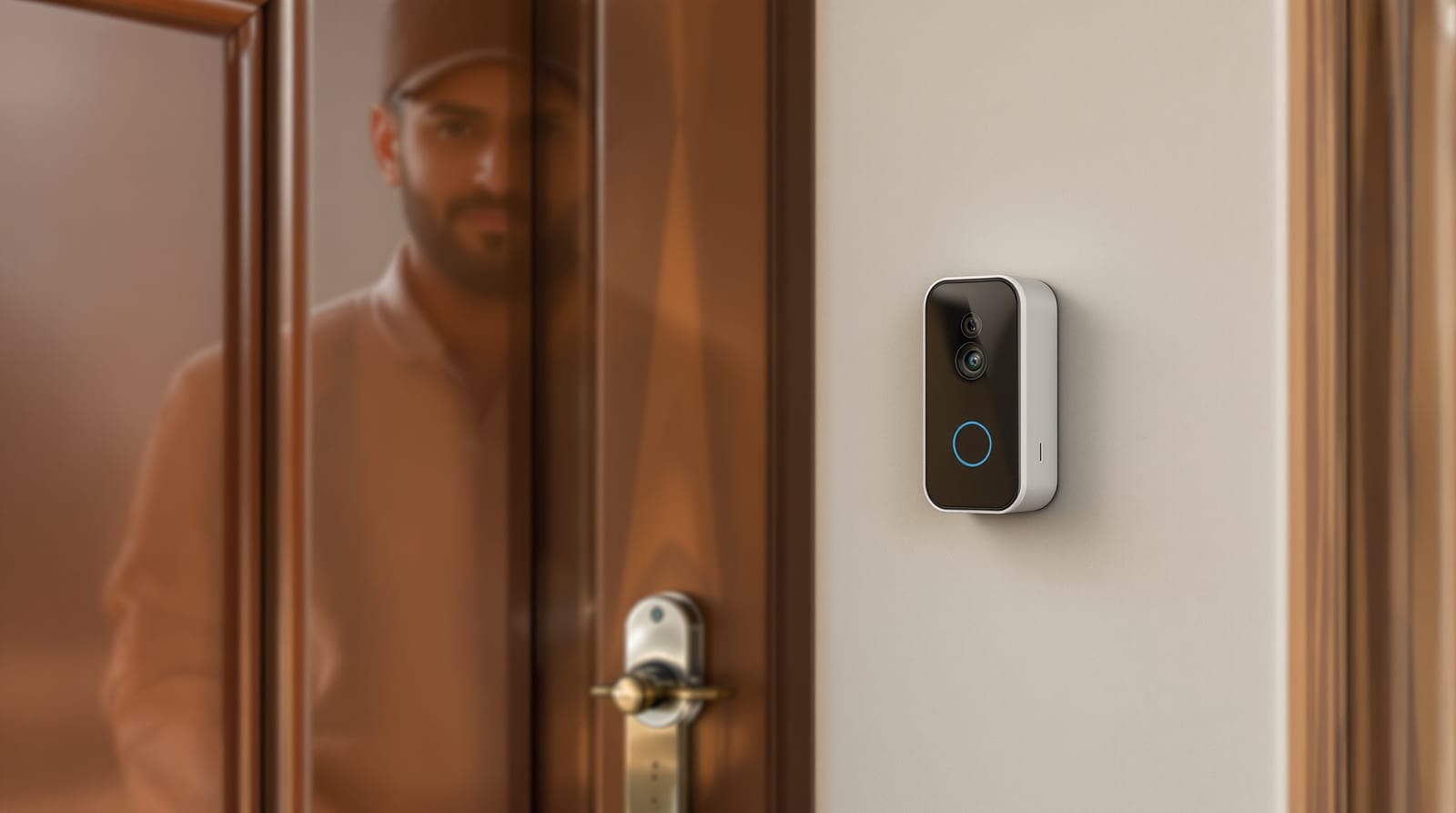
Door Camera Systems: Peephole, Doorbell, CCTV India 2026
Peephole cams, video doorbells and entrance CCTV compared — field of view, night vision, alerts, storage and DPDP-aware privacy for Indian homes.
A camera at the entrance is now the most-watched part of an Indian home — it sees the courier, the maid, the unexpected visitor and, increasingly, the package left on the mat. But "door camera systems" is not one product: it spans the screw-in peephole camera that replaces your old door viewer, the doorbell camera that rings your phone, and a dedicated entrance CCTV camera mounted above the door for a wider, always-on view. Each captures a different slice of the threshold, stores footage differently, and carries its own privacy obligations under India's DPDP Act. This guide compares the three, decodes the specs that actually matter — field of view, night vision, motion alerts, storage and subscription — and shows how a door camera complements, rather than replaces, your video door phones and smart door locks.
The three kinds of door camera systems
Think of the entrance as three jobs: who is at the door right now, who came while I was out, and what happened on the porch. Different cameras are tuned for each.
- Peephole camera — replaces the brass door viewer with a digital lens and a small inside screen (or a phone app). Discreet, tenant-friendly, no exterior wiring. Narrow-to-medium field of view aimed straight ahead at face height. Best where you cannot drill the wall or fit a doorbell.
- Doorbell camera (video doorbell) — mounts beside the door at chest height, combines a bell push, two-way audio, motion detection and a phone app. The mainstream choice for flats and independent homes. Good for who is at the door and who rang while I was out.
- Entrance CCTV camera — a dedicated bullet, dome or turret camera mounted above or beside the door, angled down over the porch, gate or lift lobby. Wider scene, continuous recording, and the only one that reliably catches package theft and loitering before anyone touches the bell.
Most serious entrances end up with two layers: a doorbell camera at the threshold plus one overhead CCTV camera for the wider porch. A peephole camera is the swap-in option for rented flats.
Field of view, night vision and the specs that matter
Specs sell cameras, but only a few change real-world usefulness at a door.
Field of view (FoV). A doorbell camera with a 150–180 degree diagonal view shows the visitor head-to-toe plus the package on the mat; a narrow 90 degree lens crops feet and parcels. For overhead CCTV, a 90–110 degree lens with the right mounting height covers a porch without fish-eye distortion. Peephole cameras are usually narrowest (around 90–120 degrees) because they look through a small bore.
Resolution. 2MP (1080p) is the practical floor; 3–4MP gives readable faces and number plates at the gate. More megapixels need more storage and bandwidth, so match resolution to what you actually need to identify.
Night vision. Most door cameras use infrared (IR) LEDs for black-and-white night images; better units add a starlight/full-colour sensor or a small white spotlight for colour at night — far more useful for identifying clothing and faces. India's porch lighting is uneven, so colour night vision earns its premium at an entrance.
Aspect ratio and orientation. Some doorbell cameras offer a tall head-to-toe (portrait/3:4) view specifically to show a person and the parcel by the door in one frame — a genuinely useful feature for package capture.
| Spec | Peephole camera | Doorbell camera | Entrance CCTV |
|---|---|---|---|
| Typical FoV | 90–120° | 150–180° | 90–110° |
| Resolution | 1080p–2MP | 1080p–3MP | 2–4MP |
| Night vision | IR | IR or colour | IR or colour/starlight |
| Two-way audio | Some | Yes | Some |
| Continuous recording | Rare | Event-based | Yes (24×7) |
| Catches package theft | Weak | Good | Best |
| Tenant-friendly | Yes | Sometimes | Needs mounting |
Motion alerts, AI and avoiding alert fatigue
A door camera lives or dies by its alerts. Basic motion detection pings you for every passing crow; smarter cameras use person/vehicle/package detection and activity zones so you are notified only when a human approaches your door or a parcel appears. On Indian streets and shared landings this filtering is the difference between a useful camera and one you mute within a week.
Look for: adjustable detection zones (exclude the public footpath), sensitivity control, package alerts, and a snooze. Two-way talk lets you tell a courier where to leave a parcel or warn off a loiterer in real time. Pre-roll/pre-buffer (a few seconds before the trigger) matters because the action that matters often starts before motion crosses the line.
Storage: local (SD/NVR) versus cloud and the subscription question
Where footage lives is the single biggest cost-and-privacy decision.
Local storage — a microSD card in the camera, or an NVR/DVR for wired CCTV. One-time cost, no subscription, footage stays in your home, works during an internet outage. The trade-offs: a card can be stolen with the camera, capacity is finite (overwrites in a loop), and remote review depends on your home network. NVR-based entrance CCTV gives the longest, most reliable history — typically 7–30 days at the gate.
Cloud storage — clips uploaded to the maker's servers, accessed by app. Footage survives even if the camera is ripped off the wall, and review is easy from anywhere. The catch is an ongoing subscription: many doorbell cameras give only live view and basic alerts free, and gate person detection, recorded clips and longer history behind a monthly/annual plan. Budget for the subscription as a running cost, not a one-time spend, and check whether multiple cameras need separate plans.
Hybrid — SD card plus optional cloud is the sweet spot: free local recording with cloud as off-site backup for the clips that matter. Whichever you choose, factor 18% GST and confirm whether the camera requires a subscription to record at all.
| Storage model | Up-front | Running cost | Survives camera theft | Works offline | Best for |
|---|---|---|---|---|---|
| microSD (in-camera) | Low | None | No | Yes | Doorbell/peephole, budget |
| NVR/DVR (wired) | Medium–high | None | NVR if hidden | Yes | Entrance CCTV, long history |
| Cloud only | Low | Monthly/annual | Yes | No | Off-site safety, easy access |
| Hybrid (SD + cloud) | Medium | Optional | Partly | Local yes | Most homeowners |
Indian brands worth shortlisting generically include Qubo (Hero), CP Plus, Hikvision, Godrej and Panasonic for doorbell and entrance cameras; pick on storage model and night vision rather than headline megapixels. Estimate your real spend with the video door phone selector and weigh recurring fees with the access control ROI calculator.
How the door camera fits the wider entrance system
A camera sees; it does not let people in. The complete threshold is a small ecosystem:
The camera tells you who; the video door phone lets you talk and the smart lock lets you grant entry. A premium video door phone already bundles a camera, so a separate doorbell camera is most useful when you want a phone-first experience, a wider street view, or coverage your VDP lens misses. Where you want the doorbell and lock to act as one, see how a smart doorbell is wired into the broader door automation and a smart door ecosystem, and how the whole layer ties together in the complete door guide.
Power and connectivity — the India reality
Door cameras are useless in a black-out that takes the router with it. Battery-powered doorbell cameras keep recording but lose live alerts if the Wi-Fi is down; wired/PoE entrance CCTV on a small UPS, plus a router on the same backup, is the resilient setup. Plan backup the way you would for any access device — see door access power backup. Match the radio to your home: most door cameras use 2.4GHz Wi-Fi for range through walls.
Privacy, DPDP and neighbour etiquette
A door camera necessarily films a semi-public space, which brings legal and social duties.
- DPDP Act 2023. Footage of identifiable people is personal data. Collect only what you need, secure it (strong passwords, updated firmware, encrypted cloud), and do not retain clips longer than you have a reason to. A subscription that hoards a year of porch footage you never review is a liability, not a feature.
- Neighbour overlook. Aim the lens at your doorway and porch, not into a neighbour's door, windows or a shared corridor used by other families. Use activity zones and privacy masks to blank out areas that are not yours. In housing societies, follow the RWA's policy and avoid pointing cameras into common areas without the committee's consent.
- Audio. Two-way audio recording of conversations raises sharper consent questions than video; disable continuous audio recording unless you genuinely need it.
- A visible notice that the entrance is under camera surveillance is good practice and defuses disputes.
The goal is security with restraint: enough coverage to identify a courier or catch a parcel thief, without turning your landing into a surveillance hotspot. For the lock side of the same threshold and how cameras complement keyless entry, see keyless entry systems.
Frequently asked questions
Do I need a door camera if I already have a video door phone?
Not necessarily. A video door phone already has a camera at the door. Add a separate door camera when you want phone-first alerts, a wider porch or street view, package-theft capture, or coverage of angles the VDP lens misses. Many homes pair a VDP at the threshold with one overhead entrance CCTV for the porch.
What is the best door camera for catching package theft?
An overhead entrance CCTV camera angled down over the porch, recording continuously, is the most reliable for package theft because it sees the parcel and anyone approaching it before they reach the bell. A doorbell camera with a tall head-to-toe view and package alerts is a good secondary layer.
Is local SD storage or cloud better for a door camera?
Local SD/NVR storage has no subscription, keeps footage in your home and works offline, but can be stolen with the camera. Cloud survives camera theft and is easy to access remotely but costs a recurring fee and needs internet. A hybrid setup — SD card plus optional cloud backup — suits most Indian homes.
Can my door camera point at my neighbour's door?
You should avoid it. Under the DPDP Act and basic etiquette, aim the camera at your own doorway and porch, use privacy masks or activity zones to exclude a neighbour's entrance, windows or shared corridors, and follow your society's policy on common-area coverage.
Will a door camera work during a power-cut?
Battery doorbell cameras keep recording briefly but lose live alerts if the router is also down. For continuous coverage during India's power-cuts, put wired/PoE entrance CCTV and the router on a small UPS, or choose a camera with on-board SD recording plus backup power for the network.
Export this guide
Related Guides — Deep-dive reading
How to Choose a CCTV Camera (2026): The Homeowner's Decision Guide for India
Cut through the spec-sheet noise and choose the right CCTV camera for each spot around an Indian home. What actually matters — sensor and low-light performance, lens and field of view, form factor, IP and IK ratings, honest smart features — and the marketing claims to ignore.
SecurityCCTV vs Video Door Phone: Which Does Your Home Need?
They look similar and get confused constantly, but a CCTV camera and a video door phone do different jobs — one watches the whole property and records, the other answers your door and controls who comes in. This guide settles CCTV vs video door phone for Indian homes: what each is for, where they overlap, real rupee costs, apartment versus villa relevance, and why most homes end up wanting both.
Smart HomeSmart Home Security Systems in India: CCTV, Sensors, Alarms & AI
How to think in layers — perimeter, entry, interior — and build a system that actually protects an Indian home: AI cameras, video door phones, door and glass-break sensors, alarms, panic buttons, gate automation, monitoring and DPDP-aware privacy, with real brands and rupee costs.
Smart HomeRelated Tools — Try Free
CCTV Camera Coverage & Count Calculator
Estimate how many CCTV cameras you need, the NVR channels, storage in TB for your retention period, and an indicative all-in cost with GST.
CCTV CalculatorCCTV Cloud vs Local Cost Calculator
Compare cloud CCTV subscription against a local NVR + HDD — upfront, 5-year total, monthly fee and break-even.
Cloud vs LocalVideo Door Phone Feature Selector
Tick what you want the door phone to do — app, night vision, two-way audio, smart lock, access control or facial recognition — and get the features and integrations to spec, with the privacy and safety caveats.
Feature Selector