
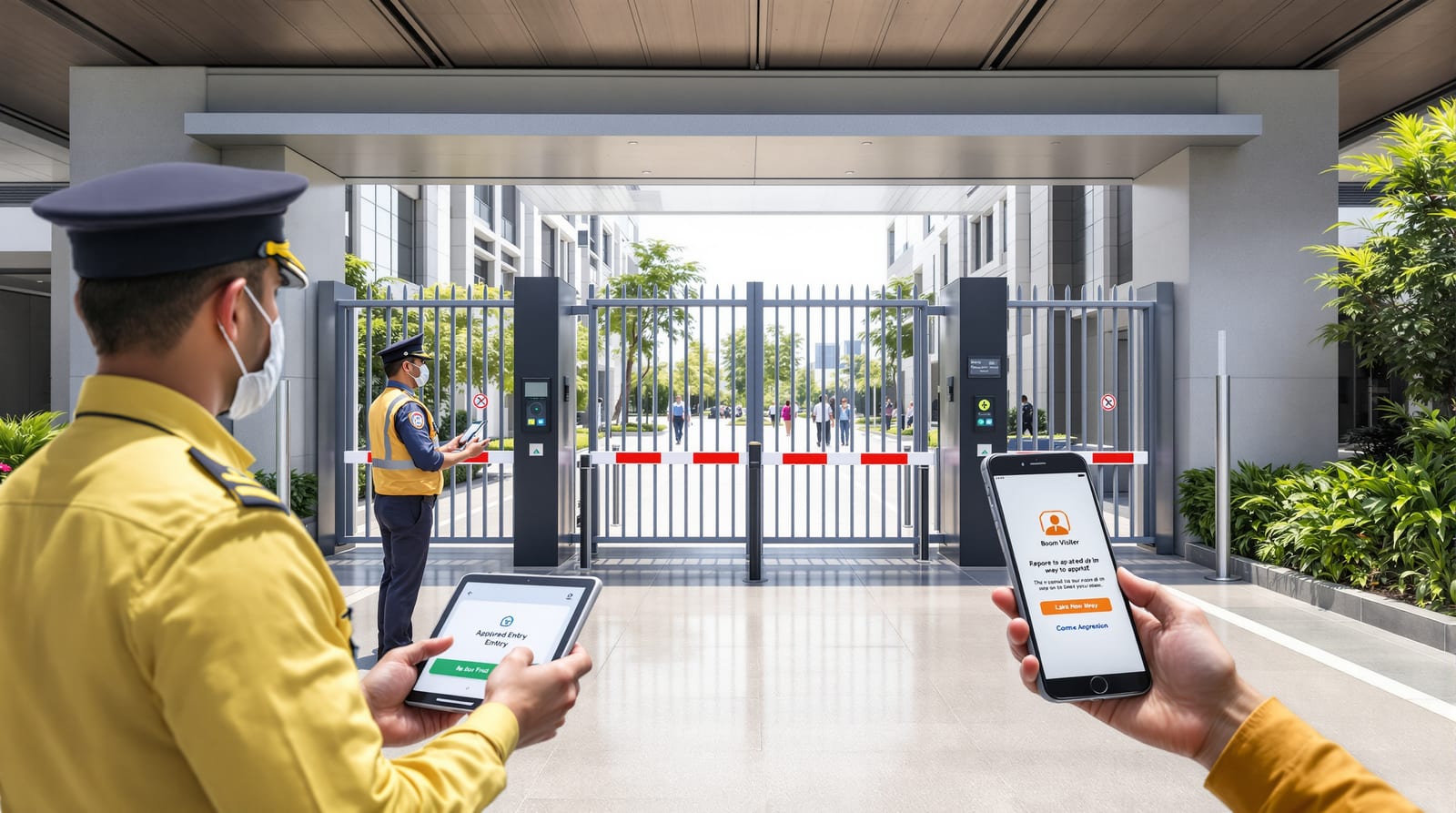
Visitor Management Systems for Doors & Gates India 2026
How gate-pass apps, OTP/QR entry, e-intercom approval and barrier integration secure society, office and factory entrances.
Visitor management systems have quietly become the busiest piece of access technology in Indian buildings. Every gated society, office tower and factory now runs hundreds of daily entries — guests, maids, delivery riders, cabs, contractors — and the old paper register simply cannot keep up or keep anyone safe. A modern visitor management system replaces that register with a gate-pass app, OTP or QR entry, e-intercom approval and a digital audit trail, and then links the decision to the actual door release or boom barrier. This guide explains how these systems work, what they cost in India in 2026, how they integrate with your access control, and what the DPDP Act now requires of you for visitor data. It is written for facility and security managers, society committees and integrators.
What a visitor management system actually does
At its core a visitor management system (VMS) digitises the question every guard asks: should this person be let in? Instead of a handwritten name and a phone number nobody verifies, the VMS captures the visitor, routes an approval to the resident or host, logs the event, and triggers the gate.
A typical flow has five steps:
1. Identify — the visitor is registered at the gate (or pre-registered by the host) with name, purpose, photo and optionally an ID.
2. Approve — the host gets an e-intercom notification on their phone or flat panel and taps Approve or Deny. No host reachable means no entry.
3. Authenticate — an OTP or QR code proves the approved visitor is the one at the gate.
4. Release — the system (or the guard) opens the boom barrier, turnstile or door.
5. Record — entry and exit time, photo and approver are written to an immutable audit log.
The popular gated-community apps used across Indian societies bundle all of this with billing, complaints and amenity booking, but standalone office and factory VMS platforms do the same thing with deeper integration to access control and HR systems.
Entry methods: gate-pass, OTP, QR and pre-approval
The single biggest improvement over the paper register is pre-approval. A resident expecting a guest, or an office hosting an interview, generates a gate-pass in advance. The visitor arrives with a code and walks through with no friction.
| Entry method | How it works | Best for | Friction |
|---|---|---|---|
| Guard-registered | Guard enters visitor details, calls/approves via app | Walk-ins, unplanned guests | Medium — depends on guard |
| Pre-approved gate-pass | Host pre-registers; visitor shows code | Expected guests, interviews | Very low |
| OTP entry | One-time code sent to visitor's phone, verified at gate | Cabs, one-off deliveries | Low |
| QR code pass | Visitor scans/shows a QR at the reader | Events, contractors, repeat vendors | Very low |
| Self-kiosk | Visitor self-registers on a tablet, host notified | Corporate receptions | Low |
OTP and QR matter because they bind a specific approved visitor to the entry — a forwarded screenshot is far harder to misuse than a name shouted at a guard. For recurring staff (maids, drivers, cooks), most society apps issue a daily-help QR or attendance pass so the same person is recognised without re-approval each day.
Delivery and cab management
Deliveries and cabs are where Indian gates get chaotic, so VMS platforms handle them as separate, lighter flows. A delivery rider is logged against a flat number and either dropped at a collection point or sent up after a quick resident tap. Many societies now enforce a delivery-at-gate policy through the VMS, where the resident chooses send up or leave at gate. Cab entries use a vehicle-number capture (sometimes ANPR — automatic number-plate recognition) plus an OTP the rider reads out. The value is the record: if a parcel goes missing or a cab overstays, there is a timestamped, photo-backed log.
Photo, ID capture and the audit trail
Every serious VMS captures a live photo of the visitor at the gate and, for higher-security sites, an ID scan (Aadhaar should be masked — capture only what you need). Some factories and offices print a temporary badge with the photo and a QR. The combination of photo, host approval and entry/exit timestamps produces an audit trail that is invaluable for incident investigation and, increasingly, for insurance and compliance.
Integrating with the gate, barrier and door release
A VMS is only as useful as its link to the physical barrier. Integration ranges from advisory (the app tells the guard, who opens manually) to fully automated (an approved QR scan triggers the boom barrier or turnstile directly). The diagram below shows a typical society topology.
For the barrier link, most platforms expose a relay output, a Wiordrop/Wiegand reader interface, or an API that drives the access controller. If you are wiring this — relay to barrier, reader to controller, controller to maglock — get a qualified integrator and electrician; isolate power before touching the panel. The wiring discipline is the same as any door automation wiring job, and the controller logic mirrors a standard access control system deployment.
Life-safety, non-negotiable: any barrier, turnstile or access-controlled door that sits on a fire-escape or egress route must allow free egress without an app or approval, and maglocks must release automatically on a fire-alarm signal. This is mandated under NBC 2016. A visitor system controls who comes in; it must never trap anyone trying to get out. See fail-safe vs fail-secure locks for the device choice.
Costs in India 2026
Society VMS is usually a low per-flat SaaS fee; office and factory VMS is project-engineered. All figures attract 18% GST.
| Deployment | Indicative cost (₹) | Notes |
|---|---|---|
| Society gate-pass app (SaaS) | ₹10–40 per flat / month | App-only; uses existing guard phone/tablet |
| Guard kiosk tablet + stand | ₹15,000–40,000 each | Per gate; rugged mount |
| Office self-service VMS kiosk | ₹60,000–2,00,000 | Tablet/kiosk + badge printer + software |
| Boom barrier (FASTAG/relay) | ₹60,000–1,80,000 | Per lane, installed |
| ANPR camera for vehicles | ₹25,000–80,000 | Number-plate capture |
| Enterprise VMS software (annual) | ₹40,000–3,00,000+ | Scales with sites, users, integrations |
As a rule of thumb, a mid-size society spends most on the app subscription and one or two kiosk tablets, while an office's cost is dominated by the barrier, ANPR and integration engineering. Use the access control cost estimator and the access control ROI calculator to size a budget before you invite quotes.
DPDP Act 2023 — visitor data is personal data
A VMS collects names, phone numbers, photos and sometimes IDs of people who are not your members — visitors. Under the Digital Personal Data Protection (DPDP) Act 2023, that makes you a data fiduciary with real obligations:
- Collect the minimum. Capture only what the entry decision needs; do not store full Aadhaar numbers — mask them.
- Notice and purpose. Display, at the gate, what you collect and why; use it only for security/entry.
- Retention limits. Auto-purge visitor logs and photos after a defined period (commonly 30–90 days for routine visits); keep longer only with reason.
- Security. Encrypt data in transit and at rest; restrict who can view logs.
- Vendor diligence. Your VMS provider is a processor — check where data is hosted and who can access it.
Biometric VMS (face recognition at the gate) raises the bar further; see face recognition access control and the broader access control standards for how to handle sensitive data lawfully.
Reliability and the India reality
Three failure modes to plan for. Power cuts — the barrier, controller and router need a UPS or battery backup, or every outage becomes a manual gate; pair this with a door access power backup plan. Connectivity — a cloud-only VMS is useless when the internet drops, so insist on offline guard mode (the guard can still log and open manually). Lock-out — keep a guard override and a physical key path; never let an app be the only way in for residents. For the whole picture of how visitor management fits the building's access strategy, see the complete door guide, the gated society access control playbook, and the office access control deep-dive.
A visitor management system is one of the highest-return security upgrades an Indian building can make — provided it is integrated cleanly, kept legal on data, and never allowed to compromise free egress.
Frequently asked questions
Do society apps replace the security guard?
No. The popular gated-community apps make the guard far more effective — pre-approvals, OTP verification and instant resident notification — but a human is still needed to handle exceptions, watch the gate and manage walk-ins. Treat the VMS as a force-multiplier, not a replacement.
Is OTP or QR entry secure enough for a high-security site?
For societies and most offices, OTP/QR plus a live photo and host approval is strong. For factories or sensitive offices, layer it with ANPR for vehicles, ID capture and a staffed kiosk, and consider multi-factor door access on the inner doors.
What happens to visitor data and is it legal?
Visitor photos, names and numbers are personal data under the DPDP Act 2023. You must collect the minimum, post a notice of purpose, secure the data and auto-purge logs after a defined retention period. Mask Aadhaar; never store full ID numbers without a clear reason.
Can the system open the boom barrier automatically?
Yes — an approved QR or OTP can drive a relay or API that releases the barrier or turnstile. But any barrier on an escape route must allow free egress and release on fire alarm per NBC 2016, and you should keep a guard override for power or network failures.
What does a basic society visitor system cost?
App-based gate-pass systems run roughly ₹10–40 per flat per month plus one or two guard tablets (₹15,000–40,000 each). Adding a boom barrier and ANPR pushes the project into lakhs. Add 18% GST and budget for a UPS.
What backup do I need for power cuts?
A UPS or battery backup for the controller, barrier and router, plus an offline guard mode so entries can still be logged and the gate opened manually. Cloud-only systems with no offline fallback are a liability during India's outages.
Export this guide
Related Guides — Deep-dive reading
Visitor Vehicle Management in India: A Professional Guide
The everyday weak point of every society and office gate is not the resident's car — it is the visitor, the cab, the delivery rider and the contractor who must be let in without opening the whole park to anyone. This is the process, not just the hardware: verify at the gate before the boom lifts, park visitors away from resident bays, and never jam the gate a fire tender needs.
SecurityDoor Automation Guide: Access Control for India 2026
The complete map of smart locks, automatic operators, access control and intercom for Indian buildings, with the standards and power-cut realities.
Home Doors & EntrancesAccess Control System Cost in India (2026): Priced Per Door, Per System, Per User
What a building-scale access control system actually costs in India — broken down per controlled door (reader, electric lock, controller, cabling and power) and per system (software, licences, integration and AMC) — with the standalone-versus-networked split, how the bill scales with the number of doors and the credential you choose, and the non-negotiable rule that escape-route doors must fail safe.
SecurityRelated Tools — Try Free
Access-Control Battery-Backup Calculator
Size the standby battery so an access system keeps running through a power cut, with an egress life-safety note.
Battery BackupSecurity System Cost Estimator
Estimate the all-in capex with GST, annual running cost and 5-year total cost of ownership of a home or building security system.
Cost EstimatorBefore vs After — Cost Reality Check
Compare what you expected to pay vs what you actually paid, category by category.
Reality Check