
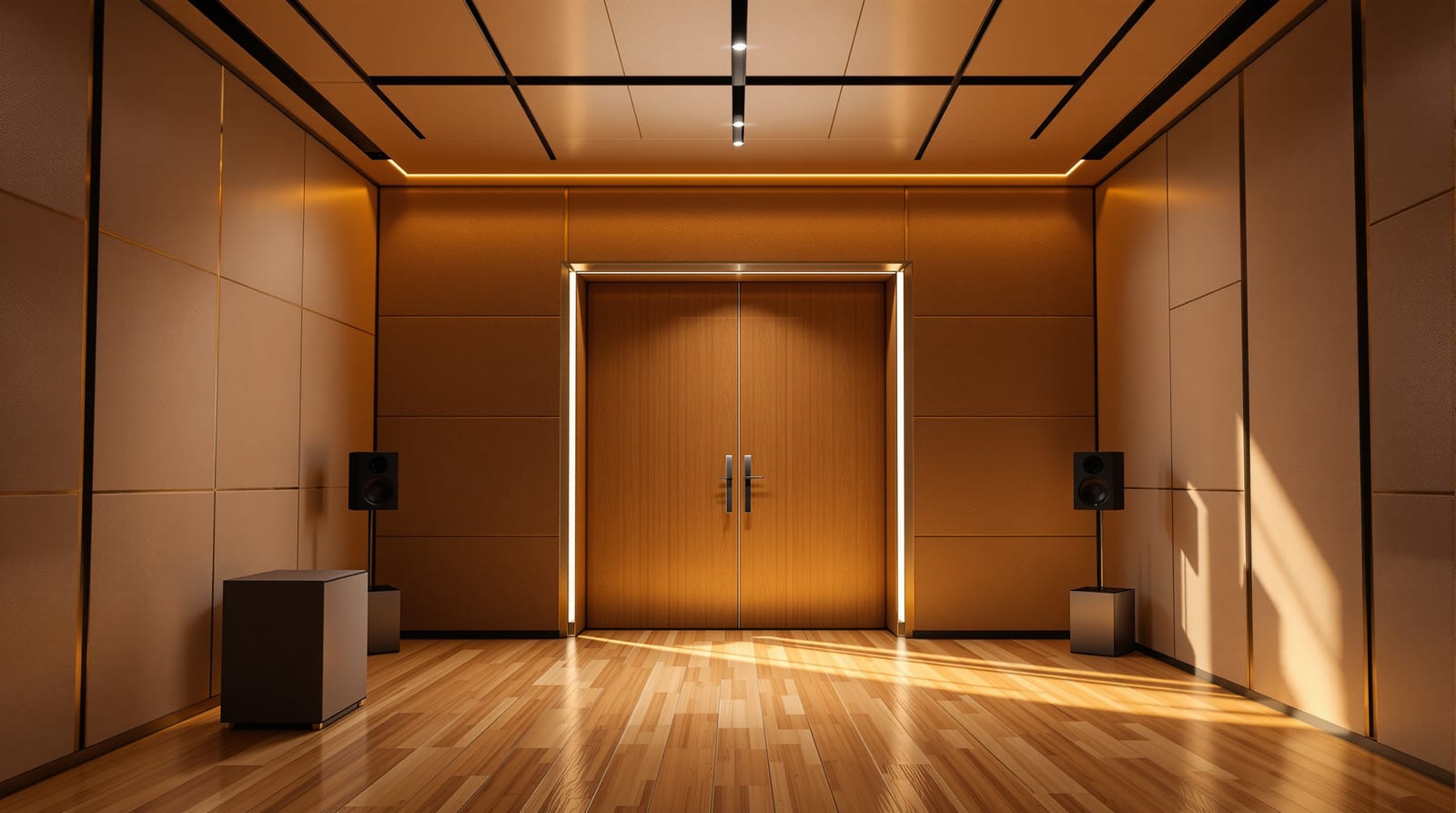
Recording Studio Door in India: Sound-Lock Airlock, STC/Rw Ratings and Costs (2026)
The highest acoustic-isolation door in any building - a very heavy lead-loaded or solid acoustic leaf with full perimeter gaskets, an automatic drop seal, a multi-pane vision window and, for true isolation, the double-door sound-lock with a dead-air vestibule.
A recording studio is built to do one thing that almost no other room in India is built to do: capture a near-silent space and keep a loud space contained. A drum kit in a live room can hit 110-120 dB. A vocal take needs a noise floor low enough that a passing scooter, a lift motor or a neighbour's TV never reaches the microphone. The walls, floating floor and ceiling do most of that work - but every isolation shell is only as good as its weakest opening, and the opening is the door. The studio door is, without exception, the highest acoustic-isolation door in the building. It is not joinery and it is not a home-theatre door scaled up; it is a specified acoustic assembly, and the serious version is not one door at all but two.
This guide is written for professionals - studio designers, architects, acousticians and studio owners - specifying doors for recording, music production, broadcast, podcast, dubbing and post-production rooms in India. It covers what STC and Rw really mean, why the double-door sound-lock is the only honest route to STC 55-65, how to detail the leaf, frame, gaskets, drop seal and vision window, and what it costs. For the underlying isolation theory shared with quieter rooms, pair this with our soundproof doors guide and the home theatre door guide, which is the residential cousin of this far more demanding spec.
What a studio door has to do that no other door does
Most acoustic doors in a building - a conference cabin, a hotel room, a media room - are trying to civilise speech and entertainment levels across maybe 25-45 STC. A studio door faces a different problem entirely.
Two-way, high-level isolation. It must stop loud music getting OUT to the rest of the building and the street, AND stop ambient noise getting IN to a microphone that may be running at high gain. Both directions matter, and the levels are extreme.
A very low target noise floor. Recording rooms are designed to noise-criteria targets (NC 15-25, far below an office). A door that leaks even a little undoes the whole room's rating, because the leak, not the wall, then sets the noise floor.
Decoupling, not just mass. Studio shells are deliberately built as a room-within-a-room - structurally separated from the building so vibration cannot bridge across. The door and frame must respect that decoupling and not become a rigid bridge between the two structures.
A sightline. Unlike a theatre door, a studio door usually needs a flush acoustic vision window so the engineer in the control room and the musicians in the live room can see each other and cue takes. That window must isolate as well as the door around it.
Put together, these demands push the studio door past every other door in the building. A single sealed door, however heavy, tops out around STC 43-50. Studios routinely need STC 55-65. There is only one reliable way to get there.
STC and Rw: the numbers to specify
Ask every supplier for a tested rating of the whole door-frame-seal assembly, never the bare leaf.
STC (Sound Transmission Class) is the US/North-American single-number rating used by most acoustic-door makers and is the figure you will see most in India. Rw (Weighted Sound Reduction Index, from ISO) is the European/Indian-standard equivalent - similar in magnitude and used interchangeably in practice for specification. Each point is roughly one decibel of broadband reduction; higher is better. For studios, what matters even more than the single number is low-frequency performance, because bass (kick drum, bass guitar, sub) is the hardest to contain and the part a thin door fails first.
Practical targets: a bare hollow door is about STC 20 and useless. A solid-core door with a full seal kit reaches roughly STC 35-43 - fine for a quiet voice-over booth in a low-noise area, not for music. A single purpose-built acoustic studio door reaches STC 43-50. A double-door sound-lock - two acoustic doors with a vestibule between them - reaches STC 55-65, and this is the standard for any live room, control room or broadcast studio. Aim for STC 50 minimum for a serious vocal/podcast room, STC 55-60 for music production, and STC 60-65 where a live drum room shares structure with other rooms or with neighbours.
The double-door sound-lock - the heart of a studio
The single most important concept in studio door design is the sound-lock (also called an airlock or acoustic vestibule): two separate acoustic doors with a small dead-air space between them, each door fitted to its own decoupled frame in the relevant structural shell. Sound that gets past the first door has to cross the dead air and then defeat a second sealed door; the two stages multiply, and the air gap kills the resonance that lets a single door leak bass. This is why two STC-45 doors in a sound-lock comfortably outperform one STC-55 door - and cost less than chasing an exotic single leaf. The vestibule also gives a place for people to enter and exit without ever opening both doors at once, so the studio is never momentarily wide open during a take.
How to detail a studio acoustic door
Each leaf in the assembly is a specified component, not a stock door.
The leaf. A heavy, dense, purpose-built acoustic leaf - typically 50-75 mm thick, often constructed in layers around a dense core (high-density particleboard or mineral board) and, for the highest ratings, lead-loaded or fitted with a constrained mass layer for low-frequency mass. Weight is the point: these leaves can run 60-120 kg each, far beyond a normal door.
The frame, decoupled. A heavy acoustic frame (usually steel) bedded on resilient material so it does not rigidly bridge the two structural shells. The frame is part of the rated assembly - a great leaf in a sloppy frame fails.
Perimeter gaskets - magnetic plus compression. The head and jambs carry continuous compression gaskets, and the best studio doors add a magnetic seal (like a heavy refrigerator-style magnetic gasket) that pulls the leaf tight against the stop for a positive, repeatable seal every close. Continuity at the corners is critical.
Automatic drop seal. The bottom edge - the worst leak on any door - carries a spring-loaded automatic drop-down seal that descends onto a threshold plate when the door closes and lifts clear when it opens. Detail these properly with our door seals and weatherstripping guide.
Acoustic vision window. A flush, multi-pane laminated glazing unit set into the leaf, with two or more panes of different thickness laminated glass, an air gap, and the panes often slightly splayed (non-parallel) to defeat resonance. It must be rated close to the door so it is not the weak link, and the windows in the inner and outer doors are aligned to give the control-room-to-live-room sightline.
Recommended doors, ranked for an Indian studio
Rank by isolation first, then sightline, then ease of use. Cost climbs steeply with STC.
| Door option | Typical STC/Rw (sealed assembly) | Best for | Indicative cost per door (incl. frame, seals, fitting) | Notes |
|---|---|---|---|---|
| Solid-core leaf + full perimeter seal kit + drop seal | 35-43 | Quiet voice-over / podcast booth in a low-noise location | 25,000 - 45,000 | Entry level; not enough for music or a noisy site |
| Single purpose-built acoustic studio door (dense/mineral core, integral gaskets, drop seal) | 43-50 | Small VO room, edit suite, single-stage isolation | 60,000 - 1,50,000+ | Specialist supply; certified single-leaf rating |
| Lead-loaded / constrained-mass acoustic door (single leaf, vision window) | 48-54 | Where one heavy stage is the only option (space-limited) | 1,20,000 - 2,50,000+ | Heaviest single leaf; needs upsized frame and hinges |
| Double-door sound-lock (two acoustic doors + dead-air vestibule) | 55-65 | Live rooms, control rooms, broadcast, drum rooms - the standard | 1,50,000 - 4,00,000+ (two doors + vestibule works) | The only reliable route to STC 55+; consumes floor area |
Costs are indicative for 2026, vary widely by rating, size, core, vision window, brand and city, and exclude 18% GST. These are specialist, high-value doors - far above ordinary commercial doors - so always get a tested rating in writing. For where doors sit in the wider material and pricing picture, see our flush doors guide for solid-core versus hollow-core construction and the doors-by-space guide to coordinate the studio with the rest of the building.
Hardware, swing, fire and egress
Spec the hardware around weight, silence and code. A 60-120 kg acoustic leaf needs four heavy ball-bearing hinges (or a continuous geared hinge) and a frame anchored solidly into the shell. Latches and handles must be quiet and positive - rattly hardware buzzes through a live take. A discreet closer or the magnetic seal helps the door shut fully so the gaskets compress every time; seals only work when the door is properly closed.
On swing and egress: the studio door must still let people out quickly. A studio is an occupied space, so the door must always open easily from inside without a key, and you must reconcile acoustic sealing with fire and life-safety code. Under NBC 2016 and IS 3614, escape routes and fire-compartment openings carry their own requirements; a studio that sits within a larger commercial building may need a fire-rated door on its egress path with a self-closer and, on a designated exit, panic hardware. Where the studio's only exit also serves a corridor, do not let acoustic detailing trap people - coordinate with our fire exit doors guide and confirm clear opening width (at least 900 mm) for equipment and accessibility. Pair the access-control or smart-lock spec from the door hardware guide only where it does not conflict with instant egress.
Do and do not
Do start with a genuinely heavy, purpose-built acoustic leaf - you cannot seal your way out of a light door. Do specify the door, decoupled frame, gaskets, drop seal and vision window as one tested assembly with a stated STC/Rw. Do build a double-door sound-lock for any live room, control room or broadcast studio - it is the only honest route to STC 55-65. Do align the inner and outer vision windows for the sightline. Do upsize hinges and frame for the weight, and detail low-frequency mass for music rooms.
Do not assume one heavy door equals a sound-lock - it does not; the vestibule and second stage are what defeat bass. Do not let a parallel-pane vision window or an open corner gap become the weak link. Do not bridge the decoupled structures with a rigid frame. Do not compromise fire egress for acoustics - the door must open instantly from inside. Do not specify from leaf ratings alone; always demand the assembly's tested figure.
Single acoustic door or a sound-lock?
For a small voice-over or podcast room in an already quiet location, a single purpose-built acoustic door (STC 43-50) with full gaskets and a drop seal can be enough, and it is far cheaper and saves the vestibule's floor area. For anything involving music, monitoring at level, broadcast, or a site with real ambient noise, build the double-door sound-lock (STC 55-65) - it is the standard for a reason, outperforms any single leaf, and lets people move without ever opening the room fully during a take. To weigh the trade-off for your room, run it through our acoustic door selector tool, and if your space is a performance or assembly room rather than a recording space, compare with the auditorium door guide, where panic hardware and egress dominate the brief.
Frequently asked questions
What STC rating does a recording studio door need in India?
Aim for STC 50 as a minimum for a serious voice-over or podcast room, STC 55-60 for music production, and STC 60-65 where a live or drum room shares structure with other rooms or neighbours. A single sealed door tops out around STC 43-50, so reaching the higher targets means a double-door sound-lock. Always specify the tested rating of the full assembly, not the leaf alone.
Why do studios use a double-door sound-lock instead of one heavy door?
Because two stages multiply. Sound that gets past the first door must cross a dead-air vestibule and then defeat a second sealed door, and the air gap kills the low-frequency resonance that lets a single leaf leak bass. Two STC-45 doors in a sound-lock comfortably beat one STC-55 door, usually for less money, and the vestibule lets people enter and leave without ever opening the room fully during a take.
Can a studio door have a window?
Yes, and most should. The control-room-to-live-room sightline needs a flush acoustic vision window - a multi-pane laminated unit with panes of different thickness, an air gap, and often slightly splayed (non-parallel) glass to defeat resonance. It must be rated close to the door so it is not the weak link, and the windows in the inner and outer doors of a sound-lock are aligned to keep the sightline.
What does a recording studio door cost in India?
A single purpose-built acoustic door typically runs about 60,000 to over 1,50,000 rupees fitted; a lead-loaded or constrained-mass single leaf 1,20,000 to over 2,50,000; and a full double-door sound-lock 1,50,000 to over 4,00,000 for the two doors and vestibule works. These are specialist, high-value figures, indicative for 2026, vary widely by rating, size and city, and exclude 18% GST.
How do I keep a soundproof studio door safe for fire escape?
Treat acoustics and life safety as two requirements that must both be met. The door must always open instantly from inside without a key, the clear opening should be at least 900 mm, and where the studio sits in a larger building its egress door may need a fire rating, a self-closer and panic hardware under NBC 2016 and IS 3614. Coordinate the egress path early so acoustic sealing never traps occupants.
Export this guide
Related Guides — Deep-dive reading
Home Theatre Door in India: Acoustic Sealing, STC Ratings and Costs (2026)
Why a normal door ruins a media room - and how to spec a heavy solid-core acoustic door with full perimeter seals, a drop-down bottom seal, light-tight finish and (for serious rooms) a double-door airlock.
Home Doors & EntrancesSoundproof Doors in India: How Doors Leak Sound, STC Ratings, Seals & Real Costs
A door is the weakest acoustic link in any wall - and it usually leaks through the gaps, not the panel - so here is how to actually quieten a bedroom, home theatre or street-facing room, from a 1,500-rupee seal kit to a proper acoustic door.
Home Doors & EntrancesHigh-STC acoustic doors: STC 45-60 specified, India 2026
How an acoustic door reaches STC 45-60 — dense core, full perimeter compression gaskets, automatic drop seal and the sound-lock vestibule.
Home Doors & EntrancesRelated Tools — Try Free
Acoustic Privacy (STC) Visualizer
Indian healthcare acoustic visualizer — compare wall assemblies and noise sources, see received SPL after STC attenuation, and check FGI 2018 / IS 1950 / NABH speech-privacy compliance with live dual-canvas waveform.
Acoustic ToolAcoustic Door Selector
Get the STC rating and door build you need for a quiet space — home theatre, studio, boardroom or hotel room.
Door ToolAcoustic Window Calculator
Estimate how much outside noise a window blocks and the resulting indoor dB level and comfort.
Window Tool