
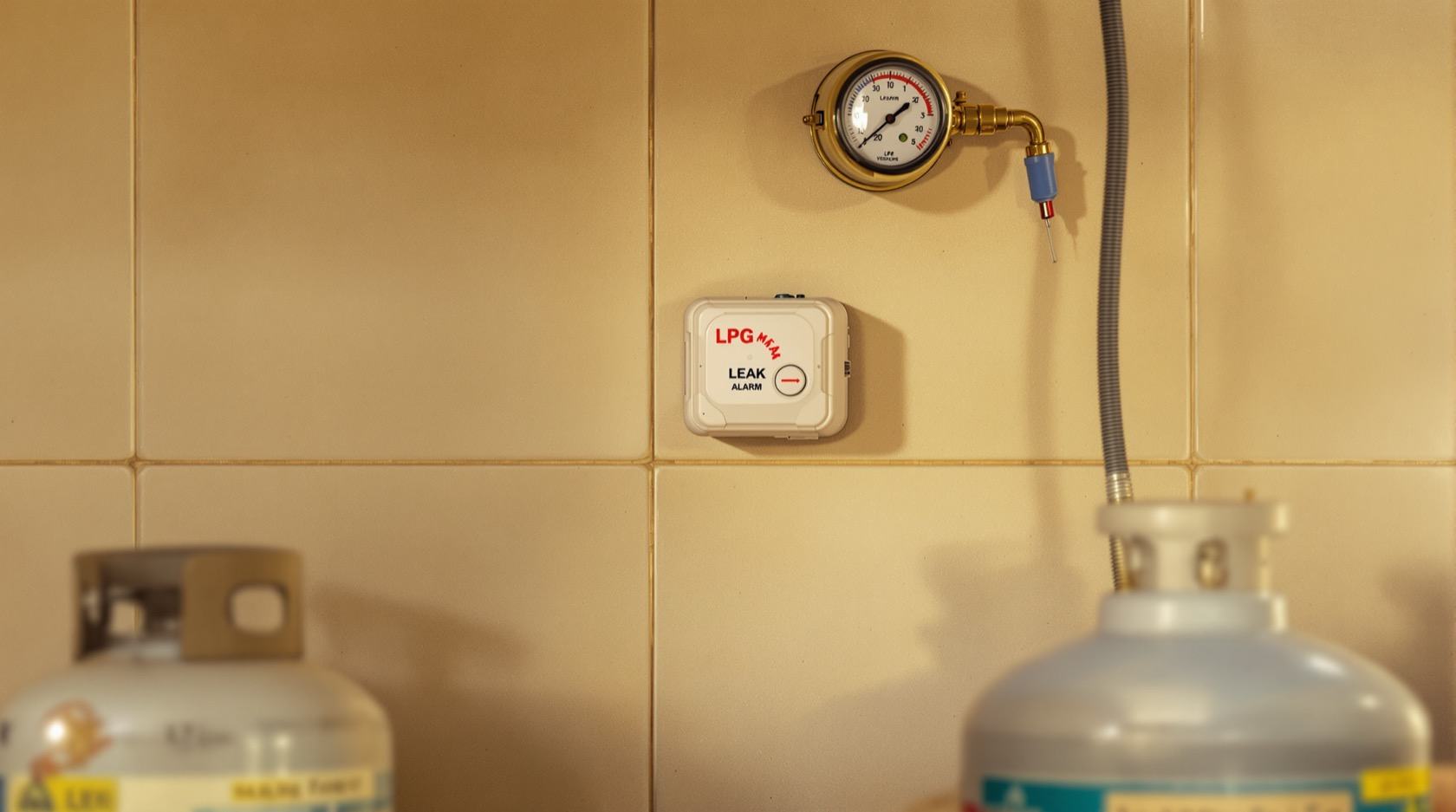
LPG Leak Detectors in India (2026): The Kitchen Gas Alarm Every Home Should Fit
Almost every Indian home cooks on LPG or PNG, and a leak pools invisibly until one spark ignites it. Here is the cheap kitchen gas alarm to fit, and the one placement rule that decides whether it works.
Almost every Indian home cooks on gas. Whether it is an LPG cylinder under the counter or a piped PNG line at the meter, the kitchen holds a store of fuel that is perfectly safe inside the pipe and lethal the moment it escapes into the room. The danger of a leak is not the smell — it is that leaked gas is invisible, it collects silently, and then a single ordinary spark ignites it: a light switch, a fridge compressor kicking in, the doorbell, a mobile phone. An LPG leak detector is a small, inexpensive alarm that sniffs the air continuously and screams before the room ever reaches that point. It is the one detector almost no Indian kitchen has and almost every one should.
This is the LPG-alarm chapter of Studio Matrx's fire-safety library, and it sits under the complete guide to fire safety in India. It is the consumer, India-specific sibling to the broader, more technical gas detectors guide — this page stays at the kitchen counter and answers one practical question: which small gas alarm should a gas-using home buy, and where does it go? For what to actually do during a leak, we reinforce and cross-link the kitchen fire-safety guide rather than repeat it.
Scope and safety — read this first. A standalone LPG/PNG leak alarm is a device you can buy and fit yourself, and this guide helps you choose, place, test and maintain one — all homeowner-doable. But two things are not DIY. Any change to your gas installation — a new pipe run, a PNG connection, moving the regulator or meter — is the job of the authorised distributor's fitter under the Gas Cylinder Rules / PESO framework, not you. And the statutory automatic gas-detection and fire-alarm system for a restaurant, hotel kitchen, society community kitchen or any commercial premises is designed, installed and certified by licensed fire professionals per IS 2189 : 2026 and the Fire NOC. This is educational guidance, not legal advice. And one rule overrides everything below: if you smell a strong leak, do not investigate with a device — follow the leak response, get everyone out, and call the LPG emergency helpline from outside.
Why a gas leak is so dangerous — and so preventable
A gas leak kills in two ways, and a detector addresses the more common one. The rarer path is asphyxiation, where escaping gas displaces the oxygen in a small sealed room. The far more common path in Indian homes is an explosion or flash fire: LPG builds up unseen, mixes with the air into a flammable cloud, and the next spark turns the whole kitchen into a fireball. People are hurt not by the leak but by the ignition — and the tragedy is that the ignition source is almost always something harmless the person did without thinking, because they never knew the room was full of gas.
That is exactly the gap a detector closes. The rotten-egg odourant added to LPG and PNG is a real safety feature, but it fails you in three common situations: while you are asleep, when a slow overnight leak builds up before anyone wakes, and for the many people whose sense of smell is dulled by a cold or age. A leak detector never sleeps and never loses its sense of smell. It gives you an early, loud warning while the concentration is still far below the level that would ignite.
The one rule that decides whether your alarm works: mounting height
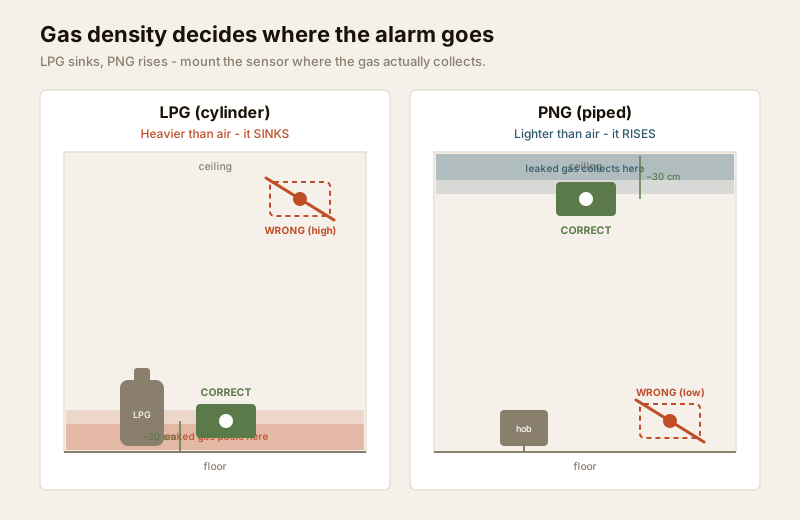
This is the single most important idea in the guide, and getting it wrong makes an otherwise-good detector completely useless. Gas density decides mounting height.
- LPG is HEAVIER than air. Domestic cooking gas (a propane/butane mix) is denser than the air around it, so when it leaks it sinks and pools near the floor, spreading outward like an invisible puddle. To catch it early you must put the sensor where the gas actually goes: mount an LPG alarm LOW, roughly 30 cm (about a foot) above the floor — near, but not directly on top of, the cylinder and stove. An LPG alarm fixed high on a wall or ceiling will not sense the leak until the room is already dangerously full.
- PNG / natural gas is LIGHTER than air. Piped natural gas is mostly methane, which is lighter than air, so a PNG leak rises and collects near the ceiling. If your home is on piped PNG, the rule flips: mount the alarm HIGH, about 30 cm below the ceiling, near the appliance.
If you are unsure which fuel you have: a cylinder under the counter is LPG (mount low); a metered pipe from a city gas utility is PNG (mount high). If a kitchen uses both, it needs the sensor placed for each — or a detector rated and positioned for the gas that is actually present. Do not compromise with a "middle" height; place it for the gas density.
| Fuel | Density vs air | Where a leak goes | Mount the alarm | Typical position |
|---|---|---|---|---|
| LPG (cylinder — propane/butane) | Heavier | Sinks, pools on the floor | LOW | ~30 cm above the floor, near the cylinder/stove |
| PNG (piped natural gas — methane) | Lighter | Rises, collects at ceiling | HIGH | ~30 cm below the ceiling, near the appliance |
| Carbon monoxide (separate device) | Similar to air | Mixes fairly evenly | Per manufacturer | Breathing height / as specified |
A quick but vital clarification: an LPG leak detector is not a carbon-monoxide alarm and not a smoke alarm. They sense three different things and a leak detector will not warn you about CO from a geyser or generator. If that hazard applies to your home, read the separate carbon-monoxide detectors guide — CO is colourless and odourless and needs its own device.
How an LPG leak detector works
Inside the plastic housing is a combustible-gas sensor — most domestic units use a semiconductor (metal-oxide) sensor, some use a catalytic (pellistor) element. The sensing surface reacts to combustible gas molecules in the air and its electrical resistance changes in proportion to the concentration. The electronics watch that signal, and when the gas reaches a set fraction of the Lower Explosive Limit (the concentration at which the mix could ignite) — well below the danger point — the alarm triggers.
What triggering does depends on the type you bought, which is the next decision.
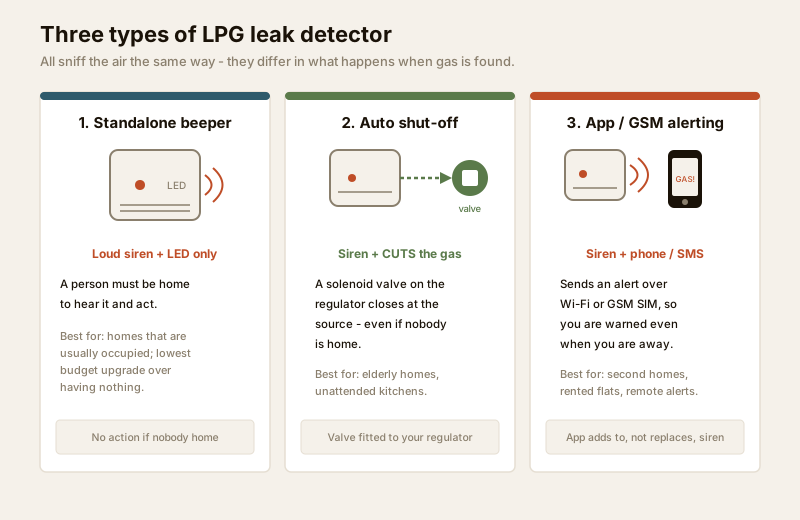
The three types — pick for your home
1. Standalone beeper alarm
The basic and most affordable unit. On detecting gas it does one thing: sounds a loud siren (often 85 dB or more) and flashes an LED, alerting anyone present to act. It is a warning device, nothing more — a person still has to be home to hear it and carry out the shut-off and ventilation. For most single-family homes where someone is usually around, a well-placed beeper alarm is a genuine, low-cost upgrade over having nothing.
2. Alarm with automatic shut-off (solenoid valve)
A step up: the alarm is paired with an electrically operated solenoid valve fitted onto the cylinder regulator (or the PNG line). When gas is detected, the alarm not only sounds but sends a signal that automatically closes the valve and cuts the gas supply at the source — stopping the leak even if no one is home to turn the regulator off. This is the strongest protection for the highest-risk situations: homes with elderly residents, holiday homes, or any kitchen left unattended for long periods. The valve should be fitted by, or per the guidance of, your authorised gas distributor so it is compatible with your regulator and installed correctly.
3. App / GSM-alerting models
Smart detectors add connectivity: over Wi-Fi or a GSM SIM they send a phone notification or SMS when they detect gas, so you are warned even when you are away from home. Many combine this with the local siren and some also drive a shut-off valve. Useful for second homes, rented-out flats, or anyone who wants a remote alert — but the app is an addition to, not a replacement for, a loud local siren and correct placement.
| Type | What it does on a leak | Best for | Trade-off |
|---|---|---|---|
| Standalone beeper | Loud siren + LED only | Homes usually occupied; lowest budget | No action if nobody is home |
| Auto shut-off (solenoid valve) | Siren + cuts gas at the source | Elderly, unattended kitchens, holiday homes | Valve must be fitted to suit your regulator |
| App / GSM alerting | Siren + phone/SMS alert (often + valve) | Second homes, remote alerts, tech-comfortable users | Needs power/network; app is an add-on, not the core |
What to do when the alarm sounds
The alarm buys you time — using it well is the whole point. The response is the same fixed sequence covered in depth in the kitchen fire-safety guide; here it is in short, in order, because the order matters:
1. No sparks, no switches. Do not touch any switch, light, fan, chimney or phone, and never light a match or lighter — a switch arc alone can ignite a gas-filled room.
2. Shut off the gas. Turn off the LPG regulator (or for PNG, the appliance valve, then the meter's main isolation valve). An auto shut-off model does this for you, but confirm it.
3. Open up. Throw open all windows and doors so the gas disperses instead of collecting.
4. Get everyone out — evacuate the whole family and do not go back in until the smell has fully cleared.
5. Call from outside. From outside or a neighbour's home, call the LPG emergency helpline (the number printed on your cylinder or bill) and, if the leak is serious, the fire brigade on 101 or 112.
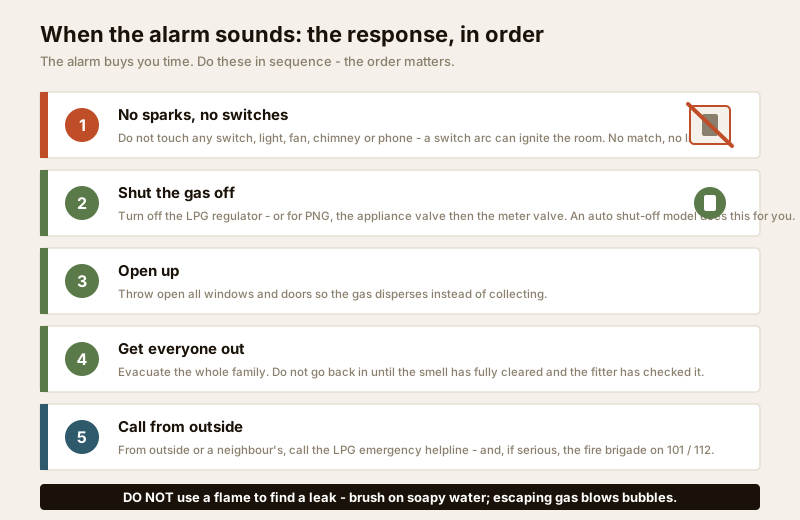
Do not go back to investigate, and never use a flame to locate a leak — brush soapy water on the joints and watch for bubbles once the room is safe. That soap-bubble test is the only safe way to find a leak point.
How to place, test and maintain it
Buying the alarm is half the job; siting and upkeep are the other half.
- Place it for the gas density — LOW for LPG, HIGH for PNG, as above — and near the source (the cylinder, stove or appliance), but not directly over the burner where cooking heat, steam and grease would foul the sensor and cause nuisance trips.
- Give it power it can rely on. In an Indian home, mains cuts are routine, so prefer a unit with a battery or backup, or a plug-in with battery backup, so an outage does not leave you unprotected. Note where the reset and test controls are.
- Test it monthly. Press the test button to confirm the siren and electronics work. This checks the alarm circuit; follow the manufacturer's instructions if it also offers a gas-response self-check.
- Keep the sensor clean. Wipe dust and grease off the vents gently; a clogged sensor is a slow sensor. Do not spray cleaners or aerosols near it.
- Respect the sensor's life. Combustible-gas sensors age and lose sensitivity — most units state a service life (commonly around five years, sometimes stated as a replacement date). Replace the detector at end-of-life; an expired sensor can read normal while blind to a real leak.
Never disable it — pick the right type and place instead
The most dangerous thing anyone does with any alarm is silence or unplug it permanently because it "keeps going off". A detector that nuisance-trips is telling you it is in the wrong place — too close to the burner's steam and grease, or catching aerosol spray — not that it should be switched off. A disabled detector is a dead detector, and the leak it would have caught still comes. The fix for false alarms is correct placement and a suitable sensor, never disconnection. If yours trips without cause, move it slightly away from the cooking plume (keeping it at the right height), keep the vents clean, and check it is not in the path of a deodorant or cleaning spray.
Buying tips
- Look for the ISI / BIS mark and a reputable brand with local service and spares — a gas alarm is a life-safety device, not a gadget to buy on price alone.
- Match the detector to your fuel — confirm it is intended for LPG (or for PNG if that is your supply); some are dual-rated.
- Prefer a loud siren (around 85 dB) plus an LED, a clear test button, and a stated sensor service life printed on the unit.
- Decide on shut-off. If the kitchen is often unattended or used by elderly family, choose an auto shut-off (solenoid valve) model and have the valve fitted to suit your regulator via the gas distributor.
- Consider a remote alert (app/GSM) for a second home or a flat you rent out.
An LPG alarm is one layer. It pairs naturally with the small kitchen kit — a fire blanket and an ABC extinguisher — covered in the kitchen fire-safety guide, and it sits inside the whole-home picture of smoke alarms and an escape plan in the home fire-safety guide. For flats, the apartment fire-safety guide covers the shared risks of a society building. You can turn all of this into a ten-minute self-check with the home fire-safety scorecard, and match the right sensor to each risk with the fire detector selector.
When a professional or statutory system is required. For a home, choosing and fitting a standalone LPG/PNG alarm is yours to do. But for any commercial or institutional kitchen — a restaurant, hotel, canteen or society community kitchen — the gas-detection and fire-alarm system is part of the statutory automatic fire detection and alarm installation governed by IS 2189 : 2026 and the National Building Code (via SP 7 : 2026, Part 4 Fire and Life Safety), tied to the premises Fire NOC and your State Fire Services Act and Rules. That system must be designed, installed, certified and maintained by licensed fire professionals — never a retail purchase, never DIY. Any change to the gas installation itself is likewise the job of the authorised distributor's fitter under the Gas Cylinder Rules / PESO framework. If in doubt, route the work to a qualified professional and confirm the Fire NOC.
Key takeaways
- Almost every Indian home cooks on gas, and a leak is invisible until it ignites — an inexpensive LPG leak detector sniffs the air continuously and warns you long before the room reaches the danger point.
- The mounting-height rule decides everything: LPG is heavier than air, so mount the alarm LOW (about 30 cm above the floor) near the cylinder/stove; PNG is lighter than air, so mount it HIGH near the ceiling. Get this wrong and the detector is useless.
- Choose the type for your home: a standalone beeper for an occupied home, an auto shut-off (solenoid valve) model for elderly or unattended kitchens, and an app/GSM-alerting model for remote warning at a second home.
- On a leak, act in order: no switches or flames, shut the gas off, open up, get everyone out, and call the LPG emergency helpline and 101/112 from outside — never use a flame to find a leak.
- Buy ISI/BIS-marked, test it monthly with the test button, keep the sensor clean, replace it at end-of-life — and never disable it; if it nuisance-trips, fix its placement, do not switch it off. An LPG alarm is not a CO or smoke alarm.
References
- IS 2189 : 2026 (Selection, Installation and Maintenance of Automatic Fire Detection and Alarm System — Code of Practice), Bureau of Indian Standards — the system code for statutory automatic gas/fire detection and alarm installations; verify the current edition via the BIS catalogue: https://www.services.bis.gov.in/
- National Building Code of India, SP 7 : 2026 (the NBC), Part 4 "Fire and Life Safety" — the fire and life-safety framework for premises requiring a detection and alarm system; the older SP 7 : 2016 edition is withdrawn but still widely quoted. Verify the current edition via the BIS catalogue: https://www.services.bis.gov.in/
- The Gas Cylinder Rules and the PESO (Petroleum and Explosives Safety Organisation) framework governing LPG cylinders, regulators and hoses, plus your authorised LPG/PNG distributor's safety guidance and emergency helpline — the basis for cylinder safety and the leak-response sequence.
- Manufacturer datasheets for domestic combustible-gas leak detectors (sensor type, service life, alarm threshold and placement height) — read the specific unit's instructions and confirm it is rated for your fuel (LPG or PNG) and carries the ISI/BIS mark.
This is an educational overview, not legal advice, and not a substitute for a licensed fire-safety professional or your authorised gas distributor. Statutory gas-detection and fire-alarm systems, the Fire NOC and any change to a gas installation are qualified professional tasks — engage licensed professionals and the State Fire Services, and verify any standard's current status via the BIS catalogue before relying on it.
Export this guide
Related Guides — Deep-dive reading
Gas Detectors in India (2026): Combustible-Gas Sensing, LPG vs PNG & the Mounting-Height Rule
How combustible-gas detectors sense a leak before it can explode, why gas density decides whether you mount the unit LOW for LPG or HIGH for PNG, and how to place, test and maintain one.
SecurityKitchen Fire Safety in India (2026): LPG, Oil Fires and the Right Extinguisher
The kitchen starts most Indian home fires. Here is how to prevent an LPG or PNG leak, kill an oil fire the right way, and keep the small kit that actually stops a flare-up spreading.
SecuritySmoke Detectors in India (2026): Photoelectric vs Ionisation, Placement & Testing
The single most important fire-safety device every Indian home should own - how smoke detection works, which type to buy, exactly where to fit it, and how to keep it alive for a decade.
SecurityRelated Tools — Try Free
Cross-Ventilation Analyzer
Estimate airflow and air changes per hour (ACH) from room size, window areas, layout, and local wind — with NBC 2016 Part 8 compliance check.
Ventilation CalculatorApartment Video Door System Planner
Enter flats, entrances, floors and guard desk for a first-pass building intercom plan — door stations, indoor monitors, guard station, the right architecture and an indicative cost band.
Building PlannerFire Detector Selector
Smoke, heat, CO, gas or flame? Pick a space and its fuels and hazards and get the right detector type(s) to consider — with the one placement rule that matters most for each, including the LPG-low vs PNG-high gas rule.
Detector Selector