
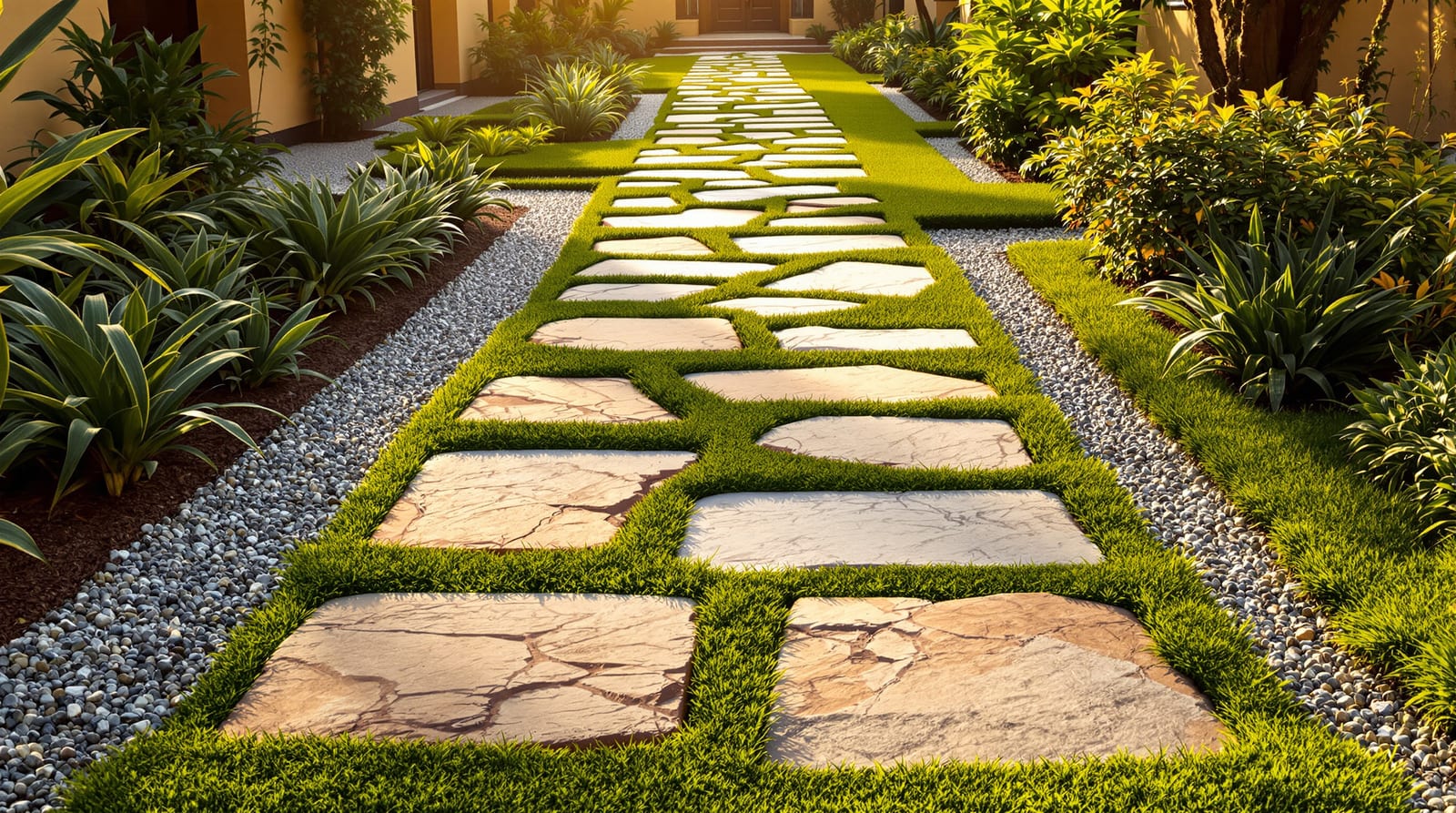
Garden Path Flooring in India: Natural, Anti-Slip & Permeable Walkway Materials (2026)
How to choose path and walkway flooring that blends with greenery, grips when wet, drains the monsoon and stays low-maintenance.
A garden path is the one floor in your home that has to do three jobs at once: look like it belongs in the garden, stay grippy when it is wet and mossy, and let the monsoon soak away instead of pooling. Get it right and the walkway disappears into the greenery; get it wrong and you have a slippery, weed-choked, puddling strip you fight all year. This guide ranks the materials Indian gardens actually use, with grip, drainage, weeds and cost per square foot for each.
What a garden path really has to handle
Before picking a material, look at what your path is up against. A walkway through a lawn has very different demands from a paved spine that takes a wheelbarrow.
- Wet-weather grip. Shaded, north-facing and tree-covered paths grow moss and algae through the monsoon and stay damp for weeks. A polished or smooth surface here is genuinely dangerous. Favour textured, riven, flamed or honed stone, exposed aggregate or pebble — anything with a natural matt key. See anti-slip flooring for wet areas and the anti-skid floor treatment guide for retrofits.
- Drainage and permeability. Indian rainfall is intense and seasonal. A path that sheds water onto the lawn, or better still lets it percolate, protects both the walkway and your soil. Gravel, stepping stones in grass, and grass pavers are naturally permeable; solid paving needs a slight cross-fall (about 1 in 60 to 1 in 80) and open or sand-filled joints.
- Looks that complement the garden. The whole point of a garden path is that it should feel natural and informal, not like a strip of indoor tile dropped outside. Earthy stone, irregular shapes, planted joints and warm tones read as "garden"; large glossy tiles read as "floor".
- Low maintenance — weeds and moss. Open joints invite weeds; damp surfaces grow moss. Choose joint treatment (mortar vs sand vs planting) and material with this in mind, because you will be managing it for years.
- Defined edges. A path without an edge restraint spreads, sinks and loses its line. Brick-on-edge, steel or aluminium edging, granite kerb or a simple concrete haunch keeps gravel and pavers in place.
- Budget. Paths are often where you can be clever with money — offcuts, broken stone (crazy paving), local gravel and reclaimed brick make beautiful walkways cheaply. See flooring cost per square foot in India for the wider picture.
The materials, ranked for an Indian garden path
1. Flagstone and crazy paving (the classic rustic path)
Irregular slabs of sandstone, slate or limestone laid with planted or sand joints. Crazy paving uses broken offcuts in random shapes, which is why it is so cheap and so charming. The riven (naturally split) surface grips well even when wet, and the earthy colour sits beautifully in greenery. This is the default rustic garden path for most Indian homes. Read the dedicated flagstone flooring guide for laying patterns and stone choices.
2. Stepping stones (in grass or gravel)
Individual slabs — natural stone, cast concrete rounds, or large flat pebbles — set into a lawn or a gravel bed with greenery between. The most informal, most permeable and often the cheapest option, because you only buy the stones the foot lands on, not a continuous surface. Space them at a comfortable stride (around 450-600 mm centre to centre) and bed them flush so the mower passes over. Perfect for low-traffic routes and cottage-style gardens.
3. Natural stone pavers (sandstone, kota, slate, tandur)
Cut, regular paving stones give a cleaner, more architectural path while still reading as natural. Sandstone in beige, brown and rust tones is the most popular garden stone in India; flamed or natural-finish slate suits contemporary gardens; kota stone and tandur are tough, cheap and locally available across much of India. Always specify a riven, flamed, leathered or honed finish for paths — never polished outdoors. The full natural stone pavers guide covers thickness, finishes and laying.
4. Pebble and exposed aggregate (textured, drains well)
Pebble flooring — washed river pebbles set in mortar, or loose in a bed — and exposed aggregate (concrete washed back to reveal the stones) both give a richly textured, very anti-slip surface that drains and looks organic. Pebble inlays also make lovely decorative bands and reflexology strips. Loose pebble is permeable; bonded pebble and exposed aggregate shed water and need a fall.
5. Cobblestone (characterful, very grippy)
Tumbled granite or sandstone setts laid on a sand or mortar bed. Cobbles are extremely durable, take vehicle loads and grip superbly when wet, but the uneven surface is harder on heels and wheelbarrows, so they suit feature paths, edges and courtyards more than primary walkways. See cobblestone flooring.
6. Gravel and grass pavers (informal, permeable, cheap)
Loose gravel or pea shingle within an edge restraint is the cheapest, most permeable, most cottage-garden path there is — it drains completely, suppresses weeds when laid over a membrane, and gives a satisfying crunch. Grass pavers (open-cell concrete or plastic grids filled with grass or gravel) let a path or drive stay green and permeable while bearing load. Both are excellent for sustainable, water-sensitive gardens.
7. Brick (warm, traditional, modular)
Clay brick or paver brick laid in herringbone, basketweave or running bond gives a warm, mellow, modular path that ages gracefully and is easy to repair brick by brick. Lay it on a compacted sand bed with sand-filled joints for permeability, or on mortar for a firmer finish. A perennial favourite for traditional and heritage-style Indian gardens.
Comparison: look, grip, drainage and cost
The table below ranks each option for the four things a garden path is judged on, with indicative installed cost per square foot for 2026. Loose materials (gravel, stepping stones, grass pavers) cost less per square foot partly because they cover ground with less material.
| Material | Look | Wet grip | Drainage / weeds | ₹/sq ft (installed) | Best for |
|---|---|---|---|---|---|
| Flagstone / crazy paving | Rustic, organic | Very good (riven) | Good with planted/sand joints; weed the joints | 90-220 | Default rustic garden path |
| Stepping stones (in grass/gravel) | Most informal | Good (matt slabs) | Excellent — fully permeable | 60-150 | Low-traffic, lawn routes |
| Natural stone pavers (sandstone/kota/slate) | Natural, neat | Good to very good (flamed/riven) | Good with falls + open joints | 90-220 | Architectural garden paths |
| Pebble / exposed aggregate | Textured, organic | Excellent | Loose pebble permeable; bonded needs fall | 90-220 | Anti-slip shaded paths, accents |
| Cobblestone | Characterful, heritage | Excellent | Good; sand joints can weed | 90-200 | Feature paths, courtyards, edges |
| Gravel / grass paver | Loose, cottage | Good (compacted) | Excellent — permeable | 60-150 | Informal, eco, water-sensitive gardens |
| Brick | Warm, traditional | Good (matt) | Good with sand joints; moss in shade | 90-180 | Heritage and cottage gardens |
For a continuous picture across drives, decks, patios and paths, the outdoor flooring guide for India is the companion to this page, and monsoon-ready flooring covers wet-season detailing.
How a stepping-stone-and-gravel path is built
The diagram below shows the two most popular informal layouts — stone slabs set into a planted bed, and slabs in a gravel channel with permeable joints. Both let rain percolate straight into the ground.
Design tips that make a path feel like part of the garden
- Curve it. A gently curving path reads as natural and makes a small garden feel larger; dead-straight only suits formal axial layouts.
- Mix and blend. Stepping stones in gravel, a flagstone path with planted joints, or pebble bands between stone slabs all soften the hard surface and tie it to the planting.
- Let plants spill over the edge. Low groundcover and creeping plants over the path edge blur the line between walkway and bed — the hallmark of a mature garden.
- Match the house. Pick a stone tone that echoes your elevation or boundary wall. Warm sandstone with terracotta walls; grey slate or granite with a contemporary white house.
- Keep widths usable. A single-person path is about 600-750 mm; two people walking together or a wheelchair needs about 900-1200 mm. For accessible routes, keep the surface firm and even and falls gentle — see accessible flooring standards.
- Light it low. Recessed or bollard path lights make the walkway safe and beautiful after dark, and stop the slip risk of a dark mossy path.
Do and don't
- Do lay a slight cross-fall and a granular or open joint so the monsoon drains away — standing water is the enemy of every garden path.
- Do use riven, flamed, leathered or honed finishes outdoors. Don't ever lay polished stone or glossy vitrified tile on a path; it is lethal when wet.
- Do add an edge restraint to every gravel and paver path.
- Do lay a weed-suppressing membrane under gravel and grass-paver beds.
- Don't mortar every joint solid if you want permeability — sand or planted joints drain and self-heal better, though they need occasional weeding.
- Don't skimp on the sub-base. A compacted granular base under any path prevents the slabs from rocking and sinking after the first rains.
Care and upkeep
Garden paths are low-maintenance, not no-maintenance. Brush or wash off moss and algae before the monsoon and again after, especially on shaded stretches — a stiff brush, water and a mild outdoor cleaner usually suffice; pressure-wash sparingly so you do not blast out the joints. Top up gravel and joint sand once a year. Weed planted and sand joints as needed. Re-seal porous stone such as sandstone every couple of years if you want richer colour and easier cleaning — the floor resealing guide and floor cleaning guide cover products and frequency.
To narrow the choice for your specific garden, try the space flooring selector and check budgets with the flooring cost calculator.
Frequently asked questions
What is the cheapest garden path material in India?
Gravel and stepping stones in grass are the cheapest, typically ₹60-150 per sq ft installed, because they use far less material than a continuous paved surface and need only a simple sub-base and edge restraint. Crazy paving made from stone offcuts is the cheapest solid-paved option, often around ₹90 per sq ft.
Which garden path material is least slippery when wet?
Pebble and exposed aggregate are the most anti-slip because of their constant texture, followed by riven flagstone, flamed natural stone and cobblestone. Avoid any polished or glossy surface outdoors. For shaded, moss-prone paths, choose the most textured option you can and see our anti-slip flooring guidance.
How do I stop weeds growing in my garden path?
Lay a weed-suppressing membrane under gravel beds and stepping stones, use polymeric or kiln-dried sand in paver joints, and keep an eye on planted joints. Mortared joints resist weeds best but reduce permeability, so balance the two. A quick brush and the occasional spot weed keeps any path tidy.
What is the best permeable garden path for the monsoon?
Gravel, stepping stones set in grass or gravel, and grass pavers are fully permeable and let heavy rain percolate straight into the soil instead of running off. For solid paving that still drains, use open or sand-filled joints and a slight cross-fall of about 1 in 60.
How wide should a garden walkway be?
A comfortable single-person path is 600-750 mm wide; allow 900-1200 mm where two people walk side by side or a wheelchair or wheelbarrow must pass. Keep the surface firm and even and avoid steep falls on routes that need to be accessible.
Export this guide
Related Guides — Deep-dive reading
Flagstone Flooring in India: Crazy Paving, Stones, Cost & Laying Guide
Irregular flat stone pieces laid in a random crazy-paving jigsaw give courtyards, paths and rustic verandahs a natural, anti-skid, free-draining floor — here are the stones used, how it is laid, where it suits and what it costs.
Flooring & SurfacesNatural Stone Pavers in India: Cost, Thickness & Laying Guide for Driveways & Patios
Cut-to-size sandstone, granite, limestone, basalt and cobble paving units for driveways, patios, garden paths and pool decks — how to pick the stone, the right thickness for the load, anti-skid finishes, sand-set vs mortar vs pedestal laying, and ₹60–250 per sq ft pricing.
Flooring & SurfacesBrick Flooring India: Clay and Terracotta Brick Pavers for Warm Rustic Interiors and Durable Exteriors — Types, Patterns and Cost
The earthy farmhouse, heritage and courtyard look — clay and terracotta brick pavers laid flat for warm rustic interiors and tough, breathable exteriors — their types, laying patterns, ₹/sq ft cost, sealing and care, and exactly where brick flooring suits in an Indian home.
Flooring & SurfacesRelated Tools — Try Free
Flooring Cost Calculator
Estimate the all-in cost of a floor — material, laying, wastage, skirting and GST — by area and material.
Flooring CalculatorMonsoon-Readiness Checklist
Pre-rain home audit across 9 categories — terrace, drains, waterproofing, electrical, HVAC, pest, vehicles, documents.
Seasonal AuditWindow Cleaning Cost Calculator
Estimate professional window cleaning cost per visit and per year by access and frequency.
Window Calculator