
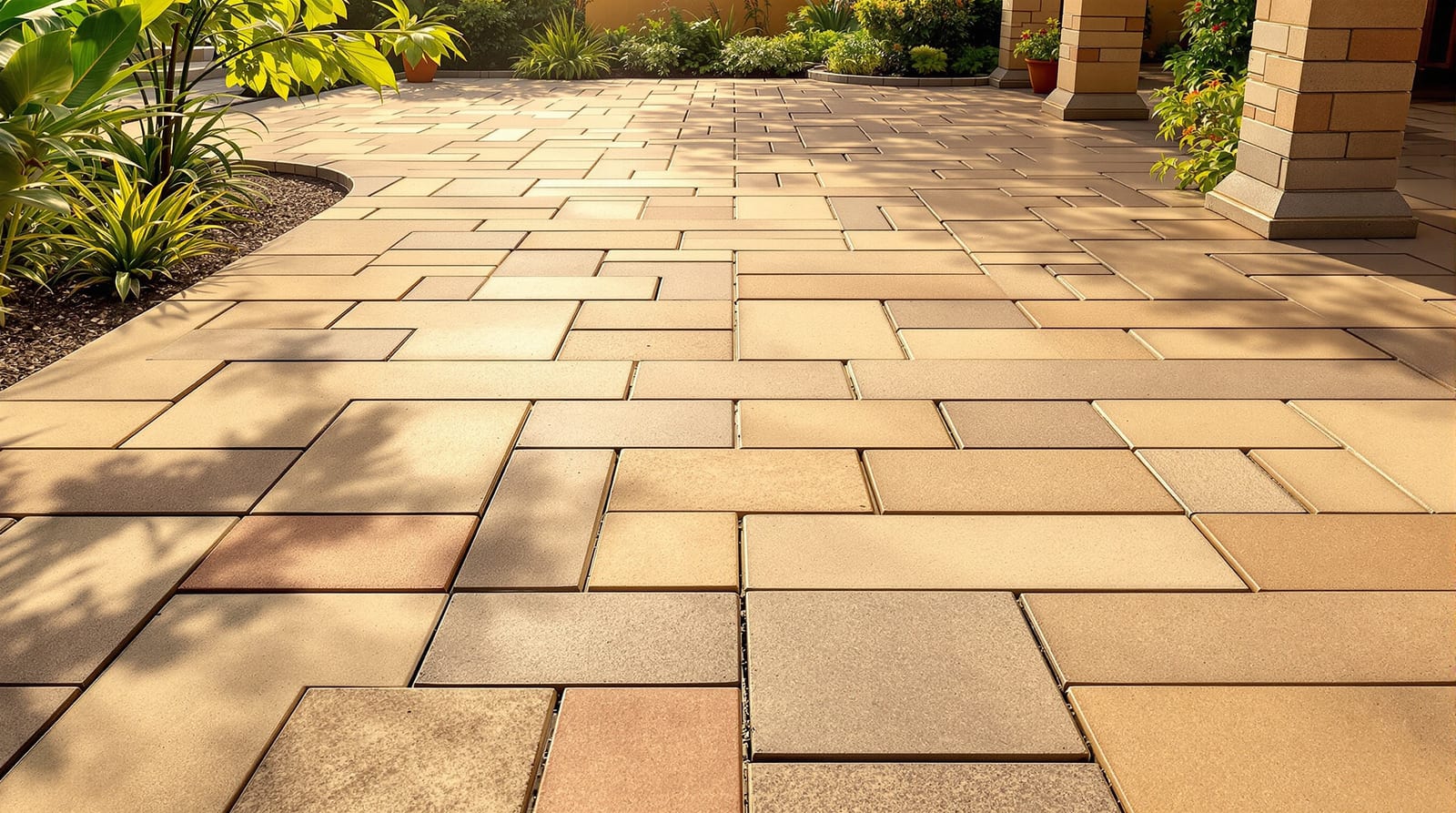
Natural Stone Pavers in India: Cost, Thickness & Laying Guide for Driveways & Patios
Cut-to-size sandstone, granite, limestone, basalt and cobble paving units for driveways, patios, garden paths and pool decks — how to pick the stone, the right thickness for the load, anti-skid finishes, sand-set vs mortar vs pedestal laying, and ₹60–250 per sq ft pricing.
Natural stone pavers are individual cut-to-size paving units — sandstone, granite, limestone, basalt or cobble — laid over a prepared base to surface the parts of an Indian home that take sun, rain and traffic: driveways, patios, courtyards, garden paths, pool decks and open parking. Unlike a poured floor, every unit is a solid piece of quarried stone, so a paver field can be lifted, re-levelled and re-laid years later. This guide covers which stone suits which job, how thick the paver must be for the load it carries, the anti-skid finishes that keep a wet monsoon surface safe, the three ways to lay them, and what you should budget at ₹60–250 per sq ft.
This is the stone-paver companion to our broader outdoor flooring guide. Where that guide maps every outdoor option, here we go deep on cut-stone paving specifically.
What counts as a natural stone paver
A natural stone paver is a piece of real quarried stone, cut to a regular size and a controlled thickness, made to be laid flat as a walking or driving surface. That sets it apart from two neighbours people often confuse it with:
- Concrete paver blocks are precast cement units, moulded in interlocking shapes (zigzag, I-section, Uni) — cheaper and uniform, but not natural stone. See paver blocks.
- Cobblestones are small stone cubes or setts, usually thicker and laid with deliberate uneven joints. They are one type of stone paver — covered in detail in our cobblestone flooring guide.
Stone pavers come in two broad cut styles. Calibrated pavers are machine-cut to a consistent thickness (say 20 mm or 30 mm), which makes laying fast and the surface even — ideal for patios and pool decks. Uncalibrated or hand-split pavers vary in thickness and need a thicker bedding layer to absorb the difference — more rustic, often cheaper, common with riven sandstone and slate.
Choosing the stone
India is one of the world's great paving-stone exporters, so the raw material is excellent and locally available. Each stone has a personality.
| Stone | Look & colour | Finish that suits outdoors | Best paving use | ₹/sq ft (material) |
|---|---|---|---|---|
| Sandstone | Warm earthy — beige, buff, rainbow, raj green, Kandla grey | Natural cleft (riven) or sandblasted | Patios, paths, courtyards, pool surrounds | 60–140 |
| Granite | Speckled grey, black, pink; very hard | Flamed or leather (never polished outdoors) | Driveways, parking, heavy-traffic patios | 120–250 |
| Limestone | Soft beige, blue-grey (Kota, Shahabad family) | Honed or natural matte | Garden paths, shaded patios, verandahs | 50–150 |
| Basalt | Dense matte black, modern | Honed or flamed | Contemporary patios, pool decks, paths | 100–250 |
| Cobble/sett | Granite or sandstone cubes | Natural split | Driveways, edging, courtyards, wheel tracks | 60–200 |
A few India-specific notes. Sandstone is the default Indian paver — Rajasthan and Madhya Pradesh quarries supply Kandla grey, Mint, Raj green, Autumn brown and rainbow sandstone the world over, so it is plentiful and fairly priced at home. Granite is the toughest and the only stone you should put under a car without hesitation; choose a flamed finish so it stays grippy. Limestone (the Kota and Shahabad family, plus Kadappa) is cool underfoot and budget-friendly but is acid-sensitive and porous, so keep it for paths and shaded areas and seal it well. Basalt gives the modern matte-black look and shrugs off weather. For the full material profile of each, see our dedicated sandstone flooring guide.
Thickness: match the stone to the load
The single most important specification — and the one most often got wrong on a job site — is thickness. A patio paver that is fine for foot traffic will crack under a car. Thickness is driven by what rolls or walks over the surface.
| Use / load | Recommended stone thickness | Bedding |
|---|---|---|
| Garden paths, foot traffic | 18–25 mm | Sand or mortar |
| Patios, courtyards, pool decks (pedestrian) | 25–30 mm | Sand or mortar |
| Pedestal-raised terrace/deck | 20 mm calibrated | Adjustable pedestals |
| Driveway — cars / SUVs | 40–50 mm (or 50–75 mm cobbles) | Mortar on concrete sub-base |
| Open parking / occasional heavy vehicle | 50 mm+ on engineered base | Mortar on RCC/well-compacted base |
For any vehicle load, thickness alone is not enough — the base build-up under the stone matters as much. A driveway needs a compacted sub-base (typically 100–150 mm of crushed aggregate/GSB) and often an RCC slab beneath the mortar bed, so the load spreads and the pavers do not rock or sink. Cobbles excel here because their small size and depth let each unit carry point loads without cracking.
Finishes: grip first, looks second
Outdoors in India, the floor will be wet through the monsoon and baking in summer. A glossy polished stone becomes lethal when wet, so anti-skid finish is non-negotiable on pavers. The common outdoor finishes:
- Natural cleft / riven — the stone is split along its bed, leaving a naturally textured, grippy surface. The classic look for sandstone and slate pavers. Best slip resistance with zero extra processing.
- Sandblasted — a fine even matte texture blasted onto the surface; uniform and grippy, good for limestone and sandstone.
- Flamed — the surface is heated so the crystals pop, leaving a coarse, faded, very grippy texture. The go-to finish for granite and basalt pavers, especially around pools and driveways.
- Honed — smooth matte, no shine. Looks refined but is the least grippy of the four when wet — keep it for covered verandahs and low-traffic shaded paths, not pool decks or ramps.
As a rule of thumb, aim for a slip rating in the R11–R13 band (DIN 51130) for wet outdoor areas and pool surrounds. For deeper detail, our anti-slip flooring for wet areas guide is worth a read.
How to lay stone pavers: three methods
How you bed the pavers depends on the load, the site and whether you ever want to lift them again.
1. Sand-set (flexible paving)
Pavers sit on a 25–40 mm screeded sand or sand-cement bed over a compacted sub-base, with joints filled by brushed-in kiln-dried sand or fine grit. Best for paths, patios and light courtyards. It is the fastest and most forgiving method, drains beautifully, and individual pavers can be lifted and reset. It is not for vehicle loads on its own, and weeds can colonise the joints unless you use a polymeric jointing sand or a sealed grout.
2. Mortar-set (rigid paving)
Pavers are bedded in a 25–40 mm cement-mortar bed (often over an RCC sub-slab) and the joints are pointed with mortar. This is the method for driveways, parking and anything carrying vehicle loads, and for areas where you want zero weed growth and a permanent finish. It is stronger but unforgiving — once set, lifting a paver means breaking it out — and a rigid bed must have drainage falls and movement joints built in or it will crack.
3. Pedestal-set (raised paving)
Calibrated 20 mm pavers (granite, basalt, porcelain-equivalents) sit on adjustable plastic pedestals over a waterproofed terrace or balcony slab. The void below drains water away and hides services, and panels lift out for access. Ideal for terraces, balconies and pool decks above a habitable space — it protects the waterproofing membrane and gives a perfectly level floor over a sloped structural slab. This overlaps with our outdoor deck tiles approach; the difference is simply that here the tile is a solid stone slab.
Here is a section through the most common build-ups:
Drainage and slope — get this right or regret it
Standing water is the enemy of every outdoor paver and the cause of most failures in India. Two rules:
- Fall. Lay the surface to a slope of at least 1 in 60 to 1 in 80 (roughly 1.5–2%) away from the house and any wall, so monsoon water runs to a drain, channel or soak pit rather than pooling or pushing back under the door.
- Permeability. Sand-set paving lets water percolate through the joints into the ground, which reduces runoff and recharges groundwater — genuinely useful in flood-prone Indian cities. For driveways and parking where you want maximum permeability, consider grass pavers and permeable systems. Mortar-set rigid paving is impermeable, so it needs proper surface channels and gully points.
Always slope a pool deck away from the pool, and never let a driveway drain toward the garage threshold.
Sealing and care
Most natural stone pavers are porous to some degree and benefit from an impregnating (penetrating) sealer that repels water and oil without leaving a film or gloss — important because a film-forming sealer would make the surface slippery and undo the anti-skid finish. Sandstone, limestone and slate especially need sealing to resist staining, algae and the dark monsoon dampening; granite and basalt are denser and need it less but still benefit on driveways where oil drips. Expect to re-seal every 2–4 years outdoors. Our floor resealing guide covers products and method.
Routine care is simple: sweep, wash down, and treat algae or moss (common on shaded north-facing paving through the monsoon) with a stone-safe biocide rather than acid. Avoid acidic cleaners on limestone and sandstone — they etch the surface.
Stone pavers vs concrete paver blocks
This is the decision most Indian homeowners actually face for a driveway or path. Both work; they trade off cost against character and longevity.
| Natural stone pavers | Concrete paver blocks | |
|---|---|---|
| Material | Real quarried stone | Moulded cement |
| Cost (material) | ₹60–250/sq ft | ₹30–90/sq ft |
| Look | Unique, natural, ages gracefully | Uniform, fades over years |
| Lifespan | Decades; colour is through-body | Surface colour can wear/fade |
| Strength | Very high (granite/basalt) | Good; graded by thickness (IS 15658) |
| Repair | Lift and reset individual units | Lift and reset individual units |
| Best for | Premium patios, paths, feature drives | Budget driveways, large parking, footpaths |
In short: concrete paver blocks win on first cost and uniformity and are the value pick for a large parking apron; natural stone pavers win on character, ageing and resale appeal, especially where the surface is seen — a front patio, an entrance courtyard, a garden path or a pool deck. Many Indian homes mix them: concrete blocks for the bulk parking, natural stone for the showpiece entrance.
To estimate quantities and budget for a paved area, our paver block calculator handles the area-to-units maths for both stone and concrete pavers. For where stone paving sits among all the alternative floor types, see the specialty flooring guide. And if you like the washed-pebble look as an alternative driveway surface, compare with exposed aggregate flooring.
Frequently asked questions
How thick should stone pavers be for a driveway?
For cars and SUVs, use granite or basalt pavers at least 40–50 mm thick, or stone cobbles 50–75 mm thick, laid on a cement-mortar bed over a properly compacted sub-base (and ideally an RCC slab). Patio and path pavers can be 25–30 mm because they only carry foot traffic. Getting the thickness and the base right matters more than the stone choice for preventing cracks.
Which natural stone is best for outdoor paving in India?
Sandstone is the most popular and best-value all-rounder for patios and paths and is quarried widely in Rajasthan and Madhya Pradesh. Granite is the toughest choice for driveways and heavy traffic. Basalt gives a modern matte-black look, and limestone is cool and economical for shaded paths. Always pick a textured finish — natural cleft, sandblasted or flamed — for grip.
Are stone pavers slippery in the monsoon?
Only if you choose the wrong finish. A polished or smooth honed stone is dangerous when wet. Specify a natural cleft, sandblasted or flamed surface (roughly DIN R11–R13 slip rating) for any outdoor or poolside paving, slope the surface to drain at about 1.5–2%, and keep algae off shaded areas with a stone-safe biocide.
Should I lay pavers on sand or mortar?
Sand-set (flexible) paving is best for paths, patios and light courtyards — it is fast, drains well and lets you lift and reset units. Mortar-set (rigid) paving on a concrete base is required for driveways, parking and any vehicle load, and where you want a permanent, weed-free surface. Raised terraces and balconies use a third method: calibrated slabs on adjustable pedestals.
Do natural stone pavers need sealing?
Most do. An impregnating, non-film-forming sealer repels water, oil and stains without making the surface glossy or slippery. Porous stones like sandstone, limestone and slate benefit most; dense granite and basalt need it less but still help on oil-prone driveways. Re-seal outdoors roughly every 2–4 years and clean with stone-safe, non-acidic products.
Export this guide
Related Guides — Deep-dive reading
Anti Slip Flooring for Bathroom and Wet Areas in India: R-Ratings, Finishes and Genuinely Safe Tile Choices
How to choose genuinely safe flooring for bathrooms, kitchens, balconies, pools, entrances and elderly- or child-friendly homes — the R-rating system, finishes that grip wet feet, anti-skid natural stone, slope to drains and the tiles to avoid.
Flooring & SurfacesPatio Flooring in India: Best Decks & Outdoor-Seating Floors for Weather, Grip & Looks
How to floor a patio, deck or outdoor lounge in India so it shrugs off UV and monsoon, grips wet feet, stays barefoot-friendly and still looks like a place you want to entertain.
Flooring & SurfacesHome Parking Flooring in India: Best Surfaces for Car Porch, Driveway & Garage
How to choose a parking floor that takes vehicle load, resists tyre marks and oil drips, drains the monsoon and still looks good.
Flooring & SurfacesRelated Tools — Try Free
Driveway Flooring Cost Calculator
Estimate driveway surfacing cost — paver blocks, exposed aggregate, stamped concrete, cobblestone or grass paver.
Flooring CalculatorMonsoon-Readiness Checklist
Pre-rain home audit across 9 categories — terrace, drains, waterproofing, electrical, HVAC, pest, vehicles, documents.
Seasonal AuditPaver Block Calculator
Estimate concrete paver blocks, bedding sand and cost for a driveway, path or parking by area and thickness.
Flooring Calculator