
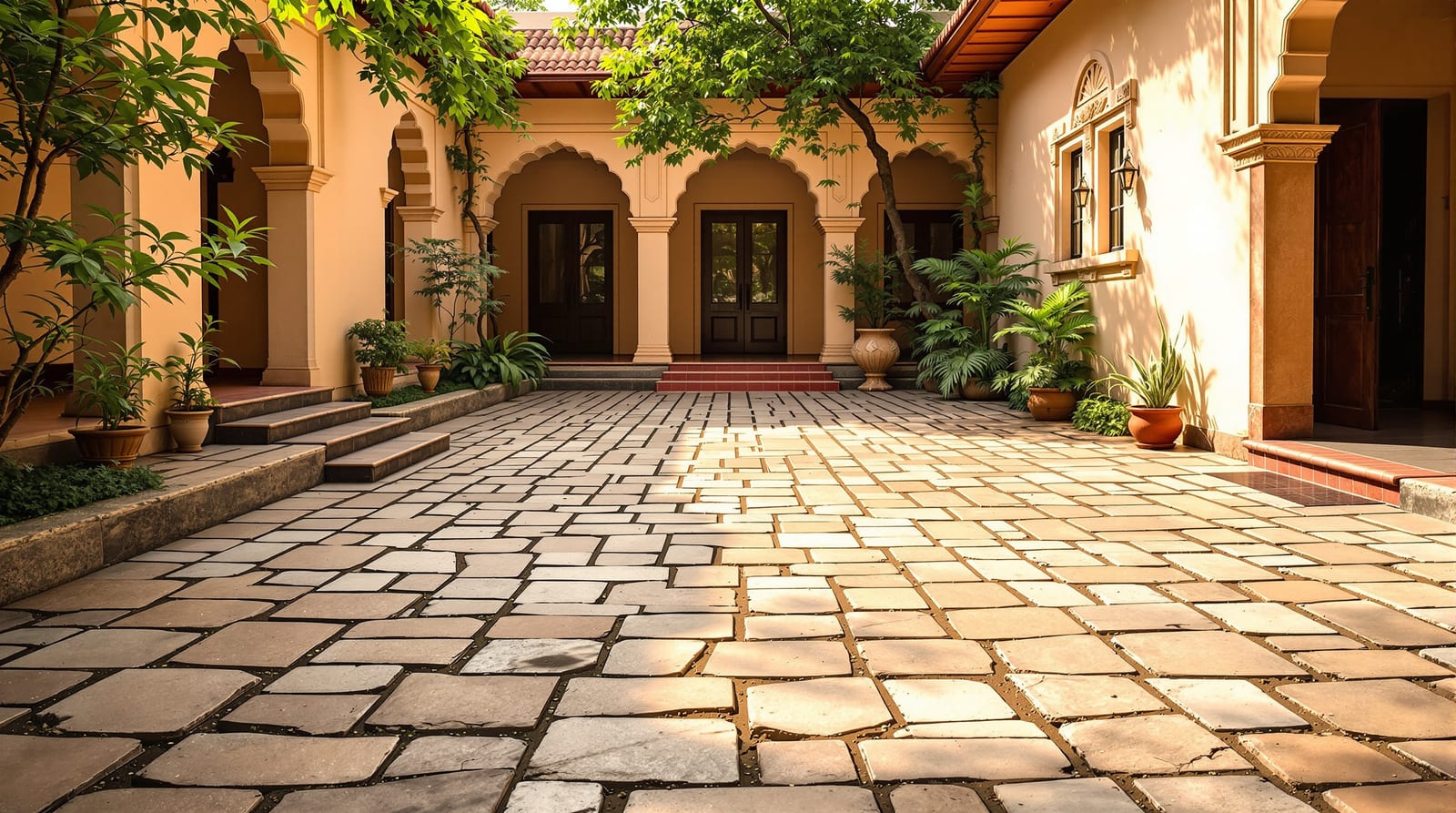
Flagstone Flooring in India: Crazy Paving, Stones, Cost & Laying Guide
Irregular flat stone pieces laid in a random crazy-paving jigsaw give courtyards, paths and rustic verandahs a natural, anti-skid, free-draining floor — here are the stones used, how it is laid, where it suits and what it costs.
Flagstone is the floor you build out of broken stone. Instead of neat rectangular tiles, you lay irregular flat pieces of stone — each a different shape and size — and fit them together like a jigsaw, filling the gaps with mortar, sand or even grass. The result, known in India and worldwide as "crazy paving," is the rustic, organic, slightly wild floor of farmhouse courtyards, garden paths, patios and shaded verandahs. Because it is most often made from offcuts and broken slabs of sandstone, slate, limestone or Kota, it is one of the cheapest natural-stone floors going — roughly ₹50–180 per sq ft — and one of the most characterful.
This guide covers which stones go into flagstone, how crazy paving is actually laid and jointed, where it belongs in an Indian home, what it costs, and the honest trade-offs of an uneven natural floor.
What flagstone and crazy paving actually are
"Flagstone" originally meant a flat slab of stone (a "flag") split or cut thin enough to lay as a floor. In Indian practice the word now covers two related things: large flat stone pieces laid as paving, and — most commonly — random irregular pieces laid in the jigsaw pattern called crazy paving. There is no fixed shape. The mason takes a heap of flat stone offcuts of mixed sizes and angles, and arranges them on the ground so the pieces sit close together with reasonably even joint gaps, then fixes and points them.
That randomness is the whole aesthetic. A good crazy-paving floor has no two pieces alike, joints that wander naturally, and a colour mix that reads as earthy and handmade rather than machine-perfect. It is the opposite of a calibrated tile floor — and that is exactly why courtyards, rustic verandahs and gardens love it.
Because flagstone uses irregular and often reclaimed pieces, it overlaps with several siblings: when you want neat cut paving units instead of random jigsaw, look at natural stone pavers in India; when you want stone cubes for driveways, see cobblestone flooring in India; and for the full menu of outdoor floors, the outdoor flooring guide for India. Flagstone is the rustic, random, hand-fitted member of that family.
The stones used for flagstone in India
Almost any flat-splitting or flat-cut stone can become flagstone, and the choice drives colour, texture and slip-grip. India's sandstone belt (Rajasthan), slate quarries and limestone yards all feed the crazy-paving trade, and the cheapest material is usually the offcut pile from a regular slab yard.
| Stone | Typical look | ₹ per sq ft (material) | Best use |
|---|---|---|---|
| Sandstone (Rajasthan) | Warm beige, buff, pink, rust; sandy matte | 50–120 | Courtyards, patios, garden paths, farmhouse floors |
| Slate (riven) | Grey, black, green, rustic multicolour; layered | 60–150 | Shaded verandahs, wet courtyards, feature paths |
| Limestone / Kota | Cool grey-green, blue; matte | 40–100 | Courtyards, verandahs, semi-covered patios |
| Shahabad / Kadappa offcuts | Grey-blue, black; budget durable | 35–90 | Utility yards, service courtyards, paths |
| Granite offcuts | Grey, pink, speckled; very hard | 80–180 | High-traffic drives, durable paths |
| Quartzite | Silver-grey, golden, riven | 70–160 | Premium rustic patios, pool surrounds |
For more on the individual stones, see our guides on sandstone flooring in India, slate flooring in India, Kota stone flooring in India and Kadappa stone in India. The key for flagstone is a riven or natural-cleft face: that micro-texture is what makes the floor grip wet feet and shrug off the monsoon.
How crazy paving is laid
Laying flagstone is more art than machine work — it is hand-fitted, and a skilled mason matters more here than for any tile job. The build-up is straightforward but the jointing has three distinct routes that change the whole character of the floor.
The sequence is: prepare a compacted base, dry-arrange the pieces, bed them, then joint. On firm outdoor ground you build up a compacted sub-base of GSB or crushed stone, a sand or lean-concrete bedding layer, and lay the flagstones on it; for a permanent courtyard or driveway, the pieces are bedded on a cement-mortar bed over a concrete base. The mason "dry-lays" the whole jigsaw first — shuffling pieces, trimming edges with a chisel or cutter, and keeping joints roughly even (commonly 10–25 mm) — before fixing anything. Only when the puzzle looks right does the bedding and pointing happen.
Three ways to fill the joints
| Joint type | How | Look & feel | Best for |
|---|---|---|---|
| Mortar / cement-pointed | Cement-sand mortar packed and tooled into the gaps | Solid, sealed, low-weed, slightly formal | Courtyards, driveways, high-traffic, rain-exposed |
| Sand / fine-aggregate | Dry sand or stone dust swept into joints | Permeable, free-draining, looser, more rustic | Garden paths, low-traffic patios, where drainage matters |
| Grass / planted | Soil in wide joints sown with grass or groundcover | Soft green seams, very natural, "stepping-stone" | Garden lawns, green courtyards, decorative paths |
Mortar joints give the most durable, weed-free and rain-proof floor and are the default for an Indian courtyard or verandah. Sand and grass joints are permeable — water drains straight through them into the ground, which suits gardens and helps with monsoon runoff — but they invite weeds and need topping up. A common hybrid is a mortar bed under the stone with sand-swept joints above, balancing stability with drainage.
The diagram below shows the random jigsaw layout and the build-up beneath it.
Where flagstone suits an Indian home
Flagstone is an outdoor and semi-outdoor specialist. Its rustic, uneven character and free-draining joints are exactly right for spaces that are about nature and weather, and wrong for polished indoor rooms.
- Courtyards and aangans. The classic home for crazy paving — durable underfoot, drains the monsoon through its joints, and the random pattern reads as timeless and handmade. A sandstone or Kota courtyard ages beautifully.
- Garden paths and stepping-stone walks. Grass-jointed flagstone laid through a lawn gives the softest, greenest path of all, and uses very little stone.
- Patios and rustic verandahs. A shaded sit-out paved in riven sandstone or slate feels cool, grippy and earthy. Pair it with the choices in our balcony flooring in India and terrace flooring in India guides for the harder surfaces nearby.
- Pool surrounds and wet courtyards. The riven, textured face is naturally anti-skid — see our anti-slip flooring for wet areas in India guide for why texture beats polish here.
- Driveways and parking (with granite/hard stone, mortar joints). Thick, hard flagstone on a concrete base handles vehicle loads; for heavy repeated traffic, compare cobblestone setts and paver blocks.
Where flagstone is a poor fit: any indoor living room, bedroom or office with furniture, because the uneven surface rocks chairs and tables and is tiring to walk on in socks; smooth formal interiors; and anywhere you need a perfectly level, easy-to-mop floor. For those, a flat stone or tile is the right call — see how to choose flooring in India.
Cost in India (2026, indicative)
Flagstone is one of the most budget-friendly natural floors precisely because it can use offcuts and broken slabs that a tile job would reject. Rates are indicative and vary by city, stone, joint type and vendor; add 18% GST, and laying is extra.
| Item | Rate (₹ per sq ft) | Notes |
|---|---|---|
| Sandstone / limestone offcut flagstone | 50–100 | Material; cheapest from slab-yard offcuts |
| Slate / quartzite flagstone | 60–160 | Material; riven texture, premium colours |
| Granite flagstone | 80–180 | Material; hardest, for drives |
| Laying — mortar bed + cement-pointed joints | 50–100 | Skilled hand-fitting, more labour than tiles |
| Laying — sand/grass joints on prepared base | 35–70 | Simpler jointing, garden work |
| Compacted sub-base / concrete base | 30–80 | Site-dependent, for new ground |
So a mortar-pointed sandstone crazy-paving courtyard typically lands around ₹120–220 per sq ft installed including base — cheaper than most cut-stone paving and far below marble or imported stone, while delivering far more character. Because flagstone is hand-fitted, labour is a bigger share of the total than for tiles, so a good mason is worth paying for. To size a job, use our flooring cost calculator and natural stone slab calculator, and for the bigger picture, the flooring cost per square foot in India guide.
The honest trade-offs
Flagstone earns its place outdoors, but it asks for the right expectations. Its strengths and weaknesses are two sides of the same uneven, natural coin.
| Pros | Cons |
|---|---|
| Rustic, one-of-a-kind, handmade character | Uneven surface — not for furniture-heavy rooms |
| Cheap — uses offcuts and broken slabs (₹50–180/sq ft) | Wide, irregular joints catch dirt and grow weeds |
| Riven faces are naturally anti-skid in the wet | Hand-fitting needs a skilled mason; slower to lay |
| Sand/grass joints drain — great for monsoon runoff | Harder to clean and mop than flat tile |
| Durable outdoors — sun, rain, traffic | Porous stone must be sealed against stains |
| Endlessly flexible shapes and sizes | Trip hazard if pieces settle unevenly over time |
Two caveats deserve emphasis. First, weeds and moss: permeable sand and grass joints will sprout, so plan for occasional weeding, or choose mortar joints for low maintenance. Second, sealing: sandstone, limestone and slate are porous and stain from oil, leaves and standing water, so seal the floor with a penetrating sealer after laying and re-apply periodically — our floor resealing guide for India covers the routine.
Care and maintenance
Sweep or hose flagstone regularly; leaves and organic litter left in wet joints stain stone and feed weeds. Clean with water and a stiff brush, or a pH-neutral stone cleaner for stubborn marks — never strong acids, which etch limestone and sandstone. Top up sand or grass joints once or twice a year as they wash out, and re-point any cracked mortar joints before water gets under the stone. Pull weeds early. Re-seal porous stone when water stops beading. Done this way, a crazy-paving courtyard lasts decades and only looks better with age. See our floor cleaning guide for India for the wider routine, and for the family of alternative floors, our specialty flooring guide for India maps where flagstone sits among them.
Frequently asked questions
What is the difference between flagstone and crazy paving?
They overlap. "Flagstone" means flat slabs of stone laid as a floor; "crazy paving" is the specific pattern where irregular, random-shaped flagstone pieces are fitted together like a jigsaw with wandering joints. In Indian practice, most flagstone floors are laid as crazy paving, so the terms are often used interchangeably for the rustic, random courtyard look.
How much does flagstone flooring cost in India?
The stone runs ₹50–180 per sq ft depending on type — sandstone and limestone offcuts are cheapest, slate and quartzite mid-range, granite the hardest and dearest. Laying adds ₹35–100 per sq ft because it is hand-fitted, plus base preparation, sealing and 18% GST. A mortar-pointed sandstone courtyard typically lands around ₹120–220 per sq ft installed. Rates are indicative and vary by city and vendor.
Can flagstone be used indoors?
It can, in rustic verandahs, entryways, garden rooms and sunrooms, but it is a poor choice for living rooms, bedrooms or offices because the uneven surface rocks furniture, is tiring to walk on barefoot, and is harder to mop. Reserve flagstone for outdoor and semi-outdoor spaces, and use a flat cut stone or tile where you need a level indoor floor.
Do flagstone joints grow weeds?
Sand and grass joints, being permeable, will sprout weeds and moss and need occasional weeding and topping up — that is the trade-off for their natural look and free drainage. Cement-mortar-pointed joints largely prevent weeds and are the low-maintenance choice for courtyards and driveways, at the cost of less permeability.
Is flagstone slippery in the monsoon?
Riven, natural-cleft flagstone in sandstone, slate or quartzite is naturally anti-skid — its textured face grips wet feet, which is why it suits courtyards, paths and pool surrounds. Avoid polished or honed flagstone outdoors, where it can turn slick, and clean off algae and moss promptly, since biofilm, not the stone itself, causes most monsoon slips. See our anti-skid floor treatment in India guide for more.
Export this guide
Related Guides — Deep-dive reading
Slate Flooring in India: Riven Stone, Colours, Cost & Sealing Guide
Indian slate is a layered, naturally anti-skid metamorphic stone for rustic interiors, courtyards, bathrooms and feature walls — here is how to choose, finish, seal and budget it.
Flooring & SurfacesCobblestone Flooring India: Granite and Sandstone Setts for Driveways, Courtyards and Paths — Types, Laying and Cost
The rugged old-world charm of stone setts — granite and sandstone cubes laid in sand or mortar for Indian driveways, courtyards, garden paths and heritage looks — their lifelong durability, drainage, ₹/sq ft cost, sand-set vs mortar-set laying, jointing and where they truly suit.
Flooring & SurfacesBrick Flooring India: Clay and Terracotta Brick Pavers for Warm Rustic Interiors and Durable Exteriors — Types, Patterns and Cost
The earthy farmhouse, heritage and courtyard look — clay and terracotta brick pavers laid flat for warm rustic interiors and tough, breathable exteriors — their types, laying patterns, ₹/sq ft cost, sealing and care, and exactly where brick flooring suits in an Indian home.
Flooring & SurfacesRelated Tools — Try Free
Flooring Cost Calculator
Estimate the all-in cost of a floor — material, laying, wastage, skirting and GST — by area and material.
Flooring CalculatorMonsoon-Readiness Checklist
Pre-rain home audit across 9 categories — terrace, drains, waterproofing, electrical, HVAC, pest, vehicles, documents.
Seasonal AuditDoor Cost Calculator
Estimate the all-in cost of a door — leaf, frame, hardware, fitting and GST — by type, material and size.
Door Calculator