
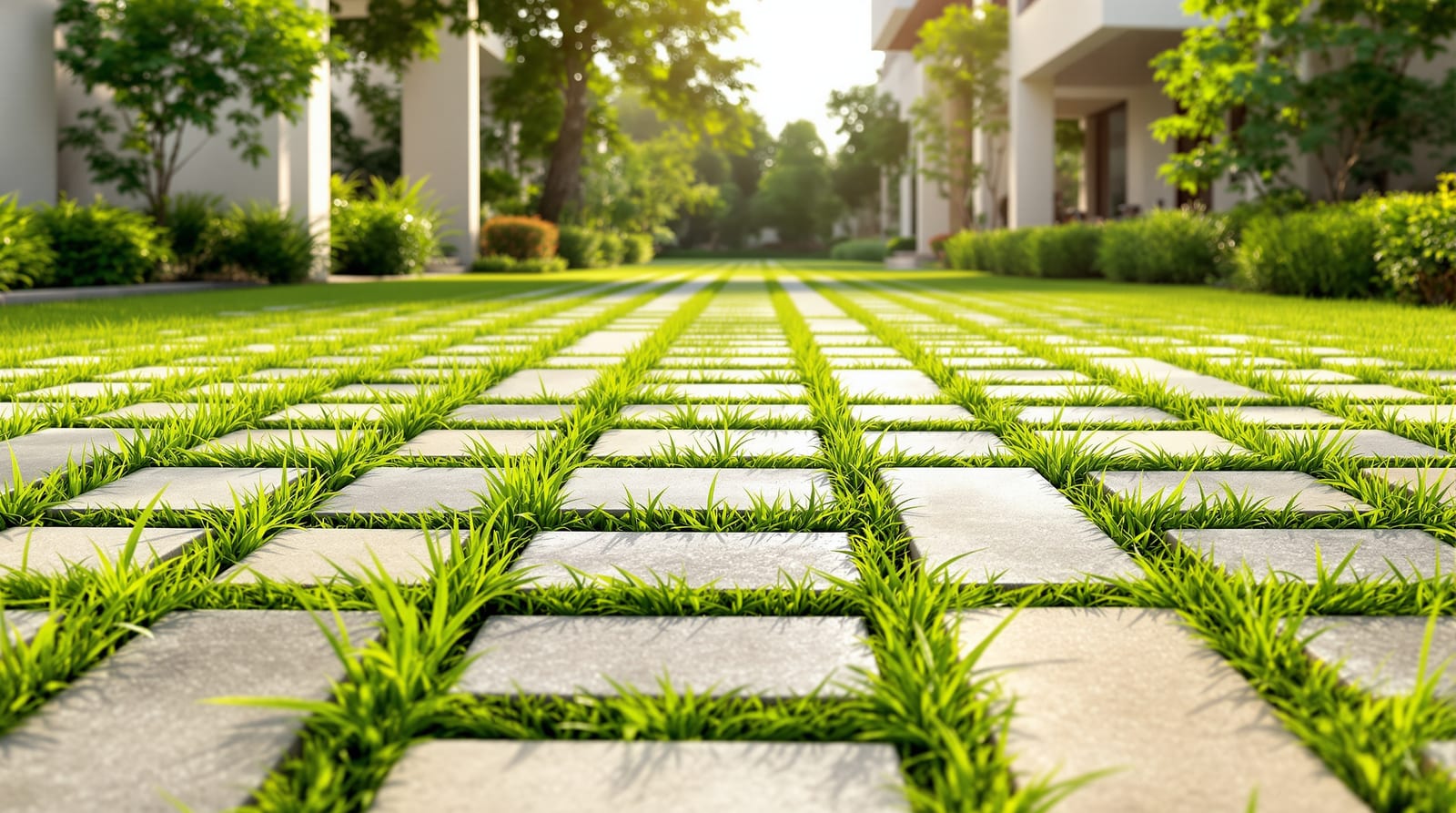
Grass Pavers & Permeable Flooring in India: Green Driveways, Parking & Eco Paving at ₹40–150 per Sq Ft
Concrete and HDPE grass-paver grids that let grass grow through, plus open-jointed permeable paving — how green driveways, overflow parking and fire-lanes infiltrate rainwater, cut runoff, stay cooler than concrete and earn IGBC/GRIHA credits, with types, ₹40–150 per sq ft costs, the free-draining base build-up, load grades, laying and care.
A grass paver is paving that does two jobs at once: it carries cars, fire-tenders and foot traffic like any hard surface, yet leaves open cells filled with soil and grass so rain soaks straight into the ground instead of sheeting off into the drain. Combined with open-jointed permeable pavers, it turns a driveway, an overflow car park or a fire-lane into a green, water-absorbing surface that stays cooler than plain concrete and helps recharge groundwater. At ₹40–150 per sq ft, it is one of the most affordable ways to make Indian outdoor paving genuinely sustainable.
This guide covers what grass pavers and permeable paving are, the main grid and paver types, the all-important free-draining base, how they are laid, the loads they carry, where they suit, honest pros and cons, and how to keep the grass alive.
What grass pavers and permeable paving are
Conventional concrete and most paver-block driveways are impervious — every drop of rain runs across them and into the storm drain, which in Indian cities means flash flooding, overloaded drains and zero groundwater recharge. Permeable paving flips that: it lets water pass through the surface into a stone reservoir below and then into the soil. This is the core idea behind Sustainable Urban Drainage Systems (SUDS), and it is increasingly written into city by-laws and rainwater-harvesting mandates across India.
There are two related families, often used together:
- Grass pavers (turf pavers / grass-crete grids): rigid grids of concrete or recycled plastic/HDPE with large open cells. The ribs and walls of the grid carry the load and protect the roots; the cells are filled with a soil-gravel mix and seeded or turfed with grass. From above you see mostly green with a faint grid of paver edges — a "green driveway" or grassed parking area.
- Permeable pavers (porous paving): solid paving units laid with deliberately wide, open joints filled with grit or fine gravel instead of sand-cement. Water drains through the joints (and, in some products, through the porous block itself) into the base below. The surface looks like a normal paved driveway but drains freely.
Both sit on the same principle: a free-draining base that stores and infiltrates water rather than shedding it. Studio Matrx classes them among the outdoor and paving floors, alongside paver blocks and natural-stone pavers, but with an eco/drainage purpose front and centre.
Types of grass paver and permeable system
| Type | What it is | Indicative ₹/sq ft | Load capacity | Best use |
|---|---|---|---|---|
| Concrete grass-paver block | Heavy precast concrete grid block with grass-filled cells | ₹50–120 | Cars, light trucks, fire-tender (load-rated) | Driveways, fire-lanes, society parking |
| Plastic / HDPE grass-paver grid | Lightweight recycled-plastic interlocking grid, grass-filled | ₹40–100 | Cars to fire-tender (rated grades) | Driveways, overflow parking, event lawns, ramps |
| Gravel-stabiliser grid (HDPE) | Same grid filled with gravel instead of grass | ₹40–90 | Cars, parking | Paths, parking, no-mow green-ish look |
| Permeable interlocking concrete pavers | Solid pavers with wide open jointing gravel | ₹60–150 | Driveways, parking | Permeable driveways, courtyards, plazas |
| Porous concrete / "no-fines" paving | In-situ concrete with voids that drain through | ₹80–200 | Paths, light vehicle | Pool decks, paths, low-traffic parking |
Costs are indicative all-in for the paving units and laying, varying by city, brand and the base build-up; add 18% GST, and add grass/turf, topsoil and the stone sub-base which can equal or exceed the paver cost. Concrete grass blocks are the traditional, heavy, durable choice favoured by municipalities and societies; lightweight HDPE grids (recycled-plastic) ship flat, click together fast and are popular for homes and overflow lawns. Permeable interlocking pavers give a more finished, "proper driveway" look while still draining.
The free-draining base: where permeable paving lives or dies
The single biggest difference between a permeable surface and a normal one is below ground. A standard paver driveway sits on compacted soil and a sand bed that water cannot pass through — so even open-celled pavers laid on it will flood. A true permeable build-up replaces the dense base with an open, free-draining one that stores water and lets it infiltrate.
The diagram shows the typical cross-section for a grass-paver or permeable driveway.
Working up from the bottom: the subgrade soil is graded to fall and lightly compacted (over-compaction kills infiltration); a geotextile membrane stops soil pumping up into the stone; then an open graded stone reservoir — typically 40 mm aggregate with no fines, often 150–300 mm deep — stores rainwater and lets it seep into the soil; a thinner bedding layer of grit or fine gravel levels the paver; and finally the grass grid or permeable paver on top. Where the soil itself drains poorly (clayey black-cotton soils in much of Maharashtra and Gujarat, for instance), a perforated land drain is laid in the stone reservoir to carry excess water to a soak-pit or rainwater-harvesting tank. Getting this base right is what separates a real permeable driveway from a grid that simply waterlogs.
How grass pavers are laid
For a concrete or HDPE grass-paver driveway, the sequence on an Indian site is broadly:
1. Excavate and grade. Dig out to the required depth (often 250–400 mm including the reservoir), set the falls, and lightly compact the subgrade without sealing it.
2. Edge restraint. Cast a concrete haunch or set precast kerbs around the perimeter so the grid cannot creep sideways under load.
3. Geotextile and stone reservoir. Lay the separation fabric, then place and lightly compact the open graded stone in layers.
4. Bedding layer. Spread and screed a thin grit/gravel bed to a precise level.
5. Lay the grid. Click the HDPE grids together, or hand-lay the concrete grass blocks, butted tight, cutting at edges to fit.
6. Fill the cells. Top the cells with a free-draining topsoil-sand-compost mix to just below the rib tops so the grid protects the grass crowns from tyres.
7. Seed or turf. Sow a hardy lawn grass (Bermuda/doob, Korean or buffalo grass suits Indian heat) or lay turf rolls, then water in.
8. Establish before traffic. Keep vehicles off for 3–6 weeks while roots knit. The grass roots reach down through the cells into the soil, anchoring the system.
Permeable interlocking pavers follow the same base, but instead of soil-and-grass cells you brush a clean angular jointing grit (not sand-cement) into the wide joints, leaving them open to drain. No establishment period is needed — they take traffic as soon as the joints are filled.
Load capacity: from footpaths to fire-tenders
A common worry is whether a "grassy" surface can take a car or a fire engine. It can, when you specify the right grade. The load is carried by the grid ribs and the compacted stone base, not the grass. Manufacturers rate HDPE and concrete grids by the load they will bear when properly installed:
- Pedestrian and cycle paths, event lawns: the lightest grids.
- Cars and regular driveways: standard residential grids.
- Overflow car parks, society parking, ramps: heavier grids on a deeper reservoir.
- Fire-tender access lanes: the heaviest rated grids (often quoted to carry fire-engine axle loads), which is exactly why grass pavers are specified for fire-lanes — the fire brigade needs the access, but the area can stay green and usable as lawn the rest of the year.
Always size the stone reservoir and grid grade to the heaviest vehicle that will use the surface, and confirm the manufacturer's load rating in writing for parking and fire-lane jobs. For comparison of solid load-bearing paving, see how concrete paver blocks are graded by thickness and strength.
Where grass pavers and permeable paving suit in India
These surfaces shine wherever you want a paved function but a green, water-absorbing result:
- Residential green driveways — a lawn you can park on, far cooler underfoot and to the eye than a concrete apron.
- Overflow and visitor parking — apartment societies, farmhouses, resorts and banquet lawns that need occasional hard standing without a permanent concrete car park.
- Fire-tender access lanes — mandated fire-engine routes around tall buildings that double as landscaped lawn.
- Garden and approach paths, ramps, verges — gravel-filled grids give a stable, mud-free, free-draining path.
- Eco homes, IGBC and GRIHA projects — permeable paving reduces stormwater runoff and the heat-island effect and can contribute to green-building credits for site water management and reduced impervious cover; it pairs naturally with rainwater harvesting.
- Plazas, campuses and commercial forecourts — permeable interlocking pavers where a clean paved look is wanted with the drainage benefit.
They are an outdoor solution: grass pavers need sun and rain to keep the grass alive, so they are not for shaded or covered areas, and never for indoor floors. In deep-shade spots, switch the cell fill to gravel rather than grass.
Pros and cons
Pros
- Rainwater infiltration and groundwater recharge — water soaks in rather than running off, easing the load on city drains and topping up the water table; a real benefit in water-stressed Indian cities.
- Less flooding and runoff — a permeable driveway sheds far less water in a downpour, reducing local flash-flooding and waterlogging.
- Cooler than concrete — grass and the moist base stay markedly cooler than a black or grey concrete slab in peak summer, softening the urban heat-island effect.
- Green, natural look — a driveway or car park that reads as lawn, not tarmac, with no loss of parking function.
- Durable and load-rated — concrete and quality HDPE grids carry cars to fire-tenders for years and resist rutting.
- Eco and green-rating friendly — recycled-plastic grids, reduced runoff and reduced impervious cover support IGBC/GRIHA goals.
Cons
- Grass needs care — the lawn must be watered, mown (a manual or wheeled mower clears the rib tops), and weeded; neglect leaves a patchy, muddy grid. Gravel-filled grids avoid the mowing.
- Possible settling and rutting — a poorly built base, or grids driven on before the grass establishes, can settle, rut or let cells slump; correct compaction and an establishment period matter.
- Not for heavy continuous traffic — fine for cars and occasional fire-tenders, but constant heavy turning traffic wears the grass to mud; choose solid permeable pavers there.
- Base cost and depth — the deep free-draining reservoir and geotextile add cost and excavation versus a simple sand-bed driveway.
- Bare patches in shade and drought — grass struggles in deep shade or unwatered summers; some seasonal browning is normal.
- Clogging over time — permeable joints and porous surfaces can silt up with fine dust; occasional brushing or vacuuming restores drainage.
Care and maintenance
Grass pavers are part garden, part paving, so they need a little of both. Water and mow the grass as you would a lawn, keeping it just above the rib tops; feed it in the growing season and reseed bare patches, especially after the establishment period and at the end of a dry summer. For gravel-filled grids and permeable pavers, top up displaced jointing grit occasionally and brush or pressure-wash the surface once or twice a year to clear silt so the joints keep draining. Inspect edge restraints and reset any grid units that have crept or settled. Avoid sealing permeable surfaces — sealers defeat the whole purpose by closing the pores. With this light routine, a well-built grass-paver or permeable driveway stays green, drains freely and carries traffic for decades.
Cross-links and where this fits
This guide is part of the Studio Matrx flooring cluster. For the full map of alternative and outdoor floors, start with the specialty flooring guide and the outdoor flooring guide. To compare with solid load-bearing paving, see paver blocks and natural stone pavers. Because the headline here is sustainability, pair it with eco-friendly flooring. And to size the load-bearing area and units, use the Studio Matrx paver block calculator.
Frequently asked questions
Can you park a car or drive a fire-tender on grass pavers?
Yes, when you specify the right grade. The load is carried by the rigid concrete or HDPE grid ribs and the compacted stone base beneath, not the grass, so a properly installed system handles cars, overflow parking and even fire-tender axle loads. That is exactly why grass pavers are commonly used for fire-engine access lanes that double as lawn. Always confirm the manufacturer's load rating for parking and fire-lane jobs.
Will a grass-paver driveway turn to mud?
Not if it is built and cared for correctly. Mud comes from a poor free-draining base, parking before the grass has rooted, or constant heavy turning traffic. With the right stone reservoir, an establishment period of a few weeks, and normal lawn care, the grass knits into a stable green surface. For shaded or very high-traffic spots, fill the grid with gravel instead of grass.
How much do grass pavers cost in India?
Indicatively ₹40–150 per sq ft for the paver units and laying — HDPE grids at the lower end, concrete grass blocks and permeable interlocking pavers higher — varying by city, brand and base build-up, plus 18% GST. Budget separately for the deep free-draining stone base, geotextile, topsoil and grass or turf, which together can match or exceed the paver cost.
Do grass pavers really help with rainwater and flooding?
Yes. Because water soaks through the open cells or joints into a stone reservoir and then into the soil, far less rain runs off into the drain than from a concrete driveway. This reduces local flash-flooding and waterlogging, recharges groundwater, and keeps the surface cooler — the core benefits of permeable paving and SUDS, and a useful contribution to IGBC or GRIHA green-building credits and rainwater-harvesting goals.
What is the difference between grass pavers and permeable pavers?
Grass pavers are open grids whose cells are filled with soil and grass, giving a green, lawn-like surface. Permeable pavers are solid paving units laid with deliberately wide, open joints filled with grit, so they look like a normal paved driveway but still drain through the joints. Both sit on the same free-draining base; choose grass pavers for a green look and permeable pavers for a clean, finished paved surface.
Export this guide
Related Guides — Deep-dive reading
Parking Area Flooring in India: Society, Mall & Basement Surfaces That Take Heavy Load
How to specify parking-area flooring for apartment complexes, malls, offices and basements - heavy vehicle load, oil, tyre wear, ramps, drainage and dust-free sealing, with India cost per sq ft.
Flooring & SurfacesCobblestone Flooring India: Granite and Sandstone Setts for Driveways, Courtyards and Paths — Types, Laying and Cost
The rugged old-world charm of stone setts — granite and sandstone cubes laid in sand or mortar for Indian driveways, courtyards, garden paths and heritage looks — their lifelong durability, drainage, ₹/sq ft cost, sand-set vs mortar-set laying, jointing and where they truly suit.
Flooring & SurfacesSustainable Compound Walls in India: Fly Ash, Recycled and Green Materials (2026)
An honest, India-grounded guide to building a lower-impact compound wall — lower-carbon masonry (fly-ash bricks, AAC, reduced-clinker cement), using less material by right-sizing the wall, recycled and local stone and reclaimed brick, a green or living boundary instead of a tall solid wall, a permeable base that lets water recharge, and durable finishes that need fewer repaints.
Compound WallsRelated Tools — Try Free
Rainwater Tank Sizer
How big should your rainwater tank be? Computes annual harvest, recommended tank capacity in litres, water-bill savings, and payback — for 10 Indian cities.
RWH CalculatorPaver Block Calculator
Estimate concrete paver blocks, bedding sand and cost for a driveway, path or parking by area and thickness.
Flooring CalculatorLandscape Cost Calculator
Estimate a garden's cost — hardscape, softscape, lawn, irrigation, lighting and annual upkeep — by area, tier and city.
Budget Calculator