
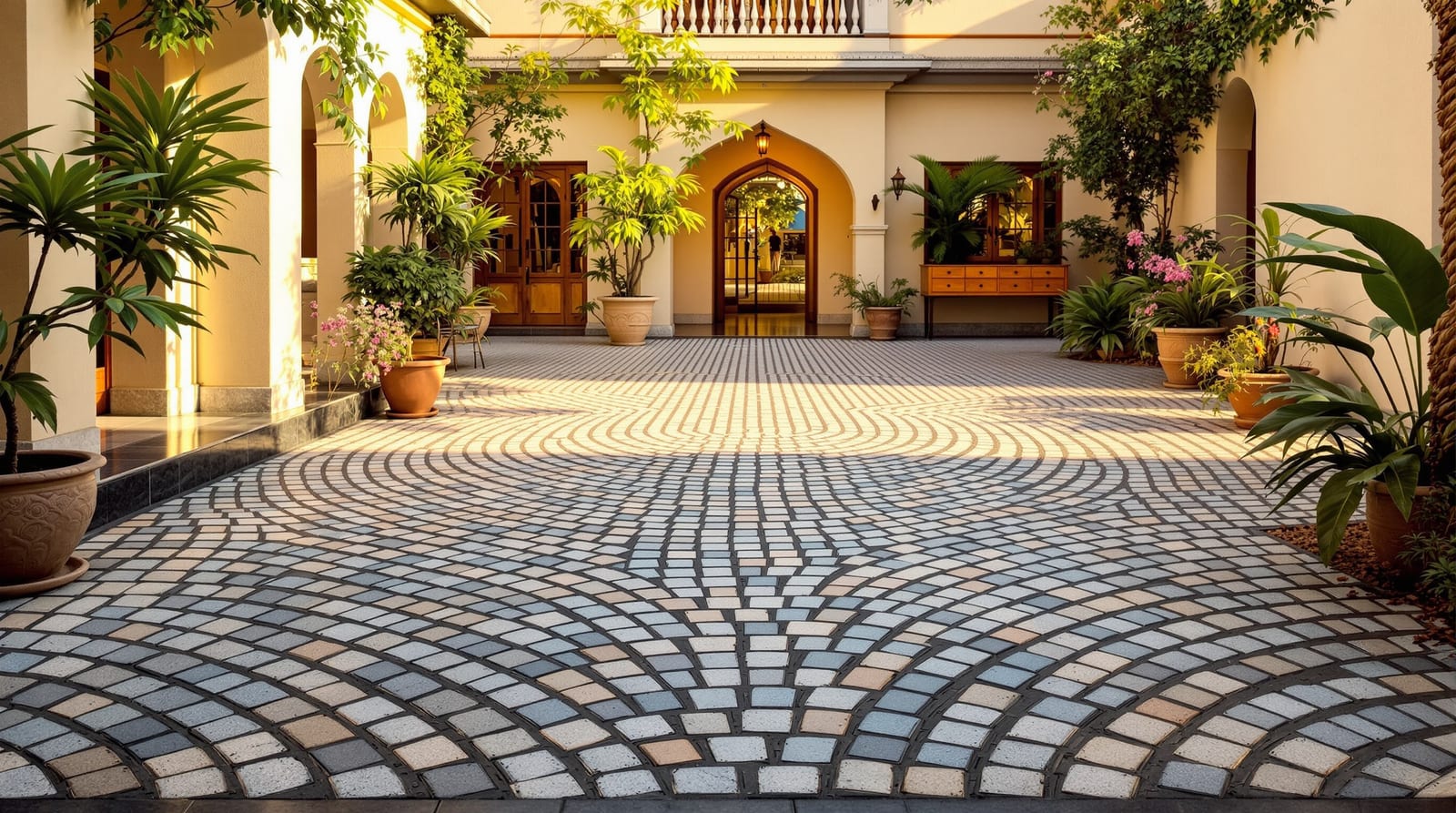
Cobblestone Flooring India: Granite and Sandstone Setts for Driveways, Courtyards and Paths — Types, Laying and Cost
The rugged old-world charm of stone setts — granite and sandstone cubes laid in sand or mortar for Indian driveways, courtyards, garden paths and heritage looks — their lifelong durability, drainage, ₹/sq ft cost, sand-set vs mortar-set laying, jointing and where they truly suit.
There is a reason cobblestone has outlasted almost every other paving idea humans have tried. The Roman roads were cobbled; so were the streets of old Pune, Goa and Fort Kochi. A cobblestone surface is nothing more than small cubes of hard stone — granite or sandstone setts — bedded one beside the other, and yet that humble idea gives you a floor that can take a truck, drain a monsoon downpour, and look better at thirty years than the day it was laid. In Indian homes today, cobblestone is enjoying a quiet revival in driveways, entrance courtyards, garden paths and farmhouse forecourts, where its rugged old-world charm and near-indestructible durability beat any tile or block.
This guide explains the stone types, the look each gives, the two ways to lay setts (sand-set versus mortar-set), how the joints are handled, what it honestly costs per square foot in India, and — most importantly — where cobblestone suits and where it does not.
What "cobblestone" means today
Strictly, a true cobble is a naturally rounded river or beach stone. What is sold and laid in India as "cobblestone" is almost always the stone sett — a roughly cube-shaped piece of hard stone, machine-cut or hand-dressed, usually 100x100 mm on the face and 50-100 mm deep. The words cobble, cobblestone, sett and "Belgian block" get used interchangeably at most Indian stone yards. What matters for your project is the stone and the cut, not the label.
Cobblestone is overwhelmingly an outdoor floor. The same property that makes it tough — an uneven, faceted surface with raised joints — makes it uncomfortable indoors for bare feet, hard on high heels, and unstable for furniture. Use it where ruggedness and drainage are the point: the approach, the parking, the path, the courtyard. For a broad map of where every alternative floor belongs, see the pillar guide /guides/specialty-flooring-guide-india.
Cobblestone types: stone, look and cost
Indian cobblestone is mostly granite (the hardest, in greys, blacks, tans and reds from South Indian and Rajasthani quarries) and sandstone (warmer beige, buff, brown and pink from Rajasthan and Madhya Pradesh). The cut — sharp cut cubes, tumbled, or natural split — changes both the look and the price.
| Type | Look and feel | ₹/sq ft (material) | Best use |
|---|---|---|---|
| Cut granite setts (sawn cube) | Crisp, near-regular cubes; tight modern joints; greys/blacks/tans | 120-250 | Formal driveways, entrance plazas, edging |
| Hand-dressed / split granite | Faceted natural top, rustic, slightly irregular | 90-180 | Courtyards, heritage looks, paths |
| Tumbled cobble (granite/sandstone) | Rounded soft edges, aged "old-street" charm | 100-200 | Period homes, garden paths, feature courts |
| Sandstone setts | Warm beige/buff/pink, softer, easy underfoot | 60-140 | Light-traffic paths, courtyards, borders |
| Natural river cobble / pebble setts | Rounded, very rustic, knobbly | 60-150 | Decorative bands, garden edging, accents |
Costs are indicative for 2026 and vary by city, stone yard and order size; add about 18% GST and laying labour on top. As a rule of thumb the laid cost (material plus sand or mortar bed plus skilled mason labour) runs roughly ₹120-380 per sq ft, with cut granite at the top and sandstone at the bottom. Compare this against precast concrete /guides/paver-blocks-india (cheaper, more uniform, shorter life) and cut /guides/natural-stone-pavers-india (flat slabs rather than cubes) before you decide.
How cobblestone is laid: the two methods
The single most important choice is the bed — what the setts sit on. It governs cost, drainage, durability and repairability.
Sand-set (flexible paving). The setts are bedded in 30-50 mm of coarse sand over a compacted aggregate base, then vibrated or tamped down, and the joints are filled with sand (or fine grit, or polymeric jointing sand). Nothing is glued. This is the traditional, permeable way: rainwater drains between the setts into the ground, individual stones can be lifted and reset, and minor ground movement is absorbed without cracking. It is ideal for driveways, parking and paths on firm soil. The trade-off is that joints can host weeds and silt, and edges must be restrained with a kerb or edging or the field slowly spreads.
Mortar-set (rigid paving). The setts are laid on a 25-40 mm cement-mortar bed over an RCC slab and the joints are grouted with mortar. This gives a hard, sealed, weed-free, very stable surface — better for formal entrances, pool surrounds, and anywhere you want a clean pointed joint. It is more expensive, not permeable, and if the slab cracks the joints can crack with it; repairs mean chiselling. Indian masons follow the spirit of IS 1443 (laying and finishing cement concrete flooring) for the base and bedding work.
Laying patterns and joints
Setts can be laid in running bond (offset rows, simplest), stack bond (grid, most formal), herringbone (interlocking zig-zag, strongest for vehicle loads), basketweave, or the classic fan / peacock pattern that hides the irregularity of hand-dressed stone and looks wonderful on a courtyard. Herringbone is the engineer's choice under car wheels because the interlock resists creep. For jointing, sand-set jobs increasingly use polymeric jointing sand that hardens slightly to lock setts and resist weeds while staying permeable; mortar-set jobs use a 1:3 to 1:4 cement-sand pointing.
Pros and cons: the honest picture
| Strengths | Limitations |
|---|---|
| Lifelong durability — granite setts outlast the building | Uneven surface: hard on heels, wobbly for furniture, not for indoors |
| Excellent for vehicle and heavy traffic | Labour-intensive, slow to lay — skilled mason cost is real |
| Sand-set version drains beautifully — great for monsoon | Joints collect silt and grow weeds (sand-set) |
| Individual setts can be lifted and reset — easy local repair | Not wheelchair, pram or stiletto friendly |
| Natural anti-skid texture, even wet | Needs edge restraint or the field spreads over time |
| Ages with character — moss and patina add charm | Higher upfront cost than precast paver blocks |
| No fading, no rot, low maintenance | Hand-dressed setts vary in size; needs a good craftsman |
For the wet-area and slip angle across all floors, see /guides/anti-slip-flooring-wet-areas-india. For terrace and roof applications where heat and waterproofing dominate, cobblestone is usually the wrong tool — see /guides/terrace-flooring-india instead.
Where cobblestone suits in an Indian home
- Driveways and parking aprons — the classic use. Granite setts in herringbone, sand-set, take cars and the odd lorry for decades and drain the monsoon. Far tougher than /guides/paver-blocks-india long term.
- Entrance courtyards and forecourts — fan-pattern setts give an instant heritage, Goan-villa or Rajasthani-haveli character.
- Garden and landscape paths — tumbled cobble or sandstone setts as stepping routes; weeds in the joints can even be embraced as planted joints.
- Decorative borders and bands — a single course of cobble edging a /guides/natural-stone-pavers-india patio or a /guides/flagstone-flooring-india crazy-paving terrace ties a landscape together.
- Tree pits, drains and transition strips — where you want a rugged, draining, easily-lifted surface around services.
For a full outdoor surface strategy — decks, paving, permeable parking — read the companion /guides/outdoor-flooring-guide-india. To estimate quantities and budget for a paved area, the /utilities/paver-block-calculator gives a quick sq-ft-to-cost and sett-count starting point (the same arithmetic applies to setts).
Buying and laying well in India
Buy from an established stone yard and inspect a sample lot: setts should be of consistent depth (so the laid surface is level), free of through-cracks, and from a single quarry batch for colour. Granite needs little sealing; sandstone is porous and benefits from a breathable stone sealer to slow staining and moss — see /guides/floor-resealing-guide-india. Insist on a proper compacted base and edge restraint; most cobblestone failures in India are base failures, not stone failures. Budget for skilled labour: a good sett mason lays slowly, and the result is only as good as the bedding and the level. For how cobblestone fits the wider stone family and standards, see /guides/natural-stone-standards-india and /guides/sandstone-flooring-india.
Frequently asked questions
Is cobblestone flooring suitable indoors?
Rarely. The uneven, faceted surface and raised joints make it uncomfortable underfoot, unstable for furniture and hard to clean indoors. It shines outdoors — driveways, courtyards, paths. If you love the look indoors, use it only as a small decorative band or in a foyer, and choose flat tumbled setts laid mortar-tight.
Cobblestone or paver blocks for my driveway?
Concrete paver blocks (/guides/paver-blocks-india) are cheaper, faster and more uniform, but fade and wear in 10-15 years. Granite cobblestone costs more upfront and is slower to lay, yet effectively lasts a lifetime, drains better when sand-set, and ages with character. For a forever driveway, cobblestone wins; for budget and speed, pavers do.
How do I stop weeds growing in the joints?
Use polymeric jointing sand, which firms up to resist weeds while staying permeable, or choose mortar-set laying for fully sealed joints. On sand-set paving, periodic re-sanding and an occasional weed treatment keep joints clean. Many owners simply accept a little moss as part of the rustic charm.
What does cobblestone cost per square foot in India?
In 2026, material runs about ₹60-250 per sq ft — sandstone and river cobble at the lower end, cut granite setts at the top. Laid cost, including sand or mortar bed and skilled labour, is roughly ₹120-380 per sq ft. Add about 18% GST. Prices vary by city, stone and order size, so treat these as indicative.
Sand-set or mortar-set — which should I choose?
Sand-set for driveways, parking and paths where you want drainage, easy repair and a flexible surface on firm soil. Mortar-set over an RCC slab for formal entrances, pool surrounds and anywhere you want a hard, sealed, weed-free, clean-pointed finish. Sand-set is more permeable and repairable; mortar-set is more stable and formal.
Export this guide
Related Guides — Deep-dive reading
Flagstone Flooring in India: Crazy Paving, Stones, Cost & Laying Guide
Irregular flat stone pieces laid in a random crazy-paving jigsaw give courtyards, paths and rustic verandahs a natural, anti-skid, free-draining floor — here are the stones used, how it is laid, where it suits and what it costs.
Flooring & SurfacesBrick Flooring India: Clay and Terracotta Brick Pavers for Warm Rustic Interiors and Durable Exteriors — Types, Patterns and Cost
The earthy farmhouse, heritage and courtyard look — clay and terracotta brick pavers laid flat for warm rustic interiors and tough, breathable exteriors — their types, laying patterns, ₹/sq ft cost, sealing and care, and exactly where brick flooring suits in an Indian home.
Flooring & SurfacesNatural Stone Pavers in India: Cost, Thickness & Laying Guide for Driveways & Patios
Cut-to-size sandstone, granite, limestone, basalt and cobble paving units for driveways, patios, garden paths and pool decks — how to pick the stone, the right thickness for the load, anti-skid finishes, sand-set vs mortar vs pedestal laying, and ₹60–250 per sq ft pricing.
Flooring & SurfacesRelated Tools — Try Free
Monsoon-Readiness Checklist
Pre-rain home audit across 9 categories — terrace, drains, waterproofing, electrical, HVAC, pest, vehicles, documents.
Seasonal AuditRainwater Tank Sizer
How big should your rainwater tank be? Computes annual harvest, recommended tank capacity in litres, water-bill savings, and payback — for 10 Indian cities.
RWH CalculatorFlooring Cost Calculator
Estimate the all-in cost of a floor — material, laying, wastage, skirting and GST — by area and material.
Flooring Calculator