
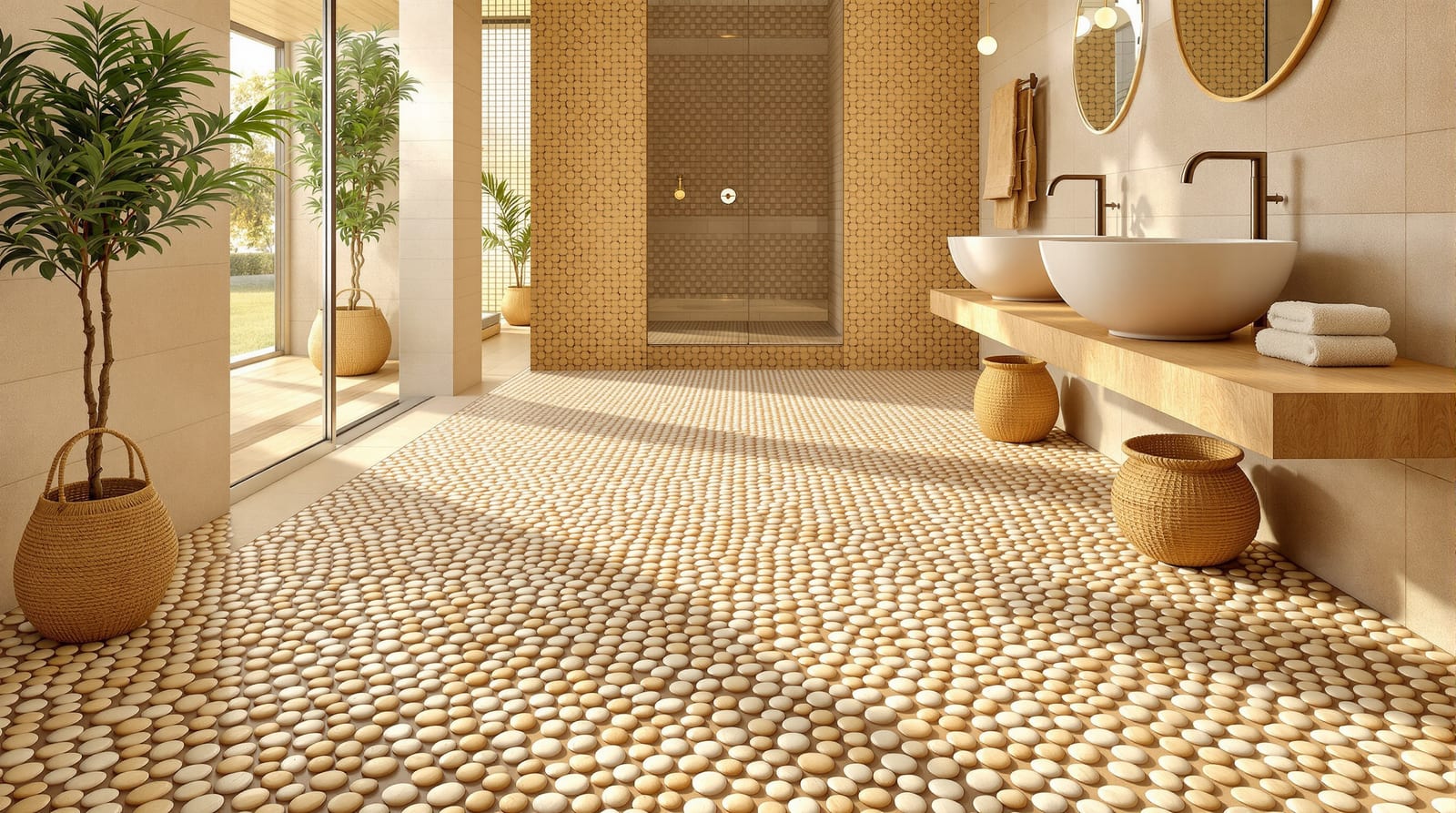
Pebble Flooring in India: River-Pebble Mosaic, Types, Cost & Sealing
Smooth river pebbles set in cement, epoxy or resin give a spa-like, massage-underfoot, natural floor for bathrooms, showers, garden paths and feature zones — here is where it suits, the three types, costs and how to seal it.
Few floors feel as alive underfoot as pebble flooring. Smooth river pebbles set in a bed of cement, epoxy or resin turn a bathroom, a garden path or a balcony corner into something you notice with your feet before your eyes — a gentle reflexology massage, the texture of a riverbed, the look of a Kerala courtyard or a spa retreat. It is one of the most decorative, tactile and genuinely natural finishes available in India, and at ₹80–300 per sq ft it is affordable enough to use as a feature rather than a whole-house floor. This guide explains the three ways pebbles are laid, where the finish actually works, what it costs, how to seal it, and the very real drawbacks — grout-heavy, hard to mop, uneven for furniture — that decide whether it belongs in your home.
What pebble flooring actually is
Pebble flooring is a wearing surface made of natural rounded stones — typically river pebbles or beach pebbles in grey, white, black, tan and multicolour — embedded in a binder so their tops stand proud and you walk on the curved stone, not the matrix. The pebbles do the work of texture, grip and drainage; the binder (cement mortar, epoxy or polyurethane resin) holds them and forms the joint.
This is not the same as exposed aggregate flooring, where small crushed aggregate is cast into concrete and then washed back to reveal a uniform speckle — that is a poured-and-revealed surface for driveways and pool decks, covered in our exposed-aggregate-flooring-india guide. Pebble flooring uses larger, hand-placed or mat-mounted rounded stones and reads as individual pebbles. It also differs from a cobblestone or sett floor, which uses cut stone cubes for driveways and courtyards.
In India the look has deep roots — pebble-set courtyards and tulsi-platform surrounds appear in traditional South Indian and coastal homes — and a strong modern revival in spa bathrooms, boutique-hotel showers and biophilic interiors. It sits in the broader family of alternative and natural floors mapped in our specialty-flooring-guide-india pillar.
The three types of pebble flooring
How the pebbles are held together changes the cost, the look and where the floor can go. There are three common methods.
1. Loose-laid pebbles in cement mortar (in-situ)
The traditional, lowest-cost method: pebbles are pressed by hand into a fresh bed of cement mortar over a waterproofed, sloped base, then the surface is grouted, cleaned and sealed. It is the most artisanal — a skilled mason can grade colours, control the density and create borders or simple patterns. Joints are wider and the look is rustic and organic. Best for courtyards, garden paths, foot-reflexology strips and outdoor showers where the rugged look suits the setting.
2. Pebble-mosaic mats (mesh-backed)
Pebbles are pre-sorted and glued onto a flexible mesh or net backing in roughly 30x30 cm sheets, sold loose-laid like tile. You set the mats into thin-bed adhesive or mortar exactly like laying tiles, butt the edges so the seams disappear, then grout over the whole field and seal. This is the most popular indoor method — far faster and more consistent than hand-laying, ideal for bathroom floors, shower trays and feature zones. The mats are sold by stone yards, tile shops and online; this is also the route most DIY pebble floors take.
3. Epoxy or resin-bound pebble flooring
Pebbles are mixed with a clear two-part epoxy or polyurethane resin and trowelled out as a seamless, troweled topping, then either left with a porous open-pore surface (river-rock drainage look, used for pool surrounds and patios in the West, growing in India) or flood-coated to a smooth, glassy, fully-sealed surface. Resin-bound is grout-free, the most water-resistant and the easiest to clean, but it is the most expensive and needs a skilled epoxy applicator — the same trade behind our epoxy-flooring-india work. Smooth flood-coated resin loses the massage texture; open-pore keeps it.
Type, look, cost and best use
The table below maps the three methods plus the wider pebble family against finish, indicative all-in cost and where each belongs. Costs are 2026 indicative, vary by city and vendor, and exclude 18% GST; binder and labour are included where stated because pebble work is labour-heavy.
| Type | Look | Cost (₹/sq ft) | Best use |
|---|---|---|---|
| Loose-laid pebbles in cement | Rustic, organic, wide joints | 80–160 | Courtyards, garden paths, outdoor showers, reflexology strips |
| Pebble-mosaic mats (mesh) | Even, consistent, tileable | 120–250 | Bathroom floors, shower trays, balcony feature zones |
| Epoxy/resin-bound (open-pore) | Crisp, drainage texture, seamless | 200–300 | Pool surrounds, patios, wet feature areas |
| Epoxy/resin flood-coat (smooth) | Glassy, pebbles under resin | 220–300+ | Indoor feature floors, low-maintenance wet zones |
| Pebble wall/feature panel | Vertical accent | 100–250 | Shower walls, accent strips, tulsi/planter surrounds |
For comparison within the cluster, in-situ marble-chip terrazzo and mosaic-flooring-india sit in a similar craft-labour bracket, while a plain cement IPS floor is cheaper. Use our /utilities/flooring-cost-calculator to convert ₹/sq ft into a total for your actual area, and /utilities/floor-sealer-calculator to size the sealer you will need.
Where pebble flooring suits — and where it does not
Pebble flooring earns its place in specific zones, not as a whole-house floor.
It works beautifully in bathrooms and showers. The curved stones give natural grip when wet, the gaps drain water, and the spa look is exactly what many Indian renovations want. Pair it with the slip and drainage thinking in our anti-slip-flooring-wet-areas-india and bathroom-flooring-india guides — pebble floors are inherently textured, which is a real anti-skid advantage in the one room where slips happen most.
It suits garden paths, courtyards and outdoor showers, where rustic joints and natural stone read correctly and the surface shrugs off monsoon rain — see our outdoor-flooring-guide-india for the full exterior picture. On balconies, a pebble feature strip or a small loose-laid zone adds texture without committing the whole floor; our balcony-flooring-india guide covers drainage and weather. Foot-reflexology paths — a strip of larger, rounded pebbles set in a garden or a meditation corner — are a popular wellness use, deliberately knobbly to stimulate the soles.
Where it struggles: large open living areas and bedrooms, because the uneven surface is uncomfortable for bare feet over time, wobbles chair and table legs, and makes furniture placement awkward. Kitchens, because the deep joints trap oil, atta and grime and are punishing to clean. And any space where you mop daily — pebble floors are grout-heavy and the recessed gaps hold dirt, so they need brushing rather than a quick swab.
Pros and cons
| Pros | Cons |
|---|---|
| Strong natural texture and massage-underfoot feel | Grout-heavy — lots of joint to seal and clean |
| Excellent grip and drainage when wet | Hard to mop; gaps trap dirt, oil and grime |
| Genuinely natural stone, biophilic, no two floors alike | Uneven surface — wobbles furniture, tiring underfoot |
| Affordable as a feature (₹80–300/sq ft) | Labour-intensive; quality depends on the mason/applicator |
| Hides minor unevenness in the base | Porous binder and stone need regular sealing |
| Suits wet, outdoor and spa zones | Not for kitchens, large living areas or daily-mop floors |
Sealing and maintenance
Sealing is non-negotiable. Both the cement matrix and many natural pebbles are porous, so an unsealed pebble floor stains, harbours mould in monsoon humidity and is murder to clean. After laying and a full cure (cement needs about 21–28 days), apply a penetrating stone-and-grout sealer; for a wetter, glossier "permanently wet stone" look, a topical or enhancing sealer deepens the pebble colours. Cement-bound floors typically want resealing every 1–2 years, faster in showers and outdoors — our floor-resealing-guide-india has the schedule. Resin-bound and flood-coated epoxy floors are effectively self-sealed and need only periodic recoating.
For day-to-day care, brush or use a soft scrubbing brush rather than relying on a mop — the recessed joints need agitation. Avoid acidic cleaners on cement and limestone-type pebbles. Our floor-cleaning-guide-india covers safe products. In showers, keep the slope and drain working so water never stands in the gaps.
DIY pebble mats
Pebble-mosaic mats are one of the more DIY-friendly natural floors, and a good weekend project for a small bathroom, a balcony corner or a planter surround. The honest version: the base must already be sound, waterproofed and sloped to a drain — get that wrong and no pebble mat will save it. Then it is essentially tiling. Dry-lay the mats first to plan the seams and colour flow; butt them tightly so the joint between mats disappears; press each mat firmly into thin-bed adhesive or cement mortar so the pebbles bed evenly; let it set; grout the entire field, working grout deep between stones and wiping the haze before it dries; cure; then seal. Buy 10–15% extra mats for cuts and breakage, and plan border pebbles by hand for a clean edge. For anything structural, wet-room waterproofing, or a large floor, use an experienced mason or epoxy applicator — Studio Matrx generally recommends DIY only for small, well-drained feature zones.
Frequently asked questions
Is pebble flooring good for bathrooms in India?
Yes, for showers and bathroom floors it is one of the better natural choices — the rounded stones give grip and the gaps drain water, which directly helps with the slip risk covered in our anti-slip-flooring-wet-areas-india guide. The catch is cleaning: the joints trap soap scum and need brushing, not just a quick mop, and the floor must be properly waterproofed and sloped to a drain underneath.
How much does pebble flooring cost per sq ft in India?
Roughly ₹80–160 for loose-laid pebbles in cement, ₹120–250 for mesh-backed mosaic mats, and ₹200–300 or more for epoxy/resin-bound floors, before 18% GST. Pebble work is labour-heavy, so the mason or applicator skill is a big part of the price. Use the Studio Matrx /utilities/flooring-cost-calculator to size it for your area.
Is pebble flooring hard to clean?
Honestly, yes — it is the main drawback. The recessed joints between pebbles trap dirt, oil and grime, so you brush rather than mop, and a sealed surface is essential to stop staining and mould. This is why we do not recommend it for kitchens or large daily-use living floors, only for showers, gardens, balconies and feature zones.
Do I need to seal a pebble floor?
Almost always. The cement binder and many natural pebbles are porous, so an unsealed floor stains and grows mould in humidity. Apply a penetrating or enhancing sealer after full cure, and reseal cement-bound floors every 1–2 years per our floor-resealing-guide-india. Resin-bound and flood-coated epoxy pebble floors are self-sealing and only need occasional recoating.
What is the difference between pebble flooring and exposed aggregate?
Pebble flooring uses larger, rounded river pebbles, hand-placed or on mats, so you read individual stones and walk on their curved tops. Exposed aggregate is concrete cast with small crushed aggregate, then surface-washed to reveal a uniform speckle — a poured driveway-and-pool-deck finish. See our exposed-aggregate-flooring-india guide for that distinct material.
Export this guide
Related Guides — Deep-dive reading
Anti Slip Flooring for Bathroom and Wet Areas in India: R-Ratings, Finishes and Genuinely Safe Tile Choices
How to choose genuinely safe flooring for bathrooms, kitchens, balconies, pools, entrances and elderly- or child-friendly homes — the R-rating system, finishes that grip wet feet, anti-skid natural stone, slope to drains and the tiles to avoid.
Flooring & SurfacesExposed Aggregate Flooring in India: Method, Aggregate Choices, Cost & Pros and Cons
Concrete cast with decorative pebbles and chips, then surface-washed to reveal the stones, gives a tough, anti-skid, seamless finish for driveways, pool decks, paths, parking and courtyards at ₹60–180 per sq ft — here is how it is made, the aggregate options, costs and trade-offs.
Flooring & SurfacesEpoxy Bathroom Flooring India: Seamless Resin Floors, Cost & Slip (2026)
How seamless epoxy and resin bathroom floors work in Indian homes — no grout lines means fully waterproof and hygienic, plus anti-slip additives, colours, curing, the wet-floor slip risk, an IPS comparison, and honest rupee costs per sq ft.
BathroomsRelated Tools — Try Free
Full-Room BOQ — Living, Bedroom, Kitchen, Bath
Room-wise BOQ across living, bedrooms, kitchen, utility, and bathrooms with line-item pricing.
Full-Room BOQMonsoon-Readiness Checklist
Pre-rain home audit across 9 categories — terrace, drains, waterproofing, electrical, HVAC, pest, vehicles, documents.
Seasonal AuditPool Tile Calculator
Floor, wall and waterline area and the total number of tiles for your pool, with a wastage allowance.
Pool Calculator