
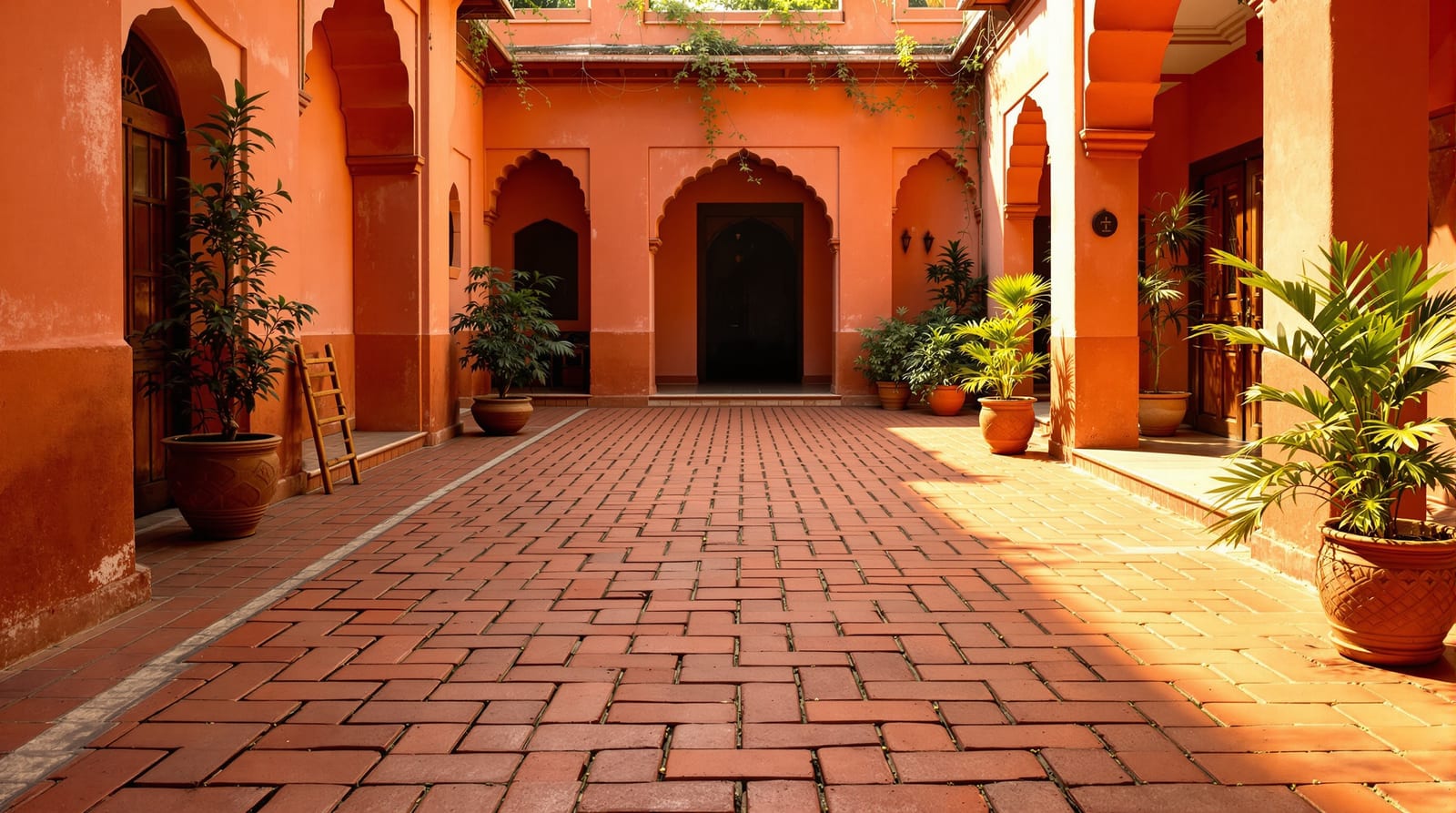
Brick Flooring India: Clay and Terracotta Brick Pavers for Warm Rustic Interiors and Durable Exteriors — Types, Patterns and Cost
The earthy farmhouse, heritage and courtyard look — clay and terracotta brick pavers laid flat for warm rustic interiors and tough, breathable exteriors — their types, laying patterns, ₹/sq ft cost, sealing and care, and exactly where brick flooring suits in an Indian home.
Few floors feel as instantly warm and lived-in as brick. Long before vitrified tiles arrived, Indian homes, havelis and colonial bungalows were floored with humble fired-clay bricks laid flat — and that earthy, hand-made surface is making a confident comeback in farmhouses, courtyard homes and rustic interiors. Brick flooring gives you a floor that is warm underfoot in winter, surprisingly cool in summer shade, ages beautifully with a deepening patina, and shrugs off the kind of outdoor abuse that wrecks delicate finishes.
This guide covers the brick types you can actually buy in India, the laying patterns that make or break the look, what brick flooring honestly costs per square foot, the all-important business of sealing a porous clay floor, how it compares with terracotta floor tiles, and where it truly belongs in an Indian home.
What brick flooring is — and why it works
Brick flooring is simply fired-clay brick units laid flat as a finished floor, set in a sand or cement-mortar bed and jointed with sand or grout. The unit may be a standard building brick laid on its broad face, a thinner purpose-made brick paver, a wire-cut brick, or a terracotta floor tile cousin. What they share is the material: natural clay, fired in a kiln, with the warm red, rust, ochre, brown and pinkish tones that no synthetic finish quite matches.
The reason brick performs so well is the clay itself. Fired terracotta is breathable — it lets moisture move through it rather than trapping it, which suits India's humid and monsoon climate and avoids the damp-trap problems of fully sealed floors. It has good thermal behaviour: it stays cool in shaded summer interiors yet feels warm and soft to the eye in winter. It is tough enough for verandahs, courtyards and patios, yet handsome enough for a rustic living room. The one catch — and it governs everything about care — is that clay brick is porous. An unsealed brick floor drinks up water, oil and stains, so sealing is not optional. For where brick sits among all the alternative floors, see the pillar guide /guides/specialty-flooring-guide-india.
Brick flooring types: look and cost
Several distinct products get laid as "brick flooring" in India. The table below maps each type to its look and an indicative material cost per square foot.
| Type | Look and feel | ₹/sq ft (material) | Best use |
|---|---|---|---|
| Traditional clay brick (laid flat) | Rustic, irregular, warm red-brown; visible kiln variation | 50-90 | Courtyards, verandahs, farmhouse interiors |
| Brick pavers (purpose-made, thinner) | Cleaner, more uniform brick face; easier to lay flat | 70-130 | Patios, paths, rustic living areas |
| Wire-cut bricks | Crisp edges, dense, low-porosity, smooth face | 80-150 | Modern-rustic interiors, high-traffic |
| Terracotta floor tiles (Mangalore-clay type) | Flatter, tile-like, even thickness; warm matte | 60-140 | Indoor rustic floors, kitchens, dining |
| Reclaimed / antique brick | Worn, characterful, deep patina, one-of-a-kind | 90-200+ | Heritage restoration, feature floors |
Costs are indicative for 2026 and vary by region, kiln and order size; add about 18% GST and laying labour on top. As a rough rule the laid cost — brick plus sand or mortar bed plus skilled mason — runs roughly ₹120-300 per sq ft, with reclaimed and herringbone-laid floors at the top. Brick sits in a sweet spot: dearer than a plain /guides/ips-flooring-india cement floor or basic /guides/paver-blocks-india, but far cheaper than natural stone or imported tile, and unmatched on character per rupee.
Laying patterns: the look lives here
The single biggest design decision is the pattern. The same bricks read completely differently depending on how they are laid, and the pattern also affects wastage and labour.
Running bond is the everyday classic — bricks in offset rows, the same way a brick wall is bonded. It is the simplest to lay, wastes the least, and gives the calm, traditional verandah look. Herringbone sets bricks at right angles in an interlocking zig-zag; it is the premium pattern, visually rich and structurally self-locking under foot and wheel traffic, but it costs 15-20% more in wastage and labour because of all the angled cuts at the borders. For the pattern explained across all materials, see /guides/herringbone-flooring-india. Basketweave lays bricks in square pairs turned alternately horizontal and vertical, a decorative period look lovely for courtyards and entries. Stack bond (a plain grid) and stretcher courses round out the common choices.
Properties, sealing and care
A clay brick floor is forgiving and long-lived, but it has one demand: respect its porosity.
| Strengths | Limitations |
|---|---|
| Warm, earthy character that improves with age | Porous — must be sealed, or it stains and absorbs water |
| Breathable; suits humid and monsoon climates | Slightly uneven surface; not for stiletto heels |
| Cool in shaded summer interiors; pleasant outdoors | Wide sanded joints can collect dust and grow moss outdoors |
| Very durable for verandahs, courtyards, patios | Efflorescence (white salt bloom) can appear early on |
| Naturally anti-skid texture, even slightly wet | Acid cleaners and harsh chemicals attack clay |
| Easy local repair — lift and replace a single brick | Reclaimed brick varies in thickness; needs a good mason |
Sealing is the make-or-break step. Once laid and fully dry, a brick floor should be sealed with a breathable penetrating sealer — a stone/terracotta impregnator that repels water and oil while still letting the clay breathe. Indoors, many owners add a matte or satin top sealer or a traditional linseed-oil-and-wax finish for a soft sheen and easier cleaning. Avoid thick film-forming epoxy or PU coatings on outdoor brick: they trap moisture, blister and defeat the floor's breathability. Reseal periodically — see /guides/floor-resealing-guide-india for the schedule and products.
Efflorescence — a powdery white salt bloom — is common on new brick and cement-jointed floors as moisture carries soluble salts to the surface. It is harmless and usually weathers off or brushes away dry; never wash it in, and let the floor cure fully before sealing. Outdoors, moss and algae colonise damp, shaded joints during the monsoon; a stiff brush, a mild bleach-free moss treatment and good drainage keep them in check. For routine upkeep, sweep and damp-mop with a pH-neutral cleaner — never acid or strong detergent — as covered in /guides/floor-cleaning-guide-india. For the wet-area slip angle, see /guides/anti-slip-flooring-wet-areas-india.
Brick flooring vs terracotta floor tiles
These two are close cousins — both fired clay — and people often confuse them.
| Brick flooring (clay brick / pavers) | Terracotta floor tiles | |
|---|---|---|
| Form | Thick brick units laid flat | Thinner, flatter, tile-shaped clay units |
| Look | Chunky, rustic, three-dimensional, patterned | Flatter, more even, calmer field |
| Thickness | 40-65 mm typical | 15-25 mm typical |
| Strength outdoors | Excellent — handles vehicles and weather | Good for paths, less so for heavy load |
| Joints | Wider, sand or mortar, emphatic | Narrower, tile-like |
| Best for | Courtyards, verandahs, patios, farmhouse floors | Indoor rustic floors, kitchens, dining |
In short: choose brick when you want chunky rustic character and outdoor toughness; choose terracotta tiles when you want a flatter, calmer indoor clay floor that lays more like conventional tile. Both seal and breathe the same way. For the broader natural and traditional floor family, see /guides/eco-friendly-flooring-india, since fired clay is among the most sustainable, low-energy and recyclable floors you can lay.
Where brick flooring suits in an Indian home
- Courtyards and aangans — the spiritual home of brick. Running-bond or herringbone clay brick gives an instant heritage, haveli or farmhouse character and drains the monsoon well.
- Verandahs and porches — warm, anti-skid and weatherproof; the transition between garden and house that brick was made for.
- Rustic living and dining rooms — sealed indoor brick or terracotta tiles bring earthy warmth to farmhouse and cottage interiors.
- Kitchens — a sealed brick or terracotta floor is forgiving, warm and hides everyday wear, though spills must be wiped promptly on porous clay.
- Patios, garden paths and pool surrounds — durable, naturally non-slip and beautiful with planting; pairs well with a /guides/cobblestone-flooring-india edging band.
- Outdoor entertaining areas and barbecue zones — heat-tolerant and rugged.
For a full outdoor strategy — decks, paving and permeable surfaces — read the companion /guides/outdoor-flooring-guide-india. To estimate brick quantity and budget for your area, the /utilities/brick-flooring-calculator gives a quick sq-ft-to-brick-count and cost starting point, factoring in pattern wastage.
Buying and laying well in India
Buy from a reputable kiln or supplier and inspect a sample lot: bricks should be well-fired (a ringing sound when tapped, not a dull thud), of consistent thickness so the laid floor is level, and free of through-cracks. For flooring, ask specifically for paving bricks or dense wire-cut bricks rather than soft, under-fired wall bricks. Decide bed and joint up front: a sand-set brick floor (over a compacted base) drains and lets individual bricks be lifted and reset — ideal outdoors; a mortar-set floor over a concrete slab is rigid, sealed and best indoors, following the spirit of IS 1443 for the base and bedding. Insist on proper falls for drainage outdoors, edge restraint so the field does not spread, and a skilled mason — most brick-floor failures in India are base or jointing failures, not brick failures. Seal only after the floor has fully cured and any efflorescence has weathered. For how brick fits the wider eco and reclaimed floor story, see /guides/eco-friendly-flooring-india.
Frequently asked questions
Is brick flooring suitable indoors?
Yes, very much so. Sealed clay brick or terracotta floor tiles make warm, characterful, durable indoor floors for rustic living rooms, dining rooms and kitchens. The keys are a flat, level lay (use thinner brick pavers or terracotta tiles indoors), a breathable penetrating sealer plus an optional satin top finish, and prompt wiping of spills since clay is porous.
Does brick flooring need to be sealed?
Yes — sealing is essential. Unsealed clay brick is porous and will absorb water, oil and stains and grow moss in damp joints. Use a breathable penetrating terracotta sealer after the floor has cured and any efflorescence has cleared, and reseal periodically. Avoid thick film-forming epoxy or PU coatings outdoors, as they trap moisture and blister.
What does brick flooring cost per square foot in India?
In 2026, brick material runs about ₹50-150 per sq ft — traditional clay brick at the lower end, wire-cut and reclaimed brick at the top. Laid cost, including the sand or mortar bed and skilled mason labour, is roughly ₹120-300 per sq ft, with herringbone and reclaimed floors costing more. Add about 18% GST. Treat these as indicative; they vary by region and order size.
What is efflorescence and is it a problem?
Efflorescence is the powdery white salt bloom that often appears on new brick and cement-jointed floors as moisture carries soluble salts to the surface. It is harmless and cosmetic. Let the floor cure fully, brush off the dry powder, and do not wash it in or seal over it. It usually weathers away; persistent bloom points to ongoing moisture that drainage should address.
Brick flooring or terracotta floor tiles — which should I pick?
Choose brick when you want chunky, three-dimensional rustic character and outdoor toughness for courtyards, verandahs and patios. Choose terracotta floor tiles when you want a flatter, calmer indoor clay floor that lays more like conventional tile, ideal for living rooms, dining rooms and kitchens. Both are fired clay, both breathe, and both must be sealed.
Export this guide
Related Guides — Deep-dive reading
Basalt Flooring in India: Black Lava Stone Cost, Finishes & Use Guide
Dense, hard, low-porosity volcanic basalt gives the modern matte-black floor — here is how to choose honed, flamed or leather finishes, where it suits indoors and outdoors, and how it compares with granite.
Flooring & SurfacesEpoxy Grout vs Cement Grout for Tiles in India: Which to Specify (2026)
A plain-English guide to tile grouts for Indian homes: what grout does, how cementitious grout compares with epoxy grout on cost, stain and water resistance, hygiene and durability, and exactly where each one belongs - kitchens, bathrooms, pools, dry rooms and more.
Building MaterialsFlagstone Flooring in India: Crazy Paving, Stones, Cost & Laying Guide
Irregular flat stone pieces laid in a random crazy-paving jigsaw give courtyards, paths and rustic verandahs a natural, anti-skid, free-draining floor — here are the stones used, how it is laid, where it suits and what it costs.
Flooring & SurfacesRelated Tools — Try Free
Flooring Cost Calculator
Estimate the all-in cost of a floor — material, laying, wastage, skirting and GST — by area and material.
Flooring CalculatorCross-Ventilation Analyzer
Estimate airflow and air changes per hour (ACH) from room size, window areas, layout, and local wind — with NBC 2016 Part 8 compliance check.
Ventilation CalculatorInterior Budget Planner
Live room-wise and component-wise cost breakdown in ₹ with contingency, GST, and PDF summary.
Budget Calculator