
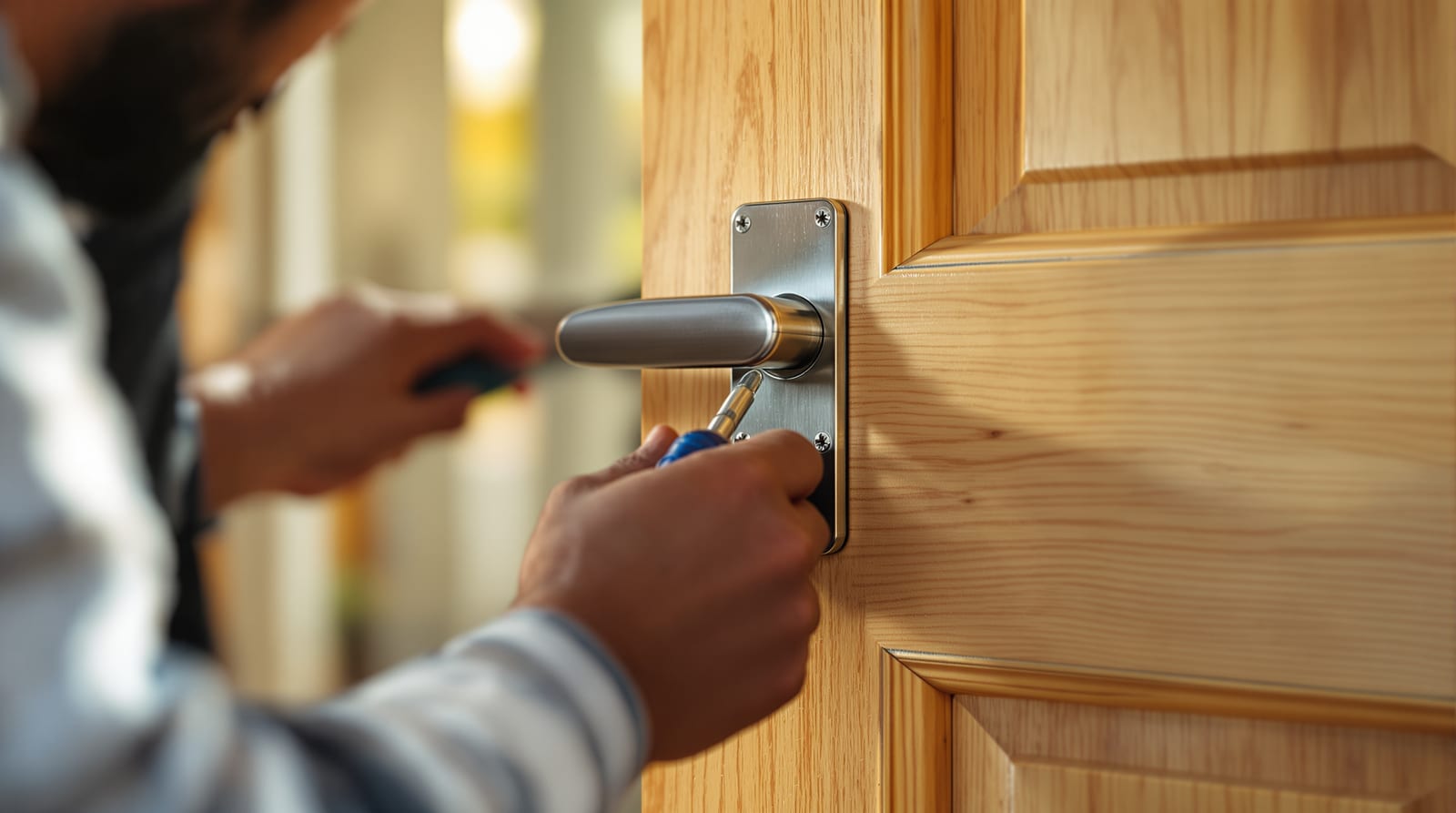
Fitting Door Hardware: Ironmongery Install Guide India 2026
The new-fit craft of mounting hinges, locks, levers, closers, bolts, stops and seals onto a door and frame — in the right order, at the right heights.
Fitting door hardware is the trade craft of marking, cutting and mounting the ironmongery — hinges, mortise lock, lever, closer, bolts, stops and seals — onto a new door leaf and frame so it hangs true, latches first time and meets India's accessibility and fire-safety rules. This is not the same as choosing hardware (what a hinge or lock is — see the door hardware guide), and it is not repair work (fixing a hardware that has already failed). It is the precise, one-shot set-out and installation that turns a bare leaf and frame into a working, code-compliant door-set. Get the marking-out and the order wrong and you chase binding leaves and stiff locks for the rest of the snagging period. This guide is the overview pillar for the whole fitting layer; for the full picture start at the complete door guide.
What "fitting hardware" covers — and what it does not
On an Indian fit-out the leaf and frame arrive separately, the frame is usually already fixed and plastered, and the ironmongery comes in a set keyed to the door reference on the ironmongery schedule. Fitting hardware means everything from there: confirming handing, marking the heights, mortising the hinge and lock recesses, boring the cylinder and follower holes, mounting the furniture, fitting the strike/keep into the frame, hanging closers and bolts, and proving the door operates. It assumes the leaf is already hung true and the gaps are even — that hanging step lives in the install-sequence guides such as how to fit a door. It deliberately excludes the product description (covered by the door hinges guide and mortise locks) and excludes repair. Think of this page as the conductor; the individual operations have their own deep dives, cross-linked below.
Get these right before you cut anything
Three decisions, made before the chisel touches the leaf, prevent most rework:
- Handing. Confirm left-hand vs right-hand and inswing vs outswing against the schedule and the room — a mortise lock and a lever fitted to the wrong hand is a scrap or a re-mortise. Check the door handing and swing logic first.
- Heights and set-out. Lift the standard heights off the schedule and the calculator, mark a horizontal datum 1000mm above the finished floor on the frame, and work all heights off that single line so every door on the floor matches.
- Fire-rating. If the door is a fire door, the ironmongery is part of the tested set — hinges, closer and seals are specified, cut-outs must not breach the core, and the fitting rules are stricter (see fire-door installation compliance).
Standard fitting heights and set-out
India commonly works to the heights below, measured from finished floor level (FFL). The lever centre near 1000mm suits both general use and the RPwD Act 2016 / Harmonised Guidelines 2021 preference for lever handles, not knobs, operable one-handed in the 800–1100mm band. Confirm the project's own schedule first; the door hardware height calculator generates a marked-up set-out sheet you can take to the bench.
| Item | Height from FFL (rule of thumb) | Notes |
|---|---|---|
| Lever / handle centre | 900–1050mm (≈1000mm) | RPwD: lever, one-hand, 800–1100mm |
| Mortise lock keep / latch centre | ~900mm | Backset 60mm (some 57mm) |
| Top hinge | 150–200mm down from head | First load point |
| Bottom hinge | ~250mm up from floor | Clears skirting/threshold |
| Third hinge | mid-height or one-third down | 3 per leaf standard |
| Fourth hinge (heavy / fire) | between top and third | Adds for heavy or FD doors |
| Tower / flush bolt | top and bottom of leaf | On the inactive/double leaf |
| Door viewer | 1400–1500mm | Eye level |
| Door closer body | head rail, manufacturer template | Power size to leaf weight |
The hinge knuckle, lock backset and seal kerf
Three small dimensions decide whether the door works: the hinge knuckle must sit so the leaf swings clear of the frame edge, the lock backset (60mm typical) sets the lever clear of the frame stop, and on a fire door the seal kerf depth must match the intumescent/smoke strip so it is flush, not proud. Cut these from a jig wherever possible — a hinge-mortising jig and lock-mortising jig give repeatable, square recesses across a run of doors and save the veneer on flush leaves.
The fitting order — why sequence matters
Fitting hardware in the wrong order forces you to re-handle the leaf or re-cut a recess. Hinges first, because they fix the leaf's position and reference everything else; the lock and lever next, off the hinge side; then the frame-side strike and keep; then bolts; then the closer (which loads the head and must be set after the leaf swings freely); seals and stops last, and signage where required. Each step has a sibling guide: fitting door hinges, fitting mortise locks, fitting strike plates and keeps, fitting flush and tower bolts, fitting door closers and fitting intumescent seals. The marking discipline that underpins all of them is in marking out door hardware.
| Step | Operation | Why it comes here |
|---|---|---|
| 1 | Confirm handing, mark 1000mm datum | Single reference for the whole leaf |
| 2 | Mark and mortise hinges (3 per leaf) | Hinges fix the leaf position |
| 3 | Hang leaf, check 2–4mm even gaps | Prove the swing before cutting the lock |
| 4 | Mortise lock body; bore cylinder/follower | Worked off the now-true leaf |
| 5 | Mount lever/furniture, set lock case | Lever centre ~1000mm |
| 6 | Mark and cut frame strike/keep | Latch must engage first time |
| 7 | Fit tower/flush bolts (if double leaf) | After both leaves hang |
| 8 | Fit and adjust closer | Set after free swing confirmed |
| 9 | Fit seals, stops; fix signage on FD | Last, so they are not damaged |
| 10 | Test operation, latch, self-close | Hand over only when proven |
Tools, finishes and India site realities
Clean hardware fitting needs sharp bevel-edge and mortise chisels, a marking and mortise gauge, a combination square, a router with hinge template, a lock morticer or plunge-router jig, Forstner/auger bits (22–25mm) for cylinder bores, and a cordless driver — the full kit is in the door fitting tools guide. Keep chisels and plane irons keenly sharp: blunt edges tear flush-door veneer and over-size the recess. On Indian sites, plan for power cuts (keep batteries charged or a hand-mortising fallback), dust and monsoon damp (fit after wet trades and primer are dry so the leaf has acclimatised), and mixed-skill labour (supervise the first door of every run, then template the rest). Match the finish of every piece in a set — antique brass, satin nickel, matt black — to the ironmongery schedule; GST on hardware is generally 18%. Done right, fitting heights and recesses feed straight into a clean door snagging result and a smooth door handover.
Fire doors and accessibility — the non-negotiables
Two things you cannot fudge while fitting. Fire doors: use only the tested/certified hardware for that door-set, keep gaps ≤3mm (4mm max) around the leaf, fit continuous intumescent and smoke seals in the rebate, use fire-rated hinges (3+), never over-size a cut-out into the core, fit a self-closer, and fix "Fire door — keep shut" signage (NBC 2016, IS 3614). Accessibility: RPwD/Harmonised Guidelines require lever handles, easy one-hand operation, lever centre in the 800–1100mm band, and free egress not defeated by a fitting that jams. When in doubt on a fire or accessible door, bring in a specialist joiner rather than guessing — these are life-safety items, not finish details.
Frequently asked questions
What height do you fit a door handle in India?
The lever centre is commonly fitted at about 1000mm above finished floor level (the 900–1050mm band), with the mortise lock keep around 900mm. This suits general use and the RPwD/Harmonised Guidelines preference for lever handles operable one-handed within the 800–1100mm range. Work every door off a single 1000mm datum line so the whole floor matches.
How is fitting hardware different from choosing it?
Choosing hardware (covered in the door hardware guide) is about what a hinge, lock or closer is and which to specify. Fitting is the on-site craft of mounting it — marking the heights, mortising the recesses, boring the bores, hanging and proving the door. This page covers the fitting; the product guides cover the selection.
How many hinges should I fit per door leaf?
As a rule of thumb, three hinges per leaf: top about 150–200mm down from the head, bottom about 250mm up from the floor, and the third at mid-height or one-third down. Heavy, tall or fire-rated leaves take a fourth hinge, and on a fire door the hinges must be the fire-rated type from the tested set.
In what order should I fit the hardware?
Hinges first (they fix the leaf position), then hang and check the gaps, then the mortise lock and lever, then the frame strike/keep, then bolts, then the closer, with seals, stops and signage last. Fitting out of order forces re-handling or re-cutting. The full sequence is in the step table above.
What is special about fitting hardware to a fire door?
A fire door is a tested set: use only its specified ironmongery, keep leaf gaps ≤3mm (4mm max), fit continuous intumescent and smoke seals, use fire-rated hinges, avoid over-size cut-outs that breach the core, fit a self-closer, and add "Fire door — keep shut" signage per NBC 2016 and IS 3614. See fire-door installation compliance.
Can a general carpenter fit door ironmongery?
A skilled carpenter fits standard internal doors well, hanging and fitting around 4–6 simple flush doors a day. For fire doors, accessible doors, heavy main doors and concealed/smart hardware, use an experienced joiner or supervise closely — these carry life-safety and warranty consequences, and a botched mortise on a fire leaf can void its rating.
Export this guide
Related Guides — Deep-dive reading
Marking Out Door Hardware Positions: Set-Out (India 2026)
Standard fitting heights, story rods and templates for setting out hinges, locks, viewers and bolts consistently across an Indian project.
Home Doors & EntrancesDoor Trades Coordination: Fitting Sequence on Site (India 2026)
How carpenter, mason, electrician and painter hand off work in the right order so doors fit without rework on an Indian site.
Home Doors & EntrancesFitting Mortise Locks: New-Fit Craft Guide India 2026
The on-site craft of fitting a mortise lock to a new door — marking, mortising the pocket, boring cylinder and handle holes, and testing the throw.
Home Doors & EntrancesRelated Tools — Try Free
Fire Door Rating Checker
See the likely fire-door rating (30/60/90/120 min) and components a location needs per IS 3614 / NBC — guidance, confirm with your architect.
Compliance ToolDoor Security Rating Calculator
Score your main door out of 100 across leaf, frame, lock and hardware — and see the top upgrades.
Security ToolWindow Hardware Cost Calculator
Estimate window hardware cost — hinges, handles, locks, rollers and multipoint gears.
Window Calculator