
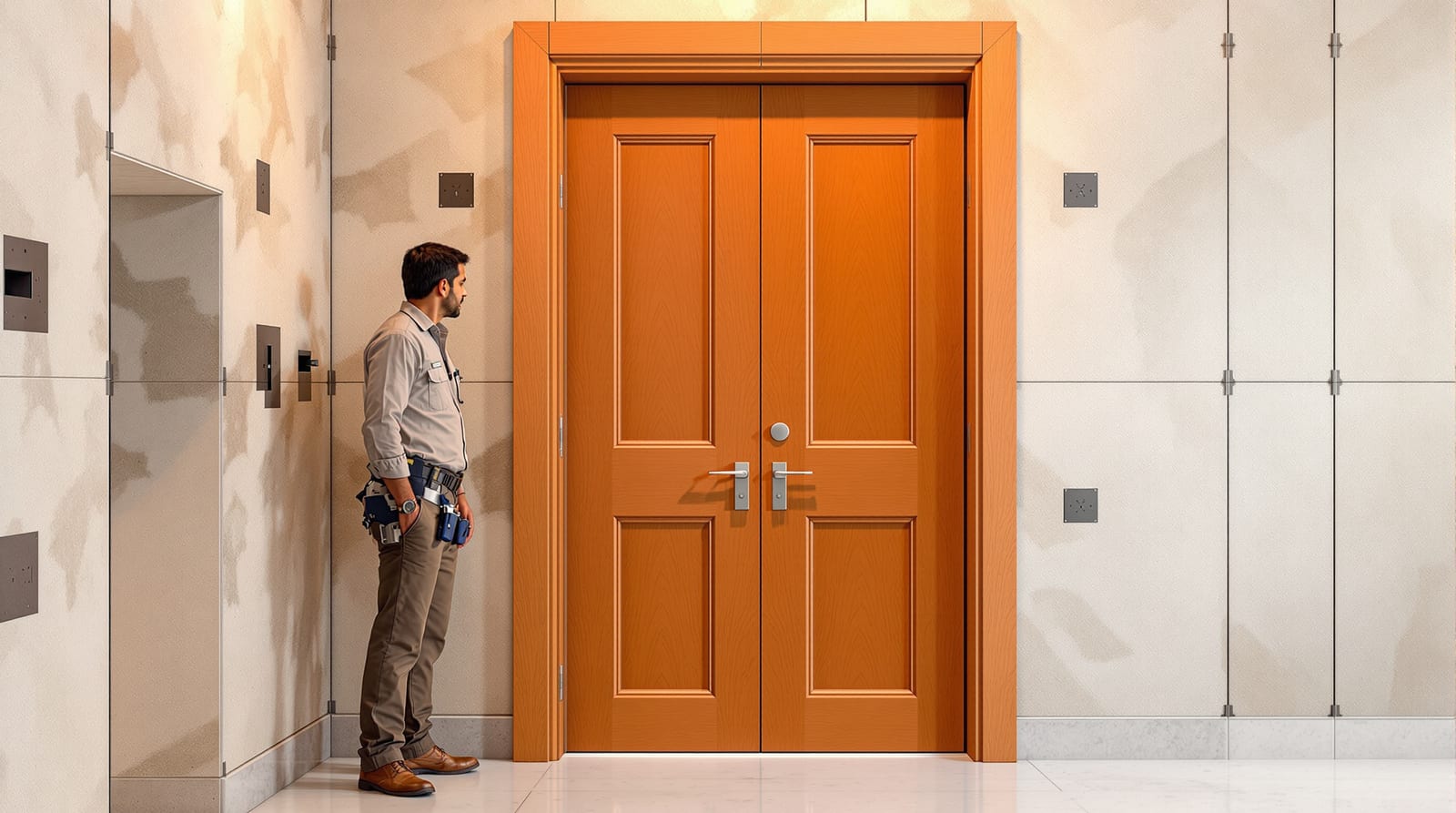
Fire-Door Installation Compliance: India 2026 Fitting Guide
Getting a fire door right at fitting — certified set, gaps under 3mm, continuous seals, fire-rated hinges, self-closing and signage to NBC 2016 and IS 3614.
Fire-door installation compliance is decided in the hour the door is hung — not at the next annual inspection. A fire door is only a fire door if the leaf, the frame, the seals and the ironmongery are fitted exactly as the assembly was tested; the moment a fitter widens a gap, breaks a seal, swaps an uncertified hinge or routes an oversize cut-out into the core, the door drops out of its certification and offers no proven FD30 or FD60 protection. This guide is the install-time discipline: what a skilled fitter must check and prove as the door goes in, so the door-set leaves site compliant under NBC 2016 and IS 3614. It is the new-fit counterpart to ongoing duty — for the in-service regime of re-checking gaps, seals and self-closers over the door's life, see fire-door maintenance and inspection. Start from the complete door guide, and pair this with fitting intumescent seals and the rating basics in fire-door ratings.
Fit the tested set — not a kit of parts
The single rule that underpins everything else: a fire door is a tested door-SET, not a leaf you can dress with whatever hardware is on the van. The certification covers the leaf, the frame, the intumescent and smoke seals, the hinges, the lock and the closer as a tested combination. Substitute any element with something untested — an ordinary butt hinge, a non-fire lock, a different closer — and the rating is void. On receiving the set, confirm the fire-rating label or certificate is present, the leaf matches the schedule reference, and the frame, seals and ironmongery are the ones specified. Store the leaf flat, off the floor, dry and acclimatised, and fit it after wet trades and plaster are dry. Key the door to its reference in the fire-rating schedule so site and drawing agree on which openings are FD30, FD60 or higher. Where the door's provenance is unknown or the certificate is missing, that is a fire-engineer's call, not a fitter's improvisation.
The perimeter gaps — the heart of compliance
More fire doors fail on gaps than on anything else. The leaf must sit in the frame with a tight, even margin so that when the intumescent activates it can bridge and choke the gap. As a rule of thumb, fire-door installation compliance demands:
| Location | Target gap | Maximum | How to check |
|---|---|---|---|
| Head (top of leaf) | 2-3mm | 4mm | Feeler / gap gauge along the head |
| Both jambs (hinge & lock sides) | 2-3mm | 4mm | Feeler gauge top, middle, bottom |
| Meeting stile (double doors) | 2-3mm | 4mm | Gauge full height of the meeting edge |
| Threshold (no drop seal) | typically 8-10mm | per certificate | Measure leaf bottom to finished floor |
| Threshold (sealed / drop seal) | sealed to spec | per certificate | Confirm seal drops and contacts |
The working standard is ≤3mm around the leaf, 4mm absolute maximum, kept even — a door that is 1mm one side and 4mm the other is as much a defect as one that is too wide overall. The threshold gap is typically ≤8-10mm where the floor is the seal, or smaller and sealed where a drop seal or threshold seal is fitted; always defer to the door-set's tested datasheet. Use a calibrated feeler gauge and record the readings against the door reference — gaps you cannot prove are gaps that will be queried at handover. The door gap inspection guide covers the feeler-gauge method in detail.
Seals, hinges, cut-outs and self-closing
With the gaps right, the rest of the assembly must match the test.
Continuous intumescent and smoke seals
The intumescent strip and cold-smoke seal must run continuous around the leaf perimeter — head and both jambs as a minimum — seated in the routed groove the certification specifies, in the frame rebate or the leaf edge. A break at a corner is a hole the fire will find. Do not cut the perimeter strip for hinges or the lock where the test keeps it continuous; many sets use intumescent hinge pads behind the blades and intumescent around the lock body instead. Our fitting intumescent seals guide is the full craft.
Three (or more) fire-rated hinges
Fit a minimum of three CE/fire-rated hinges per leaf — heavy or tall fire doors add a fourth — set top ~150-200mm from the head, bottom ~250mm from the floor, the third at mid-height. Ordinary hinges, or fewer than three, void the rating and let the leaf droop into the frame. Use the screws specified; short or wrong-gauge screws pull out under closing load.
No core-breaching cut-outs
The leaf core is the fire barrier. Never route oversize mortises, vision-panel holes or letter-plate cut-outs that breach the tested core or exceed the certified positions. A lock pocket cut too deep, or a glazed aperture larger than tested, destroys the rating. Fit vision panels and air-transfer grilles only as a tested, intumescent-lined component to the door-set's specification.
Self-closing and signage
A fire door must be self-closing — fit the tested closer (or spring hinges) and prove the leaf closes fully and latches first time from any open angle, against the seals. Finally, fix the statutory signage: "Fire door — keep shut" on each side of a kept-shut door, or "Fire door — keep locked" where the opening is a locked cupboard or riser. Signage is a compliance item, not an afterthought.
Install-time compliance checklist
Work this punch-list before the architraves go on and before handover. The fire-door compliance checker walks the same checks per rated door; pair it with the door snagging checklist generator for the wider list.
| # | Check | Pass criterion | Standard |
|---|---|---|---|
| 1 | Certified set | Label/certificate present, matches schedule | IS 3614 / NBC 2016 |
| 2 | Perimeter gaps | ≤3mm, 4mm max, even all round | Tested datasheet |
| 3 | Threshold gap | ≤8-10mm or sealed to spec | Tested datasheet |
| 4 | Intumescent seal | Continuous, correct size, seated | IS 3614 |
| 5 | Smoke seal | Continuous, wipes leaf when shut | NBC 2016 |
| 6 | Hinges | 3+ fire-rated, correct screws | Tested set |
| 7 | Core integrity | No oversize / unauthorised cut-outs | Tested set |
| 8 | Self-closing | Closes fully, latches first time | NBC 2016 |
| 9 | Ironmongery | All items fire-rated as tested | Tested set |
| 10 | Signage | "Fire door — keep shut/locked" fitted | NBC 2016 |
| 11 | Record | Gaps, seal type, photos vs door ref | IS 1200 / CPWD |
India site realities bite hardest on fire doors: mixed-skill labour, monsoon damp lifting self-adhesive seals, dust spoiling adhesive bonds, and power cuts tempting a fitter to chisel a rough groove instead of routing one. Supervise these openings closely. Where the certificate is missing or a leaf has been modified, stop and bring in a fire-door specialist — life safety, not finish, is the standard.
Recording and handover
A fire door you cannot prove is a fire door that will be challenged. Photograph the seals, hinges and gaps before architraves and skirtings cover them, record the readings and the seal type against the door reference in the as-built fire-rating and ironmongery schedules, and hand over the door-set certificates. CPWD specifications and IS 1200 govern measurement and workmanship on contract work, and the rated openings should be itemised in the door fire-rating schedule. Feed the results into door snagging so any non-compliant opening is captured on the punch-list and rectified before sign-off. Then hand the door over to its in-service regime — the periodic gap, seal and self-closer checks in fire-door maintenance and inspection keep it compliant for life, not just on day one.
Frequently asked questions
What is the maximum gap allowed around a fire door?
As a working rule the perimeter gap between leaf and frame should be 2-3mm, with 4mm the absolute maximum, kept even all round — at the head and both jambs. The threshold gap is typically ≤8-10mm where the floor is the seal, or smaller and sealed where a threshold or drop seal is fitted. Always defer to the door-set's tested datasheet, and check with a feeler gauge.
Can I use ordinary hinges or a normal closer on a fire door?
No. A fire door is a tested SET — its hinges, lock and closer are part of the certification. Fit a minimum of three CE/fire-rated hinges (a fourth on heavy or tall doors) and the tested self-closer. Substituting any uncertified component voids the rating, however well it works mechanically.
Why can't I cut a bigger lock pocket or vision panel?
The leaf core is the fire barrier. Oversize mortises, lock pockets or glazed apertures beyond the certified positions breach the core and destroy the FD30/FD60 rating. Cut only to the tested specification, and fit vision panels and grilles as tested, intumescent-lined components.
Do I have to fit a 'Fire door — keep shut' sign?
Yes — signage is a compliance item under NBC 2016, not optional dressing. Fix "Fire door — keep shut" on a self-closing door kept shut, or "Fire door — keep locked" where the opening is a locked cupboard or services riser. Fit it on the relevant face(s) before handover.
How is install compliance different from fire-door maintenance?
Install compliance is proving the door-set is fitted correctly on day one — gaps, continuous seals, fire-rated hinges, no core cut-outs, self-closing and signage. Maintenance is the in-service regime of re-checking those same items periodically over the door's life. See fire-door maintenance and inspection for the ongoing duty.
Who should fit a fire door?
Fitting a certified set to its tested specification is within a skilled, supervised carpenter's range. But verifying provenance when a certificate is missing, specifying seals, or modifying a leaf is a fire-door specialist's or fire-engineer's call. When in doubt, get the test certificate and follow it to the letter.
Export this guide
Related Guides — Deep-dive reading
Measuring for a Door: Opening Sizes & Checks (India 2026)
How to measure a door opening in India — three width and height points, diagonals, plumb and level — so the carpenter cuts it right the first time.
Home Doors & EntrancesFitting Intumescent Seals on Fire Doors: India 2026
How to route the rebate groove and fit continuous intumescent and cold-smoke seals on fire doors — why continuity matters, plus combined seals and acoustic drop seals.
Home Doors & EntrancesFire Rated Doors in India: IS 3614 Ratings, Cost & Where They're Required (2026)
What a fire-check door is, how the 30/60/90/120-minute ratings work to IS 3614, where the NBC makes them mandatory, and why the whole assembly must be certified.
Home Doors & EntrancesRelated Tools — Try Free
Fire Door Rating Checker
See the likely fire-door rating (30/60/90/120 min) and components a location needs per IS 3614 / NBC — guidance, confirm with your architect.
Compliance ToolSnag Checklist
Professional interior snag checklist for handover inspection across 10 work categories.
Snag ListAccess-Control Schedule Generator
Build the time schedules that decide when each access group can enter — an editable list for your integrator.
Time Schedules