
Door Fitting Tools Guide: The Fitter's Kit (India 2026)
Every hand tool, power tool, jig and support an Indian carpenter needs to hang and fit doors — organised by category, with indicative kit costs.
A good carpenter is only as good as the door fitting tools in the bag — and on Indian sites, where labour is mixed-skill and the same kit hangs a budget flush door in the morning and a teak main door in the afternoon, the right tools (kept sharp and true) are the difference between a leaf that latches first time and one that binds, drops or tears its veneer. This Studio Matrx guide is the gateway to the complete fitter's kit: every hand tool, power tool, jig and support you need to hang and fit a new door, organised by category, with indicative rupee bands for a basic, mid and pro kit. It is deliberately a new-fit toolkit — if your job is fixing a door that has gone wrong, see the separate door repair tools guide instead, which is built around diagnosis and rectification rather than hanging from scratch.
Think of this page as the index to a whole library. Each category below links to a deep dive, and the on-site craft of using these tools — marking out, mortising, mounting hardware — lives in the fitting door hardware and setting out doors Acts. For the full picture of doors end to end, the complete door guide is the cluster pillar.
The tool layout: what goes where
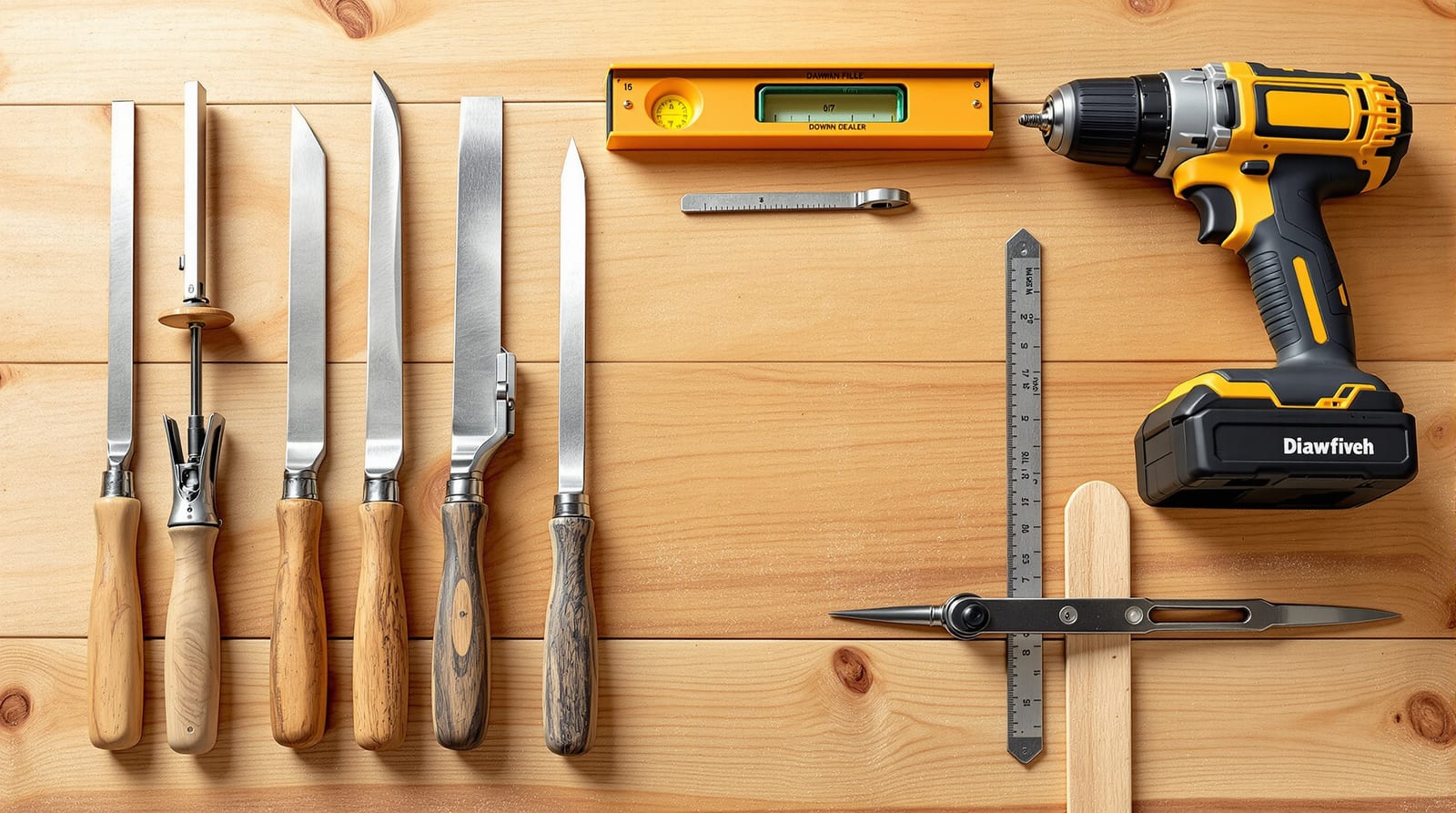
Before the lists, picture the kit. A fitter's tools fall into four working groups — measuring and marking, cutting and shaping, mounting and driving, and the supports that hold the leaf steady while you work. The diagram below shows how a typical pro kit lays out on a site bench or in a roll bag.
Category 1 — Measuring and marking tools
Accurate fitting starts with accurate marking. A door that fails QA almost always failed at the pencil line. The core kit is a quality steel tape, a combination square (also your depth gauge and 45° reference), a sliding bevel for transferring out-of-square reveals, a marking gauge and a mortise gauge for hinge and lock recesses, and a marking knife for a crisp shoulder line that a chisel can register against. Carry a 600 mm and a 1200 mm spirit level — the long one to check the leaf and frame plumb, the short one for hardware. These tools also set your fitting heights: lever centre around 900–1050 mm (≈1000 mm is common), mortise lock keep around 900 mm, door viewer at 1400–1500 mm. The full method is in the door fitting measuring tools guide, and the marking discipline for hardware in marking out door hardware.
Category 2 — Hand tools for cutting and shaping
The hand tools are where craft lives. You need bevel-edge chisels (a 12, 18 and 25 mm set covers most hinge and lock work) and a mortise chisel for chopping deeper recesses; a jack plane to shoot the closing edge to a fine clearance; a block plane for the arris and lippings; and a Surform or rasp for quick stock removal. Sharpen chisels and plane irons to a keen edge — blunt tools crush rather than cut, and on a flush door that means torn veneer that no filler hides. The detailed hand-tool kit, including squares, mallet and bradawl, is in the door fitting hand tools guide, and the broader hanging-specific selection in door hanging tools.
Category 3 — Power tools
Power tools turn a one-hour hinge job into ten minutes — but they punish a careless line tenfold, so they belong in trained hands. The everyday power kit is a cordless drill/driver and impact driver; an electric planer for trimming oversize leaves; a jigsaw for letter-plate and glazing cut-outs; and an oscillating multi-tool for tight corners and trimming architraves in place. Two specialist tools define a pro: a router with a hinge jig/template for repeatable, dead-square hinge recesses, and a lock morticer (a dedicated chain morticer, or a plunge-router-and-jig setup) for clean, accurate lock mortices. On Indian sites, remember that power cuts and dust are real — keep spare batteries charged and tools covered. See the door fitting power tools guide; the jigs get their own deep dives in hinge mortising jig and lock mortising jig.
Drill bits worth owning
| Bit type | Typical size | Use on a door |
|---|---|---|
| Forstner / auger | 22–25 mm | Lock cylinder and tubular latch bores |
| Spade bit | 16–25 mm | Quick rough bores, viewer holes |
| Hinge-sinker / countersink | 3–5 mm | Screw pilots and countersinks |
| Faceplate / step bit | as needed | Spindle and follower holes |
Category 4 — Supports, clamps and consumables
You cannot fit a door well if it moves. A door stand or trestle holds the leaf on edge at working height; a foot-operated door lifter raises a hung leaf for the final hinge-screw or floor-clearance check; sash and F-clamps grip the leaf for planing; and folding wedges and packers set the frame reveal while you fix it. Add a dust sheet, knee pads and a roll bag so the kit travels as one. The door fitting workshop setup guide covers bench, trestles and storage; and because tools only stay accurate if maintained, see door fitting tool maintenance for sharpening and calibration.
Indicative kit costs — basic, mid and pro
As a rule of thumb, three kit tiers cover the Indian market. GST at 18% applies to tools and hardware; prices are indicative 2026 bands and vary by brand and city.
| Kit tier | What it contains | Indicative cost (₹) |
|---|---|---|
| Basic / DIY | Tape, square, 2–3 chisels, mallet, hand plane, screwdrivers, bradawl, basic levels | 3,000–8,000 |
| Mid / improver | Above + cordless drill/driver, jigsaw, spade & Forstner bits, sliding bevel, mortise gauge, clamps | 12,000–25,000 |
| Pro / fitter | Above + router with hinge jig, lock/chain morticer, electric planer, impact driver, door stand, lifter, multi-tool | 25,000–60,000+ |
A professional fitter's productivity — roughly 4–6 simple flush doors a day, fewer for heavy, glazed or fire doors — only holds up with the pro kit. If you are hiring rather than buying, the door fitting cost breakdown explains labour bands. To turn this into a shopping list for your own jobs, run the door fitting tool kit builder; the door fitting time estimator helps you size a job to the kit you own.
Standards, safety and skill level
Good fitting is governed as much by standards as by tools. IS 4021 covers timber door, window and ventilator frames; IS 1003 and IS 2202 cover door shutters; CPWD specifications and IS 1200 govern measurement and workmanship on contracts. Two non-negotiables override convenience: free egress (escape doors must open in the direction of escape and operate one-handed) and, for fire doors, the integrity of the tested fire-door set — never over-bore a cut-out or fit uncertified ironmongery that breaches the fire core. Accessible installations (RPwD Act and the Harmonised Guidelines) require lever handles, not knobs, mounted at a reachable 800–1100 mm. When a job needs a custom morticed lock case, a heavy timber main door, or fire-door compliance, bring in an experienced joiner — the right tools in untrained hands still ruin an expensive leaf. See the door fitting standards guide for the full code map.
Frequently asked questions
What is the minimum tool kit to fit a door in India?
For a single simple flush door you can manage with a tape, combination square, a 12 mm and 25 mm chisel, a mallet, a hand plane, a bradawl, a cordless drill with a Forstner bit, and a couple of clamps — a ₹3,000–8,000 basic kit. Anything heavier, glazed or fire-rated needs the mid or pro tier.
How is this different from a door repair tool kit?
This guide is for hanging and fitting a new door — marking, mortising, planing to clearance and mounting new hardware. A door repair tool kit is built around diagnosis and rectification of an existing door, so it leans on alignment gauges, screw-extraction and patching tools rather than morticers and hinge jigs.
Do I really need a router and hinge jig?
For occasional work, no — a sharp chisel and a steady hand cut a fine hinge recess. But if you fit doors for a living, a hinge mortising jig and router pay for themselves in speed and repeatability, giving dead-square recesses door after door. The same logic applies to a lock mortising jig.
What does a full pro door-fitting kit cost?
As a rule of thumb, ₹25,000–60,000 or more, depending on whether you buy a chain morticer or a plunge-router-and-jig, the planer brand, and how many cordless tools you run. The door fitting tool kit builder gives you an itemised estimate for your own list.
How do I keep my tools accurate on a dusty Indian site?
Keep edge tools keen and rust-free, check squares and levels against a known straight edge periodically, cover power tools and store batteries away from dust and damp, and re-sharpen chisels and plane irons before they tear veneer. The door fitting tool maintenance guide covers sharpening and calibration in full.
Which standards apply to door fitting in India?
IS 4021 (timber frames), IS 1003 and IS 2202 (shutters), NBC 2016 (fire and life safety), CPWD specifications and IS 1200 (measurement and workmanship), and the RPwD Act with the Harmonised Guidelines for accessible lever heights. The door fitting standards guide maps each to the work it governs.
Export this guide
Related Guides — Deep-dive reading
Door Fitting Hand Tools: Chisels, Planes, Gauges (India 2026)
A trade guide to the hand tools every door fitter needs in India — chisels, planes, marking gauges, squares and rasps — how to choose them, why sharp matters, and what they cost.
Home Doors & EntrancesDoor Fitting Power Tools: Pro Buyer's Guide (India 2026)
Cordless drills, planers, routers, jigsaws, multi-tools and the right bits for fast, clean door fitting on Indian sites.
Home Doors & EntrancesDoor Hanging Tools: Stands, Lifters & Jigs India 2026
The specific kit a fitter reaches for to hang a door leaf in India — stand, foot lifter, wedges, planes, chisels, marking tools and clamps.
Home Doors & EntrancesRelated Tools — Try Free
Door Hardware Cost Estimator
Estimate the all-in hardware cost for a door — hinges, lock, handle, closer, bolts, stopper and fitting — with GST.
Door CalculatorWindow Hardware Cost Calculator
Estimate window hardware cost — hinges, handles, locks, rollers and multipoint gears.
Window CalculatorCross-Ventilation Analyzer
Estimate airflow and air changes per hour (ACH) from room size, window areas, layout, and local wind — with NBC 2016 Part 8 compliance check.
Ventilation Calculator