
Door Hinges Guide for Indian Homes: Types, Sizes & Sag-Free Fitting
How to choose, size and count door hinges — from SS butt and ball-bearing to concealed soft-close — so your doors swing true for decades.
The hinge is the most overworked piece of hardware in your house — a 35 kg teak main door swings on three small leaves of steel that you almost never think about, until the door starts to sag, scrape the frame, or shriek every time someone opens it. Get the hinge type, count and material right and the door will swing true for twenty years. Get it wrong and you will be re-hanging it within two monsoons. This guide covers every hinge a homeowner is likely to meet, how to size and count them by leaf weight and height, and why the metal you pick matters far more in Kochi than in Delhi.
This is a component deep-dive that sits under the broader door hardware guide — start there if you want the full picture of locks, handles, closers and bolts together. Here we go deep on hinges alone.
What a hinge actually has to do
A door hinge carries the entire dead weight of the leaf as a cantilever and absorbs the repeated shock of opening, slamming and people leaning on the door. The two failure modes you are designing against are sag (the leaf droops at the latch edge because the hinges or screws have given way) and bind/squeak (the knuckle wears, dries out, or the leaf rubs the frame). The right hinge spec prevents both. Three things drive the choice: the weight of the leaf, the frequency of use, and the environment it lives in.
The main hinge types
Butt hinges (the workhorse)
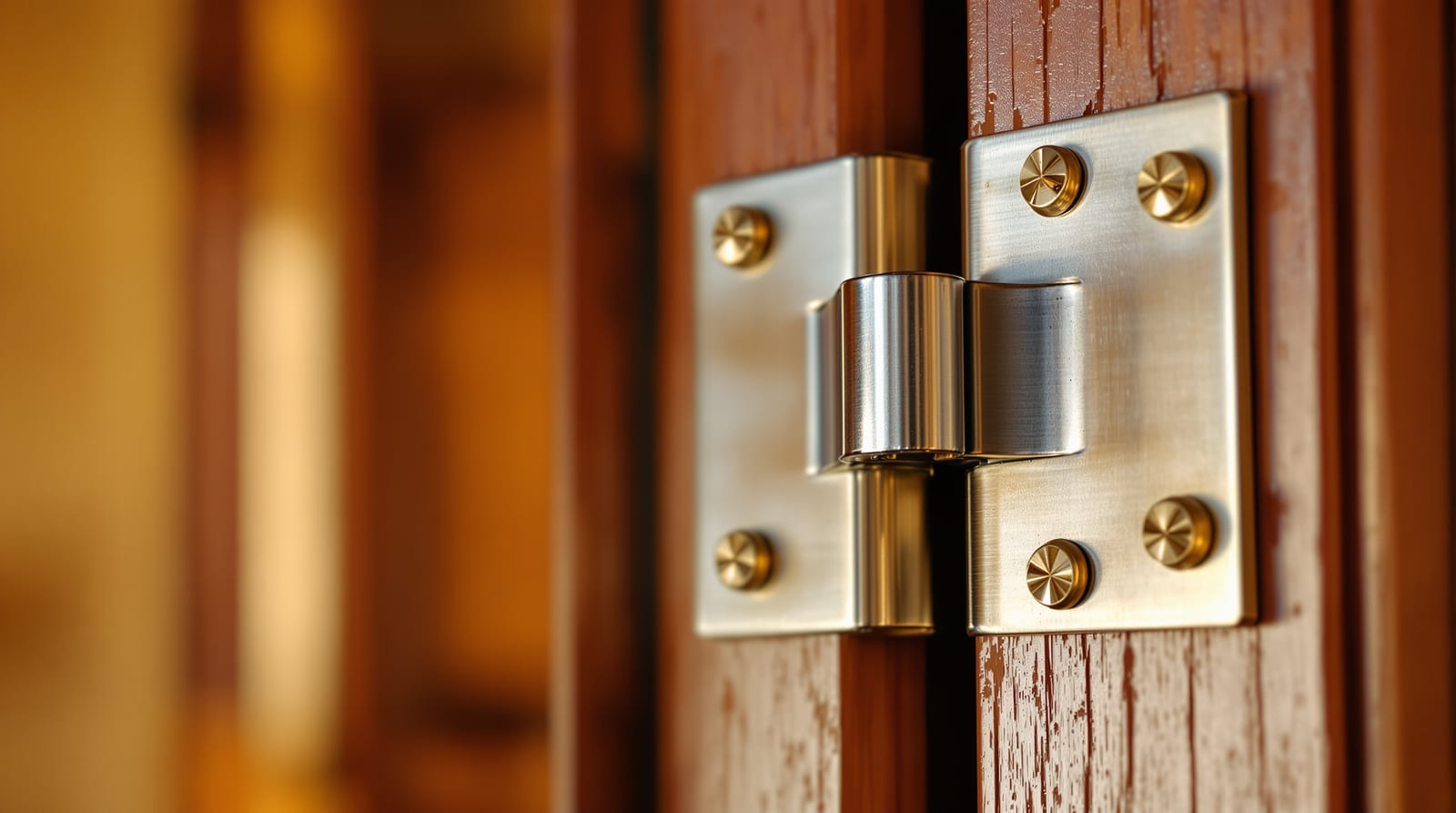
The plain butt hinge — two rectangular plates joined by a knuckle and pin — is what hangs the overwhelming majority of Indian doors. Cheap, repairable, available at every hardware shop. A plain butt hinge has a simple pin and bushing, so for a heavy or high-traffic door the knuckle wears and starts to squeak or sag. Sizes are quoted by leaf length: 100 mm (4"), 125 mm (5") and 150 mm (6") are the common house sizes, with 75 mm for light internal doors.
Ball-bearing hinges (for heavy and busy doors)
A ball-bearing hinge hides small sealed bearings inside the knuckle so the leaf turns on rolling steel, not on metal grinding against metal. This is the single most important upgrade for a heavy main door, a fire-rated door, or any door with a door closer fitted — the closer adds constant load and a plain hinge will wear out fast. Ball-bearing hinges run quieter for longer and are what you should specify for teak main doors and any leaf above ~20 kg. IS 1341 covers steel butt hinges including bearing types.
Concealed / European (cup) hinges
The clip-on cup hinge you see inside every modern wardrobe and kitchen cabinet, and increasingly on flush interior doors for a clean, frameless look. They are fully adjustable in three axes (height, depth, side) with a screwdriver, which makes alignment forgiving — but they need precise boring (35 mm cup) and are not meant for heavy solid main doors. Hettich and Hafele dominate this segment in India.
Soft-close hinges
A concealed hinge with an integrated damper so the door (or shutter) glides shut silently instead of banging. Standard now on better modular kitchens and wardrobes; lovely on a child's bedroom or a pooja-room shutter where you want a quiet close. They cost more and the damper is the part that eventually fails, so buy a known brand.
Pivot hinges
Instead of hinging on the frame edge, a pivot door turns on a point at the top and bottom of the leaf, often set in from the edge. This is what allows the dramatic oversized pivot main doors now popular in Indian luxury homes — see the pivot doors guide for that door type. The pivot itself carries enormous weight; a floor-mounted pivot or floor spring is doing the work, not a row of butt hinges.
Spring hinges
A self-closing hinge with a coiled spring inside the knuckle that pulls the door shut. Common on swing/café doors, some utility and kitchen passage doors, and lighter fire-separation doors where a full closer is overkill. Tension is adjustable. For a heavy main door a proper door closer is the better self-closing solution.
Parliament and flush hinges (special cases)
A parliament hinge has wide projecting leaves shaped like an "H" so the door can swing fully clear of a deep architrave or fold back flat against the wall — useful for shutter-style and wide-opening doors. A flush hinge nests one leaf inside the other so it needs no mortise (chiselled recess) and sits almost flat — handy for light, thin internal doors and quick fits, but not load-rated for heavy leaves.
How to size and count hinges
This is where most fittings go wrong. Two rules drive it: door height sets the count; leaf weight sets the hinge size and type.
Count by height (the standard rule):
| Door height | Hinges | Notes |
|---|---|---|
| Up to ~1500 mm (cabinets, half-doors) | 2 | Light shutters only |
| Up to 2100 mm (standard room/main door) | 3 | The default for almost every Indian door |
| 2100–2400 mm | 4 | Tall main doors, double-height entrances |
| Over 2400 mm | 5 | Oversized leaves |
A standard 2100 mm (7 ft) door — the NBC reference height for Indian doors — takes three hinges, period. Two is a false economy: the leaf twists and sags. The classic placement is one hinge ~150–250 mm from the top, one ~250 mm from the bottom, and the third not in the dead centre but slightly above middle (closer to the top hinge), because the top of the door takes the most pulling load.
Size and type by weight:
| Leaf weight | Hinge size | Type to specify |
|---|---|---|
| Light internal (≤15 kg, hollow flush) | 100 mm (4") | Plain SS or MS butt |
| Medium (15–25 kg, solid flush / WPC) | 125 mm (5") | SS butt, ball-bearing if a closer is fitted |
| Heavy (25–40 kg, solid teak / engineered) | 125–150 mm | Ball-bearing, SS 304 |
| Very heavy / oversized / fire door | 150 mm + extra hinge | Heavy-gauge ball-bearing; or pivot/floor spring |
A heavy teak main door near the top of that range should get three 125–150 mm ball-bearing hinges in SS 304, or move up to four if the leaf is tall. Add an extra hinge before you add tension to existing ones — distributing the load is always better than overloading. And remember the screws matter as much as the hinge: long screws into solid frame timber prevent the most common cause of sag, which is short screws pulling out of the frame.
Inline diagram: 3-hinge placement on a 2100 mm door
Materials: why the metal matters more on the coast
The hinge body metal decides whether your hardware survives the Indian climate. This is the choice people most often get wrong.
| Material | Corrosion resistance | Strength | Cost | Best for |
|---|---|---|---|---|
| Stainless steel 304 | Excellent | High | Mid–high | Default for main doors, bathrooms, coastal homes |
| Stainless steel 202 | Good (cheaper SS) | High | Mid | Budget interior doors inland |
| Mild steel (MS), nickel/zinc plated | Poor once plating wears | High | Low | Dry inland interiors only |
| Brass (solid) | Very good, no red rust | Medium | High | Heritage/teak doors, traditional look |
| Iron (cast/wrought) | Poor, rusts freely | High | Low–mid | Rustic/heritage look, needs paint upkeep |
The rule for India: in coastal Kerala, Konkan, Chennai, Goa and Mumbai, salt-laden air rusts plated MS hinges within a year or two — specify SS 304 or solid brass for anything exposed, and never accept a "steel" hinge that a magnet sticks to strongly (genuine 304 is only weakly magnetic). In dry inland cities a quality SS 202 or well-plated hinge is fine for interior doors, but bathrooms and the main door should still be 304 because of constant humidity and exposure. Brass is the traditional choice on carved teak and heritage doors — see brass-fitted traditional doors and the hardware finishes guide for matching the look across handles and bolts.
Finishes
Beyond raw metal, the visible finish should match your other hardware. Common options: satin/matte SS (most popular, hides scratches), polished/mirror chrome, antique brass and matte black (trending on modern doors), and PVD coatings that bond colour to SS for longer-lasting black, gold or rose-gold. PVD-coated SS 304 is the durable choice if you want a coloured finish on a coastal main door. Always finish-match hinges to handles, bolts and the lock — mixed finishes look like an afterthought.
Why doors squeak or sag — and the hinge's role
Squeak is almost always a dry knuckle: dust and grit get into the pin and the metal grinds. A few drops of light machine oil or a smear of grease on the pin usually silences it; a worn plain hinge that keeps returning should be replaced with ball-bearing. Our fix a squeaky door guide walks through it step by step.
Sag (the door catches on the frame at the latch edge) has three usual causes, in order of likelihood: (1) screws pulled loose in the frame — re-drive with longer screws or fill and re-screw; (2) too few or too small hinges for the leaf weight — add a hinge or upgrade size; (3) a bent or worn hinge. The full repair sequence is in fix a sagging door. The cheapest insurance against ever needing it is correct hinge sizing at fitting time.
What hinges cost in India
Indicative 2026 ranges, per piece, material only (fitting labour and 18% GST extra; prices vary by city and vendor):
| Hinge type | Indicative ₹ per piece | Notes |
|---|---|---|
| SS butt hinge (100–150 mm) | ₹40–250 | Mainstream; 304 costs more than 202 |
| SS/MS ball-bearing hinge | ₹120–400 | Specify for heavy/closer-fitted doors |
| Concealed (cup) hinge | ₹150–400 | Hettich/Hafele higher end |
| Soft-close concealed hinge | ₹250–600 | Damped close; brand matters |
| Solid brass butt hinge | ₹150–600 | Heritage/teak doors |
| Parliament / flush hinge | ₹150–500 | Special applications |
A standard 2100 mm door therefore needs three hinges — budget roughly ₹150–750 for the hinge set on a normal door, more for ball-bearing or brass. Carpenter fitting is usually bundled into the door-hanging labour rather than charged per hinge. For a full door-by-door budget, the door cost calculator lets you add hardware allowances.
Fitting notes that prevent callbacks
- Mortise depth: the hinge leaf should sit flush with the timber, never proud (door binds) or too deep (door won't close fully). A consistent chisel depth on both frame and leaf is the mark of good carpentry.
- Alignment: all hinges must be in a perfectly straight vertical line, or the leaf is twisted and will spring or bind.
- Screws: use the longest screws that fit, and at least one long screw per hinge driven deep into the frame stud — this is the single biggest defence against sag.
- Ball-bearing orientation: fit them the right way up (most are marked) so the bearing carries load correctly.
- Match the swing direction: confirm left- vs right-hand and inward/outward before chiselling — Vastu often wants the main door opening inward and clockwise, and re-cutting mortises is ugly.
Frequently asked questions
How many hinges does a standard Indian door need?
A standard 2100 mm (7 ft) door needs three hinges. Two is enough only for short, light shutters. Doors taller than 2100 mm or very heavy teak leaves should get four. Always size the hinge to the leaf weight as well as fitting the right number.
Which hinge material is best for a coastal home?
SS 304 stainless steel or solid brass. Plated mild-steel hinges rust within a year or two in the salt air of Kerala, Goa, Mumbai or Chennai. A strong magnet sticking firmly to a "stainless" hinge is a warning sign it isn't genuine 304.
What's the difference between a butt hinge and a ball-bearing hinge?
A plain butt hinge turns on a simple pin; a ball-bearing hinge has sealed bearings in the knuckle so it runs smoother, quieter and wears far slower. Specify ball-bearing for heavy main doors, fire doors, and any door fitted with a closer.
My door has started to sag — is it the hinges?
Usually the screws, not the hinges. Sag most often means the screws have pulled loose in the frame; re-drive with longer screws first. If the leaf is too heavy for its hinges, add a hinge or upgrade size. See our fix a sagging door guide.
Are soft-close hinges worth it?
On kitchen and wardrobe shutters and quiet rooms, yes — they stop banging and feel premium. They cost more and the damper can fail over time, so buy a known brand (Hettich, Hafele) rather than the cheapest option. They are not used on heavy solid main doors, which use a door closer instead.
Export this guide
Related Guides — Deep-dive reading
Door Hardware Guide India 2026: Hinges, Handles, Locks, Closers and Every Fitting Explained
What each piece of door hardware actually does, where it belongs, which material (SS304, brass, zinc or iron) survives Indian conditions, the quality signals to check before you pay, and a buyer's checklist with 2026 prices.
Home Doors & EntrancesDoor Hardware Finishes in India: Satin SS, Brass, Matte Black, PVD & Coastal Picks
How to choose handle, lock and hinge finishes that look right, age well and survive Indian humidity and coastal salt air.
Home Doors & EntrancesSwing Doors in India: Double-Action Café Doors, Self-Closing & How to Read Door Handing
Two-way swinging pass-through doors, self-closing AC-room doors, and a plain-English guide to door handing — left/right hand, inswing/outswing — so you order the right swing the first time.
Home Doors & EntrancesRelated Tools — Try Free
Door Cost Calculator
Estimate the all-in cost of a door — leaf, frame, hardware, fitting and GST — by type, material and size.
Door CalculatorModular Kitchen Budget Calculator
Live breakdown by running feet, countertop area, material tier and city — with wastage, design fee, GST.
Kitchen CalculatorWindow Hardware Cost Calculator
Estimate window hardware cost — hinges, handles, locks, rollers and multipoint gears.
Window Calculator