
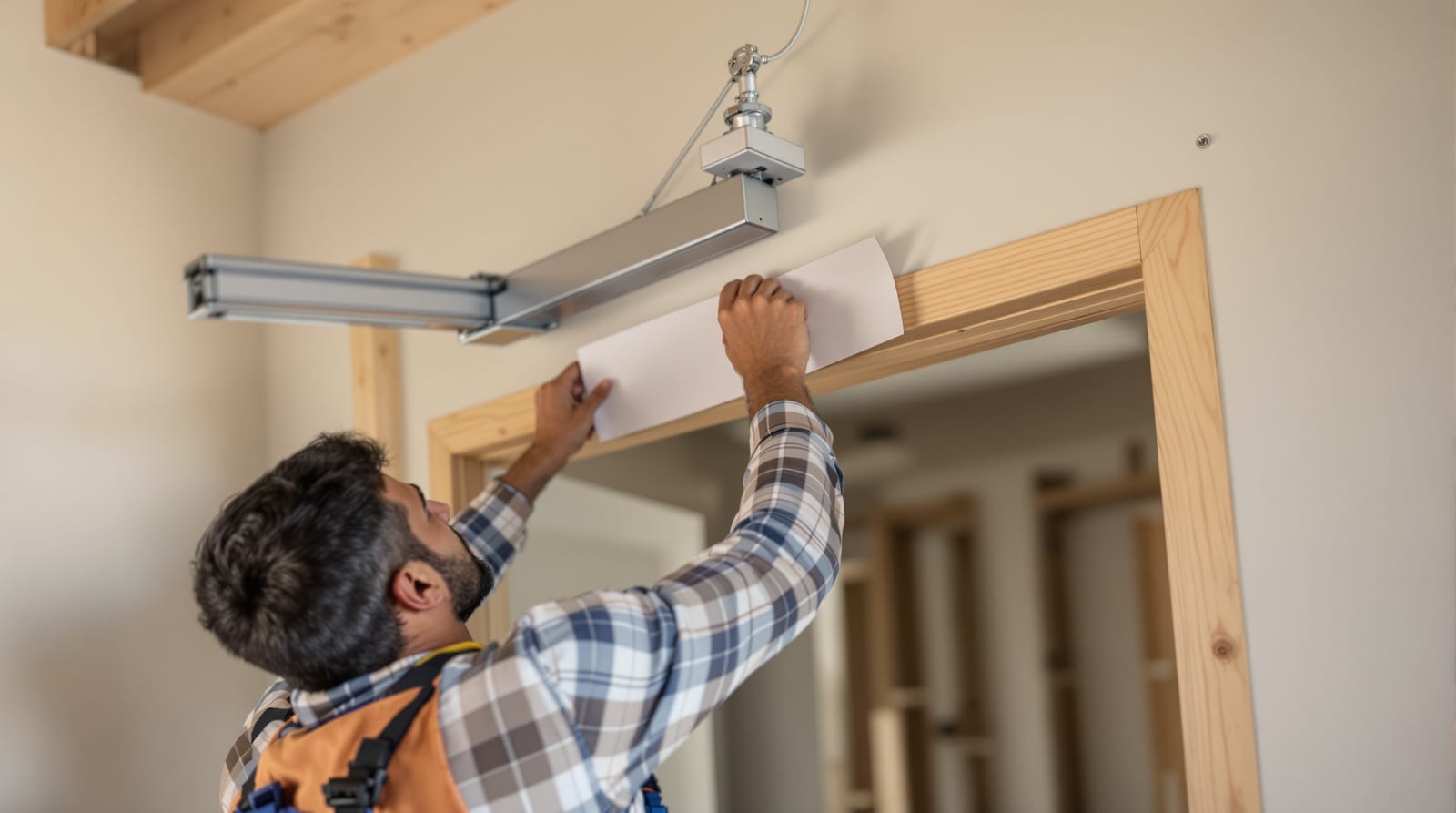
Fitting Door Closers: New Install Guide (India 2026)
Fit an overhead door closer from new — choose the mounting, template and drill the fixings, mount body and arm, set closing and latching speed.
Fitting door closers well is a quiet test of a fitter's craft: get the template position, the arm geometry and the two valve settings right and the door floats shut, latches first time and is comfortable to push open; get them wrong and you have a door that slams, won't latch, self-swings, or is so heavy a child or wheelchair user cannot open it. This guide covers fitting door closers from new on a new leaf — choosing the mounting, marking and drilling the fixings off the template, mounting the body and arm, and dialling in the closing and latching speeds. It is the new-fit craft, not the product comparison in door closers explained, and not a repair: if you are diagnosing a closer that has stopped closing or leaks oil, see the dedicated repair work instead. On any fire door a self-closing device is mandatory under NBC 2016 and the tested door-set — so this is life-safety work, not a convenience fitting.
Choose the mounting before you touch the template
A surface overhead closer can mount three ways, and the choice is dictated by which face is the push side and how the door swings. Decide this first, because the template, the fixings and the closer's measured power all change with it.
Regular (standard) mounting
The closer body is on the pull side of the door (the face the door opens toward you) and the arm projects to the frame on the same side. This is the strongest, most efficient geometry — the arm works at its best angle — and is the default for most internal flush and main doors where the closer can sit on the swing side. It is the first choice for fire doors because it delivers the most reliable self-closing force.
Top-jamb mounting
The body sits on the frame head (the transom/lintel face) and the arm reaches down to the door. Use it when the leaf is too narrow or the rail too shallow to take the body, or when you want the closer off the leaf for appearance. Power is slightly reduced versus regular, so size up if the door is heavy.
Parallel-arm mounting
The body is on the push side of the leaf and the arm runs parallel to the door, anchored to a bracket on the frame soffit. It keeps the arm tucked back out of reach (good for schools, hospitals, public corridors and vandal-prone routes) and is the tidiest look, but it is the least powerful of the three — you lose roughly 15-25% of the rated force, so step up a power size. It needs a parallel-arm bracket, which not every closer ships with.
| Mounting | Body location | Power efficiency | Best for | Watch-out |
|---|---|---|---|---|
| Regular | Pull side of leaf | Highest | Most internal/main, fire doors | Body intrudes on pull face |
| Top-jamb | Frame head | Medium | Narrow rails, off-leaf look | Size up for heavy leaves |
| Parallel-arm | Push side of leaf | Lowest (−15-25%) | Public/corridor, tamper-resistance | Needs PA bracket; size up |
Size the closer to the leaf — power, not guesswork
Closers are graded by power size (the international scale, EN 1154 power sizes 1-7), matched to leaf width and mass. A non-adjustable size-3 closer that suits a 950mm internal flush door will fail to latch a heavy 1100mm main door; an oversize closer makes a light door punishingly hard to open. Use an adjustable-power (size 2-4 or 3-6) closer for site flexibility and to satisfy accessibility.
| Leaf width (max) | Approx. leaf mass | Indicative power size | Typical use |
|---|---|---|---|
| ≤850mm | ≤40kg | 2-3 | Light internal flush |
| ≤950mm | ≤60kg | 3-4 | Standard internal, office |
| ≤1100mm | ≤80kg | 4-5 | Main door, FD30 fire door |
| ≤1250mm | ≤100kg | 5-6 | Heavy/FD60, wide entrance |
As a rule of thumb, a decent adjustable surface closer runs ₹600-2,500, a branded fire-rated/heavy-duty unit ₹2,500-6,000+, and a concealed/floor-spring closer (IS 6315) ₹3,500-12,000+ with the floor box. Add GST 18% on hardware.
Mark and drill off the template
Every closer ships with a paper or card drilling template dimensioned for each mounting (regular, top-jamb, parallel-arm) and often for both handings — read it before you cut anything.
Step sequence
| # | Step | Tool / check |
|---|---|---|
| 1 | Confirm handing and push/pull side; pick the mounting | Template + door schedule |
| 2 | Tape the correct template panel to leaf and frame at the spec height | Template, masking tape, tape measure |
| 3 | Set the body hinge-edge dimension from the template (distance from hinge centre) | Steel rule, combination square |
| 4 | Centre-punch every fixing hole through the template | Centre punch, hammer |
| 5 | Pilot-drill all holes to the screw root diameter | Cordless drill, correct bit |
| 6 | For steel/aluminium frames, drill and tap or use the supplied machine screws/rivnuts | HSS bit, tap or rivnut tool |
| 7 | Mount body, then arm; do not over-tighten until aligned | Screwdriver, level |
Mark the height from the floor consistently — keep the closer body horizontal and the arm geometry square; a body fitted out of level binds the linkage and makes the door snatch. On a flush (hollow-core or honeycomb) leaf, fixings must land in a solid lock-block or top rail — never into the hollow skin; if there is no block, fit a top-jamb mounting onto the frame instead, or specify a leaf with a closer reinforcement. On steel or aluminium frames use machine screws into tapped holes or rivnuts, not wood screws.
Mounting positions and the two speeds
With the body and arm mounted, the closing motion has two stages, each on its own valve. The sweep (closing) speed governs the door from the open position down to about 15° — set it slow and controlled so the door does not slam. The latch speed governs the last 15° to fully closed — give it a brief speed-up so the latch bolt actually throws and the door shuts and latches first time. Adjust each valve in quarter-turn increments, clockwise to slow and anti-clockwise to speed up, testing the full swing after every tweak. Never wind a speed valve fully out — past its stop it will weep hydraulic oil and the closer is ruined. If the unit has backcheck, set it to cushion an over-eager open swing (protects walls and hinges in windy lobbies); if it has delayed action, set the hold-open period for slower-moving traffic — useful at accessible doors and where trolleys pass.
Accessibility and opening force
A closer that latches reliably but is too heavy to open fails the people who most need a self-closing door. The RPwD Act 2016 and the Harmonised Guidelines 2021 require accessible doors to be openable with low force — as a working target keep the opening force at the leaf edge around 20-22N (roughly 2.2-3kg) for internal doors on accessible routes. Reconcile this with fire-door self-closing by using an adjustable-power closer, setting the lowest power that still closes and latches the leaf reliably from any angle, and adding delayed action so a person has time to pass. Lever furniture (not knobs) at 900-1050mm completes the accessible set — see fitting mortise locks for the lock and lever set-out. Where a fire door simply needs more force than the accessible target allows, the answer is usually a lighter-swinging leaf, better hinges or a free-swing/electromagnetic hold-open closer, not winding a standard closer up until nobody can open it.
Fire doors: the self-closer is mandatory
On any fire-rated door-set the self-closing device is not optional. NBC 2016 and IS 3614 require fire/smoke doors on escape and compartment lines to be self-closing and latching, and the closer must be part of the tested door-set (or a CE/fire-rated equivalent compatible with the leaf and frame). Do not fit a domestic friction stay, a spring hinge of unknown rating, or a hold-open without a fail-safe release that lets the door close on alarm. The closer must shut the leaf fully into the frame and throw the latch from every open angle, with the door's intumescent and smoke seals continuous — see fitting intumescent seals and the install-time checks in fire-door installation compliance. Cut-outs for the closer must not breach the leaf core beyond the tested limits, and the "Fire door — keep shut" signage stays on. For ongoing duty see fire-door maintenance and inspection.
Test, snag and hand over
Before you sign the door off: open it to full swing and release — it must close and latch unaided, smoothly, with no slam and no self-swing when nearly shut. Check it from 45° and from just off the latch (the hardest test). Confirm the opening force is within target on accessible doors, the arm and shoe screws are tight, and there is no oil weep at the spindle or valves. Log the closer on the ironmongery schedule and capture any defect on the door snagging guide. This fitting sits within the wider fitting door hardware Act and the cluster complete door guide. To size and set out the device quickly, use the door hardware height calculator, and to confirm a fire leaf meets install-time rules run the fire-door compliance checker.
Frequently asked questions
What is the difference between regular, top-jamb and parallel-arm mounting?
Regular mounting puts the closer body on the pull side of the leaf and is the most powerful, efficient geometry — the default for most doors including fire doors. Top-jamb mounts the body on the frame head with the arm reaching down to the leaf, useful for narrow rails. Parallel-arm mounts the body on the push side with the arm running parallel to the door for a tidy, tamper-resistant look, but it loses roughly 15-25% of rated force, so size up.
How do I set the closing and latching speed?
A hydraulic closer has two separate speed valves. The sweep (closing) valve controls the door from open down to about 15 degrees — set it slow so it does not slam. The latch valve controls the final 15 degrees — give it a brief speed-up so the latch bolt throws and the door shuts first time. Turn each valve a quarter-turn at a time, clockwise to slow, and test the full swing after every change. Never wind a valve fully out, or it will leak oil.
Is a door closer mandatory on a fire door in India?
Yes. NBC 2016 and IS 3614 require fire and smoke doors on escape and compartment lines to be self-closing and latching, and the closer must be part of the tested door-set or a fire-rated equivalent. It must close and latch the leaf fully from any open angle. Any hold-open device must release fail-safe on the fire alarm so the door closes automatically.
How do I fit a surface closer to a hollow-core flush door?
The fixings must land in solid timber — the lock-block, the top rail or a closer reinforcement block — never into the hollow skin, which will tear out. If the leaf has no block where the template wants the body, switch to top-jamb mounting onto the frame head instead, or specify a leaf manufactured with a closer reinforcement. On steel or aluminium frames use machine screws into tapped holes or rivnuts, not wood screws.
How heavy should a door closer be to open, for accessibility?
Under the RPwD Act 2016 and Harmonised Guidelines 2021, accessible doors should open with low force — aim for roughly 20-22N (about 2.2-3kg) at the leaf edge on internal accessible routes. Use an adjustable-power closer set to the lowest power that still closes and latches reliably, add delayed action so people have time to pass, and pair it with lever handles. If a fire door needs more force than this allows, fix the leaf swing or hinges rather than over-powering the closer.
What power size of closer do I need?
Closer power follows leaf width and mass on the EN 1154 size scale (1-7). As a guide, a light internal door up to about 850mm uses size 2-3, a standard 950mm internal or office door size 3-4, a 1100mm main or FD30 fire door size 4-5, and a heavy or FD60 leaf size 5-6. An adjustable-power closer (for example size 3-6) gives site flexibility and helps you meet the accessible opening-force target.
Export this guide
Related Guides — Deep-dive reading
Door Closer Repair: Fix or Replace a Failed Unit India 2026
Loose mount, bent arm or a leaking oil closer? Here is how to diagnose, fix what is fixable and pick the right replacement.
Home Doors & EntrancesDoor Operation Testing at QA: Functional Checks India 2026
The functional tests on a fitted door at handover — smooth swing, first-time latching, lock and key throw, self-closing, one-hand operation and a slam-cycle check, with clear pass criteria.
Home Doors & EntrancesFire-Door Installation Compliance: India 2026 Fitting Guide
Getting a fire door right at fitting — certified set, gaps under 3mm, continuous seals, fire-rated hinges, self-closing and signage to NBC 2016 and IS 3614.
Home Doors & EntrancesRelated Tools — Try Free
Acoustic Privacy (STC) Visualizer
Indian healthcare acoustic visualizer — compare wall assemblies and noise sources, see received SPL after STC attenuation, and check FGI 2018 / IS 1950 / NABH speech-privacy compliance with live dual-canvas waveform.
Acoustic ToolDoor Security Rating Calculator
Score your main door out of 100 across leaf, frame, lock and hardware — and see the top upgrades.
Security ToolFire Door Rating Checker
See the likely fire-door rating (30/60/90/120 min) and components a location needs per IS 3614 / NBC — guidance, confirm with your architect.
Compliance Tool