
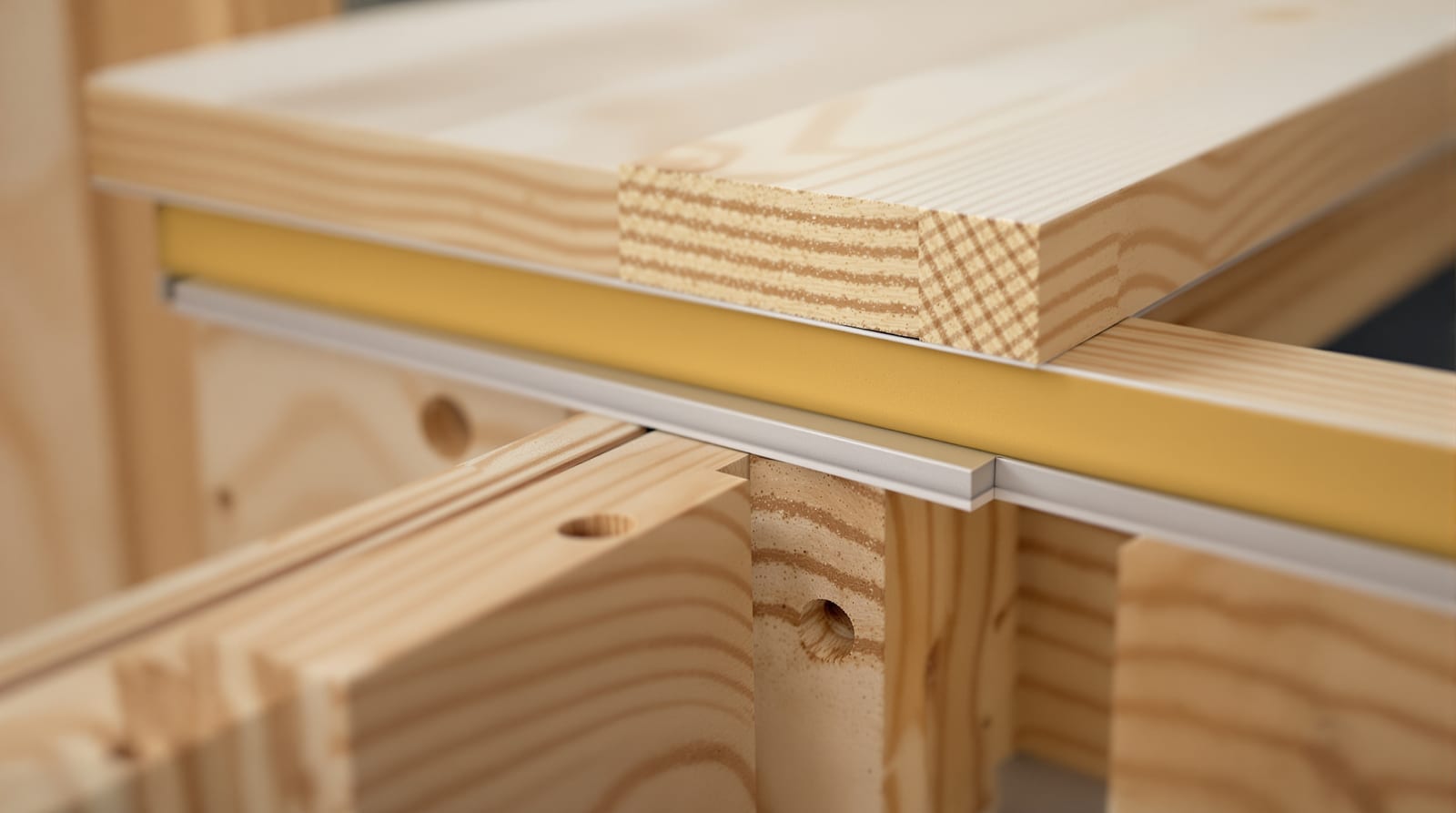
Fitting Intumescent Seals on Fire Doors: India 2026
How to route the rebate groove and fit continuous intumescent and cold-smoke seals on fire doors — why continuity matters, plus combined seals and acoustic drop seals.
Fitting intumescent seals is the part of a fire-door set that most often gets skimped on site — and the part that turns a certified door into a death-trap when it is missed. The leaf, the frame and the hinges can all be perfect, but if the intumescent strip is discontinuous, the wrong size, or never fitted at all, the door will not perform for its rated FD30 or FD60 period and the door-set falls outside its tested specification. Intumescent material is inert at room temperature, then in a fire it expands many times its volume — swelling to choke the gap between leaf and frame so flame and hot gases cannot pass. A separate cold-smoke seal (a brush or flexible fin) handles the early, cool-smoke phase before the intumescent activates. This guide is the fitter's craft of seating those seals correctly. For the wider install-time picture, start with the complete door guide and our deep dive on fire-door installation compliance.
Why the two seals do different jobs
A fire door needs to resist two different threats and the seals are not interchangeable. Intumescent strips answer integrity and insulation — they expand under heat to seal the perimeter once a fire is established (typically activating around 150–200°C). Cold-smoke seals answer life safety in the first minutes: most fire deaths are from smoke inhalation, and smoke moves through cold gaps long before the intumescent has any reason to swell. A brush or fin seal closes those cold gaps continuously while the door is shut. A compliant fire door set under IS 3614 and NBC 2016 almost always needs both — often as a single combined fire-and-smoke seal where the brush or fin is bonded to the intumescent carrier in one strip. Never substitute an ordinary weatherstrip for a tested fire seal; weatherstripping is for draught and acoustics, not for a rated assembly.
Choosing the right seal and size
The seal must match what the door-set was tested with. Read the certification or the original specification before you cut anything — you cannot improvise a fire seal and stay compliant.
| Seal type | What it does | Typical location | Notes |
|---|---|---|---|
| Plain intumescent strip | Expands to seal gap in fire | Groove in frame rebate or leaf edge | Sized to rating (FD30 vs FD60) |
| Combined fire + smoke seal | Intumescent + brush/fin in one | Frame rebate groove | Single-fix, preferred on site |
| Cold-smoke brush seal | Closes cold gaps against smoke | Frame or leaf edge | Brush pile in an aluminium carrier |
| Flexible fin smoke seal | Softer wipe seal against smoke | Frame rebate | Better acoustic + smoke seal |
| Acoustic drop seal | Seals the threshold gap | Mortised into leaf bottom | Spring-loaded, drops on closing |
| Threshold / floor seal | Static bottom seal | Frame sill or floor | Used where a drop seal is not fitted |
As a rule of thumb, an FD30 door commonly uses a 10mm × 4mm intumescent strip and an FD60 a 15mm or 20mm × 4mm strip, sometimes doubled — but always defer to the door-set's tested datasheet rather than this guide. Indicative material cost runs roughly ₹60–180 per running metre for combined fire-and-smoke strip and ₹1,500–3,500 for a good mortised acoustic drop seal. GST on hardware is generally 18%.
Routing the groove
The seal sits in a groove (kerf) routed either into the frame rebate or into the leaf edge — follow whichever the certification specifies; mixing it up can void the rating. Most Indian timber fire-door sets groove the frame rebate, which keeps the leaf core intact and is easier to fit later.
Setting out and cutting
1. Mark the groove line continuously around the head and both jambs of the rebate (or around all four edges of the leaf), keeping it a uniform distance from the door stop.
2. Route the groove to the strip's width and depth — typically a 4mm-deep × strip-width kerf. Use a router with a fence or a fire-seal-groove cutter; a sharp blade prevents the timber from tearing and leaving the strip proud.
3. Mitre or butt the corners so the strip can run continuously round the corner — the corners are where most failures happen.
4. Vacuum the groove clean of dust so the self-adhesive backing actually bonds.
Keep the groove depth correct: too shallow and the strip stands proud and stops the door shutting; too deep and the intumescent cannot bridge the gap when it expands. If you are retrofitting to a door that was never grooved, that is a specialist job — an over-deep or wandering groove can breach the leaf core and ruin the rating. For the order this fits into on a fire-door install, see fire-door installation compliance and the broader setting-out doors discipline.
Fitting the strips: continuity is everything
The single most important rule is continuity — the intumescent and smoke seals must run unbroken around the full perimeter (head and both jambs as a minimum; some sets seal the threshold too). A 20mm gap at a corner is a 20mm hole the fire will find.
Step sequence
1. Peel and press the self-adhesive strip into the cleaned groove, starting at one bottom corner. Most combined strips are self-adhesive; some carriers are stapled or pinned — use only the fixing the maker specifies.
2. Run it continuous round the corners. Butt the head strip tight to each jamb strip with no gap; if you must mitre, mitre cleanly so the two pieces meet flush.
3. Do not break the strip for hinges, the lock keep or the closer keep where the certification keeps it continuous — many tested sets require intumescent hinge pads behind the hinge blades and intumescent around the lock body, not a cut-out in the perimeter strip.
4. Seat the smoke brush/fin so its pile or fin just wipes the leaf when shut — it should close the cold gap without forcing the door or stopping it latching first time.
5. Mortise the acoustic drop seal (if specified) into the bottom of the leaf, set the activation pin against the jamb so the seal drops onto the floor as the door closes and lifts clear as it opens. Test it drops fully and the door still latches.
| Defect | Cause | Consequence | Fix |
|---|---|---|---|
| Gap at a corner | Strip cut short, butt not tight | Breach — fails fire test | Re-run continuous strip |
| Strip proud, door binds | Groove too shallow | Door won't shut/latch | Deepen groove to spec |
| Smoke brush not touching | Pile too short / mis-set | Cold smoke passes | Reset carrier / correct size |
| Wrong strip size | Not matched to FD rating | Under-performs in fire | Replace to tested spec |
| Adhesive lifting | Groove dusty / damp | Strip falls out over time | Clean, re-bond, pin if allowed |
| Drop seal doesn't drop | Pin not engaging jamb | Threshold gap open | Adjust pin / activation length |
Monsoon damp and site dust are the enemies of self-adhesive bonding — fit seals after wet trades, keep grooves dry, and press firmly. Where power cuts stall a router, do not be tempted to chisel a rough groove by hand on a fire door; an uneven kerf leaves the strip proud or loose. For the standalone product context, see fitting door hardware and door seals and weatherstripping.
Inspecting and proving the seal
A fire seal you cannot prove is a seal that does not count. At the gap-inspection stage, confirm the perimeter gap is ≤3mm (4mm maximum) all round and the threshold gap is sealed or within tested limits — our door gap inspection guide details the feeler-gauge method. Then check the seals are continuous, the right size, firmly seated, and that the door still self-closes and latches first time with the seals fitted. Photograph the seals before architraves cover them, and record the seal type against the door reference in the as-built schedule. The fire-door compliance checker walks you through the seal, gap, signage and ironmongery checks for each rated door so nothing is missed at handover; pair it with the door snagging checklist generator for the wider punch-list. For ongoing duty, cross-link the maintenance regime in fire-door installation compliance, and feed the result into door snagging.
Honesty matters here: fitting fire seals to a certified set is well within a skilled carpenter's range, but specifying which seal, or retrofitting seals to a door of unknown provenance, is a fire-engineer's call. When in doubt, get the door-set's test certificate and follow it to the letter — life safety, not finish, is the standard.
Frequently asked questions
Do I really need both an intumescent and a smoke seal?
Usually yes. The intumescent strip only activates in heat, so it does nothing in the smoke-filled first minutes — that is what the cold-smoke brush or fin seal is for. Most rated sets under IS 3614 and NBC 2016 specify a combined fire-and-smoke seal so you fit both in one strip. Always follow the door-set's tested specification.
Where does the groove go — the frame or the leaf?
Wherever the certification says. Many Indian timber fire-door sets groove the frame rebate, which keeps the leaf core intact and is easier to fit. Some are tested with the strip in the leaf edge. Do not swap them, and never route a groove so deep it breaches the leaf core.
Can I cut the seal around hinges and the lock?
No — not where the test keeps it continuous. Many sets require intumescent hinge pads behind the blades and intumescent around the lock body instead, leaving the perimeter strip unbroken. Breaking the strip at a corner or hardware point is the most common cause of fire-door failure.
What size intumescent strip do I need for FD30 or FD60?
As a rule of thumb an FD30 door uses about a 10mm × 4mm strip and an FD60 a 15–20mm × 4mm strip (sometimes doubled) — but the only correct answer is whatever the door-set was tested with. Read the certification datasheet before ordering or cutting.
What is an acoustic drop seal and is it a fire seal?
A drop seal is a spring-loaded seal mortised into the bottom of the leaf that drops onto the floor as the door closes and lifts as it opens, sealing the threshold gap for sound and smoke. It complements, but does not replace, the perimeter intumescent and smoke seals; fit it only if the specification calls for it.
Will the seals stop my door latching first time?
Correctly sized and seated seals should not. If the door binds or won't latch, the groove is too shallow (strip proud) or the brush pile is too long — reset to spec rather than forcing the door, because a door that does not latch first time fails its fire and acceptance checks.
Export this guide
Related Guides — Deep-dive reading
Fire-Door Installation Compliance: India 2026 Fitting Guide
Getting a fire door right at fitting — certified set, gaps under 3mm, continuous seals, fire-rated hinges, self-closing and signage to NBC 2016 and IS 3614.
Home Doors & EntrancesFitting Door Hardware: Ironmongery Install Guide India 2026
The new-fit craft of mounting hinges, locks, levers, closers, bolts, stops and seals onto a door and frame — in the right order, at the right heights.
Home Doors & EntrancesSwing Doors in India: Double-Action Café Doors, Self-Closing & How to Read Door Handing
Two-way swinging pass-through doors, self-closing AC-room doors, and a plain-English guide to door handing — left/right hand, inswing/outswing — so you order the right swing the first time.
Home Doors & EntrancesRelated Tools — Try Free
Fire Door Rating Checker
See the likely fire-door rating (30/60/90/120 min) and components a location needs per IS 3614 / NBC — guidance, confirm with your architect.
Compliance ToolMaterial Schedule Generator
Generate a room-wise finish schedule — walls, floors, ceilings, trim, and joinery by location.
Material ScheduleSnag Checklist
Professional interior snag checklist for handover inspection across 10 work categories.
Snag List