
Lock Mortising Jig: Cut Lock Pockets Fast (India 2026)
How a chain morticer or plunge-router lock jig cuts a clean mortise-lock pocket faster and straighter than hand chisel and drill.
A lock mortising jig is the single tool that turns the slowest part of fitting a mortise lock — chopping a deep, square pocket into the edge of the leaf for the lock case — into a clean two-minute operation. Where a fitter armed with an auger bit and a mortise chisel might take 12-20 minutes per door to drill, chop and pare a pocket that is still slightly ragged, a chain morticer or a plunge-router lock jig produces a true, repeatable mortise of the right width, depth and backset in a fraction of the time. On a project with twenty mortise-lock doors, that difference is a full day of labour. This guide is about the tool and the jig — choosing it, setting it up, and the craft of cutting the pocket. For the full fitting craft (marking the keep, boring the lever/cylinder holes, hanging the strike), read our sibling guide fitting mortise locks.
What a lock mortising jig actually does
A mortise lock (sometimes called a mortice lock) has its lock case buried inside the thickness of the door leaf, with only the forend and faceplate visible on the edge. To fit it you must cut a rectangular pocket — typically 80-160mm tall, 14-16mm wide and 60-90mm deep — into the lock stile. Cut it by hand and the work is honest but slow: bore a row of overlapping holes with a 14-16mm auger or Forstner bit, then square the sides and ends with mortise and bevel-edge chisels, paring until the case slides in snugly. The pocket must be plumb in two planes or the lock binds.
A lock mortising jig removes the freehand error. There are two families in common use on Indian sites:
- Chain morticer (chain mortiser): a powered tool carrying an endless cutting chain, like a tiny chainsaw, that plunges straight down the door edge to cut a deep, dead-square slot in seconds. It is the joinery-shop and high-volume choice. It leaves a flat-bottomed, square-cornered mortise that needs almost no paring.
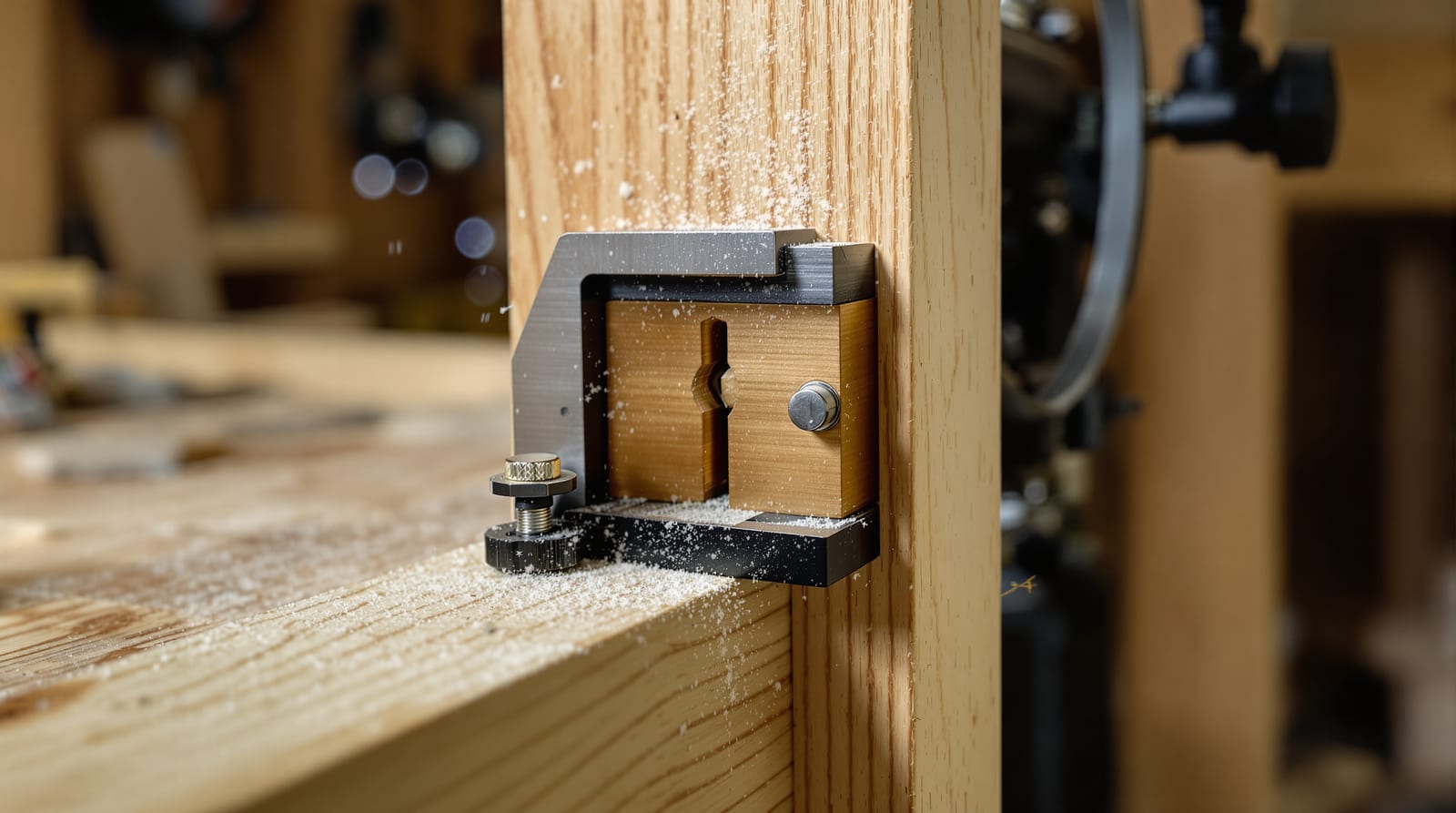
- Plunge-router lock jig: a clamp-on template that guides a plunge router fitted with a straight cutter (commonly 12-16mm) to rout the pocket. The jig sets the width and backset; you control the depth on the router. It is lighter, cheaper and the most common pro setup for site work, leaving rounded corners that you square with a chisel only if the lock forend is square-ended.
Both give you what hand work cannot guarantee at speed: a pocket that is the same on every door.
Tool families and indicative costs (India 2026)
Prices are rules of thumb, before 18% GST, and swing with brand and quality. Buy cutters and a spare chain at the same time.
| Tool / kit | What it is | Indicative ₹ band | Best for |
|---|---|---|---|
| Hand kit: 14-16mm auger bit + mortise chisels | Manual mortising, no power | ₹1,500 - 4,000 | Occasional / one-off doors, no power |
| Plunge-router lock morticer jig (jig only) | Clamp-on template for your router | ₹3,500 - 12,000 | Site fitters who own a router |
| Plunge router (1/4" or 1/2") | Power head for the jig | ₹6,000 - 18,000 | Adds versatility (hinge jigs too) |
| Combined lock + faceplate jig set | Routs case pocket and recesses forend | ₹9,000 - 22,000 | Pros wanting flush faceplates fast |
| Chain morticer (portable) | Dedicated deep-slot cutter | ₹25,000 - 70,000+ | Joinery shops, high-volume batches |
| Mortise lock fitting cutter / morticer bits | Straight cutters, spare chain | ₹600 - 3,000 each | Consumables — keep spares |
A fitter doing four or five mortise-lock doors a week recovers a ₹8,000-15,000 router-and-jig outlay within a month or two of saved labour. A chain morticer only pays back on real volume — a window-and-door joinery, a hotel fit-out, an apartment block.
Setting depth, backset and width
Three settings define a good pocket, and the jig exists to lock them in.
- Backset is the horizontal distance from the door edge to the centre of the spindle/keyhole. Indian mortise locks are commonly 60mm backset, with some at 57mm or 45mm for narrow stiles — always measure the lock you are fitting. The jig's fence or backset adjuster sets the cutter offset from the door edge; set it once and every door matches.
- Depth is how deep the case sits. Cut to the case depth plus 1-2mm clearance so the lock seats without the forend standing proud, but never so deep that you weaken or breach a hollow flush-door core. Set the router's depth stop or the morticer's depth gauge against the actual lock case.
- Width is fixed by the cutter (typically 14-16mm) on a router jig, or by the chain on a morticer. Pick a cutter that matches or is fractionally under the case thickness; widen by a hair with a second pass rather than over-routing.
Mark the lock height first: the mortise-lock keep and spindle centre usually sit so the lever falls at ~900-1050mm from finished floor (≈1000mm is common, and accessible/RPwD practice favours lever handles at 800-1100mm). Set the jig's top and bottom stops to the case length, centred on that height.
Jig vs hand chisel: a straight comparison
| Criterion | Hand chisel + auger | Plunge-router lock jig | Chain morticer |
|---|---|---|---|
| Time per pocket | 12-20 min | 3-6 min | 1-3 min |
| Squareness of sides | Skill-dependent | Excellent (rounded corners) | Excellent (square) |
| Depth/backset repeatability | Variable | Locked by jig | Locked by gauge |
| Veneer tear-out risk | Higher on flush doors | Low (climb-pass) | Low |
| Corners need paring? | n/a | Yes, if square forend | No |
| Upfront cost | ₹1,500-4,000 | ₹10,000-25,000 (with router) | ₹25,000-70,000+ |
| Pays off at | Any volume | ~4-5 doors/week | High-volume batches |
| Noise / dust / power need | Low | Mains/cordless, dust | High, mains, heavy |
The honest verdict: for one or two doors, hand work is fine and needs no investment. For steady site fitting, a router jig is the sweet spot. Reserve a chain morticer for genuine batch joinery.
Step sequence for a clean pocket
1. Read the lock. Measure case length, depth, thickness and backset off the actual lock — never assume.
2. Mark the height on the leaf (≈1000mm lever centre) and the case length on the edge.
3. Clamp the jig central on the door edge; set the backset fence and the top/bottom stops to the case.
4. Set the depth stop to case depth + 1-2mm; on flush doors confirm the core is solid where you cut.
5. Cut in passes — a router likes 2-3 shallow plunges rather than one deep grab; keep a firm down-pressure to avoid lifting.
6. Square the corners with a sharp chisel if the lock forend is square; skip if it is radiused.
7. Recess the faceplate flush with a faceplate jig or a router/chisel so the forend sits dead level with the edge.
8. Dry-fit the case, mark and bore the spindle and cylinder/keyhole holes, then fix.
Keep cutters and chains keen — a blunt cutter burns the timber and tears flush-door veneer, the same way a blunt chisel does. Sharpen or replace before forcing.
Batch work, fire doors and site realities
The jig's real value is batch consistency. Set it once for a door type and run every identical leaf without re-marking — ideal for an apartment block or hotel where dozens of doors share the same lock and height. A door schedule and ironmongery schedule keep you honest about which leaf gets which lock; see setting out doors for the discipline of marking out across a project.
A caution on fire doors: a certified fire-door set is tested as a whole, and an oversize or mis-placed lock cut-out can breach the intumescent-protected core and void the rating. Cut only to the tested lock's dimensions, keep within the manufacturer's mortise limits, and pack the cut-out with intumescent where specified. Treat fire-rated and FD30/FD60 leaves as compliance-critical work — confirm against IS 3614 and the door's certification, and read fire-door installation compliance before you cut. Mortise lock fitting workmanship is governed in spirit by IS 2202 (wooden flush doors) and CPWD/IS 1200 measurement and workmanship on contracts.
India site realities apply: power cuts stall a mains router (a cordless router or an inverter helps), dust from MDF cores needs a mask and extraction, and monsoon damp swells leaves — fit after wet trades are dry and the leaf has acclimatised. On mixed-skill crews, let one trained hand own the jig and cut all pockets while others hang and case the leaves.
Where this sits in your toolkit
The lock morticer is one of three jigs that define a pro door-fitting kit, alongside the hinge jig and the boring/lever template. Pair it with the right power and hand tools from door fitting power tools and door fitting hand tools, and budget it within the wider door fitting tools guide. For the cluster overview, see the complete door guide, and to scope your full kit and labour use the door fitting tool kit builder and the door fitting time estimator.
Frequently asked questions
Do I need a chain morticer or is a router jig enough?
For almost all site fitting, a plunge-router lock jig is enough — it sets backset, depth and width repeatably and costs a fraction of a chain morticer. Reserve a chain morticer for genuine high-volume joinery, where its dead-square, no-paring pockets and speed pay back.
What backset should I set the jig to?
Measure the actual lock. Indian mortise locks are most often 60mm backset, with 57mm and 45mm also common for narrower stiles. Set the jig fence to that measured backset and every door will match — never assume a standard.
Will a router jig damage a flush or fire door?
Not if you respect the core. On hollow flush doors, cut only where the lock block is solid; on fire doors, stay within the tested lock's dimensions so you do not breach the intumescent-protected core and void the rating. Check IS 3614 and the certification, and see fire-door installation compliance.
How much faster is a jig than hand chiselling?
As a rule of thumb, a router jig cuts a pocket in 3-6 minutes versus 12-20 minutes by hand, and a chain morticer in 1-3 minutes. Across twenty mortise-lock doors that is a full day of labour saved, which is how the tool pays for itself.
Do the rounded corners from a router matter?
Only if the lock forend is square-ended — then you square the four corners with a sharp chisel, a one-minute job. Many modern lock forends are radiused to match the routed pocket, in which case no paring is needed at all.
How does this differ from the full lock-fitting guide?
This guide covers the tool and jig that cut the case pocket. The complete craft — marking the keep, boring spindle and cylinder holes, fitting the strike and testing the throw — is covered in fitting mortise locks, with the lock product itself explained in mortise locks.
Export this guide
Related Guides — Deep-dive reading
Door Fitting Hand Tools: Chisels, Planes, Gauges (India 2026)
A trade guide to the hand tools every door fitter needs in India — chisels, planes, marking gauges, squares and rasps — how to choose them, why sharp matters, and what they cost.
Home Doors & EntrancesFitting Mortise Locks: New-Fit Craft Guide India 2026
The on-site craft of fitting a mortise lock to a new door — marking, mortising the pocket, boring cylinder and handle holes, and testing the throw.
Home Doors & EntrancesDoor Fitting Tools Guide: The Fitter's Kit (India 2026)
Every hand tool, power tool, jig and support an Indian carpenter needs to hang and fit doors — organised by category, with indicative kit costs.
Home Doors & EntrancesRelated Tools — Try Free
Before vs After — Cost Reality Check
Compare what you expected to pay vs what you actually paid, category by category.
Reality CheckAccess-Control Schedule Generator
Build the time schedules that decide when each access group can enter — an editable list for your integrator.
Time SchedulesAccessibility Compliance Calculator
Check a planned lift against the CPWD and RPwD accessible-lift benchmarks for a score.
Lift Checker