
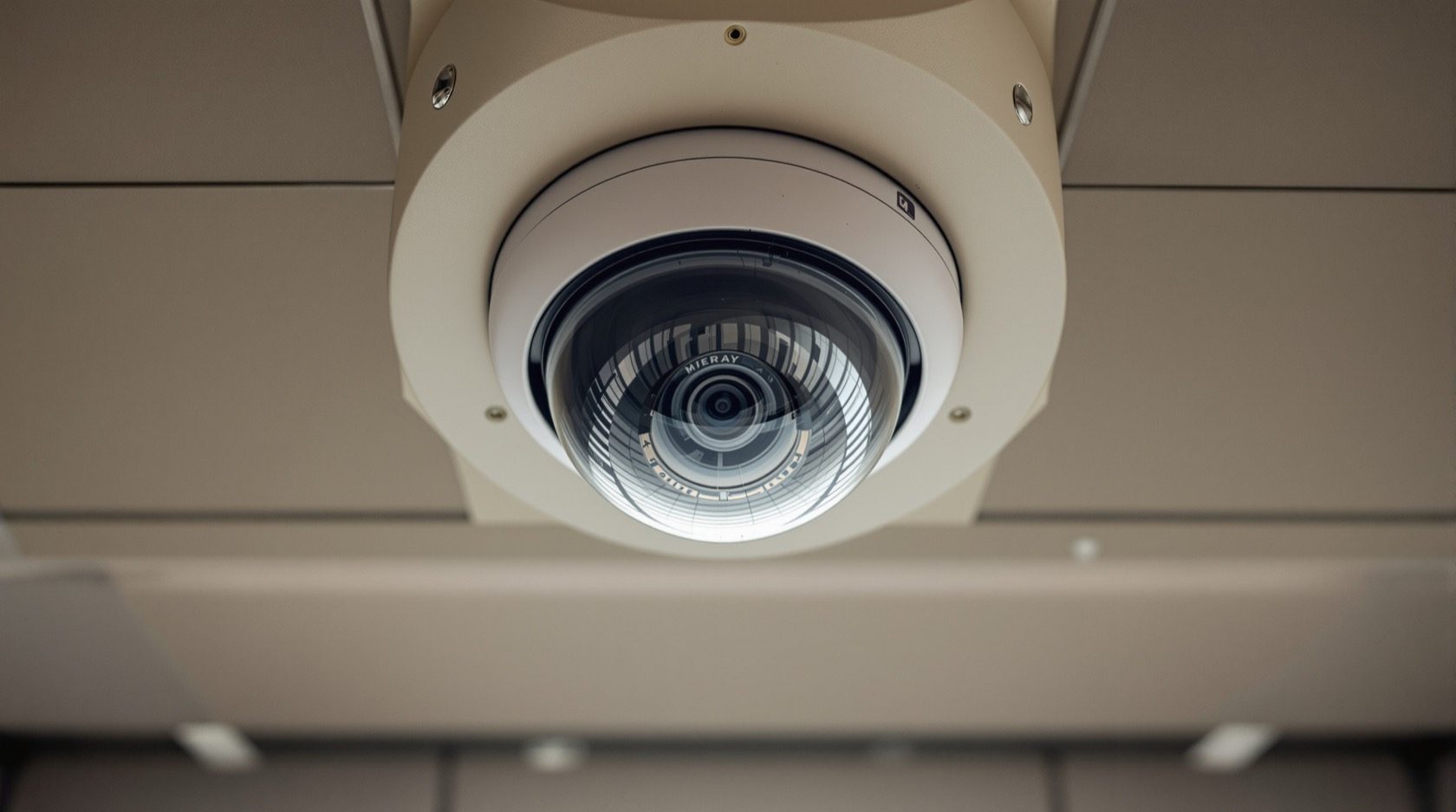
Fisheye CCTV Cameras in India: One Ceiling Dome for a Whole Room
How a single ultra-wide fisheye lens plus software dewarping covers an entire room with no blind corners, why detail thins out with distance, and how it compares to several fixed cameras or a panoramic multi-sensor.
Point one small dome at the centre of a ceiling and let it watch the whole room at once — no arm to aim, no corner left dark. That is the promise of a fisheye CCTV camera: a single ultra-wide lens, up to 180 degrees on a wall or a full 360 degrees on a ceiling, that swallows an entire room in one circular frame. Software then straightens that fish-bowl image into normal-looking views you can actually watch.
This guide is the focused explainer on the fisheye form factor in Studio Matrx's CCTV hub. It is not about recording or networks — for that, read how CCTV systems work and the complete guide to CCTV systems first. Here we answer one practical question: when does one fisheye do the job of several cameras, and when does it not?
Scope & safety. This guide helps you choose and coordinate. The housing and lens type is a decision you can make; the mounting, working at height, mains power and cabling are a licensed installer's job. A camera must never be positioned to cover a bathroom, bedroom or changing area, and must never block a door, window or fire-escape route. Cover only your own property and shared areas, respecting neighbours, staff and the Digital Personal Data Protection Act, 2023.
What a fisheye camera actually is
A fisheye camera is a single image sensor sitting behind one extreme wide-angle lens, packaged in a low ceiling dome that looks much like an ordinary dome camera. The difference is entirely in the lens and the software. That very short, very curved lens bends light from almost every direction onto one sensor, so a ceiling-mounted unit sees the whole floor beneath it in a full circle — the classic round, bulging fisheye image.
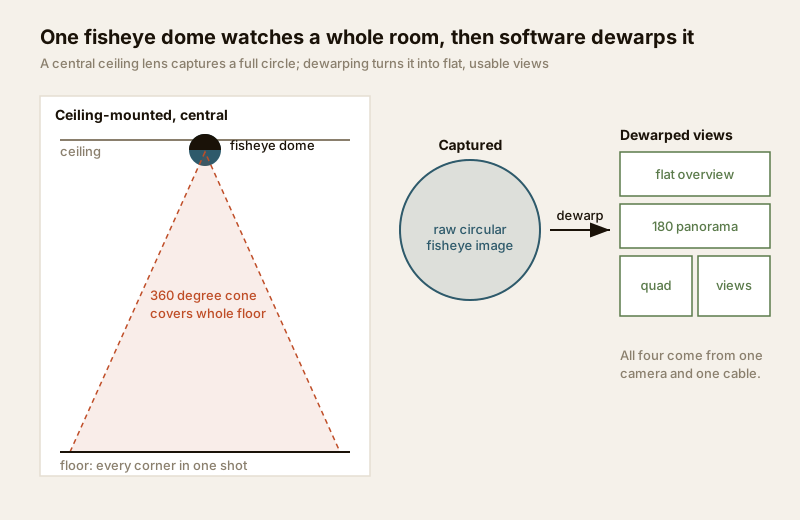
That raw circle is unnatural to watch, so the camera or recorder runs dewarping — software that flattens the curved image and straightens the lines. From one fisheye stream a good system can serve several virtual views at once: a flat overview, a 180-degree panorama strip, or two-to-four separate "quad" windows, each looking like its own normal camera. You can even pan and zoom around inside the recorded circle after the fact, because the whole room was captured — nothing outside the lens was ever cropped away.
Fisheye cameras are almost always IP (network) cameras, because dewarping and multiple virtual views need the flexibility of a digital stream; see the IP CCTV guide for the system-type side of that. The shape is a ceiling dome by nature — it must sit high and central to see the whole room.
Strengths of the fisheye form factor
The fisheye earns its place wherever one overhead view of a whole room is worth more than several partial ones.
- One camera, no blind corners. Mounted centrally on a ceiling, a 360-degree fisheye sees every corner of the room at once. There is no "dead" wedge behind a fixed camera's shoulder — a real advantage in a square shop floor, an open office or a reception.
- Unobtrusive single dome. Instead of three or four cameras bristling from the walls, there is one neat dome in the ceiling. It reads as a light fitting, not a security installation — welcome in a boutique, a clinic or a home living room.
- Cheaper, simpler cabling. One camera means one cable run, one PoE port, one recorder channel instead of several. In a room that would otherwise need three fixed cameras, the saving on cable, labour and recorder licences is real.
- Watch the past as well as the present. Because the entire room is recorded, an operator can pan and zoom into the recording later to check a spot nobody was watching live — the moment was captured even if no camera was pointed at it.
- Fewer failure points. One unit to power, mount and maintain rather than several.
Limitations to plan around
Every form factor trades something. The fisheye trades detail at distance for that total coverage.
- Megapixels spread thin. A fisheye packs the whole room into one sensor, so those pixels are shared across a huge field. Up close under the camera the image is sharp; the further a person is from the centre, the fewer pixels land on their face. A fisheye is superb for overview and movement — who was where, when — but weak for identifying a stranger across a large hall. For that you still want a fixed camera pointed at the door.
- Edge distortion. Even after dewarping, the outer ring of the image stretches and warps. People at the far edge of a big room look smeared or leaning. Dewarping tames it but cannot fully undo the physics of an ultra-wide lens.
- Height and mounting are critical. A fisheye only works well mounted centrally and reasonably high on a ceiling, looking straight down. Too low, off to one side, or on a tall double-height ceiling and its usefulness collapses. Ceiling height and room shape decide whether it fits at all.
- Needs dewarping support. The recorder or viewing app must support that camera's dewarping, or you are left watching a raw fish-bowl. Check compatibility before you buy.
- Not for long, narrow runs. A corridor or a boundary wall is the wrong shape for a fisheye — a bullet down the length does far better.
When to bring in a professional. You can decide the camera type, count and rough positions yourself using this guide. Hand the ceiling mounting, working at height, cable pulling, mains power and PoE, plus configuring the dewarping and virtual views to a licensed installer. Getting a fisheye centred at the right height, and setting its dewarped views so they actually cover the room, is a skill — a good installer shows you the live views before they leave. Any work at the electrical board is a licensed electrician's job; see the electrical hub.
Fisheye camera: pros, cons and best-fit
| Aspect | What you get | Watch-out | Best fit |
|---|---|---|---|
| Coverage | Whole room, no blind corners | Only from a central overhead spot | Square rooms, open floors |
| Detail | Sharp directly below | Faces thin out with distance | Overview, not long-range ID |
| Look | One discreet ceiling dome | Must sit high and central | Reception, boutique, office |
| Cabling | One run, one channel | Needs dewarping-capable recorder | Retrofits, tidy installs |
| Review | Pan/zoom into the recording later | Edge of frame distorts | Incident review over a room |
| Room shape | Excellent for square/open | Poor for long corridors | Rooms, not runs or boundaries |
How dewarping turns a circle into usable views
The circular image is the fisheye's whole trick, and dewarping is what makes it watchable. Understanding the modes helps you brief an installer.
- Overview (raw or lightly corrected) — the full circle, useful for spotting movement anywhere at a glance.
- Panorama — the circle unrolled into one or two wide horizontal strips, like a 180-degree or 360-degree ribbon of the room.
- Quad view — the software carves the circle into four separate windows, each behaving like its own fixed camera pointed at a quarter of the room.
- e-PTZ (electronic pan-tilt-zoom) — you drag and zoom around inside the image with a mouse. Nothing physically moves; you are just choosing which part of the captured circle to enlarge. It looks like a PTZ camera but has no motor and cannot see anything the lens did not already capture.
The key point: all of these come from one stream, and all of them are limited by the same shared pool of pixels. Zoom in too far on a distant corner and you hit the wall of missing detail.
Why detail drops off with distance
This is the single most important thing to understand before buying a fisheye, so it is worth a picture.
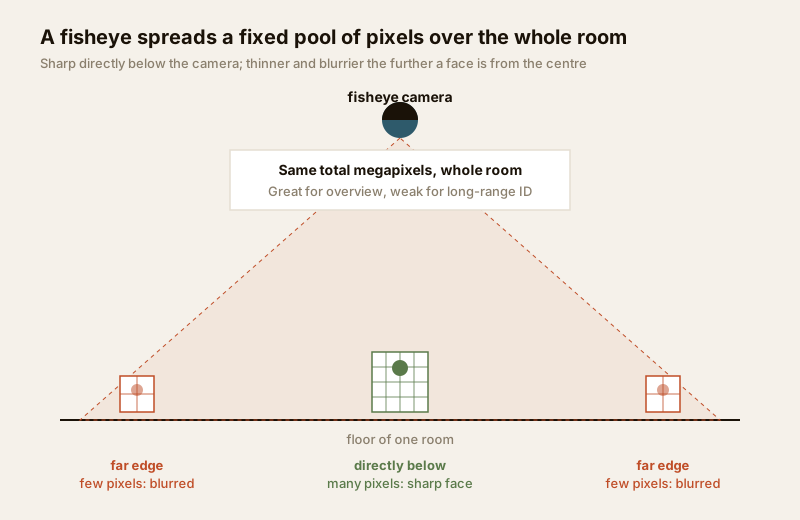
A fixed camera aimed at a doorway concentrates all its pixels on that one doorway, so a face there is crisp even from across a hall. A fisheye spends the same total pixels on the entire room. Divide a fixed number of megapixels across a whole floor and each square metre — each face — gets a small share. Directly under the camera that share is generous; at the far wall it is meagre.
So the honest rule is: use a fisheye to see what happened and where, not to identify a stranger at range. If you need a recognisable face at a specific point — a till, an entrance, a gate — put a dedicated fixed camera there and let the fisheye handle the room overview. The lens field-of-view calculator and the camera coverage calculator help you reason about how many pixels reach a given distance.
Where a fisheye fits best
A fisheye rewards being placed where its strengths line up: a single, roughly square room seen from a central overhead point.
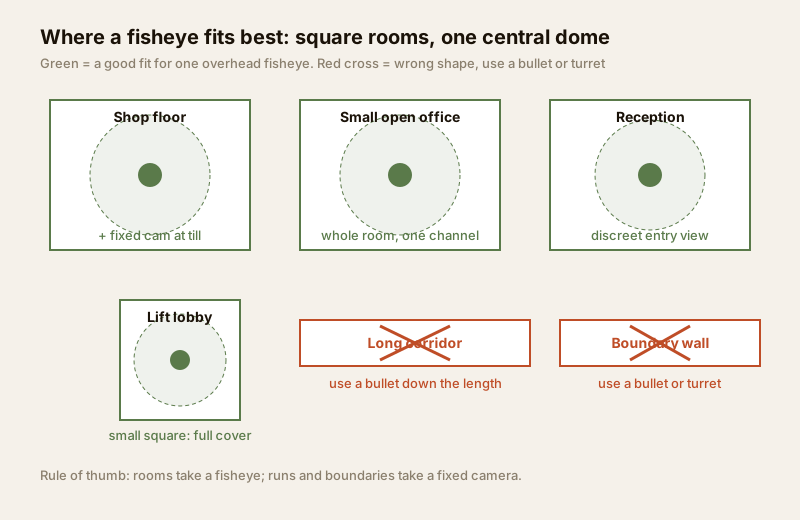
- Shop floor — one dome over an open retail area watches every aisle, with a fixed camera added at the till for face detail.
- Small office or open-plan room — the whole workspace on one channel, tidy and unobtrusive.
- Reception and waiting areas — a discreet ceiling dome sees who comes and goes across the whole hall.
- Lift lobby — a small, roughly square space a single overhead fisheye covers completely.
- A living room or common room — one camera instead of several, for a general overview of a shared space.
Where a fisheye is the wrong shape: long corridors, staircases, compound walls and driveways. Those are runs and boundaries, not rooms — a bullet or turret suits them far better. Match this to your setting in the indoor CCTV, residential and commercial CCTV guides, or let the camera type selector walk you through each spot.
Fisheye vs several fixed cameras vs a panoramic multi-sensor
The fisheye is one of three ways to cover a wide area. Each has a natural home.
- Several fixed cameras — three or four ordinary dome or bullet cameras around a room. More detail at each point (each camera concentrates its pixels), but more cabling, more channels, more cost, and small blind wedges between them.
- One fisheye — a single ceiling dome for the whole room. Cheapest and tidiest, no blind corners, but detail thins with distance.
- A panoramic multi-sensor — a single housing holding several sensors and lenses aimed at different angles, stitched into one very wide, high-detail image. It keeps detail across a large area far better than a fisheye, at a higher price. When one fisheye is not sharp enough but you still want one unit, this is the step up — see the dedicated panoramic CCTV guide.
Quick comparison
| Factor | Fisheye | Several fixed | Panoramic multi-sensor |
|---|---|---|---|
| Cameras / cables | One | Three to four | One (multiple sensors inside) |
| Blind corners | None (central) | Small wedges between | None |
| Detail at range | Thins with distance | Strong at each point | Strong across the width |
| Best area shape | Square room | Any, if planned | Wide open area |
| Install effort | Lowest | Highest | Low (one mount) |
| Typical price (India) | ₹4,000 – ₹15,000 | ₹6,000 – ₹24,000 (set) | ₹18,000 – ₹60,000+ |
If a room needs both a whole-room overview and a sharp face at the door, a common Indian setup is one fisheye for the room plus one fixed camera at the entrance — often cheaper than four fixed cameras and better than a fisheye alone.
India price bands and buying notes
Prices move with brand, resolution and season; treat these as ballparks to sanity-check a quote, not fixed rates.
| Item | Typical range (₹) | Notes |
|---|---|---|
| 5MP indoor fisheye (IP) | ₹4,000 – ₹8,000 | Small rooms, lobbies, plenty of light |
| 6–8MP fisheye (IP / PoE) | ₹7,000 – ₹15,000 | Shop floors, offices; the workhorse |
| 12MP+ premium fisheye | ₹15,000 – ₹30,000 | Larger halls, better edge detail |
| Vandal / outdoor-rated fisheye | ₹10,000 – ₹22,000 | Covered atriums, sheltered entrances |
| Panoramic multi-sensor (step up) | ₹18,000 – ₹60,000+ | When one fisheye is not sharp enough |
| Professional install / camera | ₹700 – ₹2,000 | Central mount, cabling, dewarp setup, test |
When buying, favour a higher resolution than you think you need — those megapixels are shared across the whole room, so more is better. Confirm your recorder or app supports that camera's dewarping, check the ceiling height suits a central mount, and for network cameras follow the usual IP CCTV hygiene — change default passwords and keep firmware updated. Price a whole layout with the security system cost estimator, and see smart and AI-powered CCTV for the analytics that pair well with a whole-room view.
Key takeaways
- A fisheye camera is one ceiling dome with an ultra-wide 180-to-360-degree lens that captures a whole room in a single circular image, which software dewarps into flat, panorama or quad views.
- Its strengths are total coverage with no blind corners, one discreet dome, simpler cabling and the ability to pan/zoom into the recording later — ideal over shop floors, offices, receptions and lift lobbies.
- Its main weakness is that megapixels spread thin, so detail and faces drop off with distance; a fisheye is for overview, not for identifying a stranger across a large hall, and it needs a central, high ceiling mount.
- For a sharp face at a specific point, add a dedicated fixed camera there; for a large area that needs detail across its width, step up to a panoramic multi-sensor.
- It is the wrong shape for corridors and boundaries — use a bullet or turret there; the camera type selector helps you decide.
- Choose the camera yourself; leave central mounting, height work, cabling, mains power and dewarp configuration to a licensed professional.
References
- Digital Personal Data Protection Act, 2023 — position cameras to cover only your own property and shared areas with a legitimate purpose; never bathrooms, bedrooms or changing areas, and avoid capturing neighbours' private spaces.
- IEC 60529 (IP ingress rating) and IEC 62262 (IK impact rating) — the internationally recognised marks for a camera's weather sealing and vandal resistance; verify a product's stated ratings on its datasheet.
- National Building Code of India (SP 7), Bureau of Indian Standards, and local municipal bye-laws for any structural, electrical or life-safety aspect of an install; verify the current edition via the BIS catalogue: https://www.services.bis.gov.in/
This is an educational overview. Mounting, working at height, structured cabling and any electrical work are qualified professional tasks — engage licensed installers and verify any standard's current status via the BIS catalogue before relying on it.
Export this guide
Related Guides — Deep-dive reading
How to Choose a CCTV Camera (2026): The Homeowner's Decision Guide for India
Cut through the spec-sheet noise and choose the right CCTV camera for each spot around an Indian home. What actually matters — sensor and low-light performance, lens and field of view, form factor, IP and IK ratings, honest smart features — and the marketing claims to ignore.
SecurityPanoramic CCTV Cameras in India: Multi-Sensor Wide Views That Keep the Detail
How a multi-sensor panoramic stitches several lenses into one very wide, high-detail image, why that beats a single fisheye for large open areas, its cost and storage trade-offs, and where it fits against fisheye, bullet and PTZ.
SecurityFixed vs PTZ Camera in India (2026): Which One Actually Guards Your Home?
The tempting choice between several plain fixed cameras and one motorised pan-tilt-zoom that can swivel and zoom in. What each really does, how they compare on coverage, cost, detail, reliability and who operates them — and the honest verdict on why a home is almost always better served by fixed.
SecurityRelated Tools — Try Free
CCTV Camera Type Selector
Answer five questions and get the right camera form factor — dome, vandal dome, bullet, turret or PTZ — with reasons.
Camera SelectorCCTV Camera Coverage & Count Calculator
Estimate how many CCTV cameras you need, the NVR channels, storage in TB for your retention period, and an indicative all-in cost with GST.
CCTV CalculatorCCTV Resolution Selector
The camera resolution (MP) a scene needs for identify, recognise or detect, using DORI pixel density.
Resolution