
Panoramic CCTV Cameras in India: Multi-Sensor Wide Views That Keep the Detail
How a multi-sensor panoramic stitches several lenses into one very wide, high-detail image, why that beats a single fisheye for large open areas, its cost and storage trade-offs, and where it fits against fisheye, bullet and PTZ.
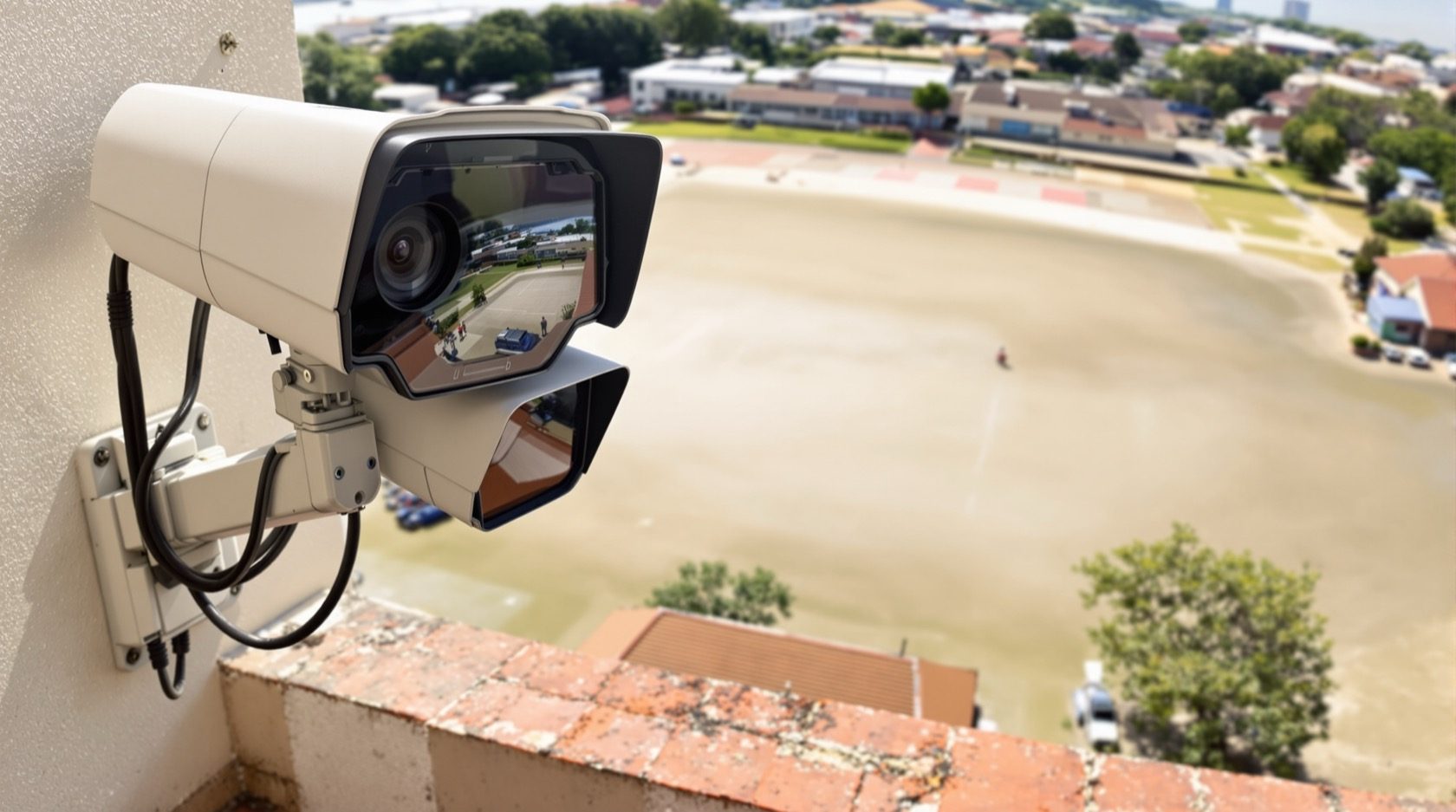
Stand at the edge of a mall car park, a wide apartment forecourt or a factory yard and count the camera poles. On many sites there are four or five, each watching one slice, each with its own cable run and its own blind spot at the joins. A panoramic camera is the answer to that mess: one unit, mounted once, that covers the whole wide scene in a single seamless image while keeping the detail sharp from edge to edge.
This is a focused explainer on the panoramic (multi-sensor) form factor in Studio Matrx's CCTV hub. It sits beside the fisheye guide, and the two are easy to confuse, so this guide draws the line clearly. For how recording, networks and storage work underneath, read how CCTV systems work and the complete guide to CCTV systems first.
Scope & safety. This guide helps you choose and coordinate. You can decide the camera type, the count and rough positions. The mounting, working at height, mains power and structured cabling are a licensed installer's job — and a panoramic on a tall pole or a high facade is almost always height work. A camera must never cover a bathroom, bedroom or changing area, and must never block a door, window or fire-escape route. Cover only your own property and shared areas, respecting neighbours, staff and the Digital Personal Data Protection Act, 2023.
What a panoramic (multi-sensor) camera actually is
A panoramic camera — the industry also calls it a multi-sensor or multi-imager camera — packs several separate lens-and-sensor pairs into one housing. A common build has three or four sensors, each pointed at a different part of the scene, each capturing its own full-resolution slice. The camera then stitches those slices together in software into one very wide picture, typically 180 degrees along a wall, or a full 360 degrees from a ceiling.
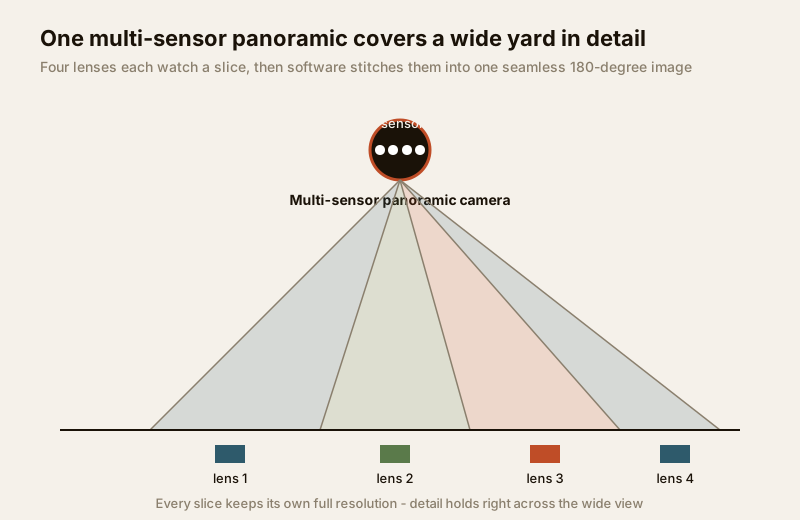
The key idea is in that word separate. Because each part of the wide view has its own sensor working at full resolution, the detail does not thin out as you look toward the edges. A 180-degree panoramic built from four 4MP sensors is effectively a 16MP wide image, sharp all the way across. That is a fundamentally different thing from a single fisheye lens trying to spread one sensor over the same width.
Panoramics come as IP (network) cameras, usually PoE, because the data they produce is far too much for old analogue cabling. The shape is a decision on top of the system type; for that groundwork see the IP CCTV guide.
How a panoramic differs from a single fisheye
This is the question that sends people to this guide, so let us settle it plainly. Both give you a very wide view from one camera. The difference is how they get there.
- A fisheye uses one sensor behind one ultra-wide lens. It sees a huge area — a whole room or a full 360 degrees from a ceiling — but that single sensor's pixels are spread thin across the whole width. The centre, right below the camera, is fine; the edges and anything at a distance go soft. Faces across a large room or number plates at the far side of a yard are often unreadable.
- A panoramic (multi-sensor) uses several sensors, each covering a slice at full resolution. Stitched together, you get the same wide coverage but with detail preserved across the entire view — you can identify a face or a plate near the edges, not just in the middle.
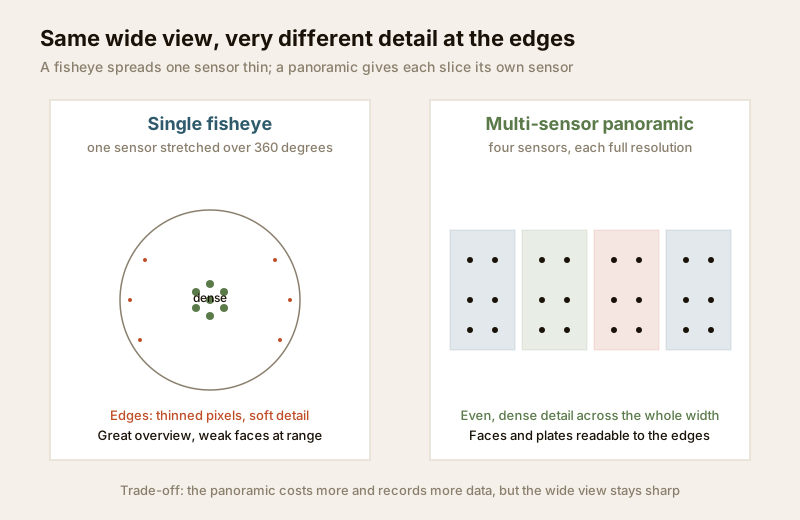
The trade is straightforward. A fisheye is cheaper, smaller and simpler — one sensor, one lens, one small budget. A panoramic costs more, is physically larger, and records much more data — but it holds the detail across a genuinely large space. Fisheye for a small-to-medium overview where you mainly want situational awareness; panoramic for a large open area where you also need to identify people and vehicles anywhere in the frame.
Strengths of the panoramic form factor
The panoramic earns its higher price on large, open sites.
- Wide and detailed at the same time. This is the headline. You get the sweep of a fisheye without surrendering the detail that lets footage actually identify someone. One image, sharp everywhere.
- One camera replaces several. A single well-placed panoramic can cover what would otherwise need three or four fixed cameras — a whole car park, a long facade, a large forecourt — from one mount, one bracket, one cable run. Fewer poles, fewer drill points, fewer things to fail.
- Seamless overview, no stitching blind spots. Where separate cameras leave awkward gaps or overlaps at their edges, a panoramic's slices are joined into one continuous picture. Nothing falls between two cameras.
- Simpler cabling and licensing. One PoE drop instead of four. On systems with per-camera recorder licences, one panoramic can also mean one licence for the area rather than several (check your recorder's policy — some count each sensor).
- Clean, unobtrusive install. A single low-profile unit on a facade or pole reads better than a cluster of brackets, and there is one point to service.
Trade-offs to plan around
None of this is free, and a panoramic in the wrong spot wastes real money.
- Higher cost per unit. A multi-sensor panoramic is one of the pricier camera types. It can still be cheaper than the three or four cameras plus mounts and cabling it replaces — but as a single line item it looks expensive, so justify it by the area it truly covers.
- More data and more storage. Four sensors at full resolution generate a large stream. Your recorder needs the bandwidth and the disk space for it, and a month of continuous panoramic footage eats storage fast. Plan the storage and consider motion-based or event recording.
- Careful mounting and aiming. Because the view is stitched, the unit must be mounted level and aimed precisely — a crooked install or a badly set stitch line shows as a visible seam where the slices meet. This is skilled work, not a DIY bracket-and-hope job.
- Stitching seams and geometry. Even a good install leaves the picture slightly bent at the joins, and a person walking across a seam can briefly distort. It rarely matters for overview and identification, but it is a real characteristic to expect.
- Overkill for small or narrow spaces. In a single room, a narrow driveway or over one doorway, a panoramic is wasted spend. A dome, turret or a single fisheye does the job for a fraction of the cost.
When to bring in a professional. You can decide that a panoramic is the right type, roughly where it goes and what it must cover. Hand the pole or facade mounting, working at height, the PoE cabling, the recorder bandwidth and storage sizing, and the level-and-stitch aiming to a licensed installer and their integrator. Getting the seam clean and the unit dead level is a skill — ask the installer to show you the stitched night image before they sign off. Any work at the electrical board is a licensed electrician's job; see the electrical hub.
Panoramic camera: pros, cons and best-fit
| Aspect | What you get | Watch-out | Best fit |
|---|---|---|---|
| Coverage | Very wide 180 to 360 degrees, one unit | Wasted on small spaces | Car parks, wide facades, yards |
| Detail | Full resolution across the whole view | Only if aimed and stitched well | Areas where you must identify people/plates |
| Camera count | One replaces three or four | Single point of failure for that area | Large open zones, campuses |
| Cabling | One PoE run, fewer poles | Needs a capable IP recorder | New or re-cabled large sites |
| Cost | Fewer mounts and licences overall | High per-unit price | Sites big enough to justify it |
| Storage | One stream, one licence (often) | Heavy data, needs disk and bandwidth | Plan storage before buying |
Panoramic vs fisheye vs multiple cameras vs PTZ
The panoramic is one of several ways to cover a wide area. Each suits a different shape of problem. The camera type selector walks you through the choice, and the field-of-view calculator helps you check what any lens actually reaches.
| Factor | Panoramic (multi-sensor) | Single fisheye | Multiple bullets/domes | PTZ |
|---|---|---|---|---|
| How it covers width | Several sensors stitched | One sensor, ultra-wide lens | Several separate cameras | One camera, moves to look |
| Detail across the view | High, edge to edge | Fades at edges/distance | High where each points | High only where aimed now |
| Whole area at once | Yes, seamless | Yes, but soft edges | Yes, with join gaps | No, one direction at a time |
| Units / cables | One | One | Several | One |
| Best area shape | Wide AND open | Small-to-medium overview | Long lines, choke points | Large area with a live operator |
| Relative cost | High per unit, fewer units | Low | Adds up with count | High |
| Typical price (India) | ₹18,000 – ₹60,000+ | ₹4,000 – ₹15,000 | ₹1,500 – ₹7,000 each | ₹12,000 – ₹60,000+ |
The distinctions in one line each: a fisheye gives cheap wide awareness but soft edges; multiple bullets or domes give detail exactly where each one points but leave you managing several units and their joins; a PTZ gives detail and zoom but only where it is looking at that moment, so it needs someone to steer it or misses everything else; a panoramic gives you the whole wide scene, in detail, all the time — which is exactly why it costs more.
Where a panoramic fits best
Panoramics reward one specific situation: an area that is wide AND open AND where you need detail everywhere, all the time.
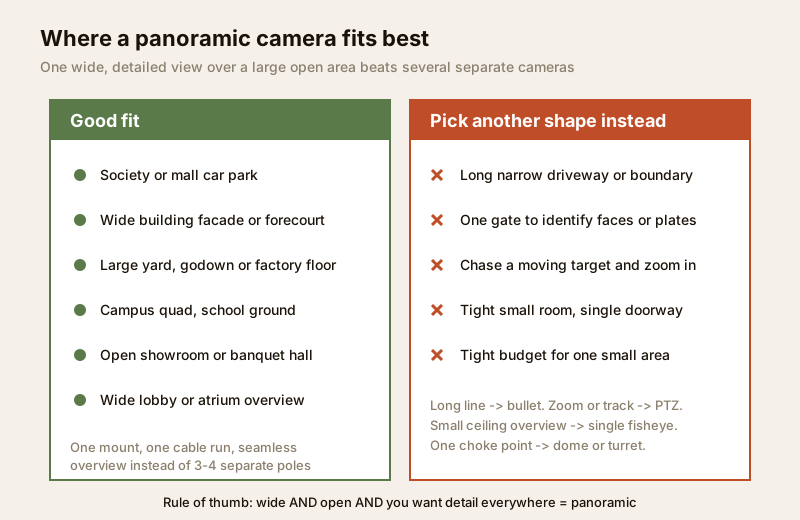
- Society and mall car parks — one unit watches the whole deck, every space and aisle in detail, instead of a pole per row.
- Wide building facades and forecourts — a single panoramic across the front of a shop, showroom or apartment block sees the whole approach.
- Large yards, godowns and factory floors — sweeping open space where separate cameras would leave gaps at their joins.
- Campus grounds, school quadrangles, banquet halls, atriums — big gathering spaces where you want a seamless overview that still resolves faces.
Where a panoramic is the wrong choice: a long narrow driveway or boundary (use a bullet — its reach suits the line); one gate where you must read faces or plates (a fixed camera or a PTZ zoomed in beats a slice of a wide view); chasing or zooming on a moving target (that is a PTZ); a small room or single doorway (a dome, turret or single fisheye is far cheaper). Match this to your setting in the residential and commercial CCTV guides, and lay out a whole site with the camera coverage calculator.
India price bands and buying notes
Prices move with brand, sensor count, resolution and season; treat these as ballparks to sanity-check a quote, not fixed rates.
| Item | Typical range (₹) | Notes |
|---|---|---|
| Entry multi-sensor panoramic (8–12MP total) | ₹18,000 – ₹30,000 | Small car parks, modest facades |
| Mainstream 4-sensor panoramic (16–20MP total) | ₹30,000 – ₹55,000 | The large-area workhorse |
| High-resolution / long-warranty panoramic | ₹55,000 – ₹1,00,000+ | Big commercial, detail at range |
| Extra recorder storage (per site) | ₹5,000 – ₹20,000+ | Panoramics need disk; size it up front |
| Professional install / unit | ₹1,500 – ₹4,000 | Height work, level mount, stitch and test |
When buying, favour a unit with an IP66 (or better) weather rating for outdoor use, an IK impact rating if it is reachable, good low-light or IR performance across all sensors, and a recorder confirmed to handle the bandwidth and per-sensor licensing. As with any network camera, the IP CCTV cautions apply — change default passwords and keep firmware updated. Price the whole layout, storage included, with the security system cost estimator.
Key takeaways
- A panoramic camera is a multi-sensor unit: several separate lenses, each capturing a slice at full resolution, stitched into one very wide 180-to-360-degree image.
- Unlike a single fisheye — which spreads one sensor thin and goes soft at the edges — a panoramic keeps high detail right across the wide view.
- Its strengths are wide-plus-detailed coverage, one unit replacing several, one cable run and a seamless overview — ideal for car parks, wide facades, large yards and campuses.
- The trade-offs are higher unit cost, much more data and storage, and the need for careful level mounting and clean stitching — so justify it by the area it genuinely covers.
- It is overkill for small rooms, single doorways and narrow driveways; for long boundaries choose a bullet, for zoom-and-track choose a PTZ, and the camera type selector helps you decide.
- Choose the type yourself; leave height work, pole/facade mounting, PoE cabling, storage sizing and stitch aiming to a licensed professional.
References
- Digital Personal Data Protection Act, 2023 — position cameras to cover only your own property and shared areas with a legitimate purpose; never bathrooms, bedrooms or changing areas, and avoid capturing neighbours' private spaces. A wide panoramic sees a lot, so aim it thoughtfully.
- IEC 60529 (IP ingress rating) and IEC 62262 (IK impact rating) — the internationally recognised marks for a camera's weather sealing and vandal resistance; verify a product's stated ratings on its datasheet.
- National Building Code of India (SP 7), Bureau of Indian Standards, and local municipal bye-laws for any structural, electrical or life-safety aspect of an install; verify the current edition via the BIS catalogue: https://www.services.bis.gov.in/
This is an educational overview. Mounting, working at height, structured cabling, storage sizing and any electrical work are qualified professional tasks — engage licensed installers and verify any standard's current status via the BIS catalogue before relying on it.
Export this guide
Related Guides — Deep-dive reading
How to Choose a CCTV Camera (2026): The Homeowner's Decision Guide for India
Cut through the spec-sheet noise and choose the right CCTV camera for each spot around an Indian home. What actually matters — sensor and low-light performance, lens and field of view, form factor, IP and IK ratings, honest smart features — and the marketing claims to ignore.
SecurityCCTV Recording Failure in India (2026): Live View Works but Nothing Was Saved
You open the recorder to pull footage of an incident and there is nothing there, even though every camera shows a crisp live picture. A calm, ordered guide to why an Indian CCTV system records live but saves nothing, and how to fix it before the next incident.
SecurityParking Security Lighting in India (2026): Lighting Basement, Stilt and Open Parking So Nothing Hides in the Dark
How to light apartment and commercial parking so vehicles, people and number plates are clearly seen, cameras can actually read the scene, and the space stops being a soft spot for theft and lurking, without ever compromising the emergency lighting on the escape route.
SecurityRelated Tools — Try Free
CCTV Camera Type Selector
Answer five questions and get the right camera form factor — dome, vandal dome, bullet, turret or PTZ — with reasons.
Camera SelectorCCTV Camera Coverage & Count Calculator
Estimate how many CCTV cameras you need, the NVR channels, storage in TB for your retention period, and an indicative all-in cost with GST.
CCTV CalculatorCCTV Identification-Distance Calculator
How far a camera can still identify a face or number plate (DORI 250 px/m), from resolution, lens and sensor.
Identify Distance