
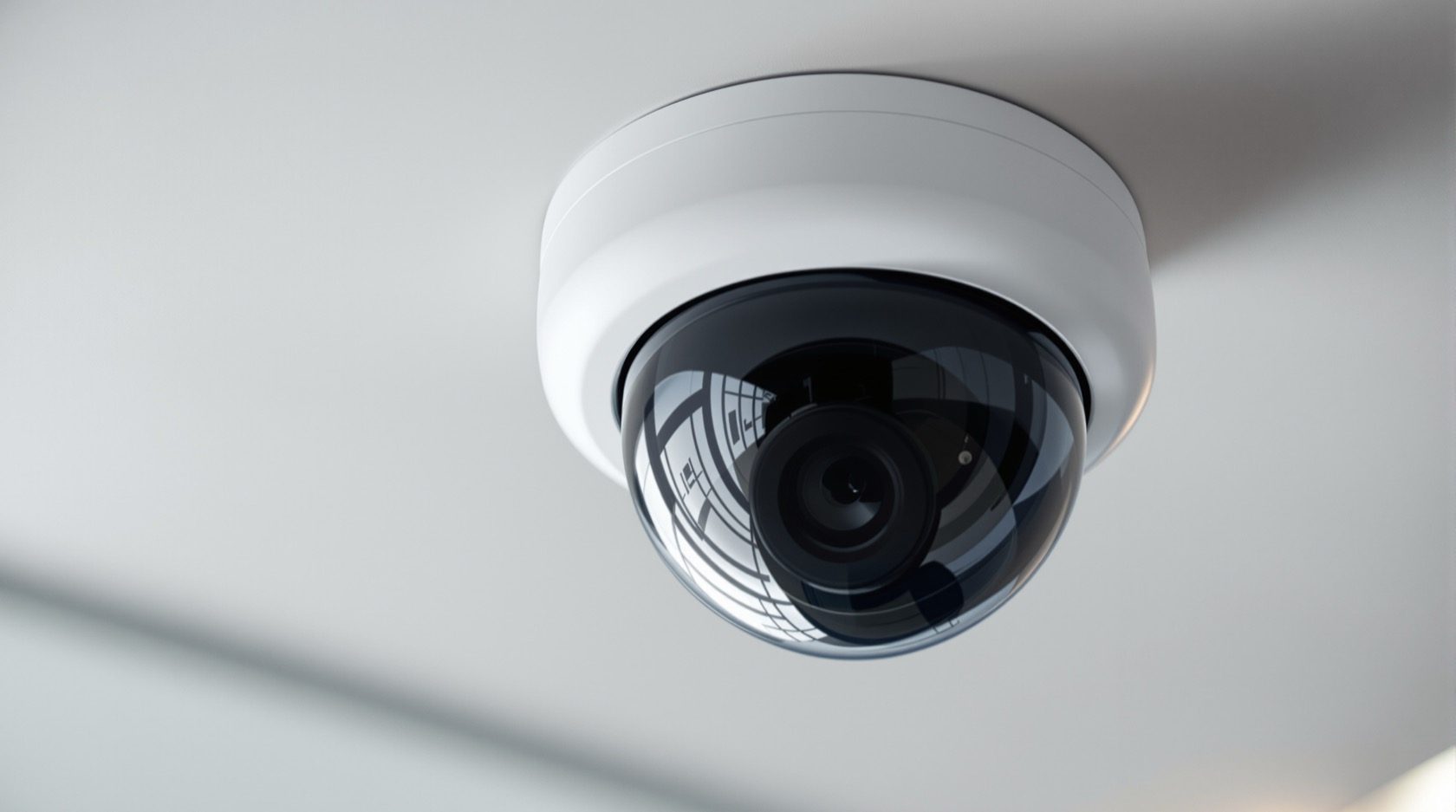
Dome CCTV Cameras in India: The Discreet, Vandal-Resistant Form Factor
What a dome camera is, why its low-profile housing suits indoors, lobbies and shopfronts, where its bubble can cause night glare, and how it compares to bullet, turret and PTZ cameras.
Walk into almost any Indian shop, bank lobby, clinic or apartment corridor and look up: the small half-sphere on the ceiling is a dome camera. It is the most common indoor CCTV shape for a reason. The camera itself is identical technology to any other; what changes is the housing — a lens tucked inside a low, rounded dome that sits flush against a ceiling or wall.
This guide is the focused explainer on the dome form factor in Studio Matrx's CCTV hub. It is not about how recording or networks work — for that, read how CCTV systems work and the complete guide to CCTV systems first. Here we answer one practical question: when is a dome the right shape for a spot, and when is a bullet or turret better?
Scope & safety. This guide helps you choose and coordinate. The camera housing is a decision you can make; the mounting, working at height, mains power and cabling are a licensed installer's job. A camera must never be positioned to cover a bathroom, bedroom or changing area, and must never block a door, window or fire-escape route. Cover only your own property and shared areas, respecting neighbours, staff and the Digital Personal Data Protection Act, 2023.
What a dome camera actually is
A dome camera is a camera module mounted inside a transparent dome-shaped cover, usually clear or smoked polycarbonate. The lens, image sensor and infrared (IR) LEDs all live behind that bubble. The whole unit screws to a ceiling or wall through a flat base, so it protrudes only a few centimetres.
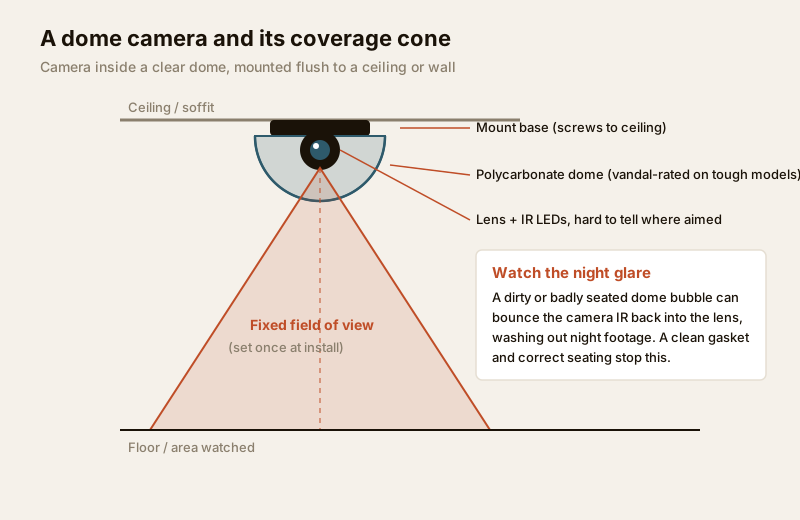
The dome is more than styling. Because the lens sits behind a curved cover, a person standing below cannot easily tell which way it is pointing — useful deterrence in a shop or lobby. And because there is no exposed barrel to grab or twist, the tougher models are built to survive tampering.
Domes come in the same technology families as any camera — you can buy an analogue dome or an IP (network) dome, wired or PoE. The shape is independent of the system type; for that decision see the analogue and IP CCTV guides, or run the system type selector.
Strengths of the dome form factor
The dome earns its place indoors and in public-facing spaces on a handful of clear advantages.
- Discreet and unobtrusive. It hugs the ceiling and reads as part of the fittings, not a piece of security kit. In a boutique, clinic or home living room, that low profile matters — a bristling bullet on the wall can feel hostile.
- Ambiguous aim. From below, the curved cover hides the exact direction of the lens. A would-be shoplifter or intruder cannot be sure whether a given aisle is in frame, which is deterrence in itself.
- Vandal and tamper resistance. There is no barrel to yank. Vandal-rated domes (often marked with an IK impact rating) use a thick polycarbonate dome and a metal base to survive knocks, making them the right choice for reachable spots — a stairwell at head height, a lift lobby, a school corridor.
- Neat ceiling or wall mount. One tidy fixing, cabling hidden inside the base, no adjustable arm sticking out. It looks finished.
- Good indoors and in public rooms. Its wide, even coverage from a central ceiling point suits rooms, lobbies, corridors, shopfronts and under eaves — exactly the places where it dominates.
Limitations to plan around
No form factor is free of trade-offs. The dome's come mostly from that same bubble.
- Night glare from the dome (IR reflection). This is the classic dome problem. At night the camera's own IR light can reflect off the inside of the dome and wash the image into a milky haze — especially if the dome is dirty, scratched, or its light-blocking gasket is seated wrong. A good install and a clean dome prevent it; a rushed one guarantees it. This alone is why many people prefer a turret for IR-heavy spots (more below).
- Fixed field of view. Once the installer sets the aim and zoom, that is the shot. A standard dome does not pan or track on its own — that is a PTZ camera, a different animal.
- Slightly harder to re-aim. Changing where a dome looks usually means opening the cover and re-seating the module inside the housing, then re-checking for glare. A turret's exposed ball is quicker to nudge.
- The dome can weather. Outdoors, an exposed dome collects dust, water spots and, over years, UV haze that softens the image. Under an eave it is fine; on an open wall in the sun and monsoon, a bullet or turret often ages better.
When to bring in a professional. You can decide the housing type, count and rough positions yourself using this guide. Hand the drilling, working at height, cable pulling, mains power and the final aiming and anti-glare seating to a licensed installer. Getting the dome gasket seated correctly to kill IR glare is a skill — a good installer checks the night image before they leave. Any work at the electrical board is a licensed electrician's job; see the electrical hub.
Dome camera: pros, cons and best-fit
| Aspect | What you get | Watch-out | Best fit |
|---|---|---|---|
| Visibility | Discreet, blends into ceiling | Some argue a visible bullet deters more | Indoor rooms, lobbies, shops |
| Aim secrecy | Hard to tell where it points | None to speak of | Retail floors, waiting areas |
| Tamper resistance | Vandal (IK) models survive knocks | Only the rated models are tough | Reachable spots, stairwells, schools |
| Coverage | Wide even spread from centre | Fixed once set | Corridors, halls, open shop floors |
| Night IR | Fine when clean and well seated | Glare if dome dirty / gasket wrong | Well-lit or well-installed indoor areas |
| Weathering | Great under eaves | Exposed dome hazes over years | Under eaves, porches, lobbies |
Vandal dome vs standard dome
Not all domes are equally tough. There are two broad grades, and picking the right one saves money or trouble.
- A standard dome has a thin plastic cover and a light plastic body. It is perfect for a ceiling out of reach — a living room, a shop ceiling, a first-floor landing — where nobody can touch it.
- A vandal-resistant dome adds a thick polycarbonate dome, a metal base and tamper-proof screws, carrying an IK impact rating (higher IK = tougher). Use it anywhere the camera is within arm's reach or a thrown object's path: a stairwell, a lift lobby, a school or clinic corridor, a shop entrance at head height, a parking area.
The rule is simple: if a person can reach it, spec the vandal version. The price difference is small next to the cost of a camera that gets knocked out the one night it mattered.
How a dome compares to bullet, turret and PTZ
The dome is one of four common shapes. They share the same sensors and analytics; the housing decides the fit. The camera type selector walks you through the choice for each spot, and each sibling shape has its own deep-dive.
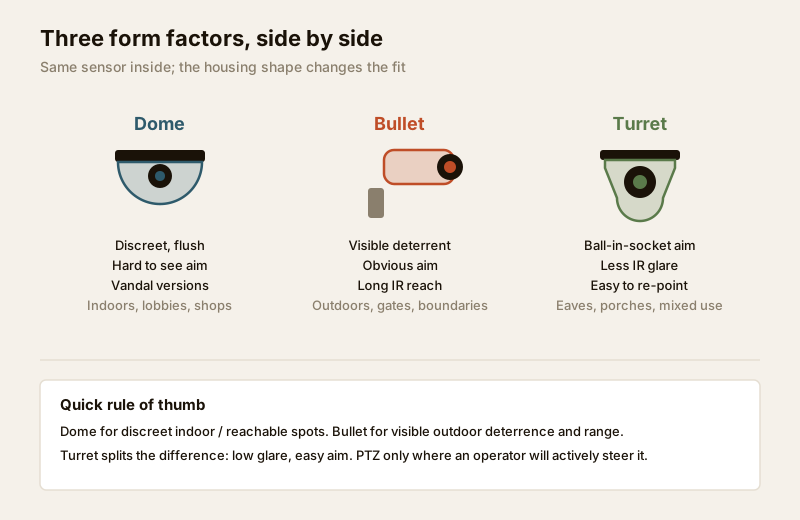
- Bullet — a visible cylindrical barrel on an arm. It is an obvious deterrent, its aim is easy to read and adjust, and it usually reaches further with IR at night. Best for outdoor boundaries, gates and driveways where you want to be seen.
- Turret (eyeball) — a ball sitting in a fixed socket. Because the lens and IR are separated and there is no dome over them, turrets largely avoid the IR glare that plagues domes, and they re-aim with a nudge. A popular all-rounder for eaves, porches and mixed use.
- PTZ — motorised pan, tilt and zoom, steered by an operator or a tour. Powerful but expensive, and it can only look one way at a time. Best where someone actively monitors a large area (a large compound, a gated society gate house).
Quick comparison
| Factor | Dome | Bullet | Turret |
|---|---|---|---|
| Look | Discreet, flush | Visible, deterrent | Compact ball |
| Best placed | Indoors, lobbies, shops | Outdoor walls, gates | Eaves, porches, mixed |
| Aim visibility | Hidden | Obvious | Semi-visible |
| Night IR glare | Possible (dome) | Low | Very low |
| Re-aiming | Fiddly (open cover) | Easy (loosen arm) | Easy (nudge ball) |
| Vandal resistance | Excellent (IK models) | Moderate | Moderate |
| Typical price (India) | ₹1,500 – ₹6,000 | ₹1,500 – ₹6,500 | ₹1,800 – ₹6,500 |
For a spot-by-spot layout across a whole home or shop, use the camera coverage calculator, and see indoor CCTV and outdoor CCTV for the setting side of the decision.
Where a dome fits best
Domes reward being placed where their strengths line up: indoors, overhead and among people.
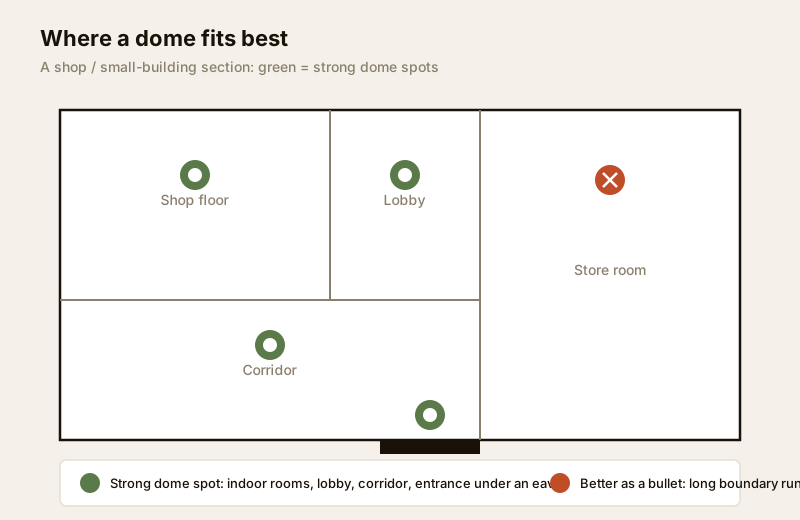
- Indoor rooms — living rooms, shop floors, clinic waiting areas: the discreet look and wide central coverage suit them.
- Lobbies and reception — a ceiling dome watches the whole entry hall without the hostile look of a barrel.
- Corridors and stairwells — long, narrow runs covered end to end; use the vandal grade where people pass close.
- Shopfronts and tills — over the counter and the door, discreet but present.
- Under eaves and porches — the one outdoor spot a dome loves, sheltered from direct sun, rain and dust.
Where a dome is the wrong shape: long open boundaries, compound walls and driveways at night. There, a bullet's reach and obvious deterrence, or a turret's glare-free IR, do the job better. Match this to your building type in the residential and commercial CCTV guides.
India price bands and buying notes
Prices move with brand, resolution and season; treat these as ballparks to sanity-check a quote, not fixed rates.
| Item | Typical range (₹) | Notes |
|---|---|---|
| 2MP indoor dome (analogue) | ₹1,200 – ₹2,500 | Budget indoor rooms, plenty of light |
| 4MP IP / PoE dome | ₹2,500 – ₹6,000 | The indoor workhorse; good detail |
| Vandal-rated (IK) dome | ₹3,000 – ₹7,000 | Reachable spots; metal base, thick dome |
| Outdoor-rated dome (IP66) | ₹3,000 – ₹7,500 | For under-eave / porch use, sealed |
| Anti-vandal + IR + 4K dome | ₹6,000 – ₹12,000 | High-traffic commercial, detail at range |
| Professional install / camera | ₹500 – ₹1,500 | Mount, aim, anti-glare seating, test |
When buying, favour a dome with an IR cut / anti-glare gasket design, an IP66 rating if it goes outdoors, and an IK rating if it is reachable. For network domes, the same IP CCTV cautions apply — change default passwords and keep firmware updated. Price a whole layout with the security system cost estimator.
Key takeaways
- A dome camera is a standard camera inside a low, rounded cover — the shape, not the technology, is what you are choosing.
- Its strengths are discretion, hidden aim, vandal resistance (IK models) and neat overhead coverage — ideal indoors, in lobbies, corridors, shopfronts and under eaves.
- Its main weakness is IR glare off the dome at night if the unit is dirty or badly seated; a fixed field of view and fiddly re-aiming are the others.
- Spec the vandal (IK) grade anywhere a person can reach the camera; a standard dome is fine only for out-of-reach ceilings.
- For outdoor boundaries and long night shots, prefer a bullet or turret; reserve PTZ for actively-monitored large areas — the camera type selector helps you decide.
- Choose the housing yourself; leave mounting, height work, cabling, mains power and anti-glare aiming to a licensed professional.
References
- Digital Personal Data Protection Act, 2023 — position cameras to cover only your own property and shared areas with a legitimate purpose; never bathrooms, bedrooms or changing areas, and avoid capturing neighbours' private spaces.
- IEC 62262 (IK impact rating) and IEC 60529 (IP ingress rating) — the internationally recognised marks for a dome's vandal resistance and weather sealing; verify a product's stated ratings on its datasheet.
- National Building Code of India (SP 7), Bureau of Indian Standards, and local municipal bye-laws for any structural, electrical or life-safety aspect of an install; verify the current edition via the BIS catalogue: https://www.services.bis.gov.in/
This is an educational overview. Mounting, working at height, structured cabling and any electrical work are qualified professional tasks — engage licensed installers and verify any standard's current status via the BIS catalogue before relying on it.
Export this guide
Related Guides — Deep-dive reading
How to Choose a CCTV Camera (2026): The Homeowner's Decision Guide for India
Cut through the spec-sheet noise and choose the right CCTV camera for each spot around an Indian home. What actually matters — sensor and low-light performance, lens and field of view, form factor, IP and IK ratings, honest smart features — and the marketing claims to ignore.
SecurityTurret vs Dome Camera in India (2026): Which One Sees Better at Night?
The two ceiling-and-wall CCTV shapes people mix up, decided honestly. What a turret (eyeball) and a dome each are, how they compare on night-time IR glare, image clarity, aiming, vandal-resistance, weather, discretion and cleaning — and which suits your eaves, your porch, a reachable spot or a discreet indoor corner.
SecurityDome vs Bullet Camera in India (2026): Which Shape Should You Fit Where?
The classic CCTV form-factor choice, decided honestly. What a dome and a bullet each are, how they compare on deterrence, aiming, range, vandal-resistance, weather and IR glare — and which shape suits an indoor lobby, a shop, a gate or a long driveway.
SecurityRelated Tools — Try Free
CCTV Camera Type Selector
Answer five questions and get the right camera form factor — dome, vandal dome, bullet, turret or PTZ — with reasons.
Camera SelectorCCTV System Type Selector
Answer five questions and get the right CCTV setup — analog / IP / hybrid, wired / wireless, local / cloud — with reasons.
CCTV SelectorCCTV Camera Coverage & Count Calculator
Estimate how many CCTV cameras you need, the NVR channels, storage in TB for your retention period, and an indicative all-in cost with GST.
CCTV Calculator