
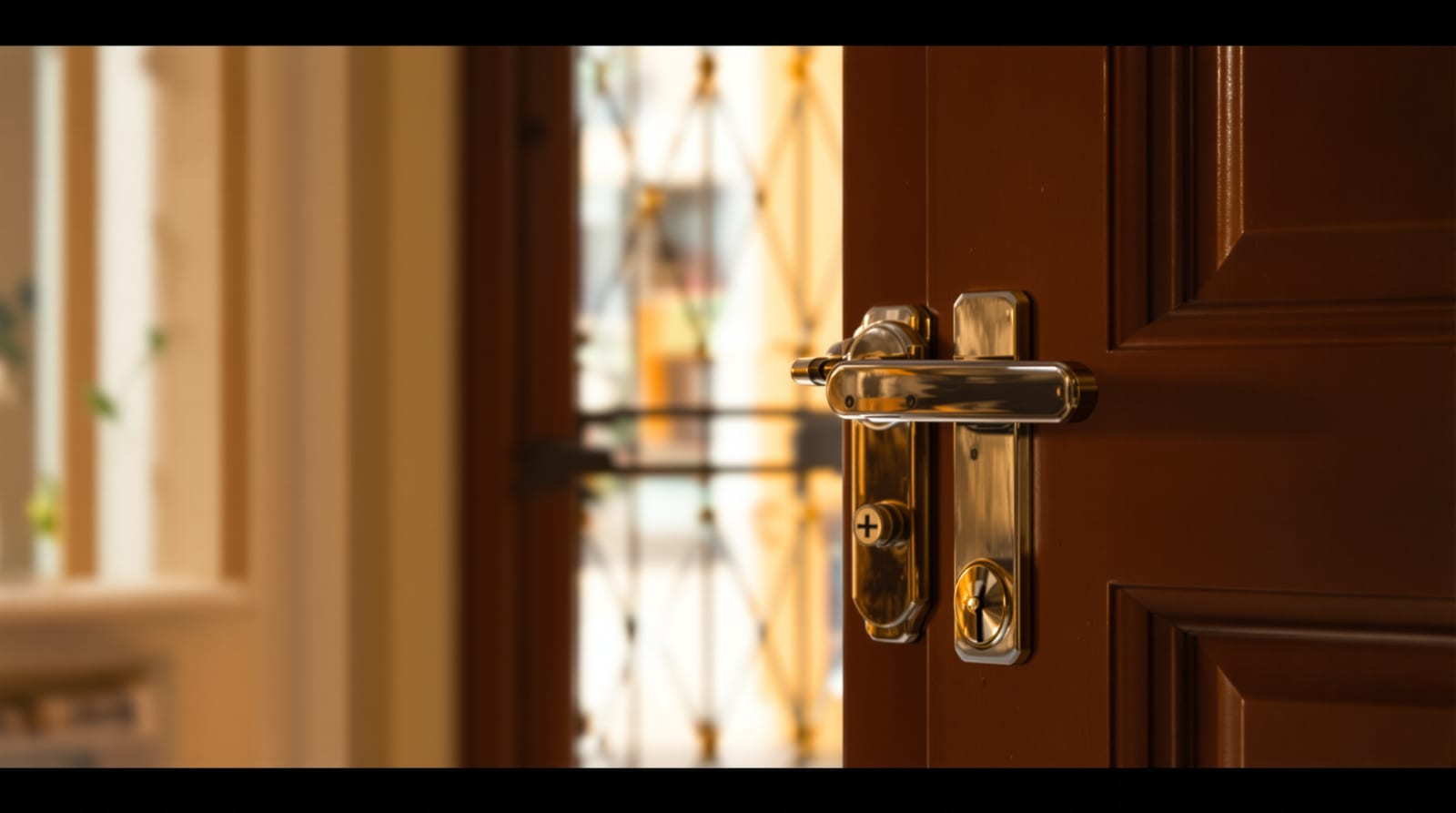
Anti-Theft Door Guide India: Affordable Ways to Burglar-Proof Your Entry (2026)
A practical, layered checklist of low-cost upgrades — deadbolts, strike-plate reinforcement, hinge bolts, viewers, grill doors and smart alerts — to make any Indian home door far harder to force.
Most break-ins are not feats of skill — they are a few hard kicks against a flimsy strike plate, a slipped latch, or an unsecured back door while the family sleeps. A burglar attacks the weakest link, never the strongest, which is why a beautiful ₹80,000 teak main door fitted with a ₹40 strike plate and two short screws is still an easy target. The good news for Indian homes is that real anti-theft protection is cheap and additive. You do not need to rip out your door — you layer small upgrades so that each one buys time, and a thief who can be delayed by even 60-90 seconds usually gives up and moves on.
This guide is a practical, budget-first plan. We go upgrade by upgrade, with ₹ costs, whether you can do it yourself or need a carpenter, and which threat each one defeats. For the bigger picture — door materials, ratings and how a whole secure entry is specified — see our pillars on door security and residential door standards, and rate your current setup with the door security rating tool. This page goes deep on the affordable, do-it-this-weekend layer.
The thief's playbook: know what you're defending against
Forced entry on Indian homes follows predictable patterns. Understanding them tells you exactly where to spend.
- Kick-in / shoulder-barge. The commonest method. The lock holds, but the strike plate (the metal plate the bolt enters) tears out of the frame because it is held by two short 12-15 mm screws into soft jamb wood. The door blows open at the frame, not the lock.
- Latch slipping ("loiding"). A spring latch with no deadlocking action can be pushed back with a card, shim or knife on doors that don't shut tight.
- Lock picking / bumping / drilling. Cheaper pin-tumbler and rim locks succumb to bumping or a battery drill. Higher-grade mortise cylinders with anti-drill pins resist this.
- Hinge-side attack. On doors that open outward (common on Indian utility, terrace and some main doors), the hinge pins are exposed and can be knocked out, lifting the whole leaf off.
- Glass-reach. Adjacent glass panel or sidelight is broken and the thumb-turn or key-left-inside is reached.
- Soft targets. The back door, utility/balcony door, terrace door and ground-floor bathroom — secured with a single ₹100 tower bolt while the main door gets all the attention.
Notice that almost none of these defeat the lock itself. They defeat everything around the lock. That is the entire strategy of cheap home hardening.
Layer 1 — Fix the frame: the ₹200 upgrade that matters most
Before spending on any lock, reinforce where the lock anchors. This is the single highest-value rupee in this guide.
Long screws into the structure. Remove the two short screws holding your strike plate and replace them with 75 mm (3-inch) wood screws that pass through the door jamb and bite into the wall stud or masonry plug behind it. Now a kick has to defeat the wall, not 15 mm of pine. Do the same for the hinge screws — swap one screw per hinge for a 65-75 mm one. Cost: a box of screws, ₹60-150. Pure DIY with a screwdriver or drill. This alone defeats most kick-ins.
A reinforced strike box / security strike plate replaces the flat plate with a deeper box that captures the bolt and spreads force across more of the frame. Indicative ₹300-1,200 including fitting; ask any carpenter or buy a "high security strike plate" online. Worth it on the main door.
Hinge bolts (dog bolts). For outward-opening doors, fit hinge bolts — fixed steel studs on the hinge edge that lock the leaf into the frame even if the hinge pins are removed. ₹150-500 a pair, carpenter fitting ₹200-400. Alternatively, use security/fixed-pin hinges. For more on hinge selection, see door hinges.
Layer 2 — Upgrade the lock to a deadbolt or multipoint
A spring latch alone is not a security lock. You want a deadlocking bolt that cannot be slipped.
- Mortise deadlock + handle set (Godrej, Yale, Dorset, Europa). The mainstream Indian upgrade: a mortise body with a throwing deadbolt and an anti-drill cylinder. ₹600-6,000 per set depending on brand and finish, plus ₹300-700 carpenter fitting. Choose a cylinder with anti-bump/anti-drill pins.
- Rim / night latch as a second lock ₹300-1,500. A second, independent locking point above or below the main lock roughly doubles the force needed to force the door and gives you a "deadlock when home" option.
- Multipoint locking door is the gold standard: one key throw shoots bolts into the frame at three or more points (top, middle, bottom), so force is spread and no single point can be levered. Common on uPVC and steel security doors; ₹3,000-12,000+ as a system. Deep dive: multipoint locking doors and burglar-proof doors.
For choosing between lock families, see door locks types and mortise locks.
Layer 3 — See who's there, and let them know you can
Wide-angle door viewer (peephole). A 180-200 degree viewer for ₹80-600 lets you check before opening — the simplest anti-deception tool there is. DIY-fit in 10 minutes with a drill. See door viewers and peepholes.
Video door phone (VDP) or smart doorbell. A VDP (₹4,000-25,000) or smart Wi-Fi doorbell (Qubo and others, ₹2,500-8,000) records callers, works when you're out, and is a strong visible deterrent. Cross-link: video door phones and smart doorbells.
Motion-sensor lights at the entrance. A ₹400-1,500 PIR floodlight that snaps on when someone approaches removes a thief's best friend — darkness and the belief they're unobserved. DIY if a point exists; electrician ₹300-600 otherwise.
Smart-lock alerts. A smart lock (budget ₹5,000-9,000, mid ₹10,000-17,000, premium ₹15,000-30,000) can push a phone alert on every lock/unlock and on tamper, give one-time PINs to maids or guests instead of spare keys, and log who entered when. Cost a setup with the smart lock cost calculator and compare approaches in smart lock vs traditional lock.
Layer 4 — The safety grill door: India's best-value deterrent
A secondary steel grill/collapsible safety door fitted in front of the main door is, rupee for rupee, one of the most effective anti-theft layers for Indian homes. It lets you keep the wooden door open for air during the day while staying locked, presents a visible second barrier, and forces a thief to defeat two doors. Costs run roughly ₹8,000-25,000 fabricated and fitted depending on size, gauge and design. See safety grill doors and collapsible gate doors.
Threat-by-threat: the cheap-fix table
Indicative all-India pricing, varies by city and vendor; add 18% GST and fitting labour where noted.
| Threat | Cheap fix | Indicative ₹ | DIY or pro |
|---|---|---|---|
| Kick-in tears strike plate out | 75 mm screws into stud/wall | ₹60-150 (box) | DIY |
| Frame splits under force | Reinforced security strike box | ₹300-1,200 | DIY/easy pro |
| Hinge pins knocked out (outward door) | Hinge/dog bolts or fixed-pin hinges | ₹150-500 + fitting | Pro |
| Latch slipped with a card | Mortise deadlock + anti-drill cylinder | ₹600-6,000 + ₹300-700 | Pro |
| Single lock levered | Add rim/night latch as second lock | ₹300-1,500 | DIY/easy pro |
| All points levered at once | Multipoint locking system | ₹3,000-12,000+ | Pro |
| Don't know who's outside | Wide-angle viewer (200 deg) | ₹80-600 | DIY |
| Caller deception / absence | Video door phone or smart doorbell | ₹2,500-25,000 | Pro |
| Approach under cover of dark | PIR motion floodlight | ₹400-1,500 + fitting | DIY/electrician |
| Spare key found / lost track of keys | Smart lock with PINs + alerts | ₹5,000-30,000 | Pro |
| Whole-day exposure of wood door | Steel safety grill door | ₹8,000-25,000 | Pro (fabricated) |
| Glass-reach to thumb-turn | Double-cylinder mortise / laminated glass | varies | Pro |
Layered door security, illustrated
The diagram below shows how the layers stack on a single leaf — frame anchoring at the strike, a deadbolt mid-height, a second lock, hinge bolts on the hinge edge, and a viewer at eye level.
DIY vs pro: where to draw the line
Comfortable with a drill and screwdriver? You can self-fit: long strike/hinge screws, a wide-angle viewer, a rim/night latch surface lock, a PIR floodlight (where a point exists), and most smart locks designed for retrofit. Call a carpenter or fabricator for: mortise lock mortising, hinge bolts, multipoint systems, the steel grill door, and any work where the door has to be re-hung or planed (monsoon swelling often means the leaf must be eased before a new lock will align). A fabricator is mandatory for the grill door. If your main door alignment is off — sagging or rubbing — fix that first, because no lock seats correctly on a misaligned leaf; see fix a sagging door and the general door reinforcement guide.
Don't undo it all with one weak habit
- Never hide a spare key outside. Under the mat, in a pot, on the meter box — burglars check these first. Use a smart-lock PIN, leave a key with a trusted neighbour, or fit a coded key safe bolted to the wall.
- Secure the back, utility and terrace doors too. These are the real entry points in most Indian break-ins and usually have the weakest hardware. Apply the same long-screw and deadbolt logic. See utility door and terrace door.
- Mind coastal and monsoon wear. Salt air and damp corrode cheap hardware and swell wood so latches stop engaging fully. Specify stainless or coated fittings near the coast and re-check engagement after the monsoon.
- Lock the deadbolt every time, including when home. A thrown bolt is the difference between a security door and a decorative one.
Walk your home tonight, find the weakest door, and start with the ₹150 box of long screws. Then work up the layers. For a complete room-by-room walkthrough, follow the main door security checklist, and pair it with the broader door security and burglar-proof doors guides.
Frequently asked questions
What is the single most cost-effective anti-theft upgrade?
Replacing the short strike-plate and hinge screws with 75 mm screws that bite into the wall behind the jamb. It costs under ₹150, takes 20 minutes with a screwdriver, and defeats the kick-in — the commonest forced-entry method. Do this before buying any new lock.
Is a smart lock more secure than a good mortise lock?
Not inherently — a quality mortise deadlock with an anti-drill cylinder is mechanically very strong. A smart lock adds convenience and intelligence: phone alerts, tamper warnings, one-time PINs instead of spare keys, and access logs. The best setup is often both, or a smart lock built on a strong mortise body. Compare in smart lock vs traditional lock.
Do safety grill doors really deter burglars?
Yes — they are among the best-value layers for Indian homes. A visible steel barrier forces a thief to defeat two doors, signals effort and noise, and lets you ventilate safely during the day. Budget ₹8,000-25,000 fabricated and fitted. See safety grill doors.
How do I protect a door with a glass panel beside it?
A thief can break the glass and reach the thumb-turn or a key left in the lock. Never leave the key in the cylinder, consider a double-cylinder (key-both-sides) mortise lock where fire-egress rules permit, and use laminated/toughened glass for the sidelight. See glass doors.
Should I worry about the back and utility doors?
Absolutely — they are statistically the more common entry point and usually carry the weakest hardware. Apply the same long-screw, deadbolt and viewer logic there. A strong main door with a flimsy utility door is a strong front and an open back.
Export this guide
Related Guides — Deep-dive reading
Main Door Security Checklist for Indian Homes (2026): Audit Your Entrance in 12 Steps
A scannable, self-score checklist to test your front door against burglars — leaf, frame, lock, hinges, strike plate, grill, lighting and smart alerts.
Home Doors & EntrancesBurglar-Proof Doors in India: What Actually Stops a Break-In (2026)
A burglar-resistant main door is a system — solid leaf, anchored frame, multipoint lock, anti-saw bolts and visibility — not just an expensive lock. Here is how each layer works and what it costs to upgrade.
Home Doors & EntrancesDoor Frame Security in India (2026): Anchoring the Chowkhat Break-Ins Actually Exploit
A homeowner's guide to the real weak point behind most forced entries: the frame, not the leaf or the lock, and how to anchor, pack and reinforce a chowkhat so a strong door genuinely stays in the wall.
SecurityRelated Tools — Try Free
Door Security Rating Calculator
Score your main door out of 100 across leaf, frame, lock and hardware — and see the top upgrades.
Security ToolDoor Lock Selector
Answer a few questions and get the right lock type — mortise, multipoint, deadbolt, privacy or smart — for any door.
Door ToolGrill Door Cost Calculator
Estimate a safety grill door or collapsible gate cost by size, material, design and mesh add-on, with GST and fitting.
Door Calculator