
Door Handle Guide for Indian Homes: Levers, Knobs & Pull Handles (2026)
How to choose the right door handle — lever-on-rose, knob, pull or mortise handle set — for every door and room in an Indian home.
The handle is the one piece of door hardware your family touches a hundred times a day — yet most Indian homeowners pick it last, off a showroom board, by looks alone. That is how a beautiful teak main door ends up with a knob your elderly mother cannot turn with wet or arthritic hands, or how a ₹40,000 entrance gets a flimsy handle that loosens in one monsoon. This guide treats the handle as what it really is: an ergonomic, structural and security decision. We cover the four handle families used in Indian homes — long pull handles, lever-on-rose, knobs and full mortise handle sets — plus functions, finishes, IS 208, ergonomics and accessibility, brands, ₹ ranges, and a clear way to choose handle by door and room. For the broader hardware picture (hinges, closers, bolts, viewers) see our door hardware guide; here we go deep on the handle alone.
The four handle families (and where each belongs)
Almost every residential handle in India falls into one of four families. Get the family right first, then worry about finish and brand.
1. Long pull handles (main-door handles). These are the tall vertical bars — typically 12 to 36 inches — fixed to one or both faces of a heavy entrance door. They give you leverage to swing a solid teak or steel leaf and a strong visual statement. A pull handle does not lock the door by itself; it pairs with a separate mortise lock or a mortise lock body operated by a key from outside and a knob or thumb-turn inside. Material matters more here than anywhere else — a salt-coast or high-traffic entrance needs SS 304 stainless or solid brass, not zinc alloy that pits.
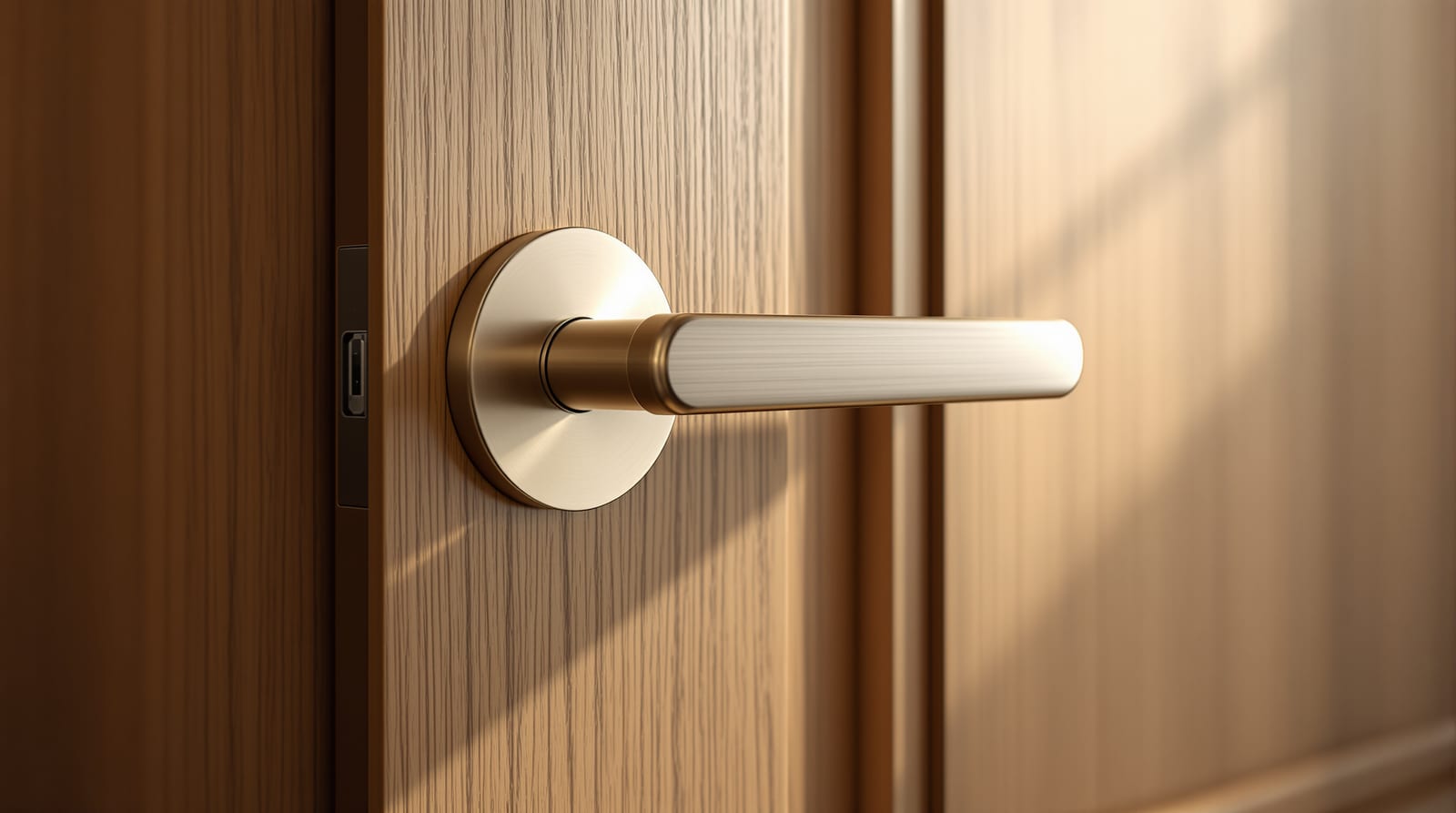
2. Lever-on-rose (internal handles). A horizontal lever mounted on a small round or square back-plate (the "rose"), usually sold as a pair with a spindle that passes through the door and engages a tubular or mortise latch. This is the default for bedrooms, study and most internal doors in modern Indian homes. Levers are pushed down with a finger, elbow or even a closed fist — which is exactly why they beat knobs on ergonomics.
3. Knobs. A round or oval grip you must grasp and twist. Knobs read as classic or vintage and suit traditional and heritage interiors, but they demand a firm pincer grip and a rotating wrist — hard for children, the elderly and anyone with wet hands or limited grip strength. We treat knobs in their own deep-dive (door knobs); the short version is: charming, but think before using them on doors that must be opened in a hurry.
4. Mortise handle sets. The most common locking handle in Indian bedrooms and main internal doors: a pair of lever handles mounted on long vertical back-plates (or roses) that house a keyhole and a cylinder, all driving a mortise lock body sunk into the edge of the door. One coordinated set gives you handle plus lock in matching finish. This is what most people mean when they say "Godrej handle set" or "mortise handle."
Handle functions: entrance, privacy, passage, dummy
Borrowed from international hardware practice but very relevant here, every handle (especially levers and knobs) performs one of four lock functions. Specifying the right function per door prevents the classic mistakes — a bathroom with no inside lock, or a wardrobe door with a redundant keyed cylinder.
- Entrance / keyed: locks with a key from outside and a thumb-turn or knob inside. For main doors, flats' front doors, and any door to the outside. Usually paired with a deadbolt or multipoint lock for real security — see main-door security.
- Privacy: locks from the inside only, with a simple push-button or twist, and an emergency release (a coin-slot or small pin) on the outside. This is the correct function for bathrooms, bedrooms and pooja rooms — privacy without the lock-out risk of a misplaced key.
- Passage: latches but does not lock at all. Right for kitchens, store rooms, utility, balconies and home-office doors that just need to stay shut, not secured.
- Dummy: a fixed handle with no working latch — purely a pull. Used on the inactive leaf of a double door, on wardrobe shutters, and on pantry or false-leaf doors.
When you brief your carpenter or hardware shop, state the function per door, not just "give me handles." It changes the lock body and the price.
Why levers beat knobs: ergonomics and accessibility
This is the single most important takeaway. A lever can be operated with a downward push of a finger, the side of a hand, an elbow or a wrist — no grip required. A knob demands a tight grasp and a rotating motion that arthritic, very young, very old or wet hands struggle with. India's own accessibility framework, the RPwD Harmonised Guidelines 2021, and universal-design practice both recommend lever handles over knobs on accessible doors, mounted around 900–1000 mm above floor level, with a clear, easy-grip lever.
For a joint family with grandparents and small children — the norm in many Indian homes — defaulting to levers on bedrooms, bathrooms and the main door is the kind, future-proof choice. Reserve knobs for low-use decorative doors where the vintage look earns its keep. For a full treatment of step-free, easy-reach doors see our accessible doors guide and the broader accessible home design companion.
A few ergonomic specifics worth insisting on:
- Lever return: choose levers that curve back toward the door at the tip ("return-to-door"). A straight lever catches sleeves, dupattas and bag straps.
- Lever length and leverage: longer levers need less force — kinder for weak grips.
- Height: internal handles around 1000 mm; main-door pull handles centred so the grip sits comfortably for an average adult, with enough bar length that a tall and a short person both reach a good hold.
- Thumb-turn over key inside bathrooms: never put a keyed cylinder on the inside of a bathroom — use a thumb-turn with outside emergency release.
IS 208 and what the standard actually covers
The Indian Standard that governs builders' hardware door handles is IS 208 (Tower bolts and door handles — non-ferrous). It specifies dimensions, material and finish requirements for cast and extruded handles in brass, aluminium and similar non-ferrous metals — the plain pull and back-plate handles still common on older flush doors and service doors. Modern lever and mortise sets are often made to manufacturers' own specs and tested for cycle life rather than to IS 208 alone, but when a tender or a quality-conscious builder says "IS 208 handles," they mean handles meeting that dimensional and material baseline.
What IS 208 does not do is rate security or finish durability for you. For that, look at the material grade (SS 304 vs lower grades), the fixing method (bolt-through vs surface screws), and the lock body the handle drives. Pair this with the lock standards discussed in our mortise locks and door locks types guides.
Finishes: matching look to climate
The finish is both aesthetic and protective. The wrong finish in the wrong micro-climate corrodes within a year.
| Finish | Look | Best for | Watch-outs |
|---|---|---|---|
| Satin / brushed stainless (SS 304) | Modern, matte silver | Main doors, kitchens, bathrooms, coastal homes | Insist on genuine 304 grade for salt air |
| Polished chrome | Bright mirror silver | Modern internal doors | Shows fingerprints and water spots |
| Antique / oil-rubbed brass | Warm, traditional | Heritage, teak, pooja and carved doors | Patinas over time (often desirable) |
| Polished brass / gold | Luxe, classic | Statement entrances, luxury interiors | Needs occasional Brasso; lacquer can chip |
| Matte black | Contemporary, industrial | Modern minimal interiors | Coating can wear at grip points |
| Rose gold / champagne | Soft, designer | Bedrooms, dressing rooms | Trend-sensitive; verify true finish, not paint |
In coastal Goa, Mumbai, Chennai and Kerala, salt-laden air is brutal on hardware — go SS 304 or solid brass and avoid zinc-alloy or thinly plated handles. For a deeper match across all hardware on the door (so handle, hinges and bolts read as one family) see our door hardware finishes guide.
Anatomy of a lever-on-rose vs a mortise handle set
The diagram below contrasts the two most common internal-door arrangements. A lever-on-rose is a clean horizontal lever on a small back-plate driving a simple latch; a mortise handle set adds a keyed/turn cylinder on a longer plate driving a full mortise lock body buried in the door edge.
Choosing handles by door and room
This is the practical heart of the guide: which handle family, function and rough ₹ range for each door in a typical Indian home. Prices are per piece or per set, material plus fitting labour, before 18% GST — indicative, varies by city and vendor.
| Door / room | Recommended handle | Function | Indicative ₹ (set) |
|---|---|---|---|
| Main door (entrance) | Long SS 304 / brass pull handle + separate mortise/multipoint lock | Entrance (keyed) | Pull ₹800–8,000; lock set ₹2,000–6,000+ |
| Bedroom | Lever-on-rose or mortise handle set | Privacy (push-button) | ₹600–4,000 |
| Bathroom | Lever-on-rose, thumb-turn inside, outside release | Privacy | ₹500–2,500 |
| Pooja room | Lever or traditional brass handle | Privacy or passage | ₹400–3,000 |
| Kitchen | Lever-on-rose | Passage | ₹400–2,000 |
| Store / utility | Lever or simple pull | Passage | ₹250–1,500 |
| Balcony / terrace | SS lever or pull (weather-grade) | Passage / privacy | ₹400–3,000 |
| Wardrobe / cupboard | Slim pull, recessed or dummy handle | Dummy / pull | ₹150–1,200 |
| Double-door inactive leaf | Dummy handle + tower bolt | Dummy | ₹150–800 + bolt |
A few cross-cutting rules:
- Main door = pull + dedicated lock, not a do-it-all mortise handle set. The handle gives leverage; the lock (or multipoint lock) gives security.
- Bathrooms and bedrooms = privacy function, never a keyed cylinder on the inside.
- High-touch and wet rooms = levers in SS 304 or brass, never zinc-alloy.
- Coordinate the family: matching finish across handle, hinges, tower bolts and door viewer makes a door look custom for very little extra cost.
For Vastu-minded households, the convention is that the main door open inward and clockwise into the home, which influences whether your pull handle and lock sit on the left or right leaf — treat it as tradition plus practical handing, and see vastu main door and entrance vastu for the full picture.
Brands and ₹ ranges in the Indian market
The Indian handle market spans local unbranded hardware to premium imported sets. A practical map:
- Godrej — wide, trusted mortise handle sets and locks; strong service network; mid-range, reliable.
- Dorset — popular for lever handle sets, mortise locks and architectural hardware; good design range.
- Europa — value-to-mid mortise handle sets and locks; common in builder projects.
- Yale — premium locks and handle sets, plus a strong smart-lock line for keyless entry and WiFi smart locks.
- Ozone — glass-door fittings, main-door pull handles and architectural hardware; popular for modern frameless and glass doors.
- Hettich / Hafele — premium European-origin handles, furniture and wardrobe pulls; designer projects.
Indicative price bands (per piece/set, before fitting and GST; varies by city and vendor):
| Item | Budget | Mid | Premium |
|---|---|---|---|
| Internal lever-on-rose (pair) | ₹250–600 | ₹600–1,500 | ₹1,500–4,000 |
| Mortise handle set (with lock) | ₹600–1,500 | ₹1,500–3,500 | ₹3,500–6,000+ |
| Main-door pull handle (SS/brass) | ₹400–1,000 | ₹1,000–3,000 | ₹3,000–8,000+ |
| Knob set | ₹200–700 | ₹700–2,000 | ₹2,000–5,000 |
| Wardrobe / cabinet pull | ₹80–300 | ₹300–800 | ₹800–2,500 |
Add roughly ₹150–500 per door for fitting if a carpenter installs hardware separately, and budget 18% GST on branded purchases. To price a whole door including hardware, the door cost calculator and door cost guide are good starting points; for sizing the leaf the handle goes on, use the door size calculator.
Buying and fitting tips
- Feel before you buy. Hold the lever or knob, push it down, twist it. If it feels stiff or cheap in the showroom, it will be worse after a year of monsoon humidity.
- Check the spindle and fixing. Bolt-through fixings (a screw passing right through the door joining both plates) are far more secure than surface screws that strip out of a hollow flush door.
- Match the lock body. A handle set is only as good as its mortise lock body — ask for the cycle rating and whether keys are restricted/duplicable.
- Backset and door thickness. Tell the shop your door thickness (typically 30–40 mm) and required backset so the cylinder lines up with the leaf edge.
- Buy a spare cylinder. For main doors, keep a matched spare cylinder; rekeying is cheaper than replacing the whole set.
- Coordinate the whole door. Decide handle, hinges, bolt, viewer and closer together; see the door hardware guide for the full checklist.
Frequently asked questions
Are lever handles better than knobs for Indian homes?
For most doors, yes. Levers can be opened with a finger, elbow or wrist and need no grip strength, which suits children, elderly parents and wet hands — exactly the joint-family reality in many Indian homes. Knobs are charming on heritage and decorative doors but are harder to operate, so reserve them for low-use doors.
What handle should I use on my main door?
Use a long SS 304 stainless or solid brass pull handle for leverage and looks, paired with a separate mortise lock or multipoint locking system for security. Avoid relying on a single do-it-all handle set on a heavy entrance door, and prefer corrosion-resistant material if you are in a coastal city.
Which handle function is right for a bathroom?
A privacy function: it locks from inside with a simple push-button or thumb-turn and has an emergency release on the outside (a coin slot or pin). Never fit a keyed cylinder on the inside of a bathroom — a misplaced key becomes a lock-out, and the emergency release lets you open the door safely if someone is unwell.
What is IS 208 for door handles?
IS 208 is the Indian Standard covering non-ferrous tower bolts and door handles — it sets dimensions, material and finish baselines for cast and extruded brass or aluminium handles. It does not by itself rate security, so also check the material grade (SS 304 vs lower) and the mortise lock body the handle drives.
What finish lasts best in coastal cities?
Genuine SS 304 stainless (satin or brushed) and solid brass resist salt air best. Avoid zinc-alloy and thinly plated handles in Goa, Mumbai, Chennai and Kerala, where humidity and salt corrode cheap hardware within a season. See our door hardware finishes guide for matching the whole door.
Export this guide
Related Guides — Deep-dive reading
Door Hardware Guide India 2026: Hinges, Handles, Locks, Closers and Every Fitting Explained
What each piece of door hardware actually does, where it belongs, which material (SS304, brass, zinc or iron) survives Indian conditions, the quality signals to check before you pay, and a buyer's checklist with 2026 prices.
Home Doors & EntrancesDoor Hardware Finishes in India: Satin SS, Brass, Matte Black, PVD & Coastal Picks
How to choose handle, lock and hinge finishes that look right, age well and survive Indian humidity and coastal salt air.
Home Doors & EntrancesBest Door Hardware Brands: Hinges, Handles, Locks India 2026
A balanced guide to the best door hardware brands in India — hinges, handles, locks and closers across premium, mid and value tiers.
Home Doors & EntrancesRelated Tools — Try Free
Door Cost Calculator
Estimate the all-in cost of a door — leaf, frame, hardware, fitting and GST — by type, material and size.
Door CalculatorDoor Security Rating Calculator
Score your main door out of 100 across leaf, frame, lock and hardware — and see the top upgrades.
Security ToolDoor Lock Selector
Answer a few questions and get the right lock type — mortise, multipoint, deadbolt, privacy or smart — for any door.
Door Tool